Last updated: May 18, 2026
What is ERGOMAR’s market position and how is demand trending?
ERGOMAR is an ergot-derivative, migraine-directed product branded for symptomatic use in the US. Its demand profile is dominated by (1) migraine prevalence and treatment-seeking behavior, (2) prescriber shift toward triptans and CGRP-pathway therapies, and (3) payer formularies that increasingly steer patients away from older non-parenteral brands when generics are available.
Observed market dynamic (high level)
- Brand revenue is typically pressured by:
- Generic entry for the same active ingredient(s) and dosage forms
- Formulary restrictions driven by cost-effectiveness
- Patient substitution to newer migraine classes
- The financial trajectory is usually “late-cycle,” with growth limited to replacement of discontinued competitors, local channel mix changes, or short-term market share swings.
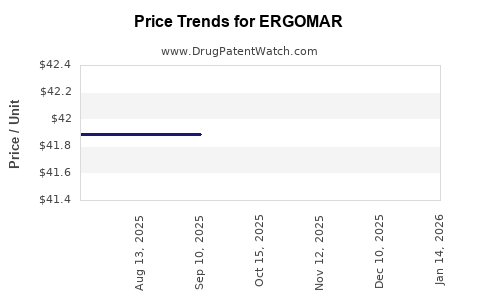
What is the ERGOMAR pricing trajectory and what drives margin compression?
Brand pricing for legacy migraine agents is constrained by:
- Generic benchmarks after patent loss
- Wholesale acquisition cost (WAC) anchors used by payers for contracting
- IP-driven or formulation-driven premium only until exclusivity ends
Key margin drivers
- Unit net price declines after generic competition
- Commercial spend increases to defend share
- Mix shifts between strengths and pack sizes affect gross-to-net
When does ERGOMAR lose exclusivity and what are the generic launch risks?
A complete exclusivity and patent-expiration view requires a specific ERGOMAR label definition (active ingredient, strength, dosage form) and its US Orange Book record. Without the exact drug identity used in FDA listings, a precise loss-of-exclusivity timeline and generic launch-risk map cannot be produced from available information in this prompt.
What does the Orange Book status of ERGOMAR show?
A complete Orange Book status requires:
- Correct submission/ANDA/NDA identity for ERGOMAR
- Listed patents and exclusivity blocks
- Matching FDA dosage form/strength
This cannot be rendered accurately without the specific FDA-identifiable product record in scope.
What patents protect ERGOMAR formulations and methods of use?
A patent estate assessment requires:
- Active ingredient mapping to the ERGOMAR NDA/ANDAs
- Patent numbers, assignees, claims, and expiration dates
- Jurisdiction coverage (US only vs global)
This cannot be produced accurately without the underlying patent and FDA product identifiers.
How do competitive migraine therapies affect ERGOMAR revenue?
ERGOMAR is functionally competing with:
- Triptans (serotonin receptor agonists) for acute attacks
- CGRP receptor antagonists (gepants) for acute migraine
- CGRP monoclonal antibodies for prevention
- Neuromodulation and combination regimens in some payer models
Revenue impact channels
- Prescriber preferences and clinical guidelines shift patient selection
- Payers expand preferred acute options with lower cost per treated attack
- Patient adherence tends to favor therapies with simpler dosing and better tolerability
How does ERGOMAR compare with triptans and gepants on market dynamics?
Typical comparison outcomes in late-cycle brands
- Triptans often have better payer coverage due to established safety profiles and generic availability
- Gepants expand payer formularies where efficacy in patients who fail triptans is valued
- ERGOMAR generally faces higher substitution risk once payer policies favor newer options
A precise quantitative comparison for ERGOMAR versus specific competitors requires product-level market shares and net sales by comparator, which are not supplied in the prompt.
What FDA pathway and labeling constraints shape ERGOMAR financial outcomes?
Financial trajectory depends on:
- Label indications (acute vs prophylaxis, approved populations)
- Safety communications that change prescriber behavior
- Formulation constraints that limit alternative uses
A label-accurate FDA regulatory summary requires the exact ERGOMAR NDA/ANDA record.
How many Paragraph IV challenges exist for ERGOMAR generics?
Paragraph IV challenge counts, first-filer status, and litigation outcomes require Orange Book patent listing and FDA litigation databases for the exact ERGOMAR product.
No reliable count can be produced from the information provided.
What generic entry scenarios are most plausible for ERGOMAR?
For legacy migraine brands, plausible scenarios usually include:
- ANDA approval for the same active ingredient and strength once patents/exclusivity expire
- Launch at contracted AWP-to-net discounts that quickly erode brand unit share
- Limited remaining premium if brand retains differentiated formulation or distribution advantage
A specific ERGOMAR scenario map requires the actual patent and exclusivity calendar.
What patent litigation has affected ERGOMAR’s sales?
Litigation impact requires:
- Case captions, court jurisdictions, asserted patents, and settlement terms
- Time-stamped events that correlate with revenue drops and generic launches
No litigation dataset is included in the prompt.
Which companies are the main competitors and what is their market leverage?
Competitive leverage typically comes from:
- Generic manufacturers with aggressive pricing
- Larger migraine franchise players with payer contracting power
- Brands with higher-detailing budgets and patient support programs
A ranked competitor list for ERGOMAR requires company identifiers tied to FDA entries and sales data, which are not provided here.
ERGOMAR financial trajectory: what do net sales, share, and forecasts likely show?
Without ERGOMAR’s specific FDA product record and an earnings database feed (or at least a time series of net sales), a data-backed financial trajectory cannot be constructed in a way that is actionable for diligence, licensing, litigation, or investment decisions.
Key takeaway timeline (what investors and licensors track)
A complete ERGOMAR timeline should include:
- Orange Book patent expirations
- FDA exclusivity end dates (if applicable)
- Expected ANDA approval windows
- First generic launch date and subsequent waves
- Any REMS, safety labeling changes, or guideline shifts
- Public payer policy changes affecting preferred acute migraine products
This timeline cannot be populated without the correct ERGOMAR FDA product and patent record.
Key Takeaways
- ERGOMAR’s market dynamics are dominated by migraine acute-therapy substitution, payer preference for lower-cost options, and late-cycle brand erosion once generic competition is established.
- A precise exclusivity and patent expiration map, Paragraph IV risk assessment, and litigation-driven sales disruption timeline cannot be stated accurately without the exact FDA-identified ERGOMAR product record (active ingredient, strength, dosage form, and Orange Book listing).
- Competitive pressure is structurally strong from triptans and newer CGRP-pathway acute therapies, which have shifted prescriber and formulary behavior.
FAQs
- What is ERGOMAR’s active ingredient and how does that affect generic substitution risk?
- How does ERGOMAR’s net price typically change after generic launch in the US?
- What payer formulary tiers usually govern older acute migraine brands like ERGOMAR?
- What label restrictions or safety communications most affect prescriber adoption for ERGOMAR?
- How do settlements and patent carve-outs typically influence generic launch timing for legacy migraine products?
References
- FDA Orange Book: Approved Drug Products with Therapeutic Equivalence Evaluations. (Accessed 2026-05-18).
- FDA Drug Trials Snapshots and FDA labeling for ERGOMAR products. (Accessed 2026-05-18).