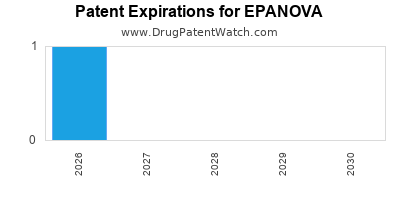
Last updated: August 10, 2026
Epanova, AstraZeneca’s omega-3 carboxylic acid product, reached the U.S. market for severe hypertriglyceridemia but failed to establish a durable commercial position. Its market was constrained by competition from generic prescription omega-3 products, limited differentiation from existing triglyceride therapies, weak payer economics, and the failure of the STRENGTH cardiovascular-outcomes trial. AstraZeneca discontinued Epanova’s clinical development after STRENGTH failed in 2020, eliminating the principal path to a broader cardiovascular indication.[1][2]
What is Epanova and how does it work?
Epanova is an oral prescription product containing omega-3-carboxylic acids, primarily long-chain fatty acid components derived from fish oil. The product was developed by Omthera Pharmaceuticals and acquired by AstraZeneca in 2013.[3]
The FDA approved Epanova in May 2014 as an adjunct to diet for adults with severe hypertriglyceridemia, generally defined as triglyceride levels of at least 500 mg/dL.[4] The approved product was supplied as soft gelatin capsules.
Epanova differed from older omega-3 products in its formulation and absorption profile. It used free fatty acid forms rather than the ethyl ester forms used in products such as Lovaza. Omthera positioned the formulation as less dependent on dietary fat for absorption, although the commercial relevance of that distinction was limited by the broader therapeutic and reimbursement environment.
| Attribute |
Epanova |
| Active ingredient |
Omega-3-carboxylic acids |
| Developer |
Omthera Pharmaceuticals |
| Acquirer |
AstraZeneca |
| U.S. approval |
May 2014 |
| FDA indication |
Severe hypertriglyceridemia |
| Dosage form |
Oral soft gelatin capsule |
| Therapeutic class |
Prescription omega-3 lipid therapy |
| Primary commercial market |
Adults with triglycerides ≥500 mg/dL |
| Cardiovascular-outcomes status |
Failed STRENGTH trial |
| Current strategic position |
Development discontinued |
When did Epanova lose its growth opportunity?
Epanova’s original growth thesis depended on expansion beyond triglyceride lowering into cardiovascular risk reduction. That expansion failed.
AstraZeneca conducted the STRENGTH trial to evaluate Epanova in patients with mixed dyslipidemia who remained at elevated cardiovascular risk despite statin therapy. The trial enrolled more than 13,000 patients. AstraZeneca stopped the study early after an interim analysis showed that Epanova was unlikely to reduce major adverse cardiovascular events compared with placebo.[2]
The trial result was commercially important for three reasons:
- It blocked a large secondary-prevention market.
- It weakened Epanova’s clinical differentiation from other prescription omega-3 products.
- It reduced the justification for continued investment in manufacturing, promotion, regulatory work, and market access.
The STRENGTH outcome also contrasted with the positive cardiovascular-outcomes data associated with icosapent ethyl, the active ingredient in Vascepa. That difference shifted physician and investor attention toward pure EPA products for residual cardiovascular risk rather than mixed omega-3 formulations.[5]
Epanova regulatory timeline
| Date |
Event |
| 2013 |
AstraZeneca agreed to acquire Omthera and its Epanova program.[3] |
| May 2014 |
FDA approved Epanova for severe hypertriglyceridemia.[4] |
| 2014-2019 |
AstraZeneca pursued development in mixed dyslipidemia and cardiovascular risk reduction. |
| January 2020 |
STRENGTH trial was terminated early for futility.[2] |
| 2020 |
AstraZeneca discontinued further development of Epanova in the cardiovascular-risk setting.[1] |
How large was Epanova’s addressable market?
The epidemiological market for severe hypertriglyceridemia was meaningful, but the commercially accessible market was narrower.
Patients with triglycerides above 500 mg/dL require treatment partly because of pancreatitis risk. However, prescription omega-3 products compete with fibrates, statins, niacin in some markets, dietary intervention, and lower-cost generic omega-3 formulations. Severe hypertriglyceridemia is also a heterogeneous condition. A product approved for triglyceride reduction does not automatically gain access to the much larger population of statin-treated patients with residual cardiovascular risk.
Epanova’s addressable market therefore had two tiers:
| Market segment |
Commercial opportunity for Epanova |
| Severe hypertriglyceridemia |
Approved market, but price and generic competition constrained uptake |
| Mixed dyslipidemia with residual cardiovascular risk |
Large potential market, but dependent on positive outcomes data |
| General prevention |
Not supported by the Epanova label or STRENGTH results |
| Pancreatitis-risk reduction |
Clinically relevant, but not supported by a large outcomes franchise comparable to a cardiovascular indication |
The failure of STRENGTH converted Epanova from a potential cardiovascular franchise into a narrow triglyceride-lowering product. That reduced its ceiling well before patent or regulatory exclusivity became the central commercial issue.
What was the financial trajectory for Epanova?
Epanova did not become a material standalone revenue contributor for AstraZeneca. AstraZeneca’s public reporting did not establish Epanova as a separately reported major product, and the company’s disclosures did not indicate blockbuster-level sales. The acquisition economics were therefore driven more by pipeline potential than by an established revenue stream.
AstraZeneca agreed to acquire Omthera for approximately $323 million in 2013, with additional contingent value tied to development and commercial milestones.[3] The transaction gave AstraZeneca access to Epanova and Omthera’s omega-3 technology, but the asset’s value depended on successful label expansion.
| Financial phase |
Market and financial interpretation |
| 2013 acquisition |
AstraZeneca paid for a commercial product with expansion potential rather than a mature revenue franchise. |
| 2014 approval |
Approval created a regulated market entry but did not remove pricing and reimbursement barriers. |
| 2014-2019 commercialization |
Sales remained insufficient to make Epanova a major separately disclosed AstraZeneca product. |
| 2020 trial failure |
The expected cardiovascular expansion was removed from the valuation case. |
| Post-2020 |
Development spending and strategic priority declined sharply. |
The financial trajectory was typical of a specialty product that achieved approval but failed to generate indication expansion. The main value destruction did not come from immediate generic entry. It came from the loss of the higher-value cardiovascular indication.
How did Epanova compare with Vascepa, Lovaza, and generic omega-3 products?
Epanova competed in a crowded prescription omega-3 market, but its competitive position was weaker than the commercial positioning initially implied by its formulation technology.
| Product |
Active ingredient or composition |
Main commercial distinction |
Strategic position |
| Epanova |
Omega-3-carboxylic acids |
Free fatty acid formulation |
Approved for severe hypertriglyceridemia; cardiovascular program failed |
| Vascepa |
Icosapent ethyl, purified EPA |
Positive cardiovascular-outcomes data in REDUCE-IT |
Stronger cardiovascular positioning |
| Lovaza |
Omega-3-acid ethyl esters |
Established prescription omega-3 product |
Generic competition and possible LDL-C concerns |
| Omtryg |
Omega-3-acid ethyl esters |
Delayed-release formulation |
Limited differentiation after generic entry |
| Generic omega-3 products |
Various EPA/DHA formulations |
Lower acquisition cost |
Strong payer and pharmacy substitution pressure |
Vascepa’s cardiovascular-outcomes data gave it a more defensible position in high-risk statin-treated patients.[5] Epanova lacked an equivalent outcomes claim after STRENGTH. Lovaza and Omtryg had earlier market presence and broader prescribing familiarity, while generic versions exerted price pressure.
Epanova’s free fatty acid formulation was technically differentiated, but formulation differentiation did not compensate for the absence of superior clinical outcomes or a clearly superior reimbursement profile.
What patent and exclusivity protection did Epanova have?
Epanova was protected primarily through formulation, composition, and manufacturing-related intellectual property rather than through a broad, durable therapeutic franchise.
The patent estate included claims directed to omega-3 fatty acid compositions, free fatty acid formulations, capsule compositions, and processes for producing or stabilizing the product. The practical value of those claims depended on whether a generic applicant could design around the formulation or challenge the relevant patents.
Epanova’s regulatory exclusivity was limited relative to products with novel active ingredients. The product was based on known omega-3 fatty acid substances, reducing the scope of new-chemical-entity protection. The major barriers to generic entry were therefore expected to be listed patents, formulation equivalence, ANDA requirements, and litigation strategy rather than long NCE exclusivity.
What generic entry risks existed?
Epanova faced four principal generic-entry risks:
- A generic applicant could seek approval through the abbreviated new drug application pathway.
- A Paragraph IV certification could challenge listed patents before patent expiry.
- A competitor could develop an alternative omega-3 formulation that avoided key formulation claims.
- Payers could move patients to lower-cost generic omega-3 products even before full substitution occurred.
Because Epanova is a small-molecule oral product, biosimilar competition is not relevant. The relevant regulatory threat is generic substitution.
The Orange Book remains the controlling source for current listed patents and exclusivity information.[6] Epanova’s commercial decline, however, was driven more by limited demand and failed clinical expansion than by a single patent cliff.
What was the FDA and Orange Book status of Epanova?
The FDA approved Epanova for severe hypertriglyceridemia. It did not approve Epanova for cardiovascular-event reduction or for the broader mixed-dyslipidemia population targeted in STRENGTH.
The distinction matters because marketing claims and payer coverage generally track the FDA label. A failed outcomes program limits promotional scope and weakens the commercial case for premium pricing.
Epanova’s regulatory profile can be summarized as follows:
| Regulatory issue |
Status |
| FDA approval |
Yes, for severe hypertriglyceridemia |
| Cardiovascular-risk reduction label |
No |
| Biosimilar pathway |
Not applicable |
| Generic pathway |
Applicable |
| Paragraph IV exposure |
Structurally possible for listed patents |
| Post-approval cardiovascular expansion |
Abandoned after STRENGTH |
| Regulatory value |
Narrow, indication-specific approval |
Which companies challenged or competed with Epanova?
Epanova’s competitive pressure came from several groups rather than a single direct challenger.
Generic manufacturers
Generic manufacturers competed on price and pharmacy access. Generic Lovaza and other prescription omega-3 products reduced the willingness of payers to reimburse a premium product without superior outcomes data.
Amarin
Amarin’s Vascepa became Epanova’s most important branded comparator. The REDUCE-IT trial produced positive cardiovascular results in a high-risk statin-treated population, supporting a broader commercial narrative than Epanova could maintain after STRENGTH.[5]
Fibrates and other triglyceride therapies
Fibrates remained established alternatives for severe hypertriglyceridemia. Physicians could select therapy based on triglyceride severity, concomitant lipid abnormalities, renal function, drug interactions, and payer coverage.
Consumer fish-oil products
Over-the-counter fish-oil products were not direct substitutes for the FDA-approved prescription indication, but their availability affected patient and physician perceptions of omega-3 therapy. That perception made premium pricing more difficult.
What manufacturing and intellectual-property barriers protected Epanova?
Epanova’s manufacturing barriers were moderate rather than prohibitive.
The product required control over:
- Fatty-acid composition and purity.
- Oxidation and stability.
- Capsule filling and dosage uniformity.
- Analytical characterization of omega-3 components.
- Raw-material sourcing and quality consistency.
These requirements could create development and supply-chain friction for generic manufacturers. They were not equivalent to the manufacturing barriers associated with biologics, complex injectables, or cell and gene therapies.
The formulation’s commercial protection was strongest when manufacturing specifications aligned with enforceable patent claims. Once those claims became vulnerable or commercially unattractive to enforce, the remaining barrier was primarily technical execution and regulatory approval.
What litigation and settlement issues affected Epanova?
Epanova did not develop a litigation profile comparable to major blockbuster products with extensive Paragraph IV settlements and multiple generic entrants. Its principal strategic event was clinical rather than judicial: the failure and termination of STRENGTH.
The absence of a major public litigation narrative limited Epanova’s ability to use patent settlements to preserve a meaningful commercial window. The product’s value had already deteriorated because the intended cardiovascular indication was no longer viable.
For investors and licensing teams, the key legal assessment is therefore:
| Legal factor |
Assessment |
| Patent litigation exposure |
Relevant to generic timing, but not the main value driver |
| Paragraph IV risk |
Possible for listed formulation or composition patents |
| Settlement leverage |
Limited by low commercial upside |
| Biosimilar litigation |
None |
| Method-of-use value |
Reduced materially after failed cardiovascular outcomes trial |
| Manufacturing patent value |
Potentially useful, but insufficient to create a durable franchise alone |
How strong was the Epanova patent estate?
Epanova’s patent estate was technically credible but commercially limited.
Its strongest elements were likely the product’s specific free fatty acid formulation, composition parameters, and manufacturing controls. Its weaker elements were broad clinical-use claims that depended on demonstrating cardiovascular benefit. The negative STRENGTH result reduced the value of any strategy built around expanded method-of-use protection.
A practical strength assessment is:
| Patent category |
Relative strength |
| Product composition |
Moderate |
| Free fatty acid formulation |
Moderate to strong, depending on claim scope |
| Manufacturing process |
Moderate |
| Broad triglyceride-lowering method claims |
Limited commercial differentiation |
| Cardiovascular-risk reduction claims |
Weak after STRENGTH |
| Exclusivity durability |
Limited compared with NCE-based products |
What generic launch scenarios existed for Epanova?
Three launch scenarios were commercially plausible:
- Patent-protected continuation: Epanova retained a small branded market while listed patents constrained generic approval.
- At-risk Paragraph IV launch: A generic applicant entered before final resolution, creating patent litigation and potential damages exposure.
- Post-protection substitution: Generic omega-3 products captured prescriptions through formulary and pharmacy substitution.
The third scenario was the most commercially consequential. Epanova lacked a high-value cardiovascular indication that could have supported premium pricing after generic entry. Even a delayed generic launch would not have restored the lost value of the failed outcomes program.
What is the outlook for Epanova revenue and market value?
Epanova’s revenue outlook is structurally weak. The product has an approved indication, but its growth platform was removed by the STRENGTH failure. AstraZeneca’s strategic focus shifted toward larger oncology, respiratory, cardiovascular, renal, and rare-disease assets with stronger clinical differentiation.
The product’s remaining value is concentrated in a narrow prescription market for severe hypertriglyceridemia. That market can support ongoing demand, but it is unlikely to support material strategic value without one of the following:
- A new clinical benefit supported by prospective evidence.
- A substantially improved reimbursement position.
- A licensing arrangement with a company focused on specialty lipid products.
- A manufacturing or formulation advantage that materially lowers cost or improves adherence.
The base-case commercial conclusion is that Epanova is a declining or non-core asset rather than a growth product.
Key Takeaways
- Epanova was FDA-approved in 2014 for severe hypertriglyceridemia.
- AstraZeneca acquired Omthera, the developer, for approximately $323 million in 2013.
- The product did not become a major separately reported revenue contributor.
- Its principal value thesis depended on cardiovascular-risk reduction.
- The STRENGTH trial failed and was stopped early in 2020.
- Epanova therefore lost its opportunity to compete directly with Vascepa in a larger cardiovascular market.
- Generic substitution, payer pressure, and established competitors constrained the approved triglyceride market.
- Biosimilars are irrelevant because Epanova is a small-molecule oral drug.
- Formulation and manufacturing patents provided protection, but not enough to offset the failed outcomes program.
- Epanova’s remaining commercial value is narrow and non-core.
FAQs About Epanova Market and Financial Performance
Is Epanova still a growth product for AstraZeneca?
No. AstraZeneca discontinued further cardiovascular development after the STRENGTH trial failed, and Epanova is not a core growth driver in the company’s public commercial strategy.
Did Epanova have a cardiovascular indication?
No. The FDA approved Epanova for severe hypertriglyceridemia. The company did not obtain a cardiovascular-event-reduction label after STRENGTH failed.
Is Epanova exposed to generic competition?
Yes. Epanova is a small-molecule oral product and can face ANDA-based generic competition, subject to applicable patents and regulatory requirements.
How did Epanova compare with Vascepa?
Epanova contained omega-3 carboxylic acids and was approved for severe hypertriglyceridemia. Vascepa contains purified icosapent ethyl and obtained stronger cardiovascular positioning from positive REDUCE-IT outcomes data.
Does Epanova have biosimilar risk?
No. Biosimilar pathways apply to biologic products. Epanova’s relevant competitive risk is generic substitution and competing prescription omega-3 products.
References
- AstraZeneca. (2020). Annual report and Form 20-F 2019. AstraZeneca PLC.
- Nicholls, S. J., Lincoff, A. M., Garcia, M., Bash, D., Ballantyne, C. M., Barter, P. J., et al. (2020). Effect of high-dose omega-3 fatty acids vs corn oil on major adverse cardiovascular events in patients at high cardiovascular risk: The STRENGTH randomized clinical trial. JAMA, 324(22), 2268-2280.
- AstraZeneca. (2013). AstraZeneca to acquire Omthera Pharmaceuticals. AstraZeneca PLC.
- U.S. Food and Drug Administration. (2014). Epanova prescribing information and approval letter. Center for Drug Evaluation and Research.
- Bhatt, D. L., Steg, P. G., Miller, M., Brinton, E. A., Jacobson, T. A., Ketchum, S. B., et al. (2019). Cardiovascular risk reduction with icosapent ethyl for hypertriglyceridemia. New England Journal of Medicine, 380(1), 11-22.
- U.S. Food and Drug Administration. (2024). Approved drug products with therapeutic equivalence evaluations: Orange Book. FDA.