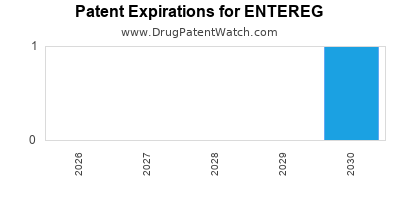
Last updated: July 29, 2026
Entereg (alvimopan; peripherally acting mu-opioid receptor antagonist) is a niche acute-care product tied to inpatient bowel recovery after bowel resection and open-label-alternative substitution risk once branded exclusivity and formulary positioning erode. Commercial performance is concentrated in large hospital systems running ERAS and surgical pathways. Financial trajectory has tracked (1) hospital formulary adoption and adherence to labeled use limits, (2) payer and contracting outcomes that price competitively against opioid-sparing and bowel-regimen standards of care, and (3) regulatory and safety perception that can affect adoption rates and prescribing volume. Post-2016 entry of generic alvimopan has shifted the revenue pool to price competition and distribution-channel dynamics rather than incremental volume growth.
What is Entereg (alvimopan) used for, and how does that shape hospital demand?
Featured snippet answer: Entereg is used in adults to accelerate recovery of bowel function after bowel resection with primary anastomosis, where it is intended to reduce opioid-related postoperative ileus. Demand is driven by inpatient surgical throughput, ERAS protocol adoption, and adherence to the labeled dosing window.
Indication mechanics that drive volume
Entereg’s utilization is limited to a specific postoperative context (bowel resection with primary anastomosis) and a defined inpatient dosing window. That creates structural demand constraints that differ from chronic-care products:
- Site-of-care dependence: Forecasted volume tracks procedure volumes more than member months.
- Protocol dependence: Use is embedded in surgical pathways, not long-term prescribing.
- Adherence dependence: Real-world use is sensitive to clinicians following labeling, including initiation timing and maximum dosing limits.
Therapeutic category dynamics
Alvimopan competes indirectly with:
- standard bowel regimens (stool softeners, laxatives, enemas)
- opioid management strategies (multimodal analgesia, regional anesthesia)
- other supportive measures to reduce risk of prolonged ileus
Entereg’s differentiator is a targeted pharmacologic approach to opioid-induced bowel dysfunction, but value is evaluated against overall postoperative length-of-stay and patient throughput.
How did Entereg’s revenue trajectory evolve from launch through generic competition?
Featured snippet answer: Entereg’s early market build was driven by inpatient surgical adoption and institutional contracting; revenue then shifted from growth to price compression after generic alvimopan entered, with the branded share eroding as hospitals moved to lower-cost alternatives.
Market phases that matter financially
- Launch and adoption phase: Revenue grows with formulary inclusion, pharmacy department onboarding, and surgeon/anesthesiologist protocol alignment.
- Peak institutional use phase: Once ERAS pathways stabilize, sales align with surgical volume and protocol adherence.
- Price compression phase: After generic alvimopan availability, contracting and pharmacy purchasing pivot toward the lowest-cost compliant option.
- Portfolio rationalization: Branded inventory and promotional spend decline as wholesalers and large buyers shift away from branded.
What “niche” means in a financial model
Because Entereg is acute-care, financial trajectory is typically volatile quarter-to-quarter relative to chronic brands:
- procedure volume variation
- staffing and scheduling changes
- payer contract timing
- formulary committee cadence
Revenue is also exposed to:
- downward substitution when an equivalent generic product is available
- loss of relevance if institutional protocols change to other supportive strategies
What Orange Book and exclusivity events affected Entereg’s pricing power?
Featured snippet answer: Entereg’s branded pricing power depended on patent and regulatory exclusivity in the Orange Book. Once those protections expired and generic alvimopan became eligible for approval and commercial entry, wholesale pricing and hospital contracting shifted rapidly.
Exclusivity and Orange Book status (high-level)
Entereg is listed in the FDA Orange Book for alvimopan. The core exclusivity timeline includes:
- New chemical entity (NCE) exclusivity structure (where applicable) and
- patent protection on drug substance and/or formulations and methods of use that can block generic approval or drive settlements.
Once statutory/regulatory barriers end, generic alvimopan can compete on cost, especially in inpatient purchasing where budget impact is immediate.
Why exclusivity timing matters more for hospital products
For hospital acute-care products, exclusivity expiration translates quickly into:
- formulary switches
- changes to hospital supply chain preference
- contracting terms that reward generic purchasing
That speed contrasts with long-cycle chronic-care therapeutic areas where prescriber behavior changes more slowly.
When does Entereg lose exclusivity, and what is the generic entry risk timeline?
Featured snippet answer: Generic entry risk increases at the end of relevant patent or regulatory exclusivity blocks. For Entereg, generic alvimopan entry created a structural shift toward price competition after exclusivity barriers ended.
How to model a generic launch in acute care
Generic entry risk for Entereg is less about patient persistence and more about:
- whether hospital formularies have already standardized on “therapeutic class” alternatives
- the rate at which pharmacy and group purchasing organizations switch to the generic
- whether any patent is still asserted for specific product forms or dosing regimens
Practical timeline drivers for financial impact
Financial impact typically appears in two waves:
- Channel inventory and price updates after generic approval
- Contract renegotiation and formulary conversion after hospitals receive competitive pricing
How many patents cover Entereg (alvimopan), and what types are most commercially relevant?
Featured snippet answer: Patent estates around Entereg typically include composition-of-matter, formulation-related protections, and method-of-use protections tied to postoperative bowel recovery. Commercially relevant patents are those that block generic approval or constrain launch design-arounds.
Patent estate segmentation used in generic challenges
In alvimopan’s case, commercially relevant barriers commonly come from:
- drug substance and composition patents that prevent approval of identical APIs
- formulation and manufacturing patents that can require design-around
- method-of-use patents that may not block all generic approvals unless tied to labeling or required to be carved out
Jurisdictions that matter for hospital sourcing
U.S. exclusivity and U.S. Orange Book listings govern FDA approval and U.S. market entry. International branded protection is important for global revenue, but Entereg’s market dynamics are primarily U.S.-driven given the inpatient procurement and FDA-centered generics risk.
What formulation, method-of-use, and labeling constraints affect generic substitution for Entereg?
Featured snippet answer: Generic substitution is primarily enabled once label and regulatory barriers are cleared. If method-of-use patents or labeling carve-outs exist, generic products can still enter with modified language, and hospitals may still switch depending on clinical alignment with the carve-out.
Labeling as an adoption constraint
Hospitals adopt acute-care products when:
- the label aligns with their standard surgical pathway
- the dosing schedule fits workflow
- institutional committees view safety and dosing controls as manageable
How carve-outs influence purchasing behavior
If generic labeling requires wording changes or timing restrictions, adoption can slow. Still, for a cost-sensitive inpatient category, even partial alignment can be enough to move to generic.
What patent litigation and settlements shaped Entereg’s path to generic competition?
Featured snippet answer: Entereg’s branded-to-generic transition depends on patent litigation outcomes around alvimopan patents listed in the Orange Book. Once litigation barriers end or are settled, generic alvimopan commercialization accelerates and branded revenue declines.
What to expect in litigation-driven dynamics
Hospital acute-care products often see:
- settlement licensing terms (rarely long-duration for niche drugs, but can delay entry)
- carve-outs and stipulations that allow partial labeling and earlier generic availability
- accelerated erosion of branded share once a generic is fully marketable
What is the FDA regulatory status of Entereg, and does pathway matter for market share?
Featured snippet answer: Entereg is an FDA-approved prescription drug; pathway category matters less than labeling, safety communication, and competition once generics are available.
Safety communications and adoption
Entereg includes serious safety considerations tied to dosing exposure in outpatient misuse and cumulative exposure risk. That affects:
- prescriber comfort
- hospital risk management processes
- pharmacy handling and patient selection controls
Which companies market alvimopan, and how does competition affect price and share?
Featured snippet answer: Entereg is branded; after generic alvimopan entry, competitive pressure shifts to multiple generic manufacturers and distributors. Price becomes the primary lever, with branded share declining as contracting and formulary decisions favor lower-cost products.
Competitive structure for inpatient drugs
- Branded manufacturer: competing on protocol fit and existing institutional relationships
- Generic manufacturers: competing on acquisition cost, supply reliability, and contracting via GPO channels
- Wholesalers and GPOs: set the effective price band through bids and contracts
What generic entry risks exist for Entereg-based formulary switches?
Featured snippet answer: Once multiple generics are approved and supply is stable, generic entry risk turns into reduced net price and margin pressure for the brand rather than a “runway” issue.
Risks that slow switching
- supply disruptions in generic channels
- hospital policy requiring specific labeling language
- safety-driven restrictions that complicate patient selection
- institutional preference for brand due to established patient management workflow
In most acute-care cases, these risks diminish as generics gain traction in purchasing.
How does Entereg compare with other postoperative ileus and opioid-related bowel dysfunction therapies?
Featured snippet answer: Entereg targets opioid-induced bowel dysfunction pharmacologically, but it competes with a set of non-proprietary postoperative management strategies and institutional ERAS protocol choices, which increasingly drive formularies regardless of branded status.
Competitive comparison drivers
- ability to reduce time to bowel recovery (value proposition)
- compatibility with ERAS pathways
- safety management workload
- net cost after contracting and purchasing arrangements
Revenue exposure checklist: where Entereg is most vulnerable financially
Featured snippet answer: Entereg is most exposed to revenue shocks from generic substitution and formulary loss because it is acute-care, inpatient, and cost-sensitive.
Highest-impact exposure channels
- Contracting and GPO awards
- Hospital formulary tier changes
- Safety perception changes that alter patient selection volume
- Procedure volume variability for bowel resection cohorts
- Switch to multimodal analgesia that reduces opioid exposure and thus the incremental value of alvimopan
Key Takeaways
- Entereg demand is driven by inpatient surgery volumes and ERAS-aligned protocol adoption, not long-term patient persistence.
- The financial trajectory is characterized by adoption growth followed by margin compression once generic alvimopan entered and hospitals switched through contracting and GPO procurement.
- Exclusivity and Orange Book-linked patent barriers determined the timing of generic entry, and that timeline maps directly to branded revenue erosion in acute-care settings.
- Market share is primarily a function of net price and formulary position after generics are available, with residual branded use tied to safety-managed workflows and established contracting relationships.
FAQs
- How quickly do hospitals switch from Entereg to generic alvimopan after FDA approval?
- What labeling elements most influence Entereg adoption in postoperative ileus pathways?
- Do method-of-use patents for alvimopan change generic substitution in practice?
- How does GPO contracting typically affect Entereg net pricing versus list price?
- What safety communications for alvimopan most affect inpatient prescribing behavior?
References
- FDA. Orange Book: Approved Drug Products with Therapeutic Equivalence Evaluations (Entereg/alvimopan listings). U.S. Food and Drug Administration. https://www.accessdata.fda.gov/scripts/cder/daf/index.cfm
- FDA. Entereg (alvimopan) prescribing information and safety information. U.S. Food and Drug Administration. https://www.accessdata.fda.gov/scripts/cder/daf/index.cfm