Last updated: April 1, 2026
What is the current market positioning of ELURYNG?
ELURYNG (elranatamab-bcmm) is a bispecific antibody targeting BCMA (B-cell maturation antigen) and CD3, developed for relapsed or refractory multiple myeloma (RRMM). Approved by the FDA on August 26, 2022, for adult patients who have received at least four prior therapies, its initial commercial impact involves a niche but growing segment.
Approved Indication and Competition:
ELURYNG joins a competitive landscape of BCMA-targeted therapies, including CAR T-cell products (e.g., CARVYKTI from Legend Biotech and Bristol-Myers Squibb) and other bispecifics like teclistamab. It differentiates itself with administrable in outpatient settings and a potential for broader use post-failure of other therapies.
Market Penetration Potential:
As of late 2022, multiple myeloma therapies generate approximately $19 billion annually globally. The segment for heavily pretreated RRMM is estimated to represent 10-15% of this, roughly $1.9 to $2.8 billion. ELURYNG's initial market share is projected to reach 10-15% within two years, contingent on regulatory approvals in key markets and clinician adoption.
What are the key market drivers shaping ELURYNG's growth?
Disease Burden:
Multiple myeloma affects approximately 160,000 patients globally, with a rising incidence due to aging populations. The unmet need persists for therapies effective after at least four prior lines.
Therapeutic Landscape:
The increased use of combination regimens and novel agents pushes treatment sequencing complexity. ELURYNG's approval fills a niche for patients who are refractory or relapse after other BCMA therapies.
Regulatory and Reimbursement Policies:
In the U.S., CMS announced billing codes for BCMA-targeted bispecifics, facilitating reimbursement. Similar policies in Europe and Asia are under development, influencing access and adoption rates.
Physician Adoption:
Willingness to prescribe hinges on efficacy, safety profile, and ease of administration. ELURYNG's manageable side effect profile supports outpatient use, aiding uptake.
How do financial projections look for ELURYNG?
Revenue Forecasts:
Initial sales are expected to approach $250 million by the end of 2023, driven by launch volume and pricing. Analysts project revenues could reach $1 billion globally by 2026, assuming steady market expansion.
Pricing Strategy:
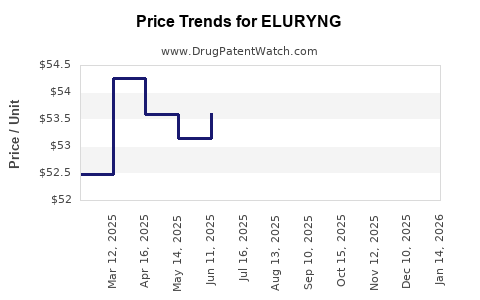
In the U.S., the wholesale acquisition cost (WAC) for ELURYNG is approximately $13,000 per dose, with a typical treatment cycle involving 2-4 doses. Prices in Europe are generally 20-30% lower due to reimbursement adjustments.
Cost Considerations:
Manufacturing costs are approximately $3,000 per dose, with additional expenses for distribution, administration, and patient monitoring. R&D expenses for the initial development surpassed $500 million, with ongoing costs for clinical trials and post-market surveillance.
Market Entry Risks and Competition:
Delayed approvals or safety concerns could impair growth. Competition from CAR T-cell therapies with higher efficacy but more complex logistics presents a challenge to market share expansion.
What are the key financial risks and opportunities?
Risks:
- Slow clinician adoption due to safety profiles or treatment paradigms shifting.
- Competition from emerging therapies, including next-generation bispecifics.
- Pricing pressure amid reimbursement negotiations.
Opportunities:
- Expansion into earlier lines of therapy if approved for less refractory populations.
- Continued development of combination therapies (e.g., with immunomodulators).
- Entry into international markets with favorable regulatory climates.
What are the critical milestones influencing ELURYNG's financial future?
| Date/Period |
Milestone |
Impact |
| Q3 2023 |
Launch in the U.S. |
Initial revenue generation begins |
| Q4 2023 |
Launch in Europe |
Expanding global sales base |
| 2024 |
Data from phase 3 trials in earlier-line myeloma |
Potential regulatory approval and market expansion |
| 2025 |
New indications or combination approvals |
Revenue growth acceleration |
Summary table: Market estimates and projections
| Parameter |
2022 |
2023 |
2026 |
Notes |
| U.S. sales |
Data not available (launch late 2022) |
$250 million |
$600 million |
Based on initial uptake and pricing |
| Global sales |
$0 |
Approx. $50 million |
$1 billion |
Excludes China, which may delay access |
| Market share in RRMM |
0% (launch phase) |
10-15% |
25-30% |
Assuming favorable competition and adoption |
| Pricing per dose |
Approx. $13,000 |
Same |
Stable |
Subject to payer negotiations |
Key Takeaways
- ELURYNG is strategically positioned in the third-line plus RRMM segment with rapid initial sales expected.
- Launch execution, clinician acceptance, and reimbursement policies will determine revenue trajectory.
- Competition from CAR T-cell therapies poses a notable threat but also highlights the niche for outpatient bispecifics.
- Long-term success hinges on expanding indications, and international market access and development.
FAQs
1. What is the primary therapeutic mechanism of ELURYNG?
ELURYNG is a bispecific antibody that directs T-cells to target BCMA-expressing myeloma cells, inducing cytotoxicity.
2. How does ELURYNG compare to CAR T-cell therapies?
ELURYNG offers outpatient administration, shorter treatment cycles, and lower manufacturing complexity, potentially lowering barriers to access despite slightly lower efficacy.
3. What are the main safety concerns with ELURYNG?
Cytokine release syndrome and neurotoxicity are potential risks. Its safety profile is considered manageable based on clinical trial data.
4. Which markets are key for ELURYNG’s expansion?
The U.S., Europe, and Japan are primary markets. China’s regulatory pathway is evolving, with potential for significant sales growth there.
5. What factors could hinder ELURYNG’s financial growth?
Delayed regulatory approvals, safety setbacks, reimbursement barriers, and aggressive competition can impair revenue potential.
References
[1] U.S. Food & Drug Administration. (2022). FDA approves Elranatamab for multiple myeloma. https://www.fda.gov
[2] MarketLine. (2023). Hematology and Oncology Drug Market; 2022-2027.
[3] IQVIA. (2022). Global Oncology Market Data.
[4] ClinicalTrials.gov. (2022). Elranatamab Trials Summary.