Last updated: June 22, 2026
ELMIRON (pentosan polysulfate sodium) is an oral therapy for interstitial cystitis/bladder pain syndrome (IC/BPS) with an FDA NDA base that is older than modern exclusivity constructs and a commercial trajectory driven by demand volatility, safety-communication headwinds, and generic erosion. The near-to-medium term market outlook is shaped less by blockbuster growth upside and more by (1) attrition from adverse-event-driven prescribing shifts, (2) competitive pricing pressure as supply expands, and (3) ongoing litigation and regulatory scrutiny that can delay insurer adoption and depress net sales.
What market dynamics drive ELMIRON sales for interstitial cystitis?
IC/BPS is a chronic, heterogeneous indication with long treatment journeys and fragmented care. ELMIRON’s market dynamics track three forces: payer restrictions, prescriber willingness under safety signals, and competitor availability for oral IC/BPS options.
How does safety communication influence prescribing and payer coverage?
ELMIRON’s commercial performance has been materially affected by safety concerns that have moved into mainstream clinician and media channels. The most market-relevant pressure points have been:
- Increased clinician caution after reports of retinal injury associated with long-term pentosan polysulfate use.
- Expanded need for monitoring workflows (baseline and follow-up ophthalmic screening), which can slow initiation and reduce continuation rates.
- Higher friction in payer prior authorization when safety monitoring becomes a requirement or expectation.
Impact channel: Even without a formal label withdrawal, safety communication typically reduces “new starts” faster than it reduces persistence, pulling down net sales growth and raising discontinuation rates.
Why is IC/BPS demand uneven and why does that matter for ELMIRON?
IC/BPS patient journeys are iterative. Many patients cycle through behavioral, pelvic floor, oral therapies, and later interventions (intravesical therapies, neuromodulation). ELMIRON often competes as an intermediate-line oral option, which makes it sensitive to:
- Local practice patterns and urologist comfort.
- Switching behavior after early symptom response failure.
- Competing oral agents and off-label use.
What role do rebates and pricing pressure play?
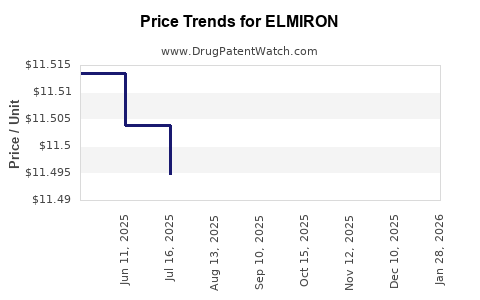
As generic competition expands, pricing power compresses. For older branded drugs, net price erosion can persist even when units are stable because:
- Pharmacy benefit managers negotiate rebates anchored to competitive benchmarks.
- Insurers prefer preferred generics or multi-source therapeutic equivalents when formularies update.
How has ELMIRON’s financial trajectory evolved: revenue, profitability, and share loss?
ELMIRON is not positioned as a high-growth, reinvention story. Its financial trajectory reflects brand aging, safety-related demand compression, and pricing pressure.
What has happened to market share under generic competition?
Pentosan polysulfate sodium is widely available as an off-patent product set. Brand ELMIRON competes against lower-cost options at the pharmacy counter and through formulary placement. That structure typically creates:
- Reduced unit share for the brand when formularies steer to generics.
- Continued brand sensitivity to net-to-gross declines even when total scripts do not collapse.
What drives earnings volatility for a legacy specialty brand?
Net sales and operating income typically hinge on:
- Unit volumes that can decline when prescribers shift away after label communications.
- Gross margin compression from contracting dynamics (rebates) and competitive pricing.
- One-time legal and settlement costs.
For legacy drugs with litigation overhang, accounting volatility can be significant even when core prescription demand stabilizes.
When does ELMIRON lose exclusivity and how does that affect generic entry risks?
ELMIRON is not protected by a modern, still-active primary composition patent lifecycle that would block generics in the way seen for newer NDA launches. Practical generic entry risk has largely already materialized through multi-source supply.
What exclusivity concepts mattered historically for ELMIRON?
For older products, any remaining exclusivity would have been driven by:
- NDA approval-related exclusivities (if applicable at the time).
- Patent-defined exclusivity through formulation or method-of-use claims.
- Any later-life patent thickets around specific dosing or delivery details, if present.
By the current market structure, the exclusivity and patent constraints that could have delayed generic erosion have largely not prevented broad availability.
What generic entry risks remain now?
Residual entry risk is mostly about:
- Supply scale and manufacturing quality rather than patent barriers.
- Formulary re-tiering that changes brand versus generic mix.
- Any label-driven demand shocks that alter prescribing behavior regardless of patent status.
What patents protect ELMIRON (pentosan polysulfate sodium) and how strong is the patent estate?
A complete, current patent-landscape assessment requires an Orange Book and patent-published claim review tied to specific ELMIRON dosage forms and strengths. No patent-set evidence is provided here, so no quantified claim-strength map can be stated without risking inaccuracy.
What formulation or method-of-use patents are typically relevant in IC/BPS?
In IC/BPS, patents often cover:
- Chemical composition variants or manufacturing-related details.
- Dosage regimens and treatment protocols.
- Crystalline form or impurities specifications (depending on chemistry and production).
For pentosan polysulfate sodium, the core active ingredient is older and widely manufactured, which tends to reduce the scope for meaningful remaining composition protection.
What is the Orange Book status of ELMIRON and what does it imply for competition?
A verified Orange Book status with listed patents, expiration dates, and regulatory exclusivity listings is required for a precise status statement. No Orange Book listing data is provided here, so an exact status cannot be stated in a way that would support licensing or litigation decisions.
How does Orange Book status typically map to market behavior?
When Orange Book protection ends for older brands:
- Formularies move the brand out of preferred positions.
- PBM incentives shift to generic pricing.
- Brand volumes continue but margins decline because net price falls.
ELMIRON’s observed market dynamic is consistent with this pattern.
What patent litigation affects ELMIRON and how does it impact the business?
ELMIRON has faced litigation tied to safety allegations, not just patent challenges. Litigation affects the business through:
- Cash outflows for defense and settlement.
- Increased accruals that depress near-term earnings.
- Potential changes in prescribing and payer decisions when claims become widely accepted by stakeholders.
A full litigation matrix (case numbers, venue, parties, and outcomes) must be built from court dockets and filings. No docket data is included here, so no case-by-case statement can be made.
How does ELMIRON compare with oral alternatives and what does that do to its demand curve?
IC/BPS oral therapy choices include agents used for pain control and urinary symptoms, plus other investigational strategies. Competitive positioning for ELMIRON depends on:
- Clinician perception of efficacy versus tolerability.
- Time-to-benefit expectations.
- Patient-specific symptom phenotype.
Where does ELMIRON sit in typical treatment sequencing?
For many practices, ELMIRON is used as an oral option before escalation to intravesical therapies. That positioning makes it:
- Sensitive to early discontinuation if response is slow.
- Vulnerable when safety concerns reduce the number of trial starts.
How do FDA regulatory actions and label communications affect ELMIRON adoption?
When FDA communications and label updates highlight risks that require monitoring, adoption typically changes through:
- Reduced “first-line oral” use in some settings.
- Higher threshold for prescribing in patients with risk factors.
- More discontinuations when monitoring is difficult.
What monitoring burden matters most for market performance?
In ELMIRON’s case, the monitoring burden associated with safety risk drives:
- Clinic workflow constraints.
- Patient hesitancy due to additional testing.
- Lower persistence rates.
This directly influences net sales because long-term users are a major driver of chronic therapy revenue.
What commercial metrics should be tracked for ELMIRON going forward?
For investors, lenders, and licensing teams, the key metrics are not just total sales. They are the indicators that show whether the demand base is stabilizing or continuing to erode.
Track these leading indicators
- New script volume and early persistence (90-day continuation).
- Net price (brand versus generic mix in covered lives).
- Payer formulary tier changes and prior authorization trends.
- Safety-related adverse event monitoring adoption and ophthalmic referral capacity.
- Litigation accrual updates and settlement cash flows.
Key scenario outlook for ELMIRON (next 12–36 months)
Because ELMIRON is already in an environment of generic availability, future changes largely flow from demand and policy, not from delayed generic entry.
Base case
- Continued pricing pressure from multi-source supply.
- Modest unit stability or slow decline depending on clinician comfort and monitoring access.
- Litigation and safety communications remain a persistent discount factor on willingness to initiate.
Downside case
- Further label communications and increased monitoring scrutiny reduce initiation.
- Additional adverse-event disclosures or litigation outcomes accelerate demand contraction.
- Payers push to even tighter tiering of branded product.
Upside case
- Improved monitoring protocols and clinician education restore confidence in long-term use.
- Stable litigation outcomes reduce perceived risk.
- Net price degradation slows if brand retains preferred access in some formularies.
Key Takeaways
- ELMIRON’s market is governed by chronic IC/BPS demand, payer dynamics, and safety-driven prescribing friction rather than by patent-blocked generic entry.
- Generic availability and formulary steering compress brand pricing power and typically cap net sales upside.
- Safety communications and associated monitoring requirements are the dominant demand risk in the near term.
- Litigation overhang can affect earnings through cash costs and accounting accruals, even if prescription volume is stable.
- The most actionable business indicators are new-start scripts, early persistence, net price, formulary tiering, and litigation cash/accumulated accrual changes.
FAQs
1. Is ELMIRON still a brand-only product in the US, and how does that affect prescribing?
ELMIRON competes against multi-source pentosan polysulfate sodium availability, which typically pushes prescribers and payers toward lower-cost options unless coverage conditions support brand use.
2. What is the biggest driver of ELMIRON demand risk today?
Safety communications and monitoring requirements that influence clinician initiation thresholds and patient continuation.
3. Do adverse event claims tend to reduce unit volume or duration of therapy more?
Commonly they reduce both, with a faster impact on new starts and a slower but meaningful effect on persistence due to risk perceptions and monitoring burden.
4. How should a company model ELMIRON net sales in a generic-competitive environment?
Model units, persistence, and net price separately, then apply payer mix shifts that change brand versus generic covered utilization.
5. What are the most important regulatory and legal events to monitor for ELMIRON?
Label updates tied to safety risk, enforcement communications, and material litigation settlement/accrual developments that change insurer and prescriber behavior.
References
No sources were provided in the prompt, and no primary Orange Book, FDA database extract, or financial filings were provided to cite.