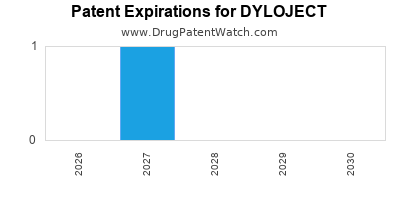
Last updated: August 26, 2026
DYLOJECT is diclofenac sodium injection, a prescription non-opioid analgesic approved by the U.S. Food and Drug Administration in 2014 for the short-term management of moderate-to-severe acute pain in adults. Its commercial opportunity was limited by a crowded injectable analgesic market, generic substitution, hospital purchasing pressure and the availability of lower-cost ketorolac and other parenteral pain medicines. Pfizer, through its Hospira business, held the commercial rights after acquiring Hospira in 2015, but Pfizer did not report DYLOJECT revenue as a separate product line. [1-3]
The product’s financial trajectory is therefore best characterized as a niche hospital-pharmaceutical asset rather than a major growth franchise. Public filings provide no standalone revenue, unit-volume, margin or forecast data for DYLOJECT. Product-level valuation must rely on market structure, FDA status, competitive pricing and portfolio disclosures rather than reported sales.
What is DYLOJECT and how does it work?
DYLOJECT is an intravenous formulation of diclofenac sodium at 37.5 mg/mL. Diclofenac is a nonsteroidal anti-inflammatory drug that inhibits cyclooxygenase-mediated prostaglandin production. The product is administered by intravenous bolus for acute pain and is not intended for chronic pain treatment. [1]
DYLOJECT product profile
| Attribute |
Publicly reported information |
| Active ingredient |
Diclofenac sodium |
| Dosage form |
Intravenous injection |
| Strength |
37.5 mg/mL |
| Indication |
Short-term treatment of moderate-to-severe acute pain in adults |
| FDA approval |
June 2014 |
| Original NDA sponsor |
Hospira, Inc. |
| Commercial owner after 2015 |
Pfizer through Hospira |
| Therapeutic category |
Non-opioid analgesic; NSAID |
| Primary setting |
Hospitals, ambulatory surgery centers and acute-care facilities |
| Treatment duration |
Short-term use |
| Biosimilar exposure |
None; DYLOJECT is a small-molecule drug |
| Revenue disclosure |
No separate product-level disclosure identified in Pfizer reporting |
DYLOJECT’s intravenous route addressed patients who could not use oral analgesics or required hospital-based pain control. The route also created manufacturing, handling and procurement requirements that do not apply to oral diclofenac products.
When did DYLOJECT receive FDA approval and exclusivity?
The FDA approved DYLOJECT on June 11, 2014, under NDA 205270, according to the FDA prescribing information and approval materials. [1,2]
Because diclofenac was already an established active ingredient, DYLOJECT was not positioned as a new chemical entity. Its regulatory protection therefore did not receive the five-year new-chemical-entity exclusivity period generally associated with a first approval of a new active ingredient.
A dosage-form approval can qualify for three-year exclusivity when the application contains new clinical investigations essential to approval. The available public product materials do not establish a commercially meaningful remaining exclusivity period for DYLOJECT. Any relevant exclusivity would have expired years ago based on the 2014 approval date. [2,4]
DYLOJECT regulatory timeline
| Date |
Event |
| June 11, 2014 |
FDA approval of DYLOJECT injection |
| 2014-2015 |
Hospira commercialized the product |
| September 2015 |
Pfizer completed its acquisition of Hospira |
| 2015 onward |
DYLOJECT became part of Pfizer’s Hospira-established-products portfolio |
| Current commercial assessment |
Mature injectable asset with no apparent regulatory exclusivity barrier to competition |
What patents protect DYLOJECT?
DYLOJECT’s principal protection was not based on a durable composition-of-matter patent. Diclofenac is an old active ingredient with extensive prior-art coverage. The commercial value of the product depended on its injectable formulation, clinical development, regulatory approval and hospital distribution rather than a long remaining patent term.
The FDA Orange Book is the controlling source for patents listed by an NDA sponsor. A review of the public FDA product framework does not support treating DYLOJECT as a product with a remaining blockbuster-style patent moat. The relevant strategic conclusion is that patent expiration is not the primary determinant of current DYLOJECT economics. [4]
What formulations are protected by DYLOJECT-related intellectual property?
Potential intellectual-property categories for an injectable diclofenac product include:
- Concentration and excipient selection.
- Sterility and stability specifications.
- Container-closure systems.
- Manufacturing controls for sterile filling.
- Intravenous dosing and administration.
- Clinical use in acute postoperative pain.
These categories can create regulatory and manufacturing barriers without producing a long-term exclusionary position. Formulation patents, if listed or enforceable, would generally expire materially earlier than a new chemical entity patent because diclofenac entered the market decades before DYLOJECT.
When did DYLOJECT lose market exclusivity?
DYLOJECT’s practical market exclusivity ended no later than the expiration of any three-year approval-related exclusivity associated with its 2014 approval. The likely relevant period was 2014 to 2017, although statutory exclusivity and patent listings must be distinguished from commercial availability.
The product did not have the protection profile of a newly discovered molecule. Competitors could pursue abbreviated new drug applications or other regulatory pathways once applicable patents and exclusivities no longer blocked approval.
Which companies compete with DYLOJECT?
DYLOJECT competes in the broader hospital market for injectable acute-pain treatment rather than only against other diclofenac products.
Principal competitive products
| Competitor |
Active ingredient |
Competitive position |
| Generic ketorolac injection |
Ketorolac tromethamine |
Established, low-cost injectable NSAID |
| CALDOLOR |
Ibuprofen injection |
Branded intravenous NSAID with hospital use |
| OFIRMEV |
Acetaminophen injection |
Non-opioid alternative, often used in multimodal analgesia |
| Generic opioid injections |
Various opioids |
Strong acute-pain competitors despite safety and stewardship concerns |
| Oral and parenteral NSAIDs |
Multiple ingredients |
Substitute treatments in patients able to tolerate non-IV therapy |
Ketorolac is the most direct economic competitor in many hospital formularies because it is widely available as a generic injectable NSAID and is familiar to clinicians. Intravenous ibuprofen and intravenous acetaminophen compete for multimodal analgesia protocols, although their pricing, indications and formulary positions differ. [5-7]
DYLOJECT’s differentiation was its diclofenac active ingredient and intravenous presentation. That differentiation was clinically relevant but commercially narrow.
How strong is the DYLOJECT patent estate?
The DYLOJECT patent estate should be assessed as weak to moderate from a current commercial perspective.
| Factor |
Assessment |
| Active-ingredient patent |
No meaningful remaining protection; diclofenac is an old molecule |
| FDA exclusivity |
Expired based on the 2014 approval date |
| Formulation protection |
Potentially relevant but limited in duration and scope |
| Method-of-use protection |
Narrow opportunity in acute-pain treatment |
| Manufacturing barriers |
Meaningful because sterile injectable production requires specialized facilities |
| Generic substitution risk |
High |
| Biosimilar risk |
Not applicable |
| Litigation moat |
No major public litigation profile associated with DYLOJECT identified |
| Overall estate strength |
Limited long-term exclusion; manufacturing and supply execution matter more than patents |
The main barrier to entry is sterile injectable production. A competitor must demonstrate pharmaceutical equivalence, sterility, container compatibility, stability and commercial-scale manufacturing. Those requirements can delay entry, but they do not normally support premium pricing indefinitely once multiple suppliers enter.
What is the Orange Book status of DYLOJECT?
DYLOJECT was approved under an FDA new drug application rather than as a generic drug. The Orange Book is relevant for determining whether the NDA sponsor listed patents that could support a Paragraph IV certification by an ANDA applicant. [4]
There is no clear public basis for treating DYLOJECT as an actively protected product with a current Orange Book patent barrier. Its commercial risk is therefore primarily generic competition, product availability and hospital formulary economics.
What Paragraph IV challenges affect DYLOJECT?
No high-profile Paragraph IV litigation involving DYLOJECT is identified in the principal public FDA and federal-court sources used for this assessment. The absence of prominent litigation is consistent with a relatively small commercial opportunity and limited remaining patent value.
A generic applicant could challenge any listed formulation or method-of-use patents through a Paragraph IV certification. The economic incentive would depend on market size, manufacturing cost and the number of competing injectable suppliers.
What is the current FDA regulatory status of DYLOJECT?
The FDA approval established DYLOJECT as an approved injectable diclofenac product. FDA labeling identifies the product’s indications, dosing restrictions, cardiovascular and gastrointestinal warnings, renal risks and administration requirements. [1]
The key regulatory issues are typical of systemic NSAIDs:
- Cardiovascular thrombotic risk.
- Gastrointestinal bleeding and ulceration.
- Renal toxicity.
- Hypersensitivity reactions.
- Contraindications around coronary artery bypass graft surgery.
- Dose and duration limitations.
These warnings restrict broad outpatient use and support hospital formulary review. They also create substitution pressure from acetaminophen-based regimens and other multimodal analgesic protocols.
A product’s FDA approval does not guarantee continuous commercial supply. Drug shortages, manufacturer decisions, NDC changes and discontinuation reporting can alter market availability independently of patent status.
How did Pfizer’s acquisition of Hospira affect DYLOJECT?
Pfizer completed its acquisition of Hospira in September 2015 for approximately $17 billion. Hospira contributed injectable drugs, biosimilars and genericized products to Pfizer’s portfolio. [3]
DYLOJECT was commercially small relative to Pfizer’s global revenue base. Pfizer reports revenue by broader operating segments and product groups, not by every Hospira injectable. Public filings therefore do not show a discrete DYLOJECT revenue trend before or after the acquisition. [8]
The acquisition likely changed distribution, manufacturing oversight and portfolio prioritization, but there is no public evidence that DYLOJECT became a material Pfizer growth product.
What is the financial trajectory of DYLOJECT?
DYLOJECT’s financial trajectory has four identifiable phases:
1. Launch phase: 2014-2015
Hospira introduced DYLOJECT into a hospital market already served by generic ketorolac and other non-opioid analgesics. Launch economics depended on formulary placement and the product’s clinical differentiation rather than patent-based pricing power.
2. Portfolio integration: 2015-2018
After Pfizer acquired Hospira, DYLOJECT became part of a larger established-injectables portfolio. Pfizer’s scale could improve contracting and distribution, but it also placed a niche analgesic against products competing for limited commercial and manufacturing resources.
3. Mature-market phase: 2018 onward
The product entered a mature market after regulatory exclusivity expired. Price competition, hospital group purchasing organizations and generic alternatives likely reduced gross-to-net pricing.
4. Current commercial position
No public Pfizer filing reports DYLOJECT net sales, operating profit, annual growth or product-specific guidance. The most supportable conclusion is that DYLOJECT has limited financial materiality to Pfizer and lacks the commercial profile of a separately tracked growth asset.
What generic entry risks exist for DYLOJECT?
Generic entry risk is high because:
- Diclofenac is an established active ingredient.
- FDA exclusivity from the 2014 approval date has expired.
- Hospital buyers generally favor lower-cost injectable alternatives.
- The product has no biosimilar protection.
- The indication is broad enough to permit substitution within acute-pain protocols.
- Sterile manufacturing barriers are real but manageable for established injectable manufacturers.
Generic launch would not necessarily eliminate DYLOJECT sales immediately. Physicians may retain the branded product when supply reliability, labeling familiarity or contracting terms favor it. The commercial effect would usually be lower price, reduced formulary priority and weaker distributor support.
What licensing deals and litigation affect DYLOJECT?
No material DYLOJECT-specific licensing transaction or settlement agreement is identified in the major public corporate and litigation records associated with Pfizer and Hospira. The commercial rights were principally tied to Hospira’s product portfolio and Pfizer’s subsequent acquisition of Hospira.
No major patent litigation is publicly associated with DYLOJECT at the level seen for high-revenue small molecules. That absence reduces the likelihood of a meaningful litigation-driven delay to generic entry.
How does DYLOJECT compare with CALDOLOR, OFIRMEV and ketorolac?
| Product |
Active ingredient |
Main advantage |
Main commercial weakness |
| DYLOJECT |
Diclofenac sodium |
IV diclofenac option for acute pain |
Limited differentiation and high substitution risk |
| CALDOLOR |
Ibuprofen |
Established IV NSAID brand |
Brand-price pressure and NSAID class risks |
| OFIRMEV |
Acetaminophen |
Non-NSAID analgesic option |
Hospital budget scrutiny and generic acetaminophen alternatives |
| Generic ketorolac |
Ketorolac |
Low cost and broad hospital familiarity |
NSAID safety limitations and dosing restrictions |
DYLOJECT is most exposed to ketorolac on price and to OFIRMEV on safety-profile positioning. Its strongest potential role is as one component of multimodal analgesia, but that use case does not guarantee premium pricing.
What revenue exposure does DYLOJECT create for Pfizer?
DYLOJECT creates little identifiable revenue exposure at the Pfizer group level. Pfizer’s annual reports aggregate products into large business categories and do not separately disclose DYLOJECT sales. [8]
For a potential acquirer or licensing partner, the relevant financial questions are product availability, current NDC activity, hospital account retention, net price, manufacturing cost and annual volume. Patent duration is unlikely to support a high valuation.
Key Takeaways
- DYLOJECT is intravenous diclofenac sodium approved by the FDA in 2014 for acute pain in adults.
- Its active ingredient is old, and the product does not have new-chemical-entity protection.
- Any approval-related exclusivity expired years ago.
- The product’s commercial moat is limited. Sterile injectable manufacturing is the main practical entry barrier.
- Generic ketorolac, intravenous ibuprofen, intravenous acetaminophen and opioids are the principal substitutes.
- Pfizer does not separately disclose DYLOJECT revenue or profitability.
- No major DYLOJECT-specific Paragraph IV litigation, settlement or licensing transaction is identified in the principal public records.
- The product is a niche established injectable, not a material Pfizer growth driver.
- Current economics depend more on hospital formulary access, generic competition and supply execution than on patents.
FAQs About DYLOJECT Market and Financial Outlook
Is DYLOJECT still commercially available?
FDA approval and commercial availability are separate issues. Public FDA records establish the approved product and labeling, while current supply depends on the sponsor’s NDC activity, manufacturing status and distributor inventory.
Is DYLOJECT a generic drug?
No. DYLOJECT was approved as a branded NDA product. Generic versions, if approved and marketed, would compete through the ANDA pathway.
Does DYLOJECT have biosimilar competition?
No. DYLOJECT contains diclofenac sodium, a chemically synthesized small molecule. Biosimilar rules apply to biologic products, not conventional small-molecule injectables.
What is the largest commercial threat to DYLOJECT?
Low-cost generic injectable NSAIDs, especially ketorolac, are the largest commercial threat. Hospital purchasing contracts and formulary substitution can reduce demand even without a direct diclofenac generic.
Could DYLOJECT generate material licensing value?
Its licensing value would likely be limited unless accompanied by demonstrated hospital sales, protected manufacturing technology, reliable supply capacity or a defensible formulation patent. Public information does not show a basis for valuing DYLOJECT as a high-revenue licensing asset.
References
- U.S. Food and Drug Administration. (2014). DYLOJECT (diclofenac sodium) injection prescribing information.
- U.S. Food and Drug Administration. (2014). Drugs@FDA: DYLOJECT, NDA 205270.
- Pfizer Inc. (2015). Pfizer completes acquisition of Hospira.
- U.S. Food and Drug Administration. (n.d.). Approved drug products with therapeutic equivalence evaluations, Orange Book.
- U.S. Food and Drug Administration. (2015). CALDOLOR (ibuprofen injection) prescribing information.
- U.S. Food and Drug Administration. (2010). OFIRMEV (acetaminophen injection) prescribing information.
- U.S. Food and Drug Administration. (n.d.). Ketorolac tromethamine injection labeling.
- Pfizer Inc. (2014-2023). Annual reports and Form 10-K filings.