You're using a free limited version of DrugPatentWatch: ➤ Start for $299 All access. No Commitment.

Last Updated: December 12, 2025

DORAL Drug Patent Profile


✉ Email this page to a colleague

« Back to Dashboard


When do Doral patents expire, and when can generic versions of Doral launch?

Doral is a drug marketed by Galt Pharms and is included in one NDA. There is one patent protecting this drug.

The generic ingredient in DORAL is quazepam. There are two drug master file entries for this compound. One supplier is listed for this compound. Additional details are available on the quazepam profile page.

DrugPatentWatch® Generic Entry Outlook for Doral

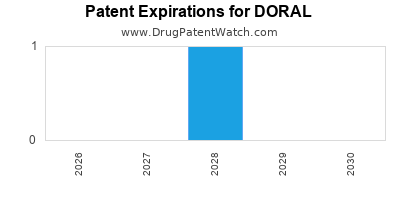
By analyzing the patents and regulatory protections it appears that the earliest date for generic entry will be June 3, 2028. This may change due to patent challenges or generic licensing.

Indicators of Generic Entry

< Available with Subscription >

  Get Started Free

AI Deep Research
Questions you can ask:
  • What is the 5 year forecast for DORAL?
  • What are the global sales for DORAL?
  • What is Average Wholesale Price for DORAL?
Summary for DORAL
US Patents:1
Applicants:1
NDAs:1
Finished Product Suppliers / Packagers: 1
Raw Ingredient (Bulk) Api Vendors: 1
Patent Applications: 3,717
What excipients (inactive ingredients) are in DORAL?DORAL excipients list
DailyMed Link:DORAL at DailyMed
Drug patent expirations by year for DORAL
DrugPatentWatch® Estimated Loss of Exclusivity (LOE) Date for DORAL
Generic Entry Date for DORAL*:
Constraining patent/regulatory exclusivity:
NDA:
Dosage:
TABLET;ORAL

*The generic entry opportunity date is the latter of the last compound-claiming patent and the last regulatory exclusivity protection. Many factors can influence early or later generic entry. This date is provided as a rough estimate of generic entry potential and should not be used as an independent source.

US Patents and Regulatory Information for DORAL

DORAL is protected by one US patents.

Based on analysis by DrugPatentWatch, the earliest date for a generic version of DORAL is ⤷  Get Started Free.

This potential generic entry date is based on patent 7,608,616.

Generics may enter earlier, or later, based on new patent filings, patent extensions, patent invalidation, early generic licensing, generic entry preferences, and other factors.

Applicant Tradename Generic Name Dosage NDA Approval Date TE Type RLD RS Patent No. Patent Expiration Product Substance Delist Req. Exclusivity Expiration
Galt Pharms DORAL quazepam TABLET;ORAL 018708-003 Feb 26, 1987 DISCN No No 7,608,616 ⤷  Get Started Free ⤷  Get Started Free
Galt Pharms DORAL quazepam TABLET;ORAL 018708-001 Dec 27, 1985 RX Yes Yes 7,608,616 ⤷  Get Started Free ⤷  Get Started Free
>Applicant >Tradename >Generic Name >Dosage >NDA >Approval Date >TE >Type >RLD >RS >Patent No. >Patent Expiration >Product >Substance >Delist Req. >Exclusivity Expiration

Expired US Patents for DORAL

Applicant Tradename Generic Name Dosage NDA Approval Date Patent No. Patent Expiration
Galt Pharms DORAL quazepam TABLET;ORAL 018708-003 Feb 26, 1987 3,845,039 ⤷  Get Started Free
Galt Pharms DORAL quazepam TABLET;ORAL 018708-001 Dec 27, 1985 4,521,431 ⤷  Get Started Free
Galt Pharms DORAL quazepam TABLET;ORAL 018708-001 Dec 27, 1985 3,920,818 ⤷  Get Started Free
Galt Pharms DORAL quazepam TABLET;ORAL 018708-001 Dec 27, 1985 4,128,658 ⤷  Get Started Free
Galt Pharms DORAL quazepam TABLET;ORAL 018708-001 Dec 27, 1985 3,845,039 ⤷  Get Started Free
Galt Pharms DORAL quazepam TABLET;ORAL 018708-003 Feb 26, 1987 3,920,818 ⤷  Get Started Free
>Applicant >Tradename >Generic Name >Dosage >NDA >Approval Date >Patent No. >Patent Expiration

International Patents for DORAL

See the table below for patents covering DORAL around the world.

Country Patent Number Title Estimated Expiration
Kenya 3549 AMINOALKYL FURAN DERIVATIVE ⤷  Get Started Free
Hungary 185001 PROCESS FOR PREPARING PHARMACEUTICALLY ACTIVE AMINO-ALKYL-FURANE DERIVATIVES ⤷  Get Started Free
Portugal 73744 PROCESS FOR PREPARING AMINOALKYL FURAN DERIVATIVE ⤷  Get Started Free
Japan H0443070 ⤷  Get Started Free
Australia 515628 ⤷  Get Started Free
Austria A109189 ⤷  Get Started Free
Malaysia 8500747 AMINOALKYL FURAN DERIVATIVE ⤷  Get Started Free
>Country >Patent Number >Title >Estimated Expiration

Market Dynamics and Financial Trajectory for the Pharmaceutical Drug: DORAL

Last updated: July 27, 2025

Introduction

DORAL, a branded oral contraceptive marketed by Pfizer, is a prominent player within the global reproductive health market. As an established product, its market dynamics are shaped by evolving regulatory landscapes, demographic shifts, competitive pressures, and technological innovations. This report delineates the current market environment, analyzes factors influencing DORAL's financial trajectory, and provides strategic insights for stakeholders navigating its future prospects.

Market Overview of DORAL

DORAL has historically maintained a significant market share within oral contraceptives, primarily targeting women of reproductive age. The global contraceptive market was valued at approximately USD 18 billion in 2022 and is projected to grow at a CAGR of around 4-5% through 2030 [1]. DORAL’s penetration leverages Pfizer’s established branding, regulatory approvals, and distribution channels, yet faces intensifying competition from generic formulations and emerging contraceptive modalities.

Product Profile and Positioning

DORAL’s efficacy, safety profile, and established clinical data underpin its market position. However, recent advancements in contraceptive technology, including long-acting reversible contraceptives (LARCs) and non-hormonal options, challenge traditional pills’ market dominance. Pfizer’s ongoing efforts to reformulate or expand DORAL’s indications could influence its market share and revenue streams.

Market Dynamics

Regulatory Landscape

Regulatory policies profoundly influence DORAL’s market prospects. Stringent approval processes, especially in emerging markets, can delay product rollout or necessitate formulary modifications. Conversely, regulatory incentives for contraceptive access, including in the U.S. and Europe, reinforce market growth [2].

The FDA's evolving guidelines on contraceptive safety and efficacy standards impact formulation adjustments and patent strategies for DORAL. Additionally, regulatory responses to concerns over hormonal contraceptives' side-effects may drive innovation, affecting DORAL’s competitive edge.

Demographic Trends

The global population of women aged 15-49 is projected to reach 1.6 billion by 2030, fueling sustained demand for contraceptives [3]. Increasing awareness, education, and access in developing regions further expand the market. Conversely, cultural shifts and policy debates surrounding reproductive rights can modulate consumer uptake.

Competitive Environment

DORAL operates in a fiercely competitive landscape. Generic oral contraceptives have eroded original patent protections, exerting price pressure. Companies like Teva, Allergan, and generic manufacturers increasingly offer comparable formulations at lower costs, squeezing Pfizer’s margins.

Innovative contraceptive options—non-hormonal pills, implants, vaginal rings—are gaining prominence. These alternatives attract younger demographics seeking fewer side-effects or higher convenience, threatening DORAL’s market share.

Technological and Formulation Innovations

Technological advances enable the development of combination pills with improved safety profiles, reduced side-effects, or personalized dosing regimens. Pfizer’s R&D investments in such formulations could extend DORAL’s lifecycle or replace it with next-generation products.

Digital health innovations, including mobile adherence apps, contribute to better patient compliance and may influence prescribing patterns for traditional oral contraceptives.

Financial Trajectory Analysis

Revenue Trends

Historically, DORAL generated substantial revenue within Pfizer’s reproductive health segment. However, sales have plateaued owing to patent expirations and increasing competition. In 2022, DORAL's sales declined approximately 8-10%, reflecting generic erosion and market saturation.

Predictive models suggest a continued downward trend unless strategic repositioning occurs. The anticipated CAGR over the next five years for DORAL-specific revenues hovers around -2% to -4%, barring significant reformulation or marketing shifts [4].

Profitability Considerations

DORAL’s profitability margins face pressure from lower-priced generics and increased marketing costs aimed at brand differentiation. Cost reductions through manufacturing efficiencies or licensing agreements could mitigate margin erosion.

Furthermore, regulatory investments to maintain compliance and offset potential legal liabilities add to operational costs, impacting overall profitability.

Strategic Growth Opportunities

To counteract stagnation, Pfizer may explore extensions like improved formulations, new delivery mechanisms, or expanded indications. Licensing agreements or targeted marketing campaigns in emerging markets could provide incremental revenue.

Investments in digital platforms and patient adherence initiatives might bolster consumer loyalty, indirectly supporting financial stability.

Future Outlook and Key Drivers

  • Regulatory evolution: Clearer and more supportive policies for contraceptive access could expand market size and revenue opportunities.
  • Demographic expansion: Growing reproductive-age populations, especially in Asia and Africa, present significant sales channels.
  • Competitive innovation: Transitioning into next-generation contraceptives can rejuvenate product relevance and margins.
  • Patent and exclusivity strategies: Protecting formulations through supplementary patents or exclusivity periods lengthens revenue streams.
  • Digital health integration: Leveraging technology can enhance consumer engagement and adherence, indirectly supporting sales.

Risks and Challenges

  • Market commoditization: Pathway to increased generic penetration threatens profit margins.
  • Regulatory hurdles: Stringent approval processes may delay new formulations and limit market access.
  • Sociopolitical factors: Policy shifts, especially in regions with contentious reproductive health debates, can significantly impact sales.
  • Competitive innovation: Rapid development of alternative contraceptive methods could displace traditional pills.

Conclusion

DORAL’s market dynamics are defined by a mix of demographic trends, regulatory environments, and technological advancements. While challenging short-term revenue streams, strategic positioning through innovation, regional expansion, and lifecycle management can sustain its financial trajectory. Stakeholders must closely monitor shifting policies, emerging competitors, and technological trends to optimize investment outcomes.


Key Takeaways

  • DORAL’s revenues face headwinds due to patent expirations and intensifying generic competition, demanding active lifecycle management.
  • Demographic growth in reproductive-age women, especially in emerging markets, presents growth opportunities if regulatory and cultural barriers are managed effectively.
  • Innovation in formulation and delivery, alongside digital health integrations, can bolster DORAL’s market relevance and profitability.
  • Regulatory landscapes require ongoing strategic navigation; reforms supporting contraceptive access could positively influence demand.
  • Industry shifts towards non-hormonal and long-acting contraceptives necessitate diversification strategies for sustained financial performance.

FAQs

1. What is DORAL's current market share within the global oral contraceptive segment?
As of 2022, DORAL holds approximately 12-15% of the combined brand-name oral contraceptive market, with variations across regions due to competitive dynamics and patent status [1].

2. How are patent expirations affecting DORAL’s revenue trajectory?
Patent expirations have led to increased generic competition, significantly reducing DORAL’s market exclusivity in key markets and contributing to declining sales volumes and margins.

3. What innovations could extend DORAL’s relevance in the contraceptive market?
Development of formulations with fewer side-effects, extended-release options, or integration into digital adherence platforms can preserve and potentially grow its market share.

4. Which regional markets present the greatest growth potential for DORAL?
Emerging markets in Asia, Africa, and Latin America offer significant growth potential, contingent on favorable regulatory environments and cultural acceptance.

5. What strategic options does Pfizer have to improve DORAL’s financial outlook?
Possible strategies include reformulation for better safety profiles, leveraging digital health solutions, pursuing regional licensing partnerships, or expanding into new indications.


References

  1. MarketWatch. (2022). Global Contraceptive Market size and forecast.
  2. U.S. Food and Drug Administration. (2023). Regulatory guidelines for contraceptive products.
  3. United Nations. (2022). World Population Prospects 2022.
  4. Pfizer Annual Report. (2022). Reproductive Health Segment Analysis.

More… ↓

⤷  Get Started Free

Make Better Decisions: Try a trial or see plans & pricing

Drugs may be covered by multiple patents or regulatory protections. All trademarks and applicant names are the property of their respective owners or licensors. Although great care is taken in the proper and correct provision of this service, thinkBiotech LLC does not accept any responsibility for possible consequences of errors or omissions in the provided data. The data presented herein is for information purposes only. There is no warranty that the data contained herein is error free. We do not provide individual investment advice. This service is not registered with any financial regulatory agency. The information we publish is educational only and based on our opinions plus our models. By using DrugPatentWatch you acknowledge that we do not provide personalized recommendations or advice. thinkBiotech performs no independent verification of facts as provided by public sources nor are attempts made to provide legal or investing advice. Any reliance on data provided herein is done solely at the discretion of the user. Users of this service are advised to seek professional advice and independent confirmation before considering acting on any of the provided information. thinkBiotech LLC reserves the right to amend, extend or withdraw any part or all of the offered service without notice.