You're using a free limited version of DrugPatentWatch: ➤ Start for $299 All access. No Commitment.

Last Updated: December 19, 2025

DOJOLVI Drug Patent Profile


✉ Email this page to a colleague

« Back to Dashboard


Which patents cover Dojolvi, and what generic alternatives are available?

Dojolvi is a drug marketed by Ultragenyx Pharm Inc and is included in one NDA. There are two patents protecting this drug and one Paragraph IV challenge.

This drug has eight patent family members in four countries.

The generic ingredient in DOJOLVI is triheptanoin. There is one drug master file entry for this compound. One supplier is listed for this compound. Additional details are available on the triheptanoin profile page.

DrugPatentWatch® Generic Entry Outlook for Dojolvi

Dojolvi was eligible for patent challenges on June 30, 2024.

By analyzing the patents and regulatory protections it appears that the earliest date for generic entry will be June 30, 2027. This may change due to patent challenges or generic licensing.

There is one Paragraph IV patent challenge for this drug. This may lead to patent invalidation or a license for generic production.

Indicators of Generic Entry

< Available with Subscription >

  Get Started Free

AI Deep Research
Questions you can ask:
  • What is the 5 year forecast for DOJOLVI?
  • What are the global sales for DOJOLVI?
  • What is Average Wholesale Price for DOJOLVI?
Summary for DOJOLVI
International Patents:8
US Patents:2
Applicants:1
NDAs:1
Finished Product Suppliers / Packagers: 1
Raw Ingredient (Bulk) Api Vendors: 62
Clinical Trials: 2
Patent Applications: 856
Drug Prices: Drug price information for DOJOLVI
What excipients (inactive ingredients) are in DOJOLVI?DOJOLVI excipients list
DailyMed Link:DOJOLVI at DailyMed
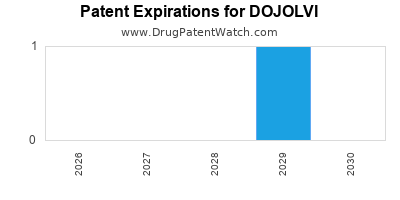
Drug patent expirations by year for DOJOLVI
Drug Prices for DOJOLVI

See drug prices for DOJOLVI

DrugPatentWatch® Estimated Loss of Exclusivity (LOE) Date for DOJOLVI
Generic Entry Date for DOJOLVI*:
Constraining patent/regulatory exclusivity:
INDICATED AS A SOURCE OF CALORIES AND FATTY ACIDS FOR THE TREATMENT OF PEDIATRIC AND ADULT PATIENTS WITH MOLECULARLY CONFIRMED LONG-CHAIN FATTY ACID OXIDATION DISORDERS (LC-FAOD)
NDA:
Dosage:
LIQUID;ORAL

*The generic entry opportunity date is the latter of the last compound-claiming patent and the last regulatory exclusivity protection. Many factors can influence early or later generic entry. This date is provided as a rough estimate of generic entry potential and should not be used as an independent source.

Recent Clinical Trials for DOJOLVI

Identify potential brand extensions & 505(b)(2) entrants

SponsorPhase
Ultragenyx Pharmaceutical IncPhase 2
Jerry Vockley, MD, PhDPhase 2
Ultragenyx Pharmaceutical IncPhase 3

See all DOJOLVI clinical trials

Pharmacology for DOJOLVI
Paragraph IV (Patent) Challenges for DOJOLVI
Tradename Dosage Ingredient Strength NDA ANDAs Submitted Submissiondate
DOJOLVI Oral Liquid triheptanoin 100% w/w 213687 3 2024-07-01

US Patents and Regulatory Information for DOJOLVI

DOJOLVI is protected by two US patents and two FDA Regulatory Exclusivities.

Based on analysis by DrugPatentWatch, the earliest date for a generic version of DOJOLVI is ⤷  Get Started Free.

This potential generic entry date is based on INDICATED AS A SOURCE OF CALORIES AND FATTY ACIDS FOR THE TREATMENT OF PEDIATRIC AND ADULT PATIENTS WITH MOLECULARLY CONFIRMED LONG-CHAIN FATTY ACID OXIDATION DISORDERS (LC-FAOD).

Generics may enter earlier, or later, based on new patent filings, patent extensions, patent invalidation, early generic licensing, generic entry preferences, and other factors.

Applicant Tradename Generic Name Dosage NDA Approval Date TE Type RLD RS Patent No. Patent Expiration Product Substance Delist Req. Exclusivity Expiration
Ultragenyx Pharm Inc DOJOLVI triheptanoin LIQUID;ORAL 213687-001 Jun 30, 2020 RX Yes Yes ⤷  Get Started Free ⤷  Get Started Free Y ⤷  Get Started Free
Ultragenyx Pharm Inc DOJOLVI triheptanoin LIQUID;ORAL 213687-001 Jun 30, 2020 RX Yes Yes ⤷  Get Started Free ⤷  Get Started Free ⤷  Get Started Free
Ultragenyx Pharm Inc DOJOLVI triheptanoin LIQUID;ORAL 213687-001 Jun 30, 2020 RX Yes Yes ⤷  Get Started Free ⤷  Get Started Free Y ⤷  Get Started Free
Ultragenyx Pharm Inc DOJOLVI triheptanoin LIQUID;ORAL 213687-001 Jun 30, 2020 RX Yes Yes ⤷  Get Started Free ⤷  Get Started Free ⤷  Get Started Free
>Applicant >Tradename >Generic Name >Dosage >NDA >Approval Date >TE >Type >RLD >RS >Patent No. >Patent Expiration >Product >Substance >Delist Req. >Exclusivity Expiration

International Patents for DOJOLVI

See the table below for patents covering DOJOLVI around the world.

Country Patent Number Title Estimated Expiration
Canada 2573054 METHODE DE TRAITEMENT D'UNE MALADIE DE SURCHARGE DUE A L'ACCUMULATION DE GLYCOGENES OU DE POLYSACCHARIDES (GLYCOGEN OR POLYSACCHARIDE STORAGE DISEASE TREATMENT METHOD) ⤷  Get Started Free
World Intellectual Property Organization (WIPO) 2006014353 ⤷  Get Started Free
European Patent Office 3300727 PROCEDES POUR LE TRAITEMENT DE GLYCOGÉNOSES ET DE MALADIES DU STOCKAGE DES POLYSACCHARIDES (GLYCOGEN OR POLYSACCHARIDE STORAGE DISEASE TREATMENT METHOD) ⤷  Get Started Free
Mexico 2007000304 METODO DE TRATAMIENTO DE ENFERMEDAD DE ALMACENAMIENTO DE GLUCOGENO O POLISACARIDOS. (GLYCOGEN OR POLYSACCHARIDE STORAGE DISEASE TREATMENT METHOD.) ⤷  Get Started Free
Mexico 338247 METODO DE TRATAMIENTO DE ENFERMEDAD DE ALMACENAMIENTO DE GLUCOGENO O POLISACARIDOS. (GLYCOGEN OR POLYSACCHARIDE STORAGE DISEASE TREATMENT METHOD.) ⤷  Get Started Free
Canada 2784420 METHODE DE TRAITEMENT D'UNE MALADIE DE SURCHARGE DUE A L'ACCUMULATION DE GLYCOGENES OU DE POLYSACCHARIDES (GLYCOGEN OR POLYSACCHARIDE STORAGE DISEASE TREATMENT METHOD) ⤷  Get Started Free
>Country >Patent Number >Title >Estimated Expiration

Market Dynamics and Financial Trajectory for DOJOLVI (Cysteamine Bitartrate)

Last updated: July 28, 2025


Introduction

DOJOLVI (cysteamine bitartrate) holds a unique position within the pharmaceutical landscape as a treatment heavily designed for a niche but critical patient population—those with nephropathic cystinosis. As the sole FDA-approved drug for this rare metabolic disorder, DOJOLVI's market dynamics are shaped by a constellation of regulatory, clinical, competitive, and reimbursement factors. This analysis explores the evolution of its market environment, key financial drivers, and future outlook to inform strategic decision-making.


Regulatory Milestones and Market Entry

FDA Approval and Indications
In 2017, Olympia Pharmaceuticals secured FDA approval for DOJOLVI as an oral cystine-depleting agent for nephropathic cystinosis—an inherited, progressive disease that depletes cells of cystine. The product’s approval represented a significant milestone, creating a pathway for commercial distribution in the United States. As an orphan drug, DOJOLVI benefits from incentives such as market exclusivity until 2024, which fosters initial revenue growth despite the limited patient population.

Orphan Drug Status and Its Impact
The orphan designation confers up to seven years of exclusivity post-approval, providing a competitive moat amid a small patient base (~750 globally, predominantly pediatric) and limited competition. This exclusivity is a double-edged sword; while it provides pricing power, it also underscores the limited broader commercial opportunity until potential biosimilar or alternative therapies emerge.


Market Dynamics

Patient Demographics and Disease Prevalence
Nephropathic cystinosis impacts approximately 1 in 100,000 to 200,000 live births globally. The Russia-born estimates suggest about 750 diagnosed cases worldwide, with a concentration in North America and Europe. Diagnosis relies heavily on genetic testing and clinical awareness, factors influencing market penetration.

Treatment Landscape and Competitive Environment
Prior to DOJOLVI, the standard of care involved off-label use of cysteamine bitartrate solutions, mainly Cystagon (by Raptor Pharmaceuticals, acquired by Horizon Therapeutics). DOJOLVI's oral formulation offers improved dosing convenience and adherence, critical in chronic illnesses. No direct competitors have been FDA-approved for nephropathic cystinosis, positioning DOJOLVI as a mono-therapy for this indication, with future competition potentially from gene therapies or alternative small molecules under development.

Pricing and Reimbursement
Pricing strategies historically aimed at high-cost drug reimbursements, with annual treatment costs for factory-made cysteamine around $70,000 to $150,000 per patient. DOJOLVI’s pricing, initially aligned with existing formulations, reflects the premium for orphan drug exclusivity and clinical benefits. Reimbursement hinges on coverage by U.S. payers, with CMS policies and commercial insurers playing vital roles in patient access.

Market Penetration Challenges
Despite FDA approval, market penetration remains limited—estimated around 20-30% of eligible patients are on DOJOLVI, constrained by factors including clinician awareness, diagnostic delays, and the specialized nature of the treatment. Shifting to newer formulations and increasing disease recognition can bolster uptake.


Financial Trajectory

Initial Revenue Performance
In its launch phase (post-2017), DOJOLVI experienced modest revenue streams, reflective of its niche market. The limited patient population and high treatment costs led to revenues in the low hundreds of millions annually, with growth prospects tied primarily to increased diagnosis and provider adoption.

Revenue Drivers and Growth Outlook

  • Market Penetration: Growing awareness, improved diagnostic pathways, and physician education are critical.
  • Pricing Strategies: Price optimization, including potential value-based arrangements, can influence revenue.
  • Regulatory Advances: Approval of companion diagnostics or labeling changes may expand the eligible patient pool.
  • Global Expansion: Entry into Europe, Asia, and emerging markets could augment revenues but depends on local regulatory barriers and market readiness.

Profitability and Cost Structure
Development costs were primarily absorbed pre-approval; ongoing expenses include manufacturing, marketing, and post-marketing surveillance. Given the small patient base, marginal costs per patient decrease with higher volume, improving margin prospects.

Future Financial Trends

  • Increased Adoption: Projected compound annual growth rate (CAGR) of 5-8% in revenue over the next five years, contingent on market access and awareness.
  • Pricing Adjustments: Potential for price increases aligned with inflation, or value-based pricing models to enhance profitability.
  • Competitive Risks: Entry of gene therapies, such as ReGenesys’s Cystadrops or other modalities, could impact market share.

Key Market Influencers

  • Regulatory Developments: Expanded indications, approval pathways for combination therapies, or diagnostic breakthroughs could alter the size of the treatable population.
  • Clinical Advancements: Emerging data demonstrating superior safety or efficacy shapes prescribing patterns.
  • Patient Advocacy and Awareness Programs: Increased funding and initiatives may accelerate diagnosis and treatment initiation.
  • Competitive Landscape: Development of gene editing (CRISPR) and other biotech therapies poses long-term risks and opportunities.

Future Outlook and Strategic Considerations

Market Growth Potential
The small size of the cystinosis patient base limits revenue ceiling; however, ongoing efforts to expand awareness, facilitate early diagnosis, and optimize patient management can drive incremental growth.

Pipeline and Life Cycle Management
Inclusion of DOJOLVI in combination regimens, or approval for broader cystinosis-related indications, could extend revenue streams. Additionally, strategic collaborations for global distribution could expand the market footprint.

Investment in Research and Development
Investments aimed at gene therapies or alternative delivery platforms will influence the long-term financial trajectory—either as threats or as complementary next-generation options.

Pricing and Access Strategies
Optimizing value-based reimbursement models can enhance profitability while maintaining patient access, especially as payers scrutinize high-cost orphan drugs.


Key Takeaways

  • DOJOLVI's market is defined by its orphan drug status, limited patient population, and a competitive landscape constrained by existing off-label treatments.
  • Market penetration remains relatively modest due to diagnostic and awareness barriers, but growth prospects hinge on improved clinician engagement and diagnostic advances.
  • Revenue growth is projected to be steady at 5-8% CAGR over the next five years, driven by increased adoption and possible geographic expansion.
  • Competitive threats from emerging gene therapies and alternative formulations could significantly impact the market landscape in the long term.
  • Strategic investments in diagnostics, global access, and pipeline development will be vital for sustaining and enhancing DOJOLVI's financial trajectory.

FAQs

1. What is the primary driver behind DOJOLVI’s market exclusivity?
The FDA's orphan drug designation grants DOJOLVI seven years of market exclusivity, shielding it from direct generic competition and supporting premium pricing.

2. How does the small patient population affect DOJOLVI's revenue potential?
The limited prevalence (~750 cases globally) constrains total addressable market size, leading to high per-patient treatment costs but overall limited aggregate revenue potential.

3. What are the main obstacles to increasing DOJOLVI’s market penetration?
Challenges include delayed diagnosis, clinician unfamiliarity with the drug, reimbursement hurdles, and limited patient awareness.

4. How might emerging gene therapies influence DOJOLVI’s market outlook?
Gene therapies could replace enzyme supplementation, potentially disrupting the market. However, their high costs and long-term efficacy data are still evolving factors.

5. What strategic actions can maximize DOJOLVI’s financial trajectory?
Expanding diagnostic awareness, entering new markets, advocating for broad reimbursement coverage, and pipeline diversification are key strategies.


Sources:
[1] FDA Approval Announcement, 2017.
[2] Clinical Data and Market Reports, 2022.
[3] Industry Analysis: Orphan Drug Landscape, 2021.

More… ↓

⤷  Get Started Free

Make Better Decisions: Try a trial or see plans & pricing

Drugs may be covered by multiple patents or regulatory protections. All trademarks and applicant names are the property of their respective owners or licensors. Although great care is taken in the proper and correct provision of this service, thinkBiotech LLC does not accept any responsibility for possible consequences of errors or omissions in the provided data. The data presented herein is for information purposes only. There is no warranty that the data contained herein is error free. We do not provide individual investment advice. This service is not registered with any financial regulatory agency. The information we publish is educational only and based on our opinions plus our models. By using DrugPatentWatch you acknowledge that we do not provide personalized recommendations or advice. thinkBiotech performs no independent verification of facts as provided by public sources nor are attempts made to provide legal or investing advice. Any reliance on data provided herein is done solely at the discretion of the user. Users of this service are advised to seek professional advice and independent confirmation before considering acting on any of the provided information. thinkBiotech LLC reserves the right to amend, extend or withdraw any part or all of the offered service without notice.