Last updated: September 7, 2026
Dipyridamole is a mature, largely generic antiplatelet drug with limited pricing power, broad manufacturer competition, and minimal remaining patent protection. Its commercial value is concentrated in low-cost generic tablets, extended-release dipyridamole-aspirin products, and hospital injectable use. Revenue growth is unlikely to come from price expansion. The main financial drivers are prescription volume, generic supply continuity, reimbursement position, manufacturing efficiency, and demand for secondary stroke prevention.
What is the current market position of dipyridamole?
Dipyridamole is an antiplatelet and vasodilator used primarily in combination with aspirin for secondary prevention of ischemic stroke and transient ischemic attack. It is marketed in several forms:
| Product or formulation |
Typical use |
Market status |
| Dipyridamole immediate-release tablets |
Antiplatelet therapy; historical cardiovascular use |
Generic |
| Extended-release dipyridamole plus aspirin capsules |
Secondary stroke prevention |
Generic equivalents to Aggrenox |
| Dipyridamole injection |
Pharmacologic stress testing and coronary vasodilation |
Generic or hospital-supplied |
| Brand Persantine |
Dipyridamole tablets and injection |
Limited commercial relevance |
| Brand Aggrenox |
Aspirin and extended-release dipyridamole |
Largely replaced by generics |
The largest commercially relevant segment is the fixed-dose aspirin and extended-release dipyridamole product. The product competes with clopidogrel, aspirin monotherapy, aspirin-dipyridamole alternatives, and newer antithrombotic strategies.
Dipyridamole does not have the growth profile of a recently approved cardiovascular drug. Its market is mature, price-sensitive, and primarily driven by chronic use among established patients.
How large is the dipyridamole market?
Public companies generally do not report dipyridamole revenue as a separate product line. Brand-level disclosure for Persantine and Aggrenox is limited because generic substitution has materially reduced branded sales. Commercial market estimates therefore differ according to whether they include:
- Dipyridamole active pharmaceutical ingredient sales
- Dipyridamole tablets
- Aspirin and extended-release dipyridamole combinations
- Injectable dipyridamole used in hospitals
- Global or U.S.-only sales
- Manufacturer revenue or pharmacy spending
The commercially relevant U.S. market is a low-revenue generic market compared with major cardiovascular categories such as statins, direct oral anticoagulants, and PCSK9 inhibitors. Unit demand remains durable because stroke-prevention therapy is chronic, but average selling prices are low.
A reasonable financial characterization is:
- Prescription volume is stable to modestly declining.
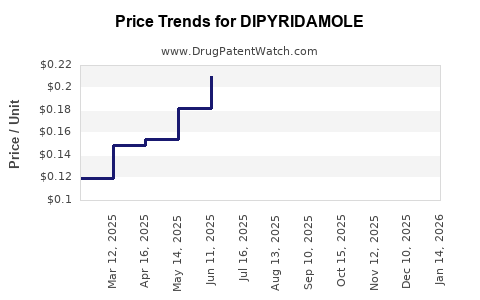
- Revenue is exposed to generic price erosion.
- Manufacturer economics depend on scale and supply reliability.
- Product-level growth is more likely to come from market-share gains than from therapeutic expansion.
- The combination product has greater commercial relevance than dipyridamole monotherapy.
What are the main demand drivers for dipyridamole?
Secondary stroke prevention
The principal demand base is patients with prior non-cardioembolic ischemic stroke or transient ischemic attack. Clinical guidelines recognize aspirin, clopidogrel, and aspirin plus extended-release dipyridamole as antiplatelet options, with treatment selection influenced by tolerance, adherence, cost, and prior therapy.
The aspirin-dipyridamole combination requires twice-daily administration and can cause headache, which can reduce persistence. Clopidogrel’s once-daily dosing and broad generic availability create a direct competitive constraint.
Pharmacologic cardiac stress testing
Injectable dipyridamole has been used to induce coronary hyperemia during myocardial perfusion imaging. Its role has narrowed as adenosine, regadenoson, and other stress-testing protocols have gained use. Hospital demand remains linked to imaging volume, formulary policy, and local practice patterns.
Chronic disease prevalence
An aging population and continued incidence of ischemic stroke support baseline demand. That demographic support does not translate directly into revenue growth because generic substitution and reimbursement pressure offset volume gains.
How does dipyridamole compare with competing antiplatelet drugs?
| Drug |
Primary commercial position |
Dosing advantage |
Competitive pressure on dipyridamole |
| Aspirin |
Low-cost first-line antiplatelet |
Simple, inexpensive |
High |
| Clopidogrel |
Broad use in stroke and coronary disease |
Once daily; generic |
High |
| Aspirin plus extended-release dipyridamole |
Secondary stroke prevention |
Combination therapy |
Core dipyridamole market |
| Ticagrelor |
Acute coronary syndrome and selected stroke uses |
Potent platelet inhibition |
Moderate, but indication-specific |
| Prasugrel |
Selected acute coronary syndrome patients |
Potent effect |
Limited overlap |
| Direct oral anticoagulants |
Atrial fibrillation and venous thromboembolism |
Indication-specific anticoagulation |
Indirect |
Clopidogrel is the most important direct commercial competitor in secondary stroke prevention. Dipyridamole products retain a role where clinicians prefer the combination regimen or where patients have an established treatment history.
Dipyridamole is not interchangeable with anticoagulants. Patients with atrial fibrillation or other cardioembolic risk generally require anticoagulation rather than antiplatelet therapy, limiting dipyridamole’s addressable population.
When did dipyridamole lose exclusivity?
Dipyridamole’s core composition-of-matter protection expired many years ago. The drug is now a mature generic active ingredient. The remaining commercial protections are not material barriers to ordinary generic tablet or capsule competition.
The former branded products have been exposed to generic competition for years:
| Product |
Commercial status |
Exclusivity assessment |
| Persantine tablets |
Generic competition |
No meaningful current market exclusivity |
| Persantine injection |
Generic competition |
No meaningful current market exclusivity |
| Aggrenox |
Generic aspirin-dipyridamole competition |
Core exclusivity expired |
| Generic dipyridamole |
Multiple suppliers |
Commodity-like market structure |
Exact patent expiry dates are less important commercially than the absence of an active, enforceable exclusivity barrier that would prevent generic supply. FDA approval records and Orange Book listings are the controlling sources for product-specific patent and exclusivity information.[1][2]
What is the Orange Book status of dipyridamole products?
Dipyridamole products have historically been listed in FDA approval records associated with Persantine and Aggrenox. Generic approvals rely on abbreviated new drug applications, typically demonstrating pharmaceutical equivalence and bioequivalence rather than repeating the original clinical development program.
For the extended-release aspirin-dipyridamole product, the relevant regulatory issues have included:
- Bioequivalence of the modified-release dipyridamole component
- Equivalent aspirin strength
- Release profile and dissolution performance
- Capsule composition and stability
- Labeling and dosing consistency
The market is therefore governed primarily by generic approval competition rather than by patent litigation or regulatory exclusivity.
Are Paragraph IV challenges relevant to dipyridamole?
Paragraph IV litigation is not a major current market risk category for standard dipyridamole. The original product patents are old, and most meaningful generic-entry disputes have already been resolved through expiry, approval, or market substitution.
Paragraph IV activity could arise for a newly developed formulation, delivery system, or fixed-dose combination. It would be less likely to create durable protection for conventional dipyridamole because:
- The active ingredient is long established.
- Basic tablet and capsule technologies are mature.
- Multiple manufacturers have commercial experience.
- The therapeutic market is price constrained.
- A new formulation would need to demonstrate a commercially meaningful clinical or adherence benefit.
What formulations are protected by dipyridamole patents?
The commercially important formulation issue is extended-release dipyridamole combined with aspirin. Such products require control of release kinetics, capsule composition, stability, and bioequivalence.
Potentially protectable features include:
- Modified-release pellets or beads
- Coating systems that control dipyridamole dissolution
- Fixed-dose aspirin and dipyridamole combinations
- Manufacturing processes for multiparticulate dosage forms
- Stability improvements
- Alternative delivery systems
These features can support formulation patents, but their economic value depends on whether they remain enforceable and whether generic manufacturers can design around them. For an old product, formulation patents generally do not recreate the commercial strength of a valid composition-of-matter patent.
How strong is the current patent estate for dipyridamole?
The current patent estate is weak from a market-exclusion perspective and moderate only for narrow formulation or process claims.
| Patent category |
Current commercial strength |
| Composition of matter |
Exhausted |
| Basic oral dosage form |
Exhausted or readily designed around |
| Aspirin-dipyridamole combination |
Limited, generally expired core protection |
| Modified-release formulation |
Potentially relevant only if an unexpired claim remains |
| Manufacturing process |
Narrow and supplier-specific |
| Injectable formulation |
Limited exclusionary value |
| Method of use |
Limited because major indications are longstanding |
The practical barriers are manufacturing know-how, regulatory compliance, product quality, and reliable supply rather than patent exclusivity.
What is the financial trajectory for dipyridamole manufacturers?
Dipyridamole revenue follows the standard mature-generic trajectory:
Revenue
Revenue is likely flat to declining over the long term unless a manufacturer captures share from a supply disruption or secures a differentiated formulation. Any increase in prescription volume is unlikely to offset persistent price erosion across multiple generic suppliers.
Gross margin
Margins vary sharply by formulation. Standard immediate-release tablets generally have low unit economics. Extended-release combination products can produce better margins when fewer suppliers are active or when manufacturing complexity limits competition. Injectable products may retain stronger pricing because of hospital procurement requirements, sterile manufacturing, and supply constraints.
Cash flow
Cash generation can remain positive despite low prices because clinical development costs are minimal and the products have established demand. Working-capital requirements, manufacturing quality systems, regulatory maintenance, and competitive tendering affect profitability.
Business risk
The principal risks are:
- FDA manufacturing observations or warning letters
- Product recalls
- Shortages of active ingredient or specialized excipients
- Loss of a hospital contract
- Additional generic entrants
- Reimbursement exclusion
- Declining use of dipyridamole injection in favor of other stress agents
- Patient switching to clopidogrel
Which companies compete in the dipyridamole market?
Competition varies by jurisdiction and product. Brand ownership historically included Boehringer Ingelheim for Aggrenox and Persantine-related products, while generic supply has involved multiple manufacturers and marketing partners.
The competitive field typically includes:
- Large generic pharmaceutical companies
- Regional generic manufacturers
- Contract manufacturers
- Hospital injectable suppliers
- Companies marketing authorized or private-label generics
Manufacturer-level market share changes frequently because generic companies enter and exit low-margin products. Public filings rarely provide a standalone dipyridamole revenue figure, making product-specific financial ranking difficult without paid prescription, wholesaler, or tender data.
What generic launch scenarios exist for dipyridamole?
Base case: continued generic erosion
Multiple suppliers maintain supply, prices remain compressed, and revenue declines gradually. This is the most likely scenario for standard tablets and capsules.
Supply-constrained scenario
A manufacturer exit, quality event, or active-ingredient shortage reduces competition. Remaining suppliers may experience temporary volume and price increases. Such gains are generally reversible.
Formulation-led scenario
A company introduces a better-tolerated or more convenient modified-release product. Commercial success would require evidence of improved adherence, lower headache-related discontinuation, or meaningful reimbursement support.
Clinical substitution scenario
Prescribers shift more patients toward clopidogrel or other antithrombotic regimens. This would reduce dipyridamole volume, especially where once-daily dosing and lower cost favor clopidogrel.
Does dipyridamole have biosimilar risk?
No. Dipyridamole is a small-molecule drug, not a biologic. Biosimilar regulation does not apply. Competitive risk comes from conventional generic drugs approved through the ANDA pathway, as well as therapeutic substitution by other antiplatelet agents.
What licensing deals affect dipyridamole?
No major recent licensing transaction is necessary to explain the current market structure. Historically, branded commercialization and generic distribution arrangements have influenced regional availability, but the product’s economics now depend more on manufacturing and distribution contracts than on high-value innovation licenses.
Any new licensing opportunity would most likely involve:
- A fixed-dose cardiovascular combination
- A novel modified-release platform
- A hospital injectable supply agreement
- Regional distribution rights
- A reformulation intended to improve adherence
The value of such a deal would be limited unless the asset included defensible intellectual property or a clear reimbursement advantage.
What litigation affects dipyridamole?
Dipyridamole is not currently characterized by a major, market-defining patent litigation campaign. Historical litigation involving branded or generic versions would have centered on formulation patents, combination-product claims, or abbreviated application certifications.
Current litigation risk is more likely to arise from:
- Product liability
- Manufacturing defects
- Antitrust or pricing allegations involving generic supply
- Contract disputes
- FDA compliance actions
- Patent disputes over a new formulation
The absence of active exclusionary litigation supports continued generic competition.
What geographic markets are most relevant?
The United States remains commercially important because of its large prescription market and established FDA-approved combination products. Europe and other developed markets also have long-standing generic supply, although national reimbursement systems and prescribing guidelines influence use.
Emerging markets can support unit growth but usually produce lower revenue per prescription. Geographic expansion is therefore volume-led, not margin-led. Injectable demand can vary significantly by hospital procurement systems and local cardiac imaging practices.
Key Takeaways
- Dipyridamole is a mature generic antiplatelet drug with limited pricing power.
- The most commercially relevant product is aspirin plus extended-release dipyridamole for secondary stroke prevention.
- Clopidogrel is the principal direct competitor.
- Core composition-of-matter and branded-product exclusivity have expired.
- Orange Book and Paragraph IV issues have limited current strategic importance.
- Formulation and manufacturing patents may protect narrow features but do not create broad market exclusion.
- Revenue is likely flat to declining, with temporary upside possible from supply disruptions.
- Injectable dipyridamole may have better economics than oral tablets because of sterile manufacturing and hospital procurement.
- There is no biosimilar risk because dipyridamole is a small molecule.
- The main commercial risks are price erosion, supplier exits, quality events, and therapeutic substitution.
FAQs
Is dipyridamole still commercially important?
Yes, but primarily as a low-cost generic product and as part of the aspirin-dipyridamole combination. Its strategic value is much lower than that of newer cardiovascular drugs.
Is Aggrenox still protected by patents?
The core commercial exclusivity for Aggrenox has expired, and generic aspirin plus extended-release dipyridamole products compete with the branded product.
Can a company obtain new patents on dipyridamole?
Yes. New patents could cover a formulation, delivery system, manufacturing process, or combination. Such patents would generally provide narrower protection than the original active-ingredient patent.
Is dipyridamole injection a growth product?
It is more defensible than standard oral tablets because of hospital supply and sterile-manufacturing requirements, but its long-term growth is constrained by competition from other pharmacologic stress agents.
What would increase the value of a dipyridamole product?
A product would need a measurable advantage in adherence, tolerability, dosing convenience, supply reliability, or reimbursement. A conventional generic tablet is unlikely to generate significant value through pricing alone.
References
-
U.S. Food and Drug Administration. (n.d.). Approved drug products with therapeutic equivalence evaluations: Orange Book. https://www.fda.gov/drugs/drug-approvals-and-databases/approved-drug-products-therapeutic-equivalence-evaluations-orange-book
-
U.S. Food and Drug Administration. (n.d.). Drugs@FDA. https://www.accessdata.fda.gov/scripts/cder/daf/
-
U.S. Food and Drug Administration. (n.d.). DailyMed: Current medication information. National Library of Medicine. https://dailymed.nlm.nih.gov/dailymed/
-
Kleindorfer, D. O., Towfighi, A., Ch tu, T., et al. (2021). 2021 guideline for the prevention of stroke in patients with stroke and transient ischemic attack. Stroke, 52(7), e364-e467. https://doi.org/10.1161/STR.0000000000000375
-
National Institute for Health and Care Excellence. (n.d.). Stroke and transient ischaemic attack in over 16s: Diagnosis and initial management. https://www.nice.org.uk/guidance/ng128