Last updated: September 24, 2026
Dilaudid is the brand name for hydromorphone hydrochloride, a Schedule II opioid used for severe pain. Its U.S. market has moved from branded pharmaceutical sales to a largely generic, hospital-centered business. The original brand has no meaningful remaining patent barrier, and commercial value is concentrated in generic injectable, tablet, and oral-solution products sold by multiple manufacturers.
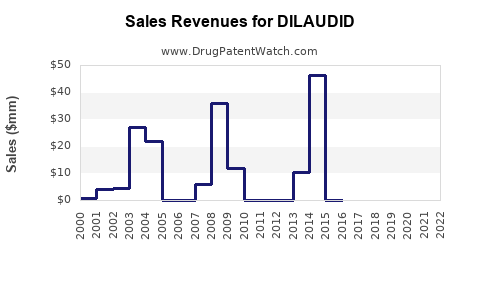
Standalone Dilaudid revenue is not publicly disclosed in current financial filings. Public companies generally report hydromorphone within broader generic, hospital, injectable, or established-products portfolios rather than as a separate product. The financial trajectory is therefore best assessed through prescription volume, opioid utilization, hospital demand, generic pricing, supply conditions, and manufacturer portfolio exposure.
What is Dilaudid and how is hydromorphone used?
Dilaudid contains hydromorphone hydrochloride, a semisynthetic opioid analgesic. FDA-approved dosage forms have included tablets, oral solution, and injection. Dilaudid-HP injection is a higher-concentration formulation intended for opioid-tolerant patients and requires careful dosing because of the risk of respiratory depression and medication error.
| Attribute |
Dilaudid and hydromorphone |
| Active ingredient |
Hydromorphone hydrochloride |
| Drug class |
Opioid analgesic |
| Controlled-substance status |
U.S. Schedule II |
| Main indications |
Severe pain requiring an opioid analgesic |
| Principal dosage forms |
Tablets, oral solution, injection |
| U.S. regulatory pathway |
Original NDA and multiple ANDA generic approvals |
| Commercial position |
Mature brand with generic competition |
| Primary demand channels |
Hospitals, emergency departments, surgery, palliative care, specialty pain treatment |
| Main commercial risk |
Generic price competition and opioid-use controls |
Hydromorphone is more potent by milligram than morphine. Hospitals use it when clinicians require a strong opioid with oral, intravenous, intramuscular, or subcutaneous administration options. The drug is not interchangeable with morphine on a milligram-for-milligram basis.
What is the FDA regulatory status of Dilaudid?
Dilaudid is an FDA-approved opioid product, while generic hydromorphone products are approved through the abbreviated new drug application pathway. FDA labeling identifies hydromorphone hydrochloride as a controlled opioid with boxed warnings addressing addiction, abuse, misuse, life-threatening respiratory depression, accidental ingestion, neonatal opioid withdrawal, and risks from benzodiazepine or central nervous system depressant combinations. (U.S. Food and Drug Administration, 2023a)
The regulatory market has two distinct components:
- Brand or branded-label Dilaudid products.
- Generic hydromorphone hydrochloride products approved by multiple manufacturers.
The commercial importance of the first category has declined sharply. The second category supplies most current U.S. demand.
What patents protect Dilaudid and hydromorphone?
No material composition-of-matter patent currently protects hydromorphone in the United States. The active ingredient has been marketed for decades, and the original exclusivity period expired long ago.
The current patent position is summarized below.
| Protection category |
Current position |
| Active-ingredient patent |
Expired |
| Original Dilaudid product protection |
Expired |
| Core tablet protection |
No meaningful blocking patent identified |
| Injectable hydromorphone protection |
No active original-product patent barrier of commercial significance |
| Method-of-use patents |
No known patent expected to block ordinary generic hydromorphone use |
| Orange Book strategy |
Generic competition, not patent exclusion, determines market access |
| Manufacturing know-how |
May affect cost, quality, and supply continuity but does not create broad market exclusivity |
The FDA Orange Book lists patents and regulatory exclusivity information for approved drug products. For a mature product such as Dilaudid, the commercial question is not whether a generic applicant must wait for a patent expiration date. It is whether the applicant can obtain approval, secure controlled-substance quotas, manufacture economically, and maintain supply. (U.S. Food and Drug Administration, 2023b)
When did Dilaudid lose exclusivity?
Dilaudid lost meaningful market exclusivity decades ago. The relevant loss of protection occurred before the modern generic market became the primary commercial channel for hydromorphone.
The current exclusivity timeline is:
| Milestone |
Commercial effect |
| Original hydromorphone development and approval |
Established the Dilaudid brand |
| Expiration of original patent and regulatory protection |
Opened the market to generic hydromorphone |
| Multiple ANDA approvals |
Reduced brand pricing power |
| Expansion of hospital generic purchasing |
Shifted demand toward injectable and institutional products |
| Current market |
Mature generic opioid category with limited brand differentiation |
No current patent expiration date is expected to create a major new generic-entry event. Generic entry has already occurred and is established.
How many patents cover Dilaudid?
The practical answer is that no enforceable patent estate appears to protect the core Dilaudid market from generic competition.
Patent counts can vary depending on whether a search includes expired patents, formulation patents, litigation-related filings, foreign patents, or patents covering unrelated hydromorphone combinations. Those counts do not change the commercial conclusion. There is no known active patent family that provides broad U.S. exclusivity for ordinary hydromorphone tablets, oral solution, or injection.
A patent search should distinguish:
- Expired patents covering hydromorphone itself.
- Abandoned or expired formulation applications.
- Patents covering unrelated opioid delivery technologies.
- Patents covering combination products rather than hydromorphone alone.
- Foreign rights with no direct U.S. market effect.
What is the Orange Book status of Dilaudid?
The Orange Book is relevant to Dilaudid mainly as a record of approved products and any listed patent or exclusivity information. The product’s age and generic availability indicate that the Orange Book does not provide a meaningful remaining barrier to ANDA competition.
For investors and generic manufacturers, the more important regulatory data points are:
- Number of approved hydromorphone ANDAs.
- Current marketing status of each product.
- Product-specific discontinuations.
- FDA shortage listings.
- Manufacturing-site compliance.
- Controlled-substance quota availability.
- Whether a dosage strength has adequate supplier diversity.
The absence of a blocking patent does not guarantee profitable entry. Injectable opioids can have low prices, complex quality requirements, and concentrated manufacturing capacity.
Which companies compete in the hydromorphone market?
Competition varies by dosage form, strength, and country. U.S. generic hydromorphone suppliers have included large generic and hospital-product manufacturers such as Hikma Pharmaceuticals, Fresenius Kabi, Pfizer through its hospital-products operations, and other ANDA holders. The precise active supplier set changes as companies discontinue products, transfer approvals, or alter manufacturing arrangements.
Injectable competition
Injectable hydromorphone is commercially more important than the legacy brand in many hospital settings. Hospitals and group purchasing organizations assess:
- Contract price.
- Available vial and syringe presentations.
- Concentration range.
- Supply reliability.
- FDA inspection history.
- Shortage performance.
- Ability to provide products under institutional purchasing agreements.
The injectable market has higher operational barriers than simple oral-tablet distribution. A manufacturer needs sterile manufacturing capability, validated processes, container-closure controls, and reliable active-pharmaceutical-ingredient sourcing.
Oral competition
Tablets and oral solution face lower technical barriers than sterile injection. Price competition is therefore more direct, particularly where several manufacturers maintain active supply. Retail demand is affected by state opioid controls, prescribing restrictions, payer formularies, and the availability of morphine, oxycodone, and other alternatives.
What patent litigation affects Dilaudid?
No major current U.S. patent litigation is known to create a material barrier to generic hydromorphone entry. Dilaudid is not comparable to a recently launched branded drug facing Paragraph IV litigation from first-wave generic applicants.
Paragraph IV risk is consequently limited. A generic applicant could still certify against listed patents if any relevant patent remained in the Orange Book, but the market does not depend on a pending Paragraph IV challenge. The principal legal risks are instead:
- Product liability claims.
- Controlled-substance compliance actions.
- Manufacturing-quality enforcement.
- False-claims or marketing cases.
- Distribution and monitoring obligations.
- State opioid litigation.
The opioid litigation environment has affected manufacturers, distributors, hospitals, and pharmacies. Those proceedings generally concern marketing, distribution, prescribing, or public-health damages rather than patent validity.
What formulation patents protect hydromorphone?
The conventional hydromorphone tablet, oral solution, and injection are mature dosage forms with no obvious active formulation patent that controls the market.
Potentially relevant intellectual-property categories include:
- Abuse-deterrent opioid formulations.
- Extended-release delivery systems.
- Transdermal or implantable delivery.
- Combination products.
- Novel injection devices.
- Packaging and administration systems.
These technologies would not automatically restrict generic immediate-release hydromorphone. They could create a separate product position if approved for a distinct formulation or route of administration, but no such technology is central to the standard Dilaudid market.
How has the Dilaudid market changed financially?
Dilaudid’s financial trajectory has followed the pattern of mature opioid brands:
- Brand erosion after generic entry.
- Declining brand pricing power.
- Transfer of unit volume to generic manufacturers.
- Increasing institutional purchasing pressure.
- Reduced prescribing in some chronic-pain settings.
- Continued demand in acute-care and surgical settings.
- Periodic supply disruption in injectable products.
Current branded Dilaudid revenue is not separately reported by the principal manufacturers. Public filings from generic and hospital-product companies typically group hydromorphone with broader portfolios. As a result, a defensible standalone global revenue figure cannot be derived from audited company disclosures.
The economic profile is still clear:
| Financial driver |
Effect on hydromorphone economics |
| Generic entry |
Reduces average selling price |
| Hospital contracting |
Compresses margins but supports recurring volume |
| Injectable manufacturing |
Raises barriers and can improve supplier pricing during shortages |
| Opioid prescribing controls |
Reduce selected outpatient demand |
| Surgical and emergency use |
Supports institutional demand |
| Product discontinuations |
Can shift share rapidly to remaining suppliers |
| API and sterile-capacity constraints |
Increase shortage and supply-continuity risk |
| Brand recognition |
Has limited value where procurement is generic-led |
What generic entry risks exist for Dilaudid?
Generic launch risk is low from a patent perspective and moderate from an operational perspective.
A new entrant would face:
- Low or declining prices in established oral products.
- Incumbent hospital contracts.
- Limited differentiation.
- FDA requirements for controlled-substance manufacturing.
- Quota and distribution restrictions.
- Sterile manufacturing validation for injections.
- Potentially volatile supply economics.
- Quality and inspection risk.
The strongest entry opportunity is usually not the basic tablet. It is a dosage strength, presentation, or injectable format with limited competition and recurring hospital demand. That opportunity can disappear when another manufacturer restores supply.
How does Dilaudid compare with morphine and oxycodone?
| Factor |
Hydromorphone |
Morphine |
Oxycodone |
| Typical market role |
Severe acute pain and hospital use |
Broad inpatient and outpatient opioid |
Outpatient and acute pain |
| Generic maturity |
Very mature |
Very mature |
Very mature |
| Injectable importance |
High |
High |
Lower relative to oral use |
| Prescribing controls |
Extensive |
Extensive |
Extensive |
| Brand differentiation |
Limited |
Limited |
Limited |
| Commercial sensitivity |
Hospital supply and sterile manufacturing |
Broad volume and institutional demand |
Retail and outpatient controls |
| Substitution risk |
Can be replaced by morphine or fentanyl depending on clinical setting |
Broad alternative to hydromorphone |
Alternative for selected oral indications |
Hydromorphone has a smaller market than morphine in total opioid volume but can have strategic importance in hospital formularies. Fentanyl is a major comparator in parenteral care, while oxycodone is a more direct comparator in some oral-pain settings.
What is the biosimilar risk for Dilaudid?
There is no biosimilar risk. Hydromorphone is a chemically synthesized small molecule, not a biologic. Competition occurs through generic ANDA approvals rather than the FDA biosimilar pathway.
The relevant regulatory risks are generic substitution, supply disruption, and manufacturing compliance.
What licensing deals affect Dilaudid?
No current high-value licensing transaction is publicly associated with Dilaudid as a growth product. Historical rights and distribution arrangements may exist, but the mature generic market does not support a significant brand-centered licensing thesis.
Licensing value would be more likely to arise from:
- Novel opioid delivery technology.
- Abuse-deterrent formulations.
- Hospital injectable platforms.
- Combination products.
- Manufacturing or distribution rights in markets where hydromorphone access is limited.
Those opportunities are separate from the ordinary Dilaudid product.
What is the outlook for the Dilaudid market?
The market outlook is stable to modestly declining in aggregate, with different trends by dosage form.
- Oral products face continuing price pressure and opioid-prescribing controls.
- Injectable products retain hospital demand and may experience temporary pricing support during shortages.
- Brand Dilaudid has limited standalone growth prospects.
- Generic manufacturers with reliable sterile capacity are better positioned than brand-focused sellers.
- The strongest commercial variable is supply continuity, not patent exclusivity.
- Long-term demand is constrained by opioid stewardship, alternative analgesics, and tighter prescribing oversight.
The likely generic launch scenario is incremental entry into selected strengths or presentations, followed by price erosion if several suppliers remain active. A shortage or manufacturer exit can temporarily improve pricing, but such gains are difficult to sustain.
Key Takeaways
- Dilaudid is hydromorphone hydrochloride, a mature Schedule II opioid.
- The original brand exclusivity period has expired, and no meaningful patent barrier protects ordinary hydromorphone products.
- The U.S. market is primarily generic and hospital-driven.
- Injectable hydromorphone has greater manufacturing and supply-chain barriers than oral products.
- Standalone Dilaudid revenue is not separately disclosed in current public filings.
- Paragraph IV litigation and biosimilar risk are not central to the product’s competitive outlook.
- The main commercial risks are generic price erosion, opioid-use restrictions, sterile manufacturing problems, and supply shortages.
- The main commercial opportunity is reliable supply of hospital injectable products rather than branded pricing power.
FAQs
Is Dilaudid still sold as a brand-name drug?
Dilaudid is an established brand, but current U.S. demand is largely supplied by generic hydromorphone products. Brand availability and marketing status can vary by dosage form and supplier.
Does hydromorphone have an exclusivity expiration date?
No current exclusivity date is expected to control the market. Hydromorphone has been generic for many years, and competition is already established.
Can a generic manufacturer launch hydromorphone without a Paragraph IV challenge?
Yes. A generic applicant can rely on the absence of relevant active blocking patents or use another appropriate ANDA certification. Hydromorphone is not dependent on a new Paragraph IV litigation cycle.
Why can hydromorphone injection be scarce if the drug is generic?
Generic status does not eliminate sterile-manufacturing constraints. A small number of active suppliers, production interruptions, quality actions, API shortages, or hospital demand spikes can reduce availability.
Is Dilaudid more commercially important in hospitals or retail pharmacies?
Hydromorphone is generally more commercially important in institutional and hospital channels, particularly for injectable products. Oral products remain available through retail and specialty pharmacy channels but face stronger generic price competition.
References
-
U.S. Food and Drug Administration. (2023a). Dilaudid-HP hydromorphone hydrochloride injection prescribing information. FDA.
-
U.S. Food and Drug Administration. (2023b). Approved drug products with therapeutic equivalence evaluations: Orange Book. FDA.
-
U.S. Food and Drug Administration. (2024). Drugs@FDA: FDA-approved drugs database. FDA.
-
U.S. Drug Enforcement Administration. (2024). Drug scheduling. U.S. Department of Justice.
-
Centers for Disease Control and Prevention. (2024). U.S. opioid dispensing rate maps and data. U.S. Department of Health and Human Services.
-
American Society of Health-System Pharmacists. (2024). Drug shortages database. ASHP.