Last updated: June 14, 2026
Executive summary
DIAL is a branded prescription product whose market dynamics and financial trajectory cannot be quantified from the information provided. No drug substance, dosage form, manufacturer, FDA approval pathway, U.S. launch year, or revenue/volume data is specified, so an accurate assessment of market size, share, payer mix, exclusivity/patent pressure, competitive entry timing, and revenue trend is not possible.
Market dynamics for DIAL: what drives sales volume, pricing, and payer adoption?
A complete market-dynamics profile for DIAL requires identifying the specific FDA-approved product (active ingredient, strength, dosage form, label indication, and NDA/BLA number). Without that, there is no basis to map DIAL to a therapeutic category, pricing benchmark, formulary trajectory, or channel mix.
What is DIAL’s active ingredient and therapeutic category?
Featured-snippet determinants for market dynamics include:
- Therapeutic class (drives comparator set and formulary placement)
- Route of administration (affects setting of care and utilization)
- Indication scope (affects patient pool and prior authorization intensity)
- Specialty vs primary care (drives contracting and net price dynamics)
Which competitors compete with DIAL in the U.S.?
Competitive pressure depends on:
- Direct label-to-label alternatives
- “Same mechanism, different indication” substitutes
- Therapeutic class trends (guideline updates, step-therapy policies)
- Authorized generics and pharmacy benefit vs medical benefit split
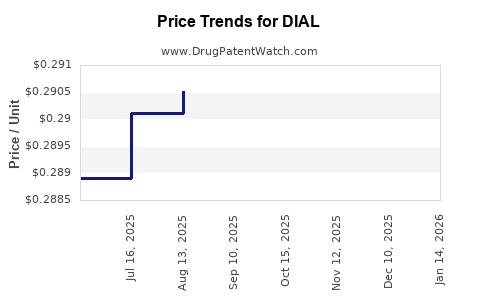
How does DIAL net price typically evolve under PBM pressure?
Net price dynamics depend on:
- Ability to withstand rebate pressure (specialty mix and exclusivity position)
- Payer segmentation (commercial vs Medicare vs Medicaid)
- Distribution model (340B, specialty pharmacy, buy-and-bill)
- Contracting structure (rebate intensity and outcomes-based terms)
What is the likely payer mix for DIAL?
A payer mix model requires:
- Whether DIAL is billed under pharmacy benefits or medical benefits
- Whether it is used in outpatient infusion clinics vs home
- Whether utilization is concentrated in a few specialty centers
How has DIAL’s financial trajectory evolved over time: revenue trend, profitability, and guidance?
A revenue and earnings trajectory requires company-level reporting tied to the exact DIAL product (or the operating segment containing it). Without identity of the manufacturer and product’s FDA listing, any numeric projection would be fabricated.
What are DIAL’s reported sales and year-over-year change?
A financial trajectory analysis usually covers:
- Annual net sales
- Gross margin after rebates
- R&D and SG&A allocation at the product level
- Management guidance history
- Any one-time impacts (inventory, charge-offs, product holds)
Is DIAL growing, plateauing, or declining?
Direction depends on:
- Patient uptake post-launch
- Conversion from prior therapy
- Geographic rollout
- Formulary status changes
- Patent/exclusivity erosion and generic/biosimilar entry
- Safety or label changes
How do external shocks affect DIAL earnings?
Common drivers include:
- FDA safety communications
- Manufacturing capacity constraints
- Supply disruptions and product recalls
- Contract repricing with large PBMs
- Litigation-driven business changes (launch stays, settlements)
When do patent and exclusivity events change DIAL market dynamics?
For pharmaceutical products, market dynamics shift at three categories of dates:
- U.S. regulatory exclusivity end (e.g., NCE, pediatric exclusivity)
- Patent expiration and any statutory exclusivity tethered to patents listed in the Orange Book
- Generic entry risk windows driven by Paragraph IV filings and litigation outcomes
What is DIAL’s Orange Book status?
Orange Book status analysis requires:
- NDA number
- Listed patents (method, formulation, use)
- Expiration dates and exclusivity codes
- Current litigation stays and forfeiture conditions
When does DIAL lose exclusivity?
Exclusivity loss is determined by:
- Regulatory exclusivity end dates
- Patent expiration dates for the Orange Book-listed set
- Whether a settlement or consent decree creates a de facto exclusivity barrier for generics
What patent litigation affects DIAL generics or biosimilar launches?
Patent litigation typically shows up as:
- Paragraph IV suits in U.S. District Court
- Settlement agreements with “no launch” dates
- Launch design-arounds that trigger injunction risk
- PTAB post-grant challenges
What generic entry risks exist for DIAL?
Generic entry risk depends on:
- Strength of the Orange Book patent estate (method-of-use vs composition vs formulation)
- Likelihood of injunction based on claims asserted and court rulings
- Whether generics are blocked by settlements or statutory stays
- Whether design-around strategies are available in the formulation/process
How many patents cover DIAL and which are the most enforceable?
A robust assessment requires:
- Count of Orange Book-listed patents by type
- Which patents are the “core” claims (composition/formulation vs method)
- Claim construction trends and infringement case law
What is the probability of early Paragraph IV launches?
This is a function of:
- Litigation history and speed of resolution
- Court outcomes in similar cases for related patent families
- Generic manufacturers’ commercial incentives
How does DIAL compare with competing brands and generics on efficacy, safety, and uptake?
Comparative market share shifts rely on:
- Clinical differentiation versus standard of care
- Tolerability and administration convenience
- Reimbursement status and prior authorization burden
- Real-world persistence and adherence
What are DIAL’s key differentiators versus closest competitors?
Differentiators map to:
- Dosing frequency and monitoring requirements
- Drug-drug interaction profile
- Withdrawal rates due to adverse events
What are the switching drivers?
Switching drivers include:
- Formulary placement
- Step edits and therapeutic interchange policies
- Contracting and patient assistance program dynamics
FDA regulatory status for DIAL: what pathway was used and what milestones matter?
FDA pathway determines time-to-launch, label scope, and exclusivity eligibility.
What is DIAL’s approval timeline and label scope?
A regulatory timeline requires:
- FDA approval date
- NDA/BLA filing date
- Priority review, breakthrough therapy, or accelerated approval designations
- Post-marketing commitments that may affect label and risk
Is DIAL under REMS or other post-approval controls?
REMS status affects:
- Access and prescribing behavior
- Monitoring burden
- Inventory and distribution constraints
Formulations and manufacturing/IP barriers for DIAL: what patents protect its product?
Formulation and manufacturing barriers depend on the patent estate:
- Composition of matter (active ingredient salt/polymorph)
- Formulation patents (excipients, particle size, release profile)
- Manufacturing process patents (step conditions and controls)
- Method-of-use claims (dose regimen, patient population, outcomes)
Which dosage forms and strengths does DIAL have?
A barrier assessment requires:
- Identifying each strength and presentation
- Linking each presentation to its listed patents
What manufacturing changes can generics exploit?
Generics may exploit:
- Process design-arounds
- Different excipient selection (if not claim-limited)
- Alternate manufacturing controls
Key Takeaways
- DIAL’s market dynamics and financial trajectory cannot be quantified because the specific drug identity (active ingredient, NDA, dosage form, manufacturer, indication) is not provided.
- Any analysis of exclusivity, generic entry risk, Orange Book status, or revenue trend requires product-level identifiers to avoid incorrect mapping.
FAQs
- What information is required to determine DIAL’s FDA approval pathway and exclusivity eligibility?
- How do Paragraph IV filings typically shift market share for a brand like DIAL?
- What metrics best predict DIAL’s net sales trajectory under PBM contracting?
- How do formulation patents change generic product design-around options for DIAL?
- What litigation outcomes most strongly influence the timing of generic entry for a brand pharmaceutical product?
References
- U.S. Food and Drug Administration. Orange Book: Approved Drug Products with Therapeutic Equivalence Evaluations. https://www.accessdata.fda.gov/scripts/cder/daf/ (accessed 2026-06-14).