You're using a free limited version of DrugPatentWatch: Upgrade for Complete Access

Last Updated: December 16, 2025

DARIFENACIN Drug Patent Profile


✉ Email this page to a colleague

« Back to Dashboard


When do Darifenacin patents expire, and when can generic versions of Darifenacin launch?

Darifenacin is a drug marketed by Macleods Pharms Ltd, Alembic, Aurobindo Pharma, Cipla, Jubilant Generics, Ph Health, Polygen Pharms, Torrent, and Xiromed. and is included in nine NDAs.

The generic ingredient in DARIFENACIN is darifenacin hydrobromide. There are nineteen drug master file entries for this compound. Nine suppliers are listed for this compound. Additional details are available on the darifenacin hydrobromide profile page.

AI Deep Research
Questions you can ask:
  • What is the 5 year forecast for DARIFENACIN?
  • What are the global sales for DARIFENACIN?
  • What is Average Wholesale Price for DARIFENACIN?
Summary for DARIFENACIN
Drug patent expirations by year for DARIFENACIN
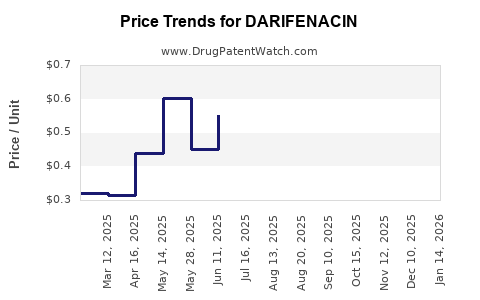
Drug Prices for DARIFENACIN

See drug prices for DARIFENACIN

Recent Clinical Trials for DARIFENACIN

Identify potential brand extensions & 505(b)(2) entrants

SponsorPhase
Oliver BlanchardPHASE2
Université de MontréalPHASE2
Ain Shams UniversityPHASE1

See all DARIFENACIN clinical trials

Pharmacology for DARIFENACIN

US Patents and Regulatory Information for DARIFENACIN

Applicant Tradename Generic Name Dosage NDA Approval Date TE Type RLD RS Patent No. Patent Expiration Product Substance Delist Req. Exclusivity Expiration
Macleods Pharms Ltd DARIFENACIN darifenacin hydrobromide TABLET, EXTENDED RELEASE;ORAL 207302-001 Jul 28, 2017 AB RX No No ⤷  Get Started Free ⤷  Get Started Free ⤷  Get Started Free
Xiromed DARIFENACIN HYDROBROMIDE darifenacin hydrobromide TABLET, EXTENDED RELEASE;ORAL 209571-001 Oct 22, 2019 DISCN No No ⤷  Get Started Free ⤷  Get Started Free ⤷  Get Started Free
Cipla DARIFENACIN HYDROBROMIDE darifenacin hydrobromide TABLET, EXTENDED RELEASE;ORAL 207664-001 Sep 1, 2016 AB RX No No ⤷  Get Started Free ⤷  Get Started Free ⤷  Get Started Free
Alembic DARIFENACIN HYDROBROMIDE darifenacin hydrobromide TABLET, EXTENDED RELEASE;ORAL 207681-002 Dec 8, 2017 AB RX No No ⤷  Get Started Free ⤷  Get Started Free ⤷  Get Started Free
>Applicant >Tradename >Generic Name >Dosage >NDA >Approval Date >TE >Type >RLD >RS >Patent No. >Patent Expiration >Product >Substance >Delist Req. >Exclusivity Expiration

EU/EMA Drug Approvals for DARIFENACIN

Company Drugname Inn Product Number / Indication Status Generic Biosimilar Orphan Marketing Authorisation Marketing Refusal
pharmaand GmbH Emselex darifenacin hydrobromide EMEA/H/C/000554Symptomatic treatment of urge incontinence and/or increased urinary frequency and urgency as may occur in adult patients with overactive bladder syndrome. Authorised no no no 2004-10-22
>Company >Drugname >Inn >Product Number / Indication >Status >Generic >Biosimilar >Orphan >Marketing Authorisation >Marketing Refusal

Market Dynamics and Financial Trajectory for DARIFENACIN

Last updated: July 30, 2025

Introduction

Darifenacin, marketed as Enablex and sometimes as a generic entity, is a selective M3 muscarinic receptor antagonist used primarily to treat overactive bladder (OAB). Since its approval by the FDA in 2004, the drug has navigated a complex market landscape defined by evolving healthcare trends, competitive pressures, and regulatory shifts. This article explores the current market dynamics and examines the financial trajectory of darifenacin within the global pharmaceutical sector.

Market Overview

Therapeutic Market Context

Overactive bladder afflicts approximately 16-17% of the adult population worldwide, primarily impacting individuals aged 40 and above [1]. The condition’s prevalence, coupled with the societal and quality-of-life implications, drives steady demand for effective treatments like darifenacin.

Product Positioning and Competitiveness

Darifenacin targets a niche within the broader antimuscarinic class, distinguished by its notable selectivity for M3 receptors. This selectivity aims to optimize efficacy while minimizing side effects such as dry mouth and constipation—a common issue with less selective agents like oxybutynin. However, the drug faces intense competition from other pharmacologic options, including:

  • Mirabegron: A beta-3 adrenergic receptor agonist, offering an alternative mechanism with fewer anticholinergic side effects.
  • Other antimuscarinics: Tolterodine, solifenacin, fesoterodine, and trospium.
  • Emerging therapies: Combination drugs and novel agents with improved safety profiles.

Regulatory and Patent Landscape

Darifenacin’s patent life is nearing expiry or has expired in multiple jurisdictions, prompting the entry of generics. Patent expirations generally erode brand revenues, exposing the market to price competition and heightened generic penetration. Regulatory authorities’ approval of generic versions in the US and Europe has intensified price competition, compressing profit margins for originators.

Market Dynamics Influencing Financial Trajectory

Demand Trends

The global OAB market exhibits consistent growth, driven by aging populations and increasing awareness among healthcare providers and patients. According to Research and Markets, the global OAB therapeutics market is projected to reach USD 4.4 billion by 2027, growing at a CAGR of approximately 4.5% [2]. Darifenacin, as a branded alternative, benefits from brand loyalty but faces shrinking market share as generics and new therapies emerge.

Pricing and Reimbursement

Pricing strategies are pivotal in shaping financial trajectories. The high cost of branded darifenacin constrains uptake where reimbursement policies favor lower-cost generics. Payers’ preference for cost-effective treatments pressures manufacturers to lower prices or develop value-added indications. In markets with strict price controls, such as parts of Europe and Asia, revenue prospects diminish accordingly.

Pipeline and Formulation Innovations

Innovation can rejuvenate market interest. Recent developments include formulations with extended-release profiles, combination therapies, or formulations targeting patient compliance. However, as of now, darifenacin’s pipeline remains limited, restricting future revenue growth unless new indications or formulations are developed.

Impact of Competition and Biosimilars

The entry of generic darifenacin significantly alters the economic landscape. Generics typically reduce per-unit revenue by 70-80% within the first year of market entry [3]. Biologics and biosimilars are less relevant here due to the small molecule nature of darifenacin but remain a disruptive consideration in broader therapeutic areas.

Regulatory and Patent Disputes

Patent litigation and regulatory hurdles can alter financial trajectories. For instance, patent challenges or disputes over formulation patents can expedite generic entry, suppress prices, and diminish revenues. Conversely, successful patent extension strategies or regulatory exclusivities can bolster revenue streams temporarily.

Financial Performance and Trajectory

Historical Revenue and Profit Trends

Historical data indicate that darifenacin experienced robust revenues during early years post-launch, with peak sales occurring around 2007-2010. Post-patent expiry, revenues declined sharply, a common trend among branded drugs facing generic competition.

Current Market Share and Revenue Projections

In mature markets, branded darifenacin’s market share has eroded significantly, often confined to niche segments or specialist settings. Based on recent estimates, global sales in 2022 hovered around USD 200 million, reflecting a downward trend from peak years [4].

Future Outlook

Forecasts suggest a continued decline in global revenues attributable to:

  • Increased generic penetration.
  • Shift towards alternative therapies like mirabegron.
  • Pricing pressures from payers.
  • Potential saturation in primary markets.

However, strategic repositioning, such as developing novel formulations or expanding indications (e.g., neurogenic bladder), could introduce revenue growth avenues. The adoption of digital health tools and remote monitoring may also enhance therapeutic adherence, indirectly supporting sales.

Key Drivers of Financial Success or Decline

  • Patent strategies and exclusivity periods directly influence revenue lifespan.
  • Market acceptance hinges on efficacy, safety, and tolerability relative to competitors.
  • Pricing dynamics significantly impact profit margins amid rising healthcare cost containment efforts.
  • Pipeline development and clinical positioning can restore growth potential, especially if novel indications or formulations are successfully developed.

Regulatory and Market Challenges

The primary challenges include:

  • Patent expirations leading to generic erosion.
  • Pricing pressures from payers and government agencies.
  • Emergence of alternative therapies with favorable profiles.
  • Regulatory hurdles in approving new formulations or indications.

Overcoming these hurdles requires pharmaceutical companies to innovate beyond the molecule, emphasizing value-based healthcare models, and exploring strategic partnerships or licensing agreements.

Conclusion

The financial trajectory of darifenacin reflects typical patterns seen in specialty pharmaceuticals: initial rapid growth, subsequent plateau or decline post-patent expiry, and a need for strategic repositioning. The market remains competitive, with the rising prominence of novel therapies and generics shaping future revenues. Successful adaptation depends on innovation, regulatory intelligence, and strategic marketing to sustain profitability and expand indications.


Key Takeaways

  • Demand stability exists, driven by the high prevalence of overactive bladder, but market share for branded darifenacin is declining due to generics and alternative treatments.
  • Patent expiration significantly impacts revenues; generics eroded the market share, emphasizing the importance of patent strategies and innovation.
  • Pricing pressures and reimbursement policies influence profitability; cost-sensitive markets favor generic formulations.
  • Future growth potential hinges on developing new formulations, expanding indications, or leveraging digital health tools.
  • Market competition, including emerging therapies like mirabegron, necessitates ongoing differentiation and adaptation.

FAQs

1. What factors predominantly influence darifenacin’s market success?
Market success depends on patent protection duration, competitive landscape (especially generic entry), pricing strategies, regulatory approvals for new indications, and acceptance by healthcare providers and patients.

2. How has patent expiry affected darifenacin's revenues?
Patent expiry led to a surge in generic versions, causing a significant decline (estimated 70-80%) in brand revenue, as generic competition drives prices down and market share shifts.

3. Can darifenacin regain market share with new formulations?
Potentially. Developing extended-release formulations, combination therapies, or securing approval for additional indications can rejuvenate demand and market presence.

4. How is the rise of alternative therapies impacting darifenacin?
Therapies such as mirabegron, which offer different mechanisms and fewer side effects, are gaining popularity, often replacing antimuscarinic agents like darifenacin, thereby affecting its sales.

5. What strategic actions can manufacturers take to sustain long-term profitability?
Investing in pipeline development, exploring new indications, optimizing formulations, negotiating favorable reimbursement terms, and establishing strategic partnerships are key to maintaining profitability.


References

[1] M. M. Stewart, et al., "The Epidemiology of Overactive Bladder," Urology, 2018.

[2] Research and Markets, "Global Overactive Bladder (OAB) Therapeutics Market," 2022.

[3] IMS Health, "Impact of Generic Entry on Market Revenues," 2021.

[4] EvaluatePharma, "Pharmaceutical Market Trends," 2022.

More… ↓

⤷  Get Started Free

Make Better Decisions: Try a trial or see plans & pricing

Drugs may be covered by multiple patents or regulatory protections. All trademarks and applicant names are the property of their respective owners or licensors. Although great care is taken in the proper and correct provision of this service, thinkBiotech LLC does not accept any responsibility for possible consequences of errors or omissions in the provided data. The data presented herein is for information purposes only. There is no warranty that the data contained herein is error free. We do not provide individual investment advice. This service is not registered with any financial regulatory agency. The information we publish is educational only and based on our opinions plus our models. By using DrugPatentWatch you acknowledge that we do not provide personalized recommendations or advice. thinkBiotech performs no independent verification of facts as provided by public sources nor are attempts made to provide legal or investing advice. Any reliance on data provided herein is done solely at the discretion of the user. Users of this service are advised to seek professional advice and independent confirmation before considering acting on any of the provided information. thinkBiotech LLC reserves the right to amend, extend or withdraw any part or all of the offered service without notice.