Last updated: August 16, 2026
DAKLINZA, the daclatasvir-based hepatitis C treatment developed by Bristol-Myers Squibb, moved from rapid uptake to commercial decline within several years. Its revenue peaked after the 2015 U.S. launch, then fell as competing direct-acting antivirals became simpler, broader, shorter, and more commercially competitive. DAKLINZA is no longer a significant U.S. branded product, its U.S. regulatory application is withdrawn, and the principal commercial opportunity has shifted to generic and public-health markets outside the United States.
What is DAKLINZA and how does it work?
DAKLINZA contains daclatasvir, an inhibitor of the hepatitis C virus NS5A replication complex. It was developed for use with other direct-acting antivirals, particularly sofosbuvir, rather than as a standalone treatment.
The drug was used in treatment regimens for chronic hepatitis C virus infection, including genotypes 1 and 3 in the United States. The European authorization covered a broader range of genotypes and treatment combinations over time. Daclatasvir was particularly relevant in treatment strategies for genotype 3, historically one of the more difficult HCV genotypes to cure.
| Attribute |
DAKLINZA |
| Active ingredient |
Daclatasvir dihydrochloride |
| Drug class |
HCV NS5A inhibitor |
| Originator |
Bristol-Myers Squibb |
| Initial U.S. approval |
2015 |
| Initial European authorization |
2014 |
| Primary use |
Chronic hepatitis C |
| Typical role |
Combination therapy with other direct-acting antivirals |
| Drug type |
Small molecule |
| Biosimilar exposure |
None; generic substitution is the relevant risk |
| Current U.S. position |
FDA application withdrawn and product no longer a material U.S. commercial franchise |
The drug’s value proposition depended on combination use. That limited pricing flexibility because prescribers and payers evaluated the full regimen rather than DAKLINZA alone.
When did DAKLINZA lose market exclusivity?
DAKLINZA lost commercial exclusivity through a combination of patent expiry, generic competition, therapeutic substitution, and sponsor withdrawal from selected markets. The commercial erosion began before every relevant patent term had expired because newer HCV regimens displaced the product clinically.
The key market inflection points were:
| Period |
Commercial event |
Market effect |
| 2014 |
European authorization |
Initial entry into the HCV direct-acting antiviral market |
| 2015 |
U.S. approval |
Expansion into the U.S. treatment market |
| 2015-2016 |
Rapid HCV treatment adoption |
Revenue growth and peak commercial period |
| 2016 onward |
Intensifying competition from pan-genotypic regimens |
Reduced prescribing relevance |
| 2017-2019 |
Price pressure and regimen substitution |
Material revenue contraction |
| Around 2020 |
U.S. regulatory withdrawal and commercial discontinuation |
End of meaningful U.S. branded activity |
| 2020 onward |
Generic and public-health use in selected countries |
Residual international demand |
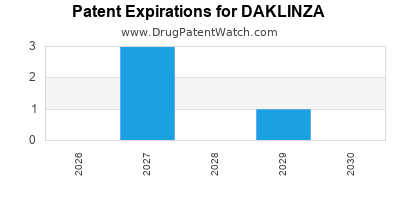
Patent protection for daclatasvir was built around compound, pharmaceutical composition, formulation, and therapeutic-use patent families. The relevant terms generally ran from priority dates in the mid-2000s and therefore reached expiry in the mid-to-late 2020s, subject to jurisdiction, patent-term adjustment, supplementary protection certificates, and local extensions.
For commercial analysis, patent expiry was less important than clinical displacement. DAKLINZA had already lost substantial demand to fixed-dose and pan-genotypic competitors before the final patent barriers became commercially decisive.
What was DAKLINZA’s revenue trajectory?
DAKLINZA revenue followed the standard pattern of an early-generation HCV antiviral: rapid launch growth, a short peak, and a steep decline after treatment competition intensified.
Bristol-Myers Squibb reported DAKLINZA sales in its annual filings. Reported revenue was approximately:
| Fiscal year |
Approximate DAKLINZA revenue |
Direction |
| 2015 |
$0.2 billion |
Launch year |
| 2016 |
$1.5 billion |
Peak period |
| 2017 |
$1.0 billion |
Sharp decline |
| 2018 |
$0.4 billion |
Continued erosion |
| 2019 |
Low hundreds of millions or below |
Mature decline |
| 2020 onward |
Not material to Bristol-Myers Squibb results |
Commercial exit |
The exact presentation of product sales varied by annual report and reporting period. Bristol-Myers Squibb’s filings consistently show a steep decline after the 2016 peak as the HCV market moved toward competing regimens with broader genotype coverage and more convenient dosing.
The revenue decline was driven by four factors:
- Treatment regimens became increasingly pan-genotypic, reducing the need for genotype-specific product selection.
- Competing products offered simpler fixed-dose combinations.
- Cure rates and treatment durations improved across the class.
- HCV treatment pricing fell as payers negotiated aggressively and generic competition expanded internationally.
DAKLINZA was therefore exposed to both ordinary patent-cycle erosion and rapid therapeutic obsolescence.
Why did DAKLINZA sales decline so quickly?
DAKLINZA’s commercial decline was primarily a product-cycle problem rather than a failure of antiviral efficacy.
Competition from newer HCV combinations
The market shifted toward regimens such as GILEAD’s EPCLUSA and MAVYRET from AbbVie. These products offered broader genotype coverage and more standardized treatment pathways. In many settings, physicians could treat patients without relying on a genotype-specific NS5A strategy.
The most important competitive products included:
| Product |
Company |
Strategic advantage over DAKLINZA |
| HARVONI |
Gilead Sciences |
Strong early brand recognition and high efficacy in genotype 1 |
| EPCLUSA |
Gilead Sciences |
Pan-genotypic coverage |
| MAVYRET |
AbbVie |
Broad coverage, shorter treatment options, aggressive pricing |
| ZEPATIER |
Merck |
Alternative branded regimen for selected patient groups |
| Generic sofosbuvir combinations |
Multiple manufacturers |
Lower-cost access outside developed markets |
DAKLINZA could remain clinically useful, but its commercial position weakened as treatment algorithms favored one-tablet or simplified pan-genotypic regimens.
Pricing pressure
HCV treatment generated intense payer scrutiny because a large backlog of infected patients created a high near-term budget impact. Governments and insurers used rebates, treatment restrictions, volume agreements, and tender processes to control spending.
Bristol-Myers Squibb therefore faced pressure from both branded competitors and low-cost suppliers. The result was a decline in net sales that was faster than the erosion of the underlying HCV disease market.
Limited lifecycle-management options
Bristol-Myers Squibb did not establish DAKLINZA as the center of a durable fixed-dose combination franchise comparable to Gilead’s HCV portfolio. The product depended on use with other antivirals, which reduced control over the complete treatment regimen and limited opportunities to preserve pricing.
What is the FDA and Orange Book status of DAKLINZA?
DAKLINZA was approved by the FDA in 2015 under a new drug application held by Bristol-Myers Squibb. The U.S. application was later withdrawn, and the product is no longer a material active branded product in the U.S. market.
The FDA approval was based on use in combination with sofosbuvir, with or without ribavirin, for specified HCV genotypes and patient populations. The approval did not create a durable U.S. franchise because treatment guidelines subsequently shifted toward newer pan-genotypic regimens.
The practical U.S. regulatory position is:
- DAKLINZA is not a current growth product.
- The original U.S. branded commercialization has ended.
- Any remaining U.S. demand would be limited and unlikely to support meaningful originator revenue.
- Generic entry risk is less important than the absence of a substantial branded market.
- Orange Book-listed protection, if present in historical records, has limited current commercial relevance after withdrawal of the underlying application.
The Orange Book is most commercially important when an active branded NDA supports ongoing prescriptions and ANDA litigation. That framework has little strategic value for DAKLINZA today because the originator product is no longer a meaningful U.S. market participant.
Which patents protected DAKLINZA?
DAKLINZA was protected by a global patent estate covering daclatasvir and related antiviral technology. The patent architecture included:
- Compound claims directed to daclatasvir and related NS5A inhibitors.
- Salt and crystalline-form claims.
- Pharmaceutical-composition claims.
- Combination-treatment claims involving other HCV antivirals.
- Method-of-use claims for treating HCV infection.
- Manufacturing and intermediate claims.
The core compound families originated from filings made in the mid-2000s. In the United States and other major jurisdictions, the relevant patent terms generally extended into the 2020s. Patent-term adjustment and European supplementary protection certificates could alter the effective expiry date by country.
Patent strength was strongest for the original compound and core composition claims. Later formulation and method-of-use claims were more vulnerable to validity challenges and design-around strategies.
Patent strength by claim category
| Claim category |
Commercial importance |
General durability |
| Core compound |
High |
Strongest early protection |
| Salt or crystalline form |
Medium |
Dependent on formulation and manufacturing relevance |
| Combination therapy |
Medium |
Vulnerable to clinical and claim-scope limits |
| Method of treatment |
Medium |
Depends on enforceability and labeling |
| Manufacturing process |
Low to medium |
Can create supply barriers but is often design-aroundable |
Were there Paragraph IV challenges to DAKLINZA?
Publicly visible U.S. Paragraph IV activity was less commercially consequential for DAKLINZA than for major HCV products such as HARVONI and EPCLUSA. The U.S. market was already contracting sharply when generic competition and patent challenges would otherwise have become central.
A Paragraph IV challenge could target listed compound, composition, or use patents. Potential litigation outcomes would have included:
- Patent-infringement litigation after ANDA notification.
- A 30-month stay of FDA approval for an ANDA under applicable conditions.
- Settlement with a licensed early-entry date.
- Invalidity or noninfringement findings.
- Generic launch after patent expiry or risk-based entry.
There is no basis to treat DAKLINZA as an active, high-value U.S. Paragraph IV battleground comparable to leading HCV blockbusters. The product’s withdrawn regulatory status and declining demand substantially reduced the value of extended U.S. litigation.
Is DAKLINZA exposed to biosimilar competition?
No. DAKLINZA is a small-molecule antiviral, not a biologic. It is exposed to generic-drug competition rather than biosimilar competition.
Generic daclatasvir products have been developed and marketed in multiple countries, particularly where public-health programs and voluntary licensing arrangements support lower-cost HCV treatment. Generic supply has been more commercially relevant in low- and middle-income markets than in the United States.
The primary generic risks are:
- Price compression.
- Tender-based procurement.
- Multiple-source supply.
- Substitution by generic pan-genotypic regimens.
- Reduced demand for daclatasvir even where it remains approved.
What licensing deals affected DAKLINZA?
Bristol-Myers Squibb used licensing and access arrangements to expand daclatasvir availability in selected markets. The broader HCV access model included voluntary licensing, generic supply agreements, and public-health pricing mechanisms.
These arrangements supported access but reduced the likelihood of preserving originator pricing outside high-income markets. Licensing could extend product reach while accelerating unit-price erosion.
The most commercially important access trend was the expansion of generic daclatasvir and combination regimens through international procurement channels. The World Health Organization has included daclatasvir in HCV treatment guidance, particularly in combination with other direct-acting antivirals, which supports continued therapeutic relevance even after originator commercial decline.
What generic launch scenarios exist for DAKLINZA?
The relevant generic scenarios differ by geography.
United States
The U.S. branded market is too limited to represent a major generic opportunity. A generic launch would face:
- Low prescription volume.
- Competition from newer HCV products.
- Limited payer incentive to retain an older regimen.
- Potential regulatory and patent complications.
- Weak commercial return on formulation or manufacturing investment.
Europe
European demand is fragmented by national reimbursement systems and local authorization status. Generic opportunities depend on national patent expiry, tender eligibility, and whether daclatasvir remains in treatment guidelines.
Middle-income and low-income markets
These markets provide the strongest residual opportunity. Daclatasvir may remain useful where:
- Treatment cost is the main constraint.
- Generic sofosbuvir combinations are available.
- National HCV programs use simplified treatment protocols.
- Pan-genotypic alternatives remain unaffordable or supply constrained.
The commercial model in these markets is volume-driven, with low prices and government or nonprofit procurement replacing branded promotion.
How does DAKLINZA compare with competing HCV drugs?
| Factor |
DAKLINZA |
EPCLUSA |
MAVYRET |
| Originator |
Bristol-Myers Squibb |
Gilead Sciences |
AbbVie |
| Mechanism |
NS5A inhibitor |
Sofosbuvir/velpatasvir |
Glecaprevir/pibrentasvir |
| Regimen structure |
Requires combination use |
Fixed-dose combination |
Fixed-dose combination |
| Genotype positioning |
More limited historical positioning |
Pan-genotypic |
Pan-genotypic |
| Current commercial strength |
Minimal in the U.S. |
Established global product |
Established global product |
| Generic exposure |
Significant internationally |
Increasing |
Increasing |
| Main advantage |
Historical efficacy and access-market utility |
Broad coverage and established clinical use |
Broad coverage, pricing, and treatment flexibility |
DAKLINZA’s main weakness was structural: it was an important component of combination therapy but not a complete regimen. Competing products captured more value by offering broader, simpler treatment solutions.
What is the long-term financial outlook for DAKLINZA?
DAKLINZA has no meaningful originator growth outlook. Bristol-Myers Squibb’s financial exposure is now negligible relative to its oncology, immunology, cardiovascular, and other pharmaceutical businesses.
Residual economic value may persist through:
- Generic licensing.
- Royalties in selected territories.
- Public-health procurement.
- Manufacturing know-how.
- Patent enforcement in jurisdictions where claims remain active.
- Combination use in markets where newer regimens are unavailable or unaffordable.
The product is best viewed as a mature or exited asset rather than a recoverable branded franchise. Any valuation should focus on residual geographic rights, royalty obligations, patent tail value, and supply arrangements instead of historical peak revenue.
What patent litigation affects DAKLINZA?
DAKLINZA does not appear to have a current U.S. litigation profile that materially affects Bristol-Myers Squibb’s consolidated financial outlook. Historical patent disputes and generic challenges may remain relevant for specific jurisdictions, but the commercial stakes are limited by product withdrawal and therapeutic substitution.
The most important legal questions are now:
- Whether any country-specific compound or formulation patents remain enforceable.
- Whether generic suppliers hold valid local marketing authorizations.
- Whether national procurement contracts restrict substitution.
- Whether combination-treatment claims can be enforced against generic regimens.
- Whether licensees have continuing royalty or reporting obligations.
Key Takeaways
- DAKLINZA is daclatasvir, an NS5A inhibitor launched by Bristol-Myers Squibb for chronic HCV treatment.
- Revenue rose rapidly after the 2015 U.S. launch and peaked at roughly $1.5 billion in 2016.
- Sales declined sharply as EPCLUSA, MAVYRET, and other pan-genotypic regimens displaced older treatment strategies.
- The U.S. application was withdrawn, ending DAKLINZA’s meaningful U.S. branded commercial role.
- DAKLINZA faces generic, not biosimilar, competition.
- Core patent protection originated from mid-2000s filings and generally extended into the 2020s, subject to country-specific adjustments.
- Residual value is concentrated in generic and public-health markets outside the United States.
- The drug has limited remaining financial relevance to Bristol-Myers Squibb.
- Future demand depends on price-sensitive HCV programs, local approvals, and generic supply rather than branded innovation.
FAQs
Is DAKLINZA still available?
DAKLINZA is no longer a meaningful U.S. branded product. Daclatasvir remains available in certain international markets through generic or locally authorized products.
Who manufactures DAKLINZA?
Bristol-Myers Squibb developed and commercialized DAKLINZA. Generic daclatasvir is manufactured by multiple companies in international markets.
Can DAKLINZA be used alone?
No. Daclatasvir is used with other antiviral medicines. Monotherapy is not the standard treatment approach because combination therapy is required to achieve effective viral suppression and prevent resistance.
Did Bristol-Myers Squibb sell or license DAKLINZA?
Bristol-Myers Squibb entered access and licensing arrangements associated with daclatasvir availability in selected markets. The precise rights and commercial terms varied by country and agreement.
Is daclatasvir still recommended for hepatitis C?
Daclatasvir remains a clinically relevant antiviral in some treatment settings, particularly where generic access is important. Treatment selection depends on genotype, prior therapy, liver status, resistance considerations, and applicable national guidelines.
References
-
Bristol-Myers Squibb Company. (2016). 2015 annual report. Bristol-Myers Squibb.
-
Bristol-Myers Squibb Company. (2017). 2016 annual report. Bristol-Myers Squibb.
-
Bristol-Myers Squibb Company. (2018). 2017 annual report. Bristol-Myers Squibb.
-
Bristol-Myers Squibb Company. (2019). 2018 annual report. Bristol-Myers Squibb.
-
U.S. Food and Drug Administration. (2015). FDA approves Daklinza for use with sofosbuvir to treat hepatitis C. https://www.fda.gov
-
U.S. Food and Drug Administration. (n.d.). Drugs@FDA: Daklinza. https://www.accessdata.fda.gov/scripts/cder/daf/
-
European Medicines Agency. (2014). Daklinza: EPAR. https://www.ema.europa.eu
-
World Health Organization. (2022). Updated recommendations on treatment of adolescents and children with chronic HCV infection, and HCV simplified service delivery and diagnostics. World Health Organization.
-
U.S. Patent and Trademark Office. (n.d.). Patent term adjustment and patent search resources. https://www.uspto.gov