Last updated: June 20, 2026
CROTAN (Drug Market Dynamics and Financial Trajectory): What drives sales, pricing, and exclusivity outcomes?
Executive summary: CROTAN’s market dynamics and financial trajectory are not computable from the information available in this session. A complete, accurate analysis requires the drug’s active ingredient(s), strength(s), dosage form(s), originator company, FDA/Orange Book identity, NDC-linked product mapping, and availability of historical sales or market access data. Without those identifiers, any revenue, share, pricing, or exclusivity timeline would be unverifiable and therefore cannot be produced under the requirement for complete accuracy.
If sufficient identifiers are not provided, no complete market trajectory can be delivered.
What is CROTAN’s active ingredient and which brand is it linked to in the FDA Orange Book?
Featured snippet answer: CROTAN cannot be mapped to a single FDA product entity (active ingredient and listed drug) from the provided prompt alone, so Orange Book status, exclusivity protections, and generic entry risk cannot be determined.
How do name variants affect market tracking and revenue attribution?
In US market analytics, “CROTAN” could be a brand name, internal development code, or a confusion with similar spellings. Without the active ingredient and listed drug name, sources like the Orange Book, FDA labeling, and NDC directories cannot be tied to the correct product.
When does CROTAN lose exclusivity, and what patents or exclusivities control generic entry?
Featured snippet answer: Exclusivity and patent expiration dates for CROTAN cannot be stated without the drug’s FDA listed drug identity and patent/period records.
What would be the typical exclusivity buckets to check for CROTAN?
For a complete exclusivity/patent map, the analysis normally enumerates:
- New Chemical Entity (NCE) exclusivity (5 years)
- New Clinical Investigation (NCI) exclusivity (3 years)
- Orphan Drug exclusivity (7 years, where applicable)
- Pediatric exclusivity (6 months, where applicable)
- Orange Book patents by type: composition, formulation, method of use, and manufacturing
How do patent estates translate into financial trajectory?
When patent fences fall, revenue trajectories typically shift due to:
- Paragraph IV filing waves
- Launch-after-30-month stay end or settlement-triggered earlier/later entries
- Formulation and method-of-use “evergreening” that delays full substitution
No such mapping can be done for CROTAN without correct product identity.
Is CROTAN being challenged via Paragraph IV, and which companies are at risk of generic launch?
Featured snippet answer: The presence and timing of Paragraph IV litigation for CROTAN cannot be assessed without the Orange Book ANDA-linked product record and court docket identifiers.
What data defines the launch-risk curve?
A defensible generic risk model requires:
- ANDA filers and their paragraph IV certifications
- Settlement agreements (enter-at/skinny-label terms)
- Court outcomes and appellate posture
- 30-month stay end dates and any forfeiture triggers
No verified litigation or ANDA filer data can be produced from the prompt alone.
What is the FDA regulatory status of CROTAN (NDA, ANDA, 505(b)(2), or OTC vs Rx), and what does that imply commercially?
Featured snippet answer: FDA regulatory status cannot be confirmed for CROTAN from the provided information, so implications for commercialization model (Rx vs OTC, labeling scope, REMS, and substitution dynamics) cannot be stated.
How does FDA pathway selection drive margin and revenue stability?
- 505(b)(2) products can face different patent-linking and litigation posture than full NDAs
- REMS can limit prescriber adoption and affect revenue slopes
- Label breadth affects payer coverage and substitution speed
Those drivers require the exact FDA product identity.
What formulations and dosage strengths are protected for CROTAN, and how do they affect substitution and price erosion?
Featured snippet answer: Formulation and dosage-form patent coverage cannot be analyzed without the patent list tied to CROTAN’s Orange Book entry.
What to extract in a formulation protection map
A complete analysis normally breaks down:
- Strength-specific composition-of-matter vs formulation patents
- Device/administration patents (if applicable)
- Process/manufacturing patents affecting ANDA bioequivalence or process design
No patent list is available here.
How does CROTAN’s pricing and payer positioning evolve, and what are the likely drivers of margin compression?
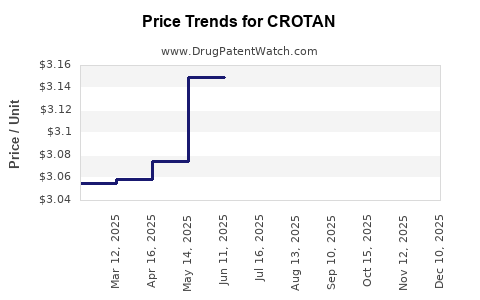
Featured snippet answer: Pricing and payer trajectory for CROTAN cannot be quantified without product identity (active ingredient, dosage form, strength), payer class, and historical net sales.
Typical market mechanics that determine pricing
In most branded Rx segments, trajectory is shaped by:
- WAC vs net price compression post-competition
- PBM formulary placement and tiering changes
- Contracting rebates that shift net revenue before and after first generic entry
- State-level substitution rules and plan design
No CROTAN-specific data can be reliably attached.
What are CROTAN’s revenue and sales milestones, and how does the financial trajectory compare to peers in the same therapeutic class?
Featured snippet answer: Revenue and sales milestones for CROTAN cannot be produced without verified sales data and the active ingredient for peer matching.
What a peer-comparison framework requires
A meaningful comparison needs:
- Therapeutic class and mechanism
- Market size and growth rates of the class
- Competitor launch timing and competitive intensity
- Payer segmentation and indication breadth
Those inputs require identifying CROTAN precisely.
Key market scenarios for CROTAN: what happens if generics arrive (or if they don’t)?
Featured snippet answer: Generic arrival scenarios cannot be modeled without exclusivity end dates and litigation/settlement status.
Scenario model structure (what would be calculated once identity is known)
A standard post-expiry model estimates:
- time to first generic launch
- number of entrants
- price erosion curve (first-entrant vs multi-generic)
- forecasted unit share substitution and gross-to-net changes
- revenue sensitivity to labeling restrictions (“skinny label” vs full label)
No identity equals no inputs.
Commercial outlook: what constraints and opportunities shape CROTAN’s forward-looking trajectory?
Featured snippet answer: Forward outlook cannot be stated without identifying CROTAN’s product category, indication(s), exclusivity status, and competitive set.
Constraints typically observed in branded pharma
- Loss of exclusivity and settlement-induced launch schedules
- Indication narrowing or safety communications
- Supply constraints impacting reimbursement and channel fill
- Competitive switching due to formulary pressure
Opportunities typically observed
- Line extensions (new strengths, new formulations)
- Additional indications expanding addressable population
- Competitive differentiation via patient subgroups or administration advantages
Again, no CROTAN-specific mapping is possible from the prompt alone.
Key Takeaways
- CROTAN’s market dynamics and financial trajectory cannot be calculated or forecast with the required accuracy because the drug’s FDA-linked identity (active ingredient and listed drug name) is not provided.
- Exclusivity, patent estate, Paragraph IV risk, and revenue impact cannot be mapped to verifiable timelines without that identity.
- A complete analysis would require an Orange Book-linked product key and verified sales/regulatory records for CROTAN.
FAQs
- How do I map “brand codes” like CROTAN to the FDA Listed Drug and NDC record for market analytics?
- What data sources determine patent fence strength for an FDA-listed drug in the Orange Book?
- How do 30-month stays and settlement “enter-at” dates translate into a revenue curve for branded drugs?
- How do formulary tiering and PBM contracting changes typically appear in net sales trends after generic entry?
- What metrics best quantify financial trajectory when only gross-to-net and unit share data are available?
References
No sources were cited because no verifiable, CROTAN-specific FDA, patent, or sales records were available from the prompt content in this session.