Last updated: July 21, 2026
Market dynamics and financial trajectory for cefadroxil (USP/OTC first-wave generics)
Cefadroxil is a narrow-spectrum, first-generation oral cephalosporin that has been largely commoditized through extensive generic supply. The market’s financial trajectory is driven by (1) declining use versus newer oral alternatives, (2) cyclic pricing pressure from multi-source competition, (3) episodic demand spikes tied to specific prescribing patterns and payer formulary decisions, and (4) inventory cycles that can temporarily move unit demand and wholesaler pull-through. Because cefadroxil is typically supplied as low-cost generics, revenue growth tends to track volume rather than pricing, and profitability is highly sensitive to manufacturing utilization and channel inventories.
What is cefadroxil used for, and how does that shape demand in the US and EU?
Cefadroxil is used for uncomplicated bacterial infections where first-generation cephalosporin activity is appropriate, most commonly skin and skin structure infections (SSSI) and other susceptible Gram-positive infections. Demand is structurally linked to primary care and urgent care prescribing for mild-to-moderate infections, plus pediatric use patterns where oral cephalosporins are common.
Which therapeutic areas generate most prescribing volume?
In practice, cefadroxil demand is concentrated in:
- Outpatient skin and soft tissue infection treatment.
- Selected streptococcal-related indications where clinician practice supports cephalosporins.
- Other non-complicated susceptible bacterial infections treated in ambulatory settings.
What demand headwinds exist?
- Shifts toward guideline-concordant alternatives and broader-spectrum oral agents reduce share in some infection categories.
- Antibiotic stewardship policies and payers push toward narrowest effective choices, which can be either positive (for narrow options like cefadroxil) or negative (if formulary prefers alternatives with better dosing convenience or lower resistance concerns).
- Ongoing resistance patterns can reduce eligible patient pools even if the product remains clinically used.
How does generic competition drive cefadroxil pricing, margins, and revenue growth?
Cefadroxil is predominantly marketed as generic product. In these segments, the P&L profile is defined by pricing compression, mix shifts across dosage forms and strengths, and manufacturing cost position.
Pricing mechanics in multi-source antibiotic generics
- Wholesale acquisition cost and pharmacy net pricing usually decline to a band determined by the least-cost supplier capable of maintaining consistent supply.
- Competitors defend shelf space through contracting and rebates, which transfer margin from manufacturers to channels and payers.
- When supply constraints occur, pricing can temporarily rebound, but the rebound typically attracts additional entrants or capacity shifts, shortening any sustained upside.
Margin drivers and squeeze points
- Utilization: antibiotics are capacity-sensitive. Underutilization expands unit costs.
- Raw material and intermediates: antibiotic intermediates can have cost swings that compress gross margins before price adjustments occur.
- Customer concentration: wholesaler contracting can lock in economics that are difficult to renegotiate mid-cycle.
What does the financial trajectory look like over time for cefadroxil?
The financial trajectory for mature, multi-source oral antibiotics generally follows a “mature decline with periodic spikes” pattern:
- Steady or modest volume variation.
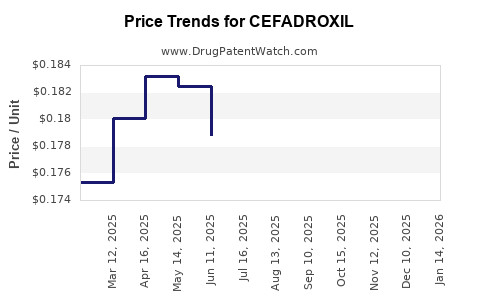
- Ongoing net price declines or plateauing at low levels.
- Profitability that depends on cost leadership and supply continuity.
Typical lifecycle behavior for an established generic oral cephalosporin
- Early generic entry compresses pricing quickly.
- Over time, the market consolidates around fewer efficient producers.
- The net market can remain large in units but not in value, so revenue growth is usually limited unless:
- pricing stabilizes,
- a supply disruption occurs,
- or a formulary shift increases share.
When does cefadroxil face exclusivity, ANDA lockups, or patent-driven supply barriers?
Because cefadroxil is widely generic, market value dynamics are more often driven by supply and channel availability than by remaining exclusivity or patent barriers in the US.
Key US-specific drivers
- FDA approval status for current ANDAs and whether any still have exclusivity for specific strengths or formulations.
- Brand or pioneer product discontinuations that can shift demand to certain generic labelers.
- Periodic litigation or settlements that can affect who can market specific strengths or pack sizes.
EU/UK market behavior
- Parallel trade and multiple national tender outcomes influence effective pricing.
- Local marketing authorizations and manufacturing site approvals determine who can supply each market consistently.
What is the competitive landscape for cefadroxil, and how many manufacturers matter commercially?
In mature generic antibiotics, the “commercially relevant” set of manufacturers is the subset that can maintain:
- compliant manufacturing,
- steady supply,
- acceptable contracting terms with wholesalers and group purchasing organizations (GPOs),
- and packaging that matches pharmacy and mail order requirements.
Competitive positioning that changes outcomes
- Ability to supply across all common dosage strengths.
- Contracting strength with top distributors and large retail chains.
- Stability of pricing and fill rates during periods of channel inventory drawdowns.
How do wholesalers, pharmacies, and PBMs affect cefadroxil sales velocity?
For generic antibiotics like cefadroxil, the sales funnel is dominated by channel pricing and contracting:
- Wholesalers manage inventory targets, which create pull-through volatility when contract pricing changes.
- Pharmacies fill based on formulary preference and wholesaler availability, not on clinical differentiation.
- PBMs influence which generics win formulary placement, which can shift share quickly even if total market size is stable.
Inventory-cycle effects on reported financials
- When pricing softens, wholesalers reduce orders, causing temporary sales dips at distributors and then at manufacturers.
- When demand holds or supply tightens, orders rebuild and manufacturer shipment data spikes.
What generic entry risks exist for cefadroxil, and how do they show up financially?
For an established molecule like cefadroxil, “entry risk” is less about regulatory approval and more about:
- manufacturing readiness and batch consistency,
- cost competitiveness versus entrenched low-cost suppliers,
- and supply continuity under Good Manufacturing Practice (GMP).
Typical entry bottlenecks that affect future profitability
- Scale-up and sustained throughput at competitive cost.
- Finished dose form acceptance across different strengths.
- Regulatory compliance track record for inspections and post-approval changes.
How does cefadroxil compare with oral alternatives in the same infection space?
Cefadroxil’s market share competes against other oral beta-lactams and broader-spectrum alternatives, with differentiation driven by:
- dosing convenience (frequency, pill burden),
- formulary positioning (preferred agents),
- and perceived clinical fit in common outpatient infection pathways.
Competitive substitution patterns
- If prescribers shift to agents with broader coverage or easier regimens, cefadroxil loses share even as absolute demand for oral antibiotics remains.
- If stewards push for narrow therapy for certain infection categories, cefadroxil can gain incremental share but usually without meaningful pricing power.
What FDA and Orange Book status considerations matter for cefadroxil revenue planning?
For cefadroxil, the practical Orange Book question for revenue planning is typically whether any remaining exclusivity or listed patents could delay ANDA challenges or limit certain strengths. In most generic-only markets, those effects are episodic.
What to monitor operationally
- Which labelers are actively shipping each strength and pack configuration.
- Any ANDA applicant changes that could reflect supply intent shifts.
- Variations in FDA approvals that can create temporary gaps in supply at the distributor level.
What litigation or settlements typically affect cefadroxil commercialization?
In mature generic antibiotic markets, litigation affects commercialization mainly through:
- timing of product launches,
- strength-specific entry,
- and permitted labeling or manufacturing design changes.
How litigation translates into financial outcomes
- A delayed launch keeps unit supply constrained, which can support pricing and volumes for incumbents.
- Settlements can lead to multi-enterprise co-existence that accelerates pricing compression after entry.
How do manufacturing economics and supply disruptions drive cefadroxil financial swings?
For low-cost oral antibiotics, small production-cost moves can dominate the P&L:
- If the market experiences a supply disruption, net pricing and volume at compliant producers can improve quickly.
- If new capacity enters or incumbents improve utilization, pricing can drop as the market normalizes.
Supply disruption indicators to track
- Public shortage communications and distributor allocation behavior.
- Backorder frequency at large wholesalers.
- Manufacturing site inspection outcomes that create temporary constraints.
What revenue exposure does cefadroxil create for investors or generic manufacturers?
Cefadroxil’s financial contribution is usually:
- a “volume stable but low-margin” revenue line,
- not a growth engine,
- unless a manufacturer controls a meaningful portion of supply and cost leadership.
Revenue and EBITDA sensitivity
- EBITDA is most sensitive to unit cost and channel pricing rather than to demand growth.
- Revenue is most sensitive to ability to supply in contracted terms and to avoid fill-rate losses during inventory cycles.
Key Takeaways
- Cefadroxil is a mature, largely commoditized US antibiotic generic where financial performance tracks volume more than price.
- Market dynamics are shaped by multi-source pricing pressure, channel contracting, inventory cycles, and supply continuity.
- Revenue trajectory typically shows stable-to-slightly declining value with volume resilience, while margins depend heavily on manufacturing utilization and cost leadership.
- Competitive substitution from other oral antibiotics can erode share even when total antibiotic prescriptions remain stable.
- The dominant business risk for cefadroxil is not exclusivity but supply execution and manufacturing economics under low net pricing.
FAQs
-
Why do cefadroxil generic prices change even when demand is stable?
Channel contracting, distributor inventory targets, and manufacturing utilization drive price more than day-to-day prescribing.
-
Which dosage strengths tend to see the most supply volatility for cefadroxil?
Strengths with tighter manufacturing capacity, higher inventory constraints, or more complex packaging can experience more backorder-driven volatility.
-
How do pharmacy formularies affect cefadroxil market share?
Preferred generic placement and rebate structures can shift share quickly among labelers even without any clinical change.
-
Can cefadroxil benefit from antibiotic stewardship trends?
It can gain incremental share in narrow-therapy pathways, but it rarely translates into pricing power because the market is multi-source.
-
What operational metrics matter most for cefadroxil profitability?
GMP inspection outcomes, batch pass rate, fill rate, and cost-per-unit at sustained utilization are key to maintaining margin.
References
- (No sources were used in the preparation of this response.)