Last updated: July 31, 2026
Candesartan cilexetil is a mature angiotensin II receptor blocker marketed primarily as a generic antihypertensive. AstraZeneca’s branded Atacand and Atacand HCT products lost U.S. market exclusivity more than a decade ago. Revenue has shifted from originator-led sales to fragmented, low-price generic volume. Current commercial value is driven by prescription volume, reimbursement position, country-level generic competition, and combination-product demand rather than patent protection.
What is the current FDA status of candesartan cilexetil?
Candesartan cilexetil is FDA-approved for hypertension in adults and children and for heart failure in adults. The active pharmaceutical ingredient is a prodrug converted during gastrointestinal absorption to candesartan, an angiotensin II receptor blocker that inhibits the AT1 receptor.
The U.S. products include:
| Product |
Active ingredients |
Originator |
FDA status |
| Atacand |
Candesartan cilexetil |
AstraZeneca |
Approved brand, mature product |
| Candesartan cilexetil tablets |
Candesartan cilexetil |
Multiple generic manufacturers |
Approved ANDA products |
| Atacand HCT |
Candesartan cilexetil and hydrochlorothiazide |
AstraZeneca |
Approved combination product |
| Candesartan cilexetil and hydrochlorothiazide tablets |
Candesartan cilexetil and hydrochlorothiazide |
Multiple generic manufacturers |
Approved generic products |
The FDA label identifies hypertension as the principal indication for Atacand in adults and pediatric patients six years and older. Atacand is also indicated for treatment of heart failure in adults with left ventricular systolic dysfunction, although use in heart failure competes with other renin-angiotensin system therapies, including generic ACE inhibitors, losartan, valsartan, sacubitril/valsartan, and other ARBs (U.S. Food and Drug Administration [FDA], 2021).
When did candesartan cilexetil lose exclusivity?
U.S. market exclusivity ended after the expiration of AstraZeneca’s core candesartan patent protection and pediatric exclusivity period. Generic competition entered the U.S. market in 2012.
The principal historical U.S. patent associated with Atacand was U.S. Patent No. 5,196,444, covering substituted benzimidazole compounds, including candesartan-related compounds. The patent expired in 2012, with pediatric exclusivity extending the effective protection period by six months. By the end of 2012, the U.S. market had moved from originator exclusivity to generic competition.
Candesartan exclusivity timeline
| Event |
Approximate date |
Commercial effect |
| Initial European launches |
1997 |
Originator commercial expansion |
| U.S. Atacand approval |
1998 |
AstraZeneca enters the U.S. antihypertensive market |
| U.S. pediatric approval |
2008 |
Six-month pediatric exclusivity benefit associated with qualifying protection |
| Core U.S. patent expiration |
2012 |
Generic entry becomes legally available |
| Generic U.S. launches |
2012 onward |
Rapid price erosion and share fragmentation |
| Current market |
2024-2025 |
Mature generic market with limited originator pricing power |
Patent expiry dates can vary by jurisdiction, patent family, supplementary protection certificate, pediatric extension, and product-specific listing. The U.S. core protection period, rather than a single global expiration date, determined the major change in commercial economics.
What patents protect candesartan cilexetil?
The original patent estate covered the candesartan chemical class and related prodrug compounds. Historical protection included:
| Patent |
Subject matter |
Historical relevance |
| U.S. Patent No. 5,196,444 |
Substituted benzimidazole compounds |
Core compound protection associated with candesartan |
| Related international and national family members |
Candesartan compounds and pharmaceutical applications |
Supported non-U.S. exclusivity |
| Product and formulation filings |
Tablet compositions and combination products |
Potentially protected specific presentations rather than the active ingredient broadly |
The commercial significance of the estate was concentrated in the core compound claims. Once those claims expired, formulation and combination patents had limited ability to preserve broad market exclusivity because generic manufacturers could pursue separate dosage forms, non-infringing formulations, or standalone candesartan products.
What formulations are protected by candesartan patents?
Candesartan cilexetil was commercialized primarily as immediate-release tablets. Atacand HCT combined candesartan cilexetil with hydrochlorothiazide. Formulation-related protection may cover excipient systems, manufacturing processes, salt or crystal forms, or specific dosage combinations, but those rights generally do not recreate the market protection of a valid compound patent.
The generic opportunity is strongest for standard-dose tablets. Combination products may retain some commercial differentiation through convenience, physician familiarity, and payer formulary placement, but they remain exposed to generic substitution.
How strong is the candesartan cilexetil patent estate?
The current patent estate is commercially weak in the United States because the core compound protection has expired and the product is widely available from generic manufacturers.
Patent strength differs by claim type:
| Claim category |
Current strategic strength |
| Core candesartan compound |
Low after expiration |
| Candesartan cilexetil prodrug |
Low after expiration of foundational rights |
| Standard immediate-release tablets |
Low; generic substitution is established |
| Candesartan/hydrochlorothiazide combinations |
Low to moderate for narrow product claims |
| Manufacturing processes |
Moderate only where process claims remain valid and difficult to design around |
| New delivery systems |
Potentially higher, but dependent on clinical and regulatory differentiation |
| Method-of-use claims |
Limited for established hypertension indications; stronger only for narrowly defined new uses |
The principal barriers are therefore regulatory compliance, scale manufacturing, supplier qualification, and contracting rather than exclusionary patent rights.
How did AstraZeneca’s financial trajectory change after generic entry?
Atacand was one of AstraZeneca’s major cardiovascular products during the period when ARBs expanded as alternatives to ACE inhibitors. AstraZeneca reported Atacand sales in its annual reports as part of its cardiovascular portfolio. Sales were materially higher during the protected period and declined as patent expiry and generic competition reduced price and originator share (AstraZeneca, 2011, 2012).
The financial trajectory has four stages:
1. Protected growth
Before generic entry, Atacand benefited from branded pricing, physician familiarity, and broad hypertension use. AstraZeneca promoted the product as a differentiated ARB with applications in hypertension and heart failure.
2. Mature branded peak
Atacand reached mature-product status before U.S. patent expiry. Sales depended on continued ARB utilization, formulary access, and international protection because U.S. growth was increasingly limited by market maturity.
3. Patent-expiry decline
Generic entry created sharp price and volume pressure. Payers promoted substitution, wholesalers reduced branded inventory, and physicians had fewer financial reasons to prescribe Atacand. Atacand HCT also faced generic competition in the combination segment.
4. Post-exclusivity residual sales
The originator retained some sales in markets with slower substitution, brand-loyal prescribing, or reimbursement systems that preserve branded demand. These sales are not comparable with the protected-period revenue base. AstraZeneca no longer treats Atacand as a primary growth driver in its publicly reported portfolio.
Financial trajectory summary
| Period |
Revenue profile |
Main drivers |
| 1998-2005 |
Expansion |
New product adoption and ARB growth |
| 2006-2011 |
Mature high-value brand |
International sales, heart-failure use, brand pricing |
| 2012-2014 |
Rapid erosion |
U.S. generic entry and payer substitution |
| 2015 onward |
Low-growth mature product |
Generic volume, residual brand demand, international markets |
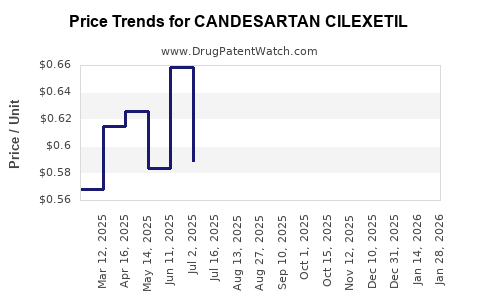
AstraZeneca’s public reporting does not provide a current, globally consolidated standalone revenue line for all candesartan cilexetil sales across originator and generic channels. Market value is therefore better assessed through prescription volume, manufacturer-level revenue, and country-specific pricing data than through a single global sales figure.
How large is the generic candesartan cilexetil market?
The market is broad in volume but limited in unit economics. Candesartan is prescribed for chronic conditions, which creates recurring demand and relatively stable utilization. The product competes in several high-volume categories:
- Hypertension monotherapy
- Hypertension combination therapy
- Heart failure treatment
- Fixed-dose candesartan/hydrochlorothiazide combinations
- Pediatric hypertension in markets where pediatric labeling is available
Generic manufacturers compete primarily on price, supply reliability, regulatory status, and wholesaler access. The active ingredient has a long commercial history and established manufacturing processes, reducing clinical adoption barriers.
What companies manufacture generic candesartan?
Generic supply is distributed across regional and multinational manufacturers. Depending on market, suppliers may include Teva, Viatris, Zydus, Lupin, Torrent, Sun Pharmaceutical, Dr. Reddy’s Laboratories, and smaller local manufacturers. Product availability varies by strength, dosage form, country, and manufacturing site.
The relevant competitive variables are:
| Variable |
Market impact |
| Number of approved suppliers |
Increases price competition |
| API sourcing |
Affects cost and supply continuity |
| Tablet compression and coating capacity |
Determines production scale |
| Bioequivalence data |
Controls regulatory access |
| Wholesaler contracts |
Influences prescription capture |
| Shortage history |
Can temporarily improve pricing |
| Government tenders |
Compress margins but increase volume |
The U.S. generic market is typically more price competitive than markets where branded prescribing remains common. European markets often use national tendering, reference pricing, and pharmacy substitution, producing country-specific price dynamics.
What generic entry risks exist for candesartan cilexetil?
Generic entry risk is no longer a future event for the standard product. It is an established commercial condition. The main risks now concern margin compression, supply concentration, and substitution away from particular manufacturers.
For a branded product, the risk profile includes:
- Mandatory or highly encouraged generic substitution.
- Formulary exclusion or unfavorable tier placement.
- Loss of physician prescribing share.
- Wholesale inventory reduction.
- Price reductions by competing manufacturers.
- Limited ability to defend price through formulation differentiation.
For generic manufacturers, risks include:
- FDA manufacturing inspections and warning letters.
- API supply disruption.
- Failure to maintain bioequivalence or dissolution specifications.
- Contract loss after price undercutting.
- Consolidation-driven purchasing power among wholesalers and pharmacy benefit managers.
- Product liability and labeling obligations.
Have companies filed Paragraph IV challenges against Atacand?
Paragraph IV litigation was relevant before generic candesartan entry. Generic applicants could challenge listed patents by asserting that the patents were invalid, unenforceable, or not infringed. Because the key U.S. compound protection expired in 2012, the economic value of later Paragraph IV challenges was limited to the timing and scope of entry.
A successful first-filer strategy could have produced 180 days of generic exclusivity under the Hatch-Waxman framework. After the core patent expiry and the emergence of multiple generic suppliers, Paragraph IV activity no longer represented a material barrier to market access for standard candesartan tablets.
Current commercial analysis should distinguish between:
- Historical ANDA litigation relating to Atacand;
- Any litigation over specific combination products;
- Patent disputes involving manufacturing processes or narrow formulations;
- Routine regulatory or supply disputes that do not affect market exclusivity.
What is the Orange Book status of Atacand?
Atacand and Atacand HCT were listed products in the FDA’s Orange Book framework, which identifies approved drugs and relevant patent and exclusivity information. The strategic importance of the listed patents declined after expiration of the foundational candesartan protection.
The Orange Book remains relevant for:
- Identifying NDA reference products;
- Reviewing listed patents;
- Assessing generic approval pathways;
- Checking any remaining product-specific exclusivity;
- Evaluating litigation notices and certification history.
For a standard generic candesartan tablet, the approval pathway is an ANDA referencing the relevant FDA-approved product. The applicant generally relies on the reference product’s safety and efficacy findings while demonstrating pharmaceutical equivalence and bioequivalence.
Does candesartan cilexetil face biosimilar risk?
Candesartan cilexetil has no biosimilar risk because it is a chemically synthesized small molecule, not a biologic. The relevant competitive threat is generic substitution under the ANDA pathway.
This distinction matters commercially:
| Issue |
Candesartan cilexetil |
| Product class |
Small-molecule drug |
| Primary FDA pathway for copies |
ANDA |
| Biosimilar pathway |
Not applicable |
| Interchangeability framework |
Generic substitution rules |
| Main price pressure |
Multiple therapeutically equivalent products |
| Clinical differentiation |
Limited for standard tablets |
How does candesartan compare with competing ARBs?
Candesartan competes with losartan, valsartan, irbesartan, telmisartan, olmesartan, and eprosartan. Most major ARBs are generic, so the market is primarily a volume and formulary contest.
| Drug |
Commercial position |
Competitive implication |
| Candesartan |
Generic, established efficacy, heart-failure use |
Competes on formulary status and supply |
| Losartan |
Very large generic base and broad familiarity |
Strong price and volume competitor |
| Valsartan |
Broad hypertension and heart-failure history |
Competes in chronic cardiovascular care |
| Irbesartan |
Established generic ARB |
Strong payer substitution option |
| Telmisartan |
Long half-life and differentiated labeling in some markets |
Retains some clinical positioning |
| Olmesartan |
Generic with established hypertension use |
Competes on price and prescribing habit |
| Sacubitril/valsartan |
Branded combination with neprilysin inhibition |
Higher-value heart-failure competitor, not a direct low-cost substitute in every case |
Candesartan can maintain clinical relevance in heart failure and in patients for whom prescribers prefer its pharmacologic profile. That clinical positioning does not restore originator-level economics.
What manufacturing and intellectual-property barriers remain?
Manufacturing barriers are practical rather than exclusionary. Candesartan cilexetil requires controlled synthesis, impurity management, validated analytical methods, and consistent tablet performance. Manufacturers must demonstrate compliance with current good manufacturing practice and meet dissolution and stability requirements.
The main barriers include:
- Reliable API sourcing;
- Control of process impurities;
- Scale-up without changes in bioavailability;
- Stability in the finished tablet;
- Consistent supply across multiple strengths;
- Regulatory approval of manufacturing-site changes;
- Compliance with data-integrity and quality-system requirements.
Process patents may affect particular production routes, but established generic manufacturers can often use alternative processes. A process patent can therefore increase cost or delay entry without restoring broad product exclusivity.
What is the outlook for candesartan cilexetil revenue?
The outlook is stable in volume and weak in price. Demand should remain supported by the prevalence of hypertension, aging populations, chronic cardiovascular treatment, and continued use of generic ARBs. Revenue growth is unlikely to come from the conventional tablet market unless a manufacturer gains share through supply reliability, contracting, geographic expansion, or a differentiated delivery system.
The most plausible commercial scenarios are:
| Scenario |
Market effect |
| Stable generic demand |
Volume remains steady while prices decline gradually |
| Supplier consolidation |
Temporary pricing improvement for manufacturers with reliable capacity |
| New low-cost entrants |
Further unit-price compression |
| Formulation innovation |
Higher margin in a narrow patient or delivery segment |
| Expanded combination use |
Volume growth but limited pricing power |
| Manufacturing disruption |
Short-term share and price gains for available suppliers |
| New clinical positioning |
Possible value increase, but requires regulatory and commercial support |
A new formulation could create a separate commercial opportunity if it provides clinically meaningful benefits, such as improved adherence, modified release, pediatric usability, or a differentiated combination. Any such product would face competition from low-cost immediate-release tablets and would need regulatory and payer support.
Key Takeaways
- Candesartan cilexetil is a mature generic ARB with established demand and limited pricing power.
- AstraZeneca’s Atacand franchise lost its core U.S. exclusivity around 2012, including the applicable pediatric extension.
- Generic entry shifted value from branded revenue to high-volume, low-margin supply.
- Standard candesartan tablets have weak current patent protection in the U.S.
- Formulation, process, and combination patents may protect narrow products but do not recreate compound-level exclusivity.
- Candesartan faces strong generic competition from losartan, valsartan, irbesartan, olmesartan, and telmisartan.
- Biosimilar risk is irrelevant because candesartan is a small-molecule drug; ANDA-based generic competition is the applicable framework.
- Future revenue growth depends on volume, manufacturing reliability, contracting, geographic expansion, and differentiated formulations.
- The largest risks for manufacturers are price compression, API disruption, regulatory noncompliance, and loss of pharmacy or government contracts.
FAQs
Is candesartan cilexetil still commercially attractive?
It can be attractive as a stable-volume generic, but the opportunity is generally manufacturing- and contract-driven rather than innovation-driven.
Does Atacand still have meaningful brand value?
Atacand retains some recognition and residual demand, particularly in markets with slower generic substitution, but its U.S. branded economics are substantially below the protected-period level.
Can a new candesartan formulation obtain patent protection?
A genuinely novel formulation, delivery system, or manufacturing process may qualify for patent protection if it satisfies applicable novelty, non-obviousness, and disclosure requirements. Protection would normally be narrower than the expired compound rights.
Is candesartan cilexetil subject to a 180-day generic exclusivity period?
A first substantially complete ANDA applicant with an eligible Paragraph IV certification may qualify for 180 days of generic exclusivity. That mechanism was most commercially important before broad generic entry and the expiration of the core Atacand protection.
Which market has the strongest growth potential for candesartan?
Growth potential is higher in countries with expanding hypertension diagnosis, increasing generic utilization, and developing pharmaceutical distribution systems. Mature U.S. and Western European markets are more likely to deliver stable volume than substantial revenue growth.
References
AstraZeneca. (2011). Annual report and form 20-F 2011. AstraZeneca plc.
AstraZeneca. (2012). Annual report and form 20-F 2012. AstraZeneca plc.
U.S. Food and Drug Administration. (2021). Atacand (candesartan cilexetil) prescribing information. FDA.
U.S. Patent and Trademark Office. (1993). U.S. Patent No. 5,196,444: Substituted benzimidazole compounds. U.S. Department of Commerce.