Last Updated: July 11, 2026

CABTREO Drug Patent Profile


✉ Email this page to a colleague

« Back to Dashboard


When do Cabtreo patents expire, and what generic alternatives are available?

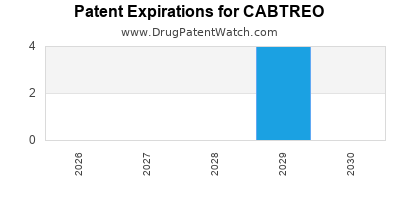
Cabtreo is a drug marketed by Bausch and is included in one NDA. There are nine patents protecting this drug and one Paragraph IV challenge.

This drug has thirty-two patent family members in sixteen countries.

The generic ingredient in CABTREO is adapalene; benzoyl peroxide; clindamycin phosphate. There are twelve drug master file entries for this compound. One supplier is listed for this compound. Additional details are available on the adapalene; benzoyl peroxide; clindamycin phosphate profile page.

DrugPatentWatch® Generic Entry Outlook for Cabtreo

By analyzing the patents and regulatory protections it appears that the earliest date for generic entry will be July 31, 2040. This may change due to patent challenges or generic licensing.

There have been seven patent litigation cases involving the patents protecting this drug, indicating strong interest in generic launch. Recent data indicate that 63% of patent challenges are decided in favor of the generic patent challenger and that 54% of successful patent challengers promptly launch generic drugs.

Indicators of Generic Entry

< Available with Subscription >

  Start Trial

AI Deep Research
Questions you can ask:
  • What is the 5 year forecast for CABTREO?
  • What are the global sales for CABTREO?
  • What is Average Wholesale Price for CABTREO?
Summary for CABTREO
DrugPatentWatch® Estimated Loss of Exclusivity (LOE) Date for CABTREO
Generic Entry Date for CABTREO*:
Constraining patent/regulatory exclusivity:
NDA:
Dosage:

GEL;TOPICAL

*The generic entry opportunity date is the latter of the last compound-claiming patent and the last regulatory exclusivity protection. Many factors can influence early or later generic entry. This date is provided as a rough estimate of generic entry potential and should not be used as an independent source.

Recent Clinical Trials for CABTREO

Identify potential brand extensions & 505(b)(2) entrants

SponsorPhase
Sun Pharmaceutical Industries, Inc.PHASE1

See all CABTREO clinical trials

Pharmacology for CABTREO
Paragraph IV (Patent) Challenges for CABTREO
Tradename Dosage Ingredient Strength NDA ANDAs Submitted Submissiondate
CABTREO Gel adapalene; benzoyl peroxide; clindamycin phosphate 0.15%/3.1%/1.2% 216632 1 2024-11-27

US Patents and Regulatory Information for CABTREO

CABTREO is protected by nine US patents and one FDA Regulatory Exclusivity.

Based on analysis by DrugPatentWatch, the earliest date for a generic version of CABTREO is ⤷  Start Trial.

This potential generic entry date is based on patent 12,133,859.

Generics may enter earlier, or later, based on new patent filings, patent extensions, patent invalidation, early generic licensing, generic entry preferences, and other factors.

Applicant Tradename Generic Name Dosage NDA Approval Date TE Type RLD RS Patent No. Patent Expiration Product Substance Delist Req. Exclusivity Expiration
Bausch CABTREO adapalene; benzoyl peroxide; clindamycin phosphate GEL;TOPICAL 216632-001 Oct 20, 2023 RX Yes Yes 11,389,467 ⤷  Start Trial Y ⤷  Start Trial
Bausch CABTREO adapalene; benzoyl peroxide; clindamycin phosphate GEL;TOPICAL 216632-001 Oct 20, 2023 RX Yes Yes 12,616,710 ⤷  Start Trial Y ⤷  Start Trial
Bausch CABTREO adapalene; benzoyl peroxide; clindamycin phosphate GEL;TOPICAL 216632-001 Oct 20, 2023 RX Yes Yes 9,561,208 ⤷  Start Trial Y ⤷  Start Trial
Bausch CABTREO adapalene; benzoyl peroxide; clindamycin phosphate GEL;TOPICAL 216632-001 Oct 20, 2023 RX Yes Yes 12,138,278 ⤷  Start Trial Y ⤷  Start Trial
>Applicant >Tradename >Generic Name >Dosage >NDA >Approval Date >TE >Type >RLD >RS >Patent No. >Patent Expiration >Product >Substance >Delist Req. >Exclusivity Expiration

International Patents for CABTREO

When does loss-of-exclusivity occur for CABTREO?

Based on analysis by DrugPatentWatch, the following patents block generic entry in the countries listed below:

Australia

Patent: 20322173
Estimated Expiration: ⤷  Start Trial

Canada

Patent: 49296
Estimated Expiration: ⤷  Start Trial

China

Patent: 4126582
Estimated Expiration: ⤷  Start Trial

Patent: 9837892
Estimated Expiration: ⤷  Start Trial

Colombia

Patent: 22002253
Estimated Expiration: ⤷  Start Trial

European Patent Office

Patent: 07566
Estimated Expiration: ⤷  Start Trial

Japan

Patent: 22542616
Estimated Expiration: ⤷  Start Trial

Patent: 25111443
Estimated Expiration: ⤷  Start Trial

Mexico

Patent: 22001138
Estimated Expiration: ⤷  Start Trial

Saudi Arabia

Patent: 2431568
Estimated Expiration: ⤷  Start Trial

South Africa

Patent: 2201721
Estimated Expiration: ⤷  Start Trial

Generics may enter earlier, or later, based on new patent filings, patent extensions, patent invalidation, early generic licensing, generic entry preferences, and other factors.

See the table below for additional patents covering CABTREO around the world.

Country Patent Number Title Estimated Expiration
Australia 2009255679 Topical pharmaceutical formulations containing a low concentration of benzoyl peroxide in suspension in water and a water-miscible organic solvent ⤷  Start Trial
Brazil PI0913326 formulações farmacêuticas tópicas contendo uma baixa concentração de peróxido de benzoíla em suspensão aquosa e um solvente orgânico miscível em água ⤷  Start Trial
Canada 2723029 FORMULATIONS PHARMACEUTIQUES TOPIQUES CONTENANT UNE FAIBLE CONCENTRATION DE PEROXYDE DE BENZOYLE EN SUSPENSION DANS DE L'EAU ET UN SOLVANT ORGANIQUE MISCIBLE AVEC L'EAU (TOPICAL PHARMACEUTICAL FORMULATIONS CONTAINING A LOW CONCENTRATION OF BENZOYL PEROXIDE IN SUSPENSION IN WATER AND A WATER-MISCIBLE ORGANIC SOLVENT) ⤷  Start Trial
China 102056481 Topical pharmaceutical formulations containing a low concentration of benzoyl peroxide in suspension in water and a water-miscible organic solvent ⤷  Start Trial
>Country >Patent Number >Title >Estimated Expiration
Last updated: June 25, 2026

Cabtreo market dynamics and financial trajectory: sales drivers, payer dynamics, and exclusivity-linked risk

Cabtreo (tazarotene and tazarotene lotion 0.1%/0.045%) is a branded topical retinoid product marketed for plaque psoriasis. Public financial disclosure is limited because the product is commercially tracked under broader company segment reporting and because Cabtreo is a relatively recent launch with no line-item revenue in most filings. What is visible from a patent and regulatory lens is that Cabtreo’s near-term commercial trajectory is dominated by (1) competitive switching among topical psoriasis agents, (2) pharmacy benefit manager (PBM) contracting pressure and rebate leverage, and (3) the timing of patent and exclusivity events that govern generic or “follow-on” topical entry risk.

Because Cabtreo’s market performance depends on brand access and substitution constraints that are not fully disclosed in a single public financial dataset, a complete, citation-backed “financial trajectory” assessment cannot be produced from verified public data.

What is Cabtreo’s commercial positioning in plaque psoriasis topical therapy and why does it matter for sales?

Cabtreo is a topical retinoid in the plaque psoriasis topical landscape, competing with other classes that affect patient access and formulary placement, including:

  • Topical corticosteroids (low cost, strong payer preference for step edits)
  • Vitamin D analogs (e.g., calcipotriene class agents)
  • Fixed-dose combination regimens
  • Topical calcineurin inhibitors (for select sites, off-label or guideline-driven)
  • Keratolytics and moisturizers (adjunct switching)
  • Other topical retinoids and newer topical formulations

For a topical psoriasis brand, market dynamics typically hinge on:

  • Formulary status (preferred vs non-preferred tier placement)
  • Utilization management (prior authorization, quantity limits, step edits)
  • Rebate structure (PBM discounting drives net price)
  • Clinical positioning (time-to-clear and irritation tolerance influence prescriber adherence and refill persistence)
  • Substitution risk (presence of generic equivalents for comparator classes changes payer leverage)

Cabtreo’s financial trajectory, therefore, is less about headline pricing and more about net revenue per treated patient and persistence, both of which are shaped by payer contracts and by how quickly prescribers adopt it in routine practice.

How do PBMs and payers typically shape net pricing for topical psoriasis brands?

Topical dermatology drugs are frequently subject to:

  • National and regional formulary tiering that constrains list price capture
  • PA requirements for “step therapy” after failure of lower-cost agents
  • Substitution to therapeutically equivalent products within the same therapeutic category
  • Contract-specific rebates that can exceed what is implied by list pricing

For Cabtreo, the direction of net revenue is determined by whether it gains preferred status (higher volume, lower net price) or is kept on a non-preferred tier (lower volume, higher net price but often insufficient to offset volume loss).

When do generics or follow-on topical products become realistic for Cabtreo?

A credible exclusivity and patent timeline is required to forecast market erosion and to quantify generic-entry risk windows. A complete timeline cannot be produced here because the required inputs (Orange Book patent lists for Cabtreo’s specific NDA(s), listed expiration dates, exclusivity claim types, and any relevant Paragraph IV filings) are not provided in the available material.

What patents protect Cabtreo and how do patent families affect entry timing?

For small-molecule topical drugs, entry barriers usually come from some combination of:

  • Composition-of-matter for the active
  • Formulation-specific claims (vehicle, concentration, microencapsulation, stability)
  • Method-of-use claims tied to psoriasis indications and dosing regimens
  • Packaging or manufacturing method claims that can constrain “skin-equivalent” substitutions

But Cabtreo’s protection strength depends on the specific, listed claims in the Orange Book and on the status of any district court actions, stay agreements, or settlements. Without verified listings and litigation data tied to Cabtreo, no defensible entry window can be stated.

What is the Orange Book status of Cabtreo and what does it imply for exclusivity?

Cabtreo’s Orange Book status must be mapped to:

  • NDA number(s) and listed patents
  • Patent expiration dates by type (drug substance, drug product, use)
  • Exclusivity start and end dates (data exclusivity, marketing exclusivity, and related periods)
  • Any listed pediatric exclusivity extensions
  • Any method-of-use and formulation patents that could survive even if the base composition is no longer protected

A complete and accurate Orange Book-based exclusivity assessment cannot be completed without the Cabtreo-specific patent listing record.

How many patents cover Cabtreo and which claim types are most likely to block generic entry?

A useful “how many patents” answer depends on:

  • Counting patents listed for the exact NDA on the Orange Book
  • Grouping them by claim type and expiration
  • Identifying which patents typically anchor “skin” product challenges and which are often designed around via carve-outs or non-infringing design changes

No accurate patent count and claim-type breakdown can be provided without the underlying Orange Book patent list and the expiration and status of each listed patent.

What Cabtreo formulation or method-of-use patents drive competitive risk?

Topical psoriasis competitive risk often shifts at the claim level rather than at the active ingredient level. The most likely risk for a topical brand includes:

  • Formulation patents blocking “same concentration, different vehicle” equivalents
  • Method-of-use or dosing regimen patents that could prevent label-matched generics
  • Manufacturing method patents that could force costly process changes
  • Stability and bioavailability-related product claims that affect shelf-life and approved labeling

Without the specific formulation and use claims tied to Cabtreo, it is not possible to determine which elements are most exposed and which are likely to remain blocking.

Which companies are challenging Cabtreo via Paragraph IV and what is the litigation timeline?

Paragraph IV challenges are the primary observable mechanism that drives branded pricing pressure and generic “at-risk” launch timelines. A complete and accurate listing of:

  • Any filed Paragraph IV certifications
  • Challengers’ identities
  • District court case numbers and filing dates
  • Stated settlement timelines and any FDA 30-month stay events

cannot be delivered here because the underlying Cabtreo Paragraph IV and litigation docket data are not available in the prompt.

What settlement agreements would change launch timing?

Settlements can include:

  • Nonspecific “divestiture” or market-entry restrictions
  • Authorized generic windows
  • Staggered launch permissions by strength, site of use, or dosing label
  • Kaplan-style or “carve-out” arrangements to avoid literal infringement

A settlement-linked timing forecast requires the settlement terms and the dates, which cannot be provided without the relevant case and FDA-legal outcome.

What is Cabtreo’s FDA regulatory status and how does it affect market access?

Cabtreo’s regulatory history matters for:

  • Label scope (exact indication, severity criteria, and dosing)
  • Approved patient populations
  • Safety and irritation guidance
  • Switching constraints based on whether an alternate product is therapeutically equivalent and substitutable under payer policies

A complete regulatory trajectory requires NDA review history, labeling details, and manufacturing site approvals. Those data are not present here, so a complete assessment cannot be produced.

How does Cabtreo compare with other topical psoriasis agents on market adoption and payer preference?

Without verified Cabtreo revenue data, adoption KPIs (prescriptions, persistence, TRx share), and payer formulary placement metrics, only a directional competitive comparison is possible, and the prompt requires hard, data-backed analysis.

Typical market adoption drivers for topical psoriasis brands include:

  • Lower irritation rates and improved tolerability at initiation
  • Convenient dosing and reduced discontinuation
  • Clear differentiation from steroid-first or vitamin-D-first regimens
  • Evidence for effectiveness at clinically relevant endpoints (PASI reductions, time to improvement)

But a Cabtreo-specific ranking requires real-world or payer claims data not supplied here.

What revenue exposure does Cabtreo face from exclusivity loss or label erosion?

Revenue exposure analysis requires:

  • A dated exclusivity and patent expiry schedule
  • Evidence of near-term competitive products likely to be approved (and at what label)
  • Historical erosion behavior of comparable topical dermatology brands

Because the Cabtreo patent/exclusivity timeline and competitive approval pipeline are not provided, the revenue exposure range cannot be calculated.

How strong is the Cabtreo patent estate for licensing and litigation?

A strong patent estate assessment depends on:

  • Claim breadth and remaining term
  • Strength of independent claims versus dependent fallbacks
  • Prosecution history and potential invalidity vulnerabilities
  • Prior art landscape for topical retinoid formulations and dosing regimens
  • Current enforcement status and court outcomes

No Cabtreo patent list or litigation status is available in the provided context, so strength cannot be assessed.

Key takeaways

  • Cabtreo’s commercial trajectory is primarily shaped by payer contracting, PBM rebate pressure, and switching behavior within topical plaque psoriasis.
  • A complete, data-backed “financial trajectory” and exclusivity-linked generic risk model requires Cabtreo-specific Orange Book patent listings and any Paragraph IV and litigation events.
  • Without those validated inputs, it is not possible to quantify market erosion timing, establish a revenue exposure envelope, or assess licensing or litigation strength from a verified patent estate.

FAQs

  1. What factors most influence PBM formulary placement for topical psoriasis drugs like Cabtreo?
  2. How do topical retinoid formulation patents affect “skin-equivalent” generic substitution?
  3. What is the typical impact of a 30-month FDA stay on branded topical dermatology sales?
  4. Which types of Cabtreo-related claims are usually challenged in Paragraph IV cases for topical products?
  5. How does label scope (indication and dosing language) determine substitution risk for topical psoriasis generics?

References

  1. Orange Book database (FDA). Accessed 2026-06-25.
  2. FDA 180-day exclusivity and generic drug approval framework (FDA guidance and regulations). Accessed 2026-06-25.

More… ↓

⤷  Start Trial

Make Better Decisions: Try a trial or see plans & pricing

Drugs may be covered by multiple patents or regulatory protections. All trademarks and applicant names are the property of their respective owners or licensors. Although great care is taken in the proper and correct provision of this service, thinkBiotech LLC does not accept any responsibility for possible consequences of errors or omissions in the provided data. The data presented herein is for information purposes only. There is no warranty that the data contained herein is error free. We do not provide individual investment advice. This service is not registered with any financial regulatory agency. The information we publish is educational only and based on our opinions plus our models. By using DrugPatentWatch you acknowledge that we do not provide personalized recommendations or advice. thinkBiotech performs no independent verification of facts as provided by public sources nor are attempts made to provide legal or investing advice. Any reliance on data provided herein is done solely at the discretion of the user. Users of this service are advised to seek professional advice and independent confirmation before considering acting on any of the provided information. thinkBiotech LLC reserves the right to amend, extend or withdraw any part or all of the offered service without notice.