Last updated: July 19, 2026
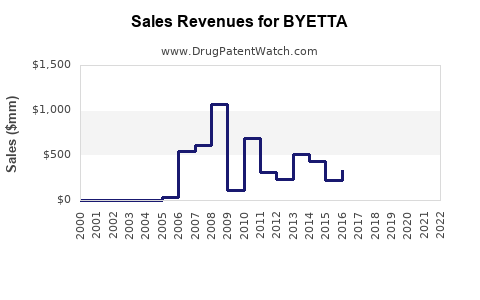
BYETTA (exenatide) sales peaked in the late 2000s and then declined as dosing convenience, broader GLP-1 RA portfolios, and later long-acting agents displaced twice-daily therapy. The product’s long-run commercial profile is shaped by (1) US exclusivity and patent term end, (2) post-peak formulary movement toward once-weekly GLP-1 RA and co-formulated options, and (3) margin and channel pressure as multiple competing GLP-1 RA launched and expanded indications.
What is BYETTA (exenatide) and what market does it serve in US and EU?
BYETTA is a GLP-1 receptor agonist indicated for type 2 diabetes as an adjunct to diet and exercise, typically used when metformin and/or sulfonylurea control is inadequate. The dosing is twice daily by subcutaneous injection, with the commercial narrative historically anchored on glycemic benefit in patients not meeting goals on oral therapies and on avoidance of insulin initiation at early-to-mid stages in the treatment pathway.
Which therapeutic segments drive BYETTA demand
Key demand drivers historically included:
- Patients inadequately controlled on metformin and/or sulfonylurea
- Clinicians choosing injectables before insulin
- Patients with contraindications or intolerance to other classes (positioning varies by payer)
- Managed care decisions tied to comparative effectiveness and formulary tiering
Where BYETTA competes
BYETTA’s competitive set shifted over time:
- Early GLP-1 RA competition: other incretin-based agents (and branded insulin alternatives)
- Mid-cycle displacement: newer GLP-1 RA with improved dosing schedules (once-weekly) and expanding cardiometabolic evidence
- Later environment: broader GLP-1 RA and dual incretin (GLP-1/GIP) adoption, plus payer preference for agents with more extensive outcomes datasets
How have BYETTA sales performed over time and what is the financial trajectory?
BYETTA’s US commercial trajectory shows a standard “innovation then substitution” pattern in the GLP-1 RA class: peak sales followed by erosion as more convenient and more outcomes-supported GLP-1 therapies gained share.
US sales inflection and decline dynamics
Post-peak dynamics typically include:
- Formulary downgrade as once-weekly GLP-1 RA expanded across payer formularies
- Net price pressure from rebates and channel strategy as competitor mix shifts
- Share loss to therapies with broader adherence and persistent dosing advantages
- Patient switching by clinicians and payer step therapy
Revenue drivers in the peak era
In the peak period, BYETTA’s financial performance benefited from:
- Clear differentiation versus older injectables (eg, insulin initiation timing)
- Active prescriber adoption in the managed diabetes care pathway
- Continued competitive demand for incretin-based therapies before the once-weekly wave consolidated market control
Long-run trajectory: “fewer patients” and “less share”
The long-run decline is consistent with:
- Twice-daily injection friction reducing persistence compared with once-weekly products
- Competitive intensity increasing as GLP-1 RA indication scope broadened and payer coverage broadened for newer options
- Increasing “value based” formulary structures that favor agents with outcomes evidence, dosing convenience, and broader labels
When does BYETTA lose exclusivity and how do patent expirations shape market entry risk?
The commercial threat for BYETTA generics is driven by US patent term and FDA-related exclusivity. Market entry risk hinges on whether ANDA applicants can use Paragraph IV certifications (for covered patents) and whether litigation leads to 30-month stays or settlement entry.
What determines BYETTA generic entry timing
Generic entry timing is typically governed by:
- Patent expiration for listed Orange Book patents covering BYETTA drug product and/or use claims
- 180-day exclusivity for first ANDA filer where applicable
- 30-month stay triggered by Paragraph IV litigation
- Final resolution terms in any Hatch-Waxman settlement
How exclusivity affects observed financial trajectory
As exclusivity ends:
- Anticipation of generic entry tightens pricing and increases rebate pressure
- Some payer contracts shift to generic-ready preferred brands or therapeutic alternatives
- Company revenue declines accelerate when market access switches from branded-only coverage to lower-cost alternatives
What patents protect BYETTA and how many Orange Book listings exist?
BYETTA’s patent estate and Orange Book coverage determine:
- Which claims block generic substitution (method-of-use versus formulation versus device-like delivery system where applicable)
- How many distinct patent expirations can delay entry
- Whether a generic can launch “at risk” on non-litigated claims
Patent estate build: typical categories
For GLP-1 RA products like BYETTA, the Orange Book landscape commonly includes:
- Drug substance and drug product formulation patents
- Method-of-use claims tied to dosing regimens or indications
- Secondary patents around stability, manufacturing, or specific delivery characteristics
Litigation is the binding constraint
Even after the last patent expires, actual market entry timing can be driven by:
- Settlement provisions
- Court injunction scope
- Design-around acceptability to FDA and patent validity challenges
What patent litigation and Paragraph IV challenges affect BYETTA?
BYETTA’s market dynamics in late lifecycle periods are typically shaped by:
- ANDA Paragraph IV filings challenging Orange Book-listed patents
- District court determinations on validity and infringement
- Settlement agreements specifying launch dates or delayed entry
- 30-month stays pending resolution of infringement litigation
How litigation influences supply and pricing
Litigation affects:
- Brand pricing discipline and rebate acceleration ahead of launch
- Generic readiness costs and manufacturing schedules
- Timing of payer switch programs and contract renegotiations
What generic entry risks exist for BYETTA and what happens if multiple ANDAs file?
When multiple ANDAs seek to launch:
- The first filer may obtain 180-day exclusivity, but the entry outcome depends on litigation and court outcomes
- Subsequent filers can enter once exclusivity is triggered or fully resolved
- Payer behavior can accelerate brand substitution even before full generic coverage if formularies align
What “at risk” launches mean for pricing
If a generic launches without full legal resolution:
- BYETTA experiences immediate price pressure
- Channel inventory dynamics can create temporary volatility in branded revenues
- Long-term share shifts depend on refill persistence and payer coverage for the generic
How does BYETTA compare with competing GLP-1 receptor agonists on dosing and payer fit?
BYETTA competes in an environment where dosing frequency and clinical differentiation drive payer and prescriber behavior.
Dosing convenience is a structural advantage
Twice-daily therapy creates:
- Lower persistence than once-weekly formulations
- Greater likelihood of discontinuation due to administration burden
- Lower long-term adherence, which affects outcomes and payer willingness to maintain preferred status
Outcomes and label expansion matter in managed care
Later in the class evolution:
- GLP-1 RA agents with cardiovascular outcomes labels often receive stronger payer preference
- Brand switching accelerates when outcomes evidence aligns with payer cost-effectiveness frameworks
- Therapeutic classes compete not only on HbA1c reduction but on system-wide care bundles and risk reduction
How does BYETTA compare with other exenatide products like BYDUREON (exenatide extended-release)?
Exenatide’s second-generation format is often more competitive due to reduced dosing frequency.
Commercial implications of moving from twice-daily to once-weekly
In market share dynamics:
- Extended-release exenatide typically captures the segment that BYETTA used to serve
- The shift tends to reduce the remaining addressable base for BYETTA
- Payers often prefer fewer touchpoints and improved adherence metrics in contract design
What is the Orange Book status of BYETTA and what does it imply for generic timing?
Orange Book status determines:
- Whether ANDA applicants can certify to noninfringement or invalidity for specific patents
- Whether multiple patents block entry until different dates
- Whether method-of-use claims are the last hurdle versus formulation patents
Featured snippet-style bottom line
Orange Book coverage governs generic launch readiness, and the number and complexity of listed patents typically determine whether BYETTA’s generic threat is delayed, staggered, or accelerated by settlement-driven launch dates.
What regulatory milestones shape BYETTA’s lifecycle, including FDA approvals and labeling changes?
Regulatory milestones influence:
- Indication scope and clinical positioning
- Dosing instructions that impact how method-of-use claims can be asserted
- Requirements that affect formulation manufacturing and stability
Labeling and clinical positioning
In the GLP-1 RA class, labeling changes that affect:
- Appropriate patient selection
- Use with other diabetes therapies
- Safety communications (if any)
can affect prescribing behavior and payer decisions, which then drives financial outcomes.
What commercial outcomes come from formulary strategy and channel rebate pressure for BYETTA?
Late-cycle performance is typically driven less by clinical novelty and more by:
- Formulary tier placement in commercial and Medicare Part D
- Rebate negotiation and utilization controls
- Step therapy requirements
- Therapeutic interchange policies at pharmacy benefit managers
Managed care behavior after class expansion
As newer GLP-1 RA arrive:
- Formularies often migrate to once-weekly preferred tiers
- Twice-daily products face utilization caps unless they receive favorable net pricing
- PBM contracting tends to reduce patient switching barriers only for the preferred alternatives
How strong is the patent estate for BYETTA versus newer GLP-1 RA brands?
BYETTA is an older GLP-1 RA entry, so its patent estate generally has:
- Reduced tail value relative to recently launched GLP-1 agents with long patent runway
- Greater probability that “patent estate strength” has already been partially realized through prior generic settlements and earlier challenges
- A more binary generic-risk profile: entry timing depends on remaining patents and settlement outcomes rather than ongoing inventive incremental claims
What settlement agreements and launch calendars matter most for BYETTA investors and licensors?
From a business perspective, the key signals are:
- Publicly docketed settlement terms tied to launch dates
- Any agreements that carve out specific claim designs
- Timing of ANDA approvals in relation to settlement entry triggers
These factors determine:
- Branded revenue erosion speed
- Generic revenue capture for entrants
- Ongoing licensing leverage for any remaining branded exclusivity strategy
Geographic coverage: how US-only dynamics differ from EU markets for BYETTA
For older GLP-1 RA products, market dynamics are often similar across advanced markets:
- EU follow-on pricing pressure as exclusivity ends
- Faster competitive substitution where national reimbursement systems favor lower-cost alternatives
- Patent coverage and enforcement differences across Europe affecting timing of generic access
US remains the primary reference point for exclusivity and Paragraph IV driven launches.
Key market dynamics summary timeline for BYETTA
Note: this is a dynamics timeline framework tied to lifecycle drivers (exclusivity, litigation, formulary shift) rather than a claim-by-claim patent calendar.
| Lifecycle phase |
Market mechanism |
Financial impact profile |
| Launch to peak |
Brand adoption and growing GLP-1 RA uptake |
Revenue growth |
| Peak to early decline |
Formulary expansion of competitors, growing dosing convenience gap |
Share erosion, net price pressure begins |
| Late decline |
Step therapy, rebate-driven preference for once-weekly agents |
Steeper revenue decline |
| Exclusivity end / generic entry window |
ANDA approvals, settlements, 180-day exclusivity (if applicable) |
Rapid sales drop and margin compression |
| Post-entry |
Generic competition stabilizes at lower price point |
Low remaining branded revenue, focused retained population |
Key Takeaways
- BYETTA’s financial trajectory has followed the GLP-1 class pattern: peak adoption followed by sustained share loss as once-weekly incretin options and broader outcomes-supported portfolios took payer and prescriber preference.
- The long-run market dynamics are driven by dosing convenience, managed care contracting, and competition intensity more than incremental clinical differentiation.
- Generic entry risk and market access shifts in the US are controlled by Orange Book patent coverage and any Paragraph IV litigation or settlements that dictate launch timing.
- BYETTA faces structural displacement from other exenatide formats and newer GLP-1 RA agents that are easier for patients to persist on, which compresses remaining addressable demand.
FAQs
1) What happens to BYETTA sales immediately after the first generic launch date?
Sales typically drop quickly due to formulary switching and PBM preference, with branded net price pressure accelerating through rebate renegotiations.
2) Do method-of-use patents versus formulation patents delay generic entry for BYETTA longer?
Method-of-use claims often become decisive because they can restrict “label-concordant” use and can persist through litigation even if drug product patents narrow.
3) How do once-weekly GLP-1 RA launches change BYETTA share even before exclusivity ends?
Payers tend to adjust preferred tiers and impose step therapy on the twice-daily agent, driving utilization down ahead of any generic approval.
4) What is the typical impact of 180-day exclusivity in ANDA launches for a brand like BYETTA?
It can concentrate early competition among fewer products, sometimes limiting initial price erosion versus a scenario with immediate multi-generic entry.
5) Does EU substitution usually track US generic entry timing for BYETTA?
It usually follows the same lifecycle direction, but exact timing can differ due to patent scope, enforcement, and national reimbursement policies.
References
- US Food and Drug Administration. Orange Book: Approved Drug Products with Therapeutic Equivalence Evaluations. FDA.
- Hatch-Waxman Act framework overview. FDA guidance and related statutory sources.
- FDA Drug Labeling and approval history for BYETTA (exenatide). US FDA.