Last updated: August 10, 2026
Brexafemme, the brand name for ibrexafungerp, is an oral, non-azole antifungal marketed for vulvovaginal candidiasis (VVC) and reduction of recurrent VVC. Its commercial value rests on differentiation from fluconazole, treatment options for azole-resistant Candida, and the recurrent-VVC market. Sales have remained modest relative to initial expectations, while a 2024 product recall and supply interruption materially affected the commercial trajectory.
Scynexis developed ibrexafungerp. GSK held U.S. commercialization rights under a licensing arrangement before returning those rights to Scynexis after a strategic review. The product faces intense competition from low-cost generic fluconazole, topical azoles, and Vivjoa, an oral therapy approved for reducing recurrent VVC.
What is Brexafemme and how does ibrexafungerp work?
Brexafemme is an oral triterpenoid antifungal that inhibits glucan synthase, an enzyme required for fungal cell-wall formation. Its mechanism differs from azole antifungals, which inhibit ergosterol synthesis.
The FDA approved Brexafemme in June 2021 for the treatment of VVC in adult and postmenarchal pediatric females. In December 2022, the FDA approved a supplemental indication for reducing the incidence of recurrent VVC in adult and postmenarchal pediatric females.
| Attribute |
Brexafemme |
| Active ingredient |
Ibrexafungerp |
| Manufacturer/developer |
Scynexis |
| U.S. commercial partner |
GSK, subsequently returned to Scynexis |
| Drug class |
Triazole-independent triterpenoid glucan synthase inhibitor |
| Initial FDA approval |
June 2021 |
| Recurrent-VVC approval |
December 2022 |
| Acute VVC regimen |
300 mg twice in one day |
| Recurrent-VVC regimen |
300 mg twice in one day monthly for six months |
| FDA application |
NDA 214810 |
| Primary market |
U.S. outpatient gynecology and women’s health |
Brexafemme’s oral administration and non-azole mechanism give it a clinical position in patients with azole intolerance, drug interactions, prior treatment failure, or suspected azole resistance. Its pricing is substantially higher than generic fluconazole, limiting broad substitution.
What clinical and commercial advantages does Brexafemme have?
Brexafemme has three principal commercial advantages.
First, it is an oral non-azole alternative. Fluconazole remains the most familiar oral therapy for uncomplicated VVC, but resistance and recurrent treatment failure create a segment for an alternative mechanism.
Second, ibrexafungerp has activity against Candida species that may be less responsive to azoles. The product label includes in vitro activity against Candida albicans and other Candida species, although susceptibility testing and clinical interpretation remain important.
Third, the recurrent-VVC indication creates recurring prescription volume. Patients receive monthly dosing for six months, unlike episodic treatment for individual infections.
The product also has important limitations. The acute regimen requires two 150 mg tablets taken twice in one day. The recurrent indication requires repeated monthly treatment and patient persistence. Brexafemme is contraindicated in pregnancy because of embryo-fetal toxicity observed in animal studies. The label requires pregnancy assessment and contraception during treatment and for four days after the final dose in the recurrent-VVC regimen. These restrictions reduce its addressable population.
How does Brexafemme compare with fluconazole and Vivjoa?
Brexafemme competes against two different groups: inexpensive generic episodic therapies and branded recurrent-disease therapies.
| Product |
Active ingredient |
FDA use |
Key commercial strength |
Main limitation |
| Diflucan and generics |
Fluconazole |
VVC and other fungal infections |
Very low cost and broad physician familiarity |
Azole resistance, interactions, recurrent treatment limitations |
| Generic topical azoles |
Multiple agents |
VVC |
Low cost and over-the-counter availability for some products |
Local administration and adherence burden |
| Brexafemme |
Ibrexafungerp |
Acute and recurrent VVC |
Oral non-azole mechanism and recurrent-VVC indication |
Price, pregnancy restrictions, limited commercial scale |
| Vivjoa |
Oteseconazole |
Reduction of recurrent VVC |
Long-duration recurrent-VVC treatment |
Not indicated for females of reproductive potential; pregnancy restrictions |
Vivjoa is a direct branded competitor in recurrent VVC, but its label excludes females of reproductive potential. Brexafemme therefore has a broader labeled population in theory, although the safety and contraception requirements still constrain use.
The largest commercial barrier is generic fluconazole. A branded product must demonstrate a clinical reason to switch, such as recurrence, resistance, intolerance, drug interactions, or failure of standard therapy.
What is the financial trajectory for Brexafemme?
Brexafemme generated an initial increase in Scynexis revenue after launch, but sales did not develop into a large specialty-pharmaceutical franchise. Scynexis reported total revenue of approximately $26.6 million in 2023, compared with approximately $29.5 million in 2022. Reported revenue included product-related revenue and collaboration-related amounts, so total company revenue should not be treated as equivalent to underlying Brexafemme demand. [1][2]
The commercial trajectory can be divided into four stages:
| Period |
Commercial development |
Financial effect |
| 2021 |
FDA approval and initial launch |
Early launch revenue; limited prescribing history |
| 2022 |
GSK commercialization arrangement and recurrent-VVC approval |
Increased commercial reach and partnership economics |
| 2023 |
Broader recurrent-VVC promotion |
Revenue remained modest relative to branded specialty-drug expectations |
| 2024 onward |
Product recall, supply disruption, and transition of commercial rights |
Reduced prescription continuity and increased execution risk |
Scynexis remained dependent on collaboration revenue, milestone payments, royalties, and financing activity while the product built market share. The company’s financial profile therefore differed from that of a mature commercial pharmaceutical company with diversified products.
Why have Brexafemme sales remained limited?
The market has several structural constraints:
- Generic fluconazole is inexpensive and deeply entrenched.
- VVC is often treated in primary care, urgent care, and retail settings where price and familiarity dominate.
- The recurrent-VVC population is clinically meaningful but smaller than the overall VVC population.
- Pregnancy restrictions exclude a high-value portion of reproductive-health prescribing.
- Brexafemme requires education around non-azole activity and appropriate patient selection.
- The 2024 recall interrupted prescriptions and may have weakened physician and pharmacy confidence.
The product has stronger economic value in recurrent VVC and treatment-experienced patients than in uncomplicated first-line infections.
What happened to GSK’s Brexafemme commercialization rights?
Scynexis entered into an agreement under which GSK obtained U.S. commercial rights to ibrexafungerp. The arrangement included an upfront payment, potential milestone payments, and royalties or other economics tied to commercial performance. The deal transferred much of the commercial execution burden to GSK while preserving Scynexis’s economic participation. [3]
GSK later conducted a strategic review of its women’s-health activities and returned U.S. rights to Scynexis. The transition increased Scynexis’s control over pricing, promotion, distribution, and relaunch strategy, but it also returned commercial costs and execution risk to a smaller company.
The rights transition is commercially important because Brexafemme needs sustained physician education and specialty sales coverage. A large-company commercial infrastructure can support reach, but the product’s sales potential must justify that infrastructure. Scynexis’s control may improve strategic flexibility while reducing available sales resources.
What happened with the Brexafemme recall and FDA regulatory status?
In 2024, Scynexis announced a voluntary recall of Brexafemme and a temporary pause in distribution after identifying a potential nitrosamine impurity issue. The company stated that the action was precautionary and that it had not received reports of adverse events linked to the impurity. The FDA communicated the product availability issue and the need to address the manufacturing problem. [4]
The recall affected both commercial and regulatory risk:
- Pharmacies could not rely on uninterrupted supply.
- Physicians faced uncertainty when initiating or continuing therapy.
- Scynexis incurred remediation, manufacturing, and relaunch costs.
- The interruption created an opportunity for fluconazole and Vivjoa to retain or gain patients.
- Future prescriptions depend on regulatory clearance, validated manufacturing, and restored distribution.
The FDA-approved label remains the controlling source for indications, dosing, contraindications, pregnancy restrictions, and warnings. The recall did not eliminate the NDA or the approved indications, but it created a significant supply-chain interruption. [5]
What patents protect Brexafemme and when does ibrexafungerp lose exclusivity?
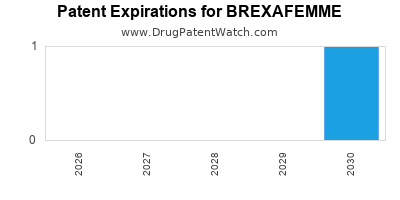
Brexafemme is protected by a patent estate covering ibrexafungerp and related compositions, formulations, dosing regimens, and methods of treating fungal infections. The estate includes U.S. and international patent families developed by Scynexis and its research collaborators.
The relevant exclusivity categories are different:
| Exclusivity type |
Relevance to Brexafemme |
| New chemical entity exclusivity |
Applied after the 2021 first approval and initially restricted certain ANDA approvals |
| Supplementary clinical exclusivity |
The recurrent-VVC approval may support additional three-year exclusivity for the approved change, subject to FDA determination |
| Drug patents |
May cover the compound, compositions, dosage forms, and methods of use |
| Pediatric exclusivity |
Could extend applicable exclusivity if FDA requirements were satisfied |
| Orphan exclusivity |
Not the principal protection for the approved VVC indications |
The original five-year new chemical entity period would generally place the earliest ANDA filing restriction around 2026, subject to FDA calculations and any pediatric extension. That restriction does not necessarily prevent all competing products from entering through other regulatory pathways, and it is separate from patent expiry.
The most important patent risks involve:
- Compound claims covering ibrexafungerp.
- Pharmaceutical composition claims.
- Oral tablet and dosage-form claims.
- Acute VVC treatment claims.
- Monthly dosing regimens for recurrent VVC.
- Manufacturing and solid-state claims.
A current Orange Book review is required to determine the exact listed patent numbers, expiration dates, pediatric adjustments, and whether any patents have been delisted or replaced. Public patent protection should not be treated as a single expiration date because different claims can expire at different times and may not all block the same generic product.
Are there Paragraph IV challenges to Brexafemme?
No publicly disclosed Paragraph IV litigation had become a material commercial event in the available company and FDA disclosures through the 2024 reporting period. That status can change quickly because generic applicants may file ANDAs with Paragraph IV certifications before a patent expiry date.
A Paragraph IV challenge would create several possible outcomes:
- Scynexis or another patent owner could sue within 45 days, triggering a statutory 30-month stay of FDA approval, subject to litigation developments.
- The generic applicant could settle, potentially receiving a licensed entry date.
- The patent claims could be narrowed, invalidated, or upheld.
- A generic could enter at risk before final resolution.
- The ANDA could remain blocked by regulatory exclusivity even if patent litigation is absent.
Because Brexafemme has a relatively small commercial base, a generic applicant may weigh litigation costs against expected volume. The probability of a challenge rises if prescription demand grows, if the product achieves durable recurrent-VVC adoption, or if manufacturing patents provide a high-value barrier.
How strong is the Brexafemme patent estate?
The estate has moderate strategic strength rather than the protection profile of a dominant oncology or biologic franchise.
Compound claims are potentially strong if valid and broad enough to cover the active ingredient used in generic products. Formulation and regimen claims are narrower and more vulnerable to design-around strategies. Method-of-use claims may remain valuable for the recurrent-VVC indication, but an ANDA applicant can contest their scope, carve out a protected indication, or seek approval for an unprotected use.
Manufacturing claims could create practical barriers if ibrexafungerp requires complex synthesis, impurity control, polymorph control, or specialized tablet production. The 2024 nitrosamine issue shows that quality and manufacturing controls are commercially relevant, but a manufacturing problem can also weaken market confidence rather than strengthen exclusivity.
The estate is more defensible if it combines:
- Valid compound claims.
- Multiple independent formulation claims.
- Long-dated recurrent-VVC method claims.
- Reliable Orange Book listings.
- Manufacturing know-how that is difficult to reproduce.
- Consistent supply and regulatory compliance.
What generic entry risks exist for Brexafemme?
Near-term generic entry risk is limited by regulatory exclusivity, patent protection, and the cost of developing a competing oral antifungal. The more immediate threat is substitution by existing therapies.
Short-term risk
Fluconazole and topical azoles can absorb demand during any supply interruption. Vivjoa can capture recurrent-VVC patients who meet its reproductive-status restrictions. Physicians may also defer branded treatment when a generic alternative is available.
Medium-term risk
An ANDA applicant could challenge composition or method patents. If the compound patent is upheld but use claims are narrow, a generic could seek a label that excludes recurrent-VVC use. Physicians could still prescribe the generic for acute VVC, depending on the approved label and patent scope.
Long-term risk
After regulatory exclusivity and core patent protection expire, price erosion could be severe. Brexafemme lacks the broad hospital, oncology, or chronic-disease demand that can sustain multiple branded and generic price tiers.
What is the revenue exposure and market outlook?
Brexafemme’s revenue exposure is concentrated in one asset and one therapeutic area. That concentration makes regulatory interruption, rights transitions, and competitive pricing more consequential than they would be for a diversified pharmaceutical company.
The market outlook depends on five variables:
- Restoration of uninterrupted supply after the recall.
- Scynexis’s ability to rebuild physician and pharmacy demand.
- Adoption in recurrent VVC rather than only episodic infections.
- Differentiation against fluconazole and Vivjoa.
- The timing and outcome of generic patent challenges.
The most credible growth path is a focused recurrent-VVC strategy. Broad conversion of uncomplicated VVC prescriptions from generic fluconazole would require a substantial clinical or economic advantage that Brexafemme has not yet demonstrated.
Key Takeaways
- Brexafemme is the first FDA-approved oral non-azole therapy for VVC and recurrent VVC.
- Ibrexafungerp’s strongest commercial position is in recurrent disease, azole intolerance, resistance, and treatment failure.
- Generic fluconazole remains the principal pricing and market-share constraint.
- GSK’s return of U.S. rights increases Scynexis’s control but also restores commercial and operating risk.
- The 2024 nitrosamine-related recall disrupted supply and weakened the product’s commercial momentum.
- Regulatory exclusivity likely delays the earliest conventional ANDA approvals until around 2026, subject to FDA calculations and applicable extensions.
- No publicly disclosed Paragraph IV litigation had become a material event through the available 2024 disclosures.
- Patent strength depends on the interaction of compound, formulation, dosing, method-of-use, and manufacturing claims.
- The franchise has moderate patent value but limited financial diversification and substantial generic-substitution risk.
FAQs
Can Brexafemme replace fluconazole as first-line treatment?
No. Fluconazole remains the lower-cost and more established first-line oral option for many uncomplicated VVC cases. Brexafemme is better positioned for patients requiring a non-azole alternative or treatment for recurrent disease.
Is Brexafemme approved for use during pregnancy?
No. Brexafemme carries pregnancy-related restrictions based on embryo-fetal toxicity findings. The prescribing information requires pregnancy assessment and contraception measures for applicable patients.
Does Brexafemme treat Candida auris?
Brexafemme is not broadly approved as a treatment for Candida auris. Use for invasive or unusual Candida infections would require clinical judgment and would not be equivalent to the FDA-approved VVC indications.
Is Vivjoa a stronger competitor than fluconazole?
Vivjoa is the more direct branded competitor for recurrent VVC, while fluconazole is the larger volume and pricing threat. Vivjoa’s label excludes females of reproductive potential, giving Brexafemme a broader potential labeled population.
What would most improve Brexafemme’s valuation?
The largest value drivers would be sustained product availability, measurable recurrent-VVC prescription growth, successful relaunch execution, stronger payer coverage, and patent protection that delays or limits ANDA competition.
References
-
Scynexis, Inc. (2024). Annual report pursuant to Section 13 or 15(d) of the Securities Exchange Act of 1934 for the fiscal year ended December 31, 2023. U.S. Securities and Exchange Commission.
-
Scynexis, Inc. (2023). Annual report pursuant to Section 13 or 15(d) of the Securities Exchange Act of 1934 for the fiscal year ended December 31, 2022. U.S. Securities and Exchange Commission.
-
Scynexis, Inc. (2022). Scynexis and GSK enter into exclusive license agreement for ibrexafungerp in the United States. Company announcement.
-
U.S. Food and Drug Administration. (2024). Brexafemme product recall and nitrosamine-related safety communications. FDA.
-
U.S. Food and Drug Administration. (2024). Brexafemme prescribing information, NDA 214810. FDA.
-
U.S. Food and Drug Administration. (2024). Orange Book: Approved drug products with therapeutic equivalence evaluations. FDA.
-
Centers for Disease Control and Prevention. (2021). Sexually transmitted infections treatment guidelines: Vulvovaginal candidiasis. U.S. Department of Health and Human Services.