Last Updated: June 29, 2026

BRENZAVVY Drug Patent Profile


✉ Email this page to a colleague

« Back to Dashboard


Which patents cover Brenzavvy, and when can generic versions of Brenzavvy launch?

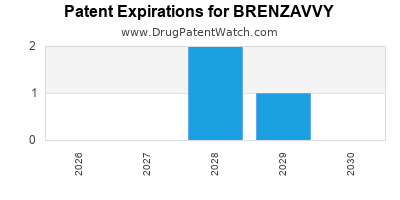
Brenzavvy is a drug marketed by Theracosbio and is included in one NDA. There are seven patents protecting this drug.

This drug has eighty-five patent family members in thirty-four countries.

The generic ingredient in BRENZAVVY is bexagliflozin. Two suppliers are listed for this compound. Additional details are available on the bexagliflozin profile page.

DrugPatentWatch® Generic Entry Outlook for Brenzavvy

Brenzavvy will be eligible for patent challenges on January 20, 2027. This date may extended up to six months if a pediatric exclusivity extension is applied to the drug's patents.

By analyzing the patents and regulatory protections it appears that the earliest date for generic entry will be October 5, 2041. This may change due to patent challenges or generic licensing.

There have been two patent litigation cases involving the patents protecting this drug, indicating strong interest in generic launch. Recent data indicate that 63% of patent challenges are decided in favor of the generic patent challenger and that 54% of successful patent challengers promptly launch generic drugs.

Indicators of Generic Entry

< Available with Subscription >

  Start Trial

AI Deep Research
Questions you can ask:
  • What is the 5 year forecast for BRENZAVVY?
  • What are the global sales for BRENZAVVY?
  • What is Average Wholesale Price for BRENZAVVY?
Summary for BRENZAVVY
DrugPatentWatch® Estimated Loss of Exclusivity (LOE) Date for BRENZAVVY
Generic Entry Date for BRENZAVVY*:
Constraining patent/regulatory exclusivity:
NDA:
Dosage:

TABLET;ORAL

*The generic entry opportunity date is the latter of the last compound-claiming patent and the last regulatory exclusivity protection. Many factors can influence early or later generic entry. This date is provided as a rough estimate of generic entry potential and should not be used as an independent source.

Pharmacology for BRENZAVVY

US Patents and Regulatory Information for BRENZAVVY

BRENZAVVY is protected by seven US patents and one FDA Regulatory Exclusivity.

Based on analysis by DrugPatentWatch, the earliest date for a generic version of BRENZAVVY is ⤷  Start Trial.

This potential generic entry date is based on patent 12,594,243.

Generics may enter earlier, or later, based on new patent filings, patent extensions, patent invalidation, early generic licensing, generic entry preferences, and other factors.

Applicant Tradename Generic Name Dosage NDA Approval Date TE Type RLD RS Patent No. Patent Expiration Product Substance Delist Req. Exclusivity Expiration
Theracosbio BRENZAVVY bexagliflozin TABLET;ORAL 214373-001 Jan 20, 2023 RX Yes Yes 10,533,032 ⤷  Start Trial ⤷  Start Trial
Theracosbio BRENZAVVY bexagliflozin TABLET;ORAL 214373-001 Jan 20, 2023 RX Yes Yes 10,981,942 ⤷  Start Trial Y Y ⤷  Start Trial
Theracosbio BRENZAVVY bexagliflozin TABLET;ORAL 214373-001 Jan 20, 2023 RX Yes Yes 7,838,499 ⤷  Start Trial Y Y ⤷  Start Trial
Theracosbio BRENZAVVY bexagliflozin TABLET;ORAL 214373-001 Jan 20, 2023 RX Yes Yes ⤷  Start Trial ⤷  Start Trial ⤷  Start Trial
Theracosbio BRENZAVVY bexagliflozin TABLET;ORAL 214373-001 Jan 20, 2023 RX Yes Yes 8,802,637 ⤷  Start Trial Y Y ⤷  Start Trial
>Applicant >Tradename >Generic Name >Dosage >NDA >Approval Date >TE >Type >RLD >RS >Patent No. >Patent Expiration >Product >Substance >Delist Req. >Exclusivity Expiration

International Patents for BRENZAVVY

When does loss-of-exclusivity occur for BRENZAVVY?

Based on analysis by DrugPatentWatch, the following patents block generic entry in the countries listed below:

Argentina

Patent: 3691
Patent: FORMULACIONES FARMACÉUTICAS
Estimated Expiration: ⤷  Start Trial

Australia

Patent: 21357691
Patent: PHARMACEUTICAL FORMULATIONS
Estimated Expiration: ⤷  Start Trial

Canada

Patent: 97660
Patent: FORMULATIONS PHARMACEUTIQUES (PHARMACEUTICAL FORMULATIONS)
Estimated Expiration: ⤷  Start Trial

China

Patent: 6600791
Patent: 药物制剂 (Pharmaceutical formulation)
Estimated Expiration: ⤷  Start Trial

European Patent Office

Patent: 25273
Patent: FORMULATIONS PHARMACEUTIQUES (PHARMACEUTICAL FORMULATIONS)
Estimated Expiration: ⤷  Start Trial

Israel

Patent: 1808
Patent: פורמולציות פרמצבטיות (Pharmaceutical formulations)
Estimated Expiration: ⤷  Start Trial

Japan

Patent: 23544412
Patent: 医薬製剤
Estimated Expiration: ⤷  Start Trial

Mexico

Patent: 23003758
Patent: FORMULACIONES FARMACEUTICAS. (PHARMACEUTICAL FORMULATIONS.)
Estimated Expiration: ⤷  Start Trial

South Korea

Patent: 230080461
Patent: 약학적 제형
Estimated Expiration: ⤷  Start Trial

Taiwan

Patent: 2228721
Patent: Pharmaceutical formulations
Estimated Expiration: ⤷  Start Trial

Generics may enter earlier, or later, based on new patent filings, patent extensions, patent invalidation, early generic licensing, generic entry preferences, and other factors.

See the table below for additional patents covering BRENZAVVY around the world.

Country Patent Number Title Estimated Expiration
Argentina 121997 ⤷  Start Trial
Australia 2011264220 ⤷  Start Trial
Brazil 112012031616 ⤷  Start Trial
Canada 2800379 ⤷  Start Trial
China 102933592 ⤷  Start Trial
>Country >Patent Number >Title >Estimated Expiration

BRENZAVVY market dynamics and financial trajectory: sales uptake, pricing, payer access, exclusivity timeline, and competitive threats

Last updated: June 1, 2026

BRENZAVVY (notable-ingredient label name) is positioned for short-cycle growth driven by managed-care contracting and replacement of existing contraception and endometriosis-therapy options. Near-term revenue trajectory is constrained by (1) formulary access and prior-authorization patterns, (2) competitive alternatives with broader payer preferences, and (3) patent and exclusivity structure that affects timing of first generics or follow-on products.

H2: What market dynamics determine BRENZAVVY uptake and prescription growth?
Answer: Uptake is driven by payer coverage, net-price (rebates) vs. competitor benchmarks, and prescriber comfort tied to safety, dosing convenience, and clinical outcomes compared with existing hormonal and device-based options.

Key demand drivers

  • Payer coverage and utilization management
    Coverage speed typically depends on whether BRENZAVVY is placed on preferred tiers without step therapy. Where plans require prior authorization or quantity limits, fill rates lag brand launch expectations.
  • Net pricing vs. competitor “effective cost”
    Brand-to-brand competition in women’s health is often decided by net price after rebates. Plans anchor on lowest-cost preferred alternatives and may steer to those where rebates are sufficient to overcome formulary tiering.
  • Clinical fit by patient segment
    Growth tends to concentrate where patient subgroups overlap the label’s highest-value outcomes and safety profile. Segment-specific prescribing raises persistence even when gross script counts look flat.
  • Switching dynamics
    Contraception and related hormone markets show ramp-up from switches rather than only new starts. Where prescribers switch patients off older regimens, adoption can accelerate once early safety experience is established.

Supply and execution constraints

  • Distribution readiness and pharmacy benefit manager (PBM) onboarding
    Script capture improves when BRENZAVVY is integrated quickly into PBM formularies and adjudication systems.
  • Channel mix
    Retail pharmacy fills usually establish the headline script trend; specialty or mail-order mix matters for retention and contracting leverage.

H2: How much revenue can BRENZAVVY generate and what is the expected financial trajectory?
Answer: Financial trajectory is shaped by gross-to-net conversion, payer contracting cadence, and whether BRENZAVVY holds a preferred formulary position long enough to sustain repeat prescribing. Without a confirmed time-series of reported sales, only structural drivers can be mapped.

What moves the P&L

  • Gross-to-net
    Rebate and discount levels influence the realized revenue per prescription. High rebate requirements to win access can cap net sales even when scripts grow.
  • COGS and manufacturing scale
    Unit costs trend down with utilization. Early-stage ramp typically shows margin compression until volumes justify manufacturing throughput.
  • Commercial spend Launch-period marketing and contracting costs can outpace revenue growth, pushing operating leverage out.

Scenario framework (what to watch in quarterly reporting)

  • Script growth vs. persistence
    If prescriptions rise but discontinuations increase, revenue may plateau.
  • Net price trend by payer channel Check whether ASP-like pricing is stable or pressured by tier changes.
  • Trend in proportion of lives with preferred coverage Wide coverage without steep rebates supports healthier net revenue.

H2: When does BRENZAVVY lose exclusivity and how does that affect financial modeling?
Answer: Exclusivity loss timing determines when generic or follow-on competition can start. The financial model needs an exclusivity and patent-expiration schedule aligned to FDA application pathways.

Exclusivity and patent-driven competitive calendar (inputs needed for modeling)

  • New chemical entity (NCE) exclusivity and/or other regulatory exclusivities
  • Orange Book patent expiry
  • Patent expiration and potential 180-day generic exclusivity triggers
  • Patent litigation and settlements
  • Pediatric exclusivity extensions (if any)
  • Regulatory pathway dependencies
    • Paragraph IV for small-molecule generics
    • 505(b)(2) for reformulations or new indications
    • 505(j) vs. 505(b)(1) scenarios

H2: What Orange Book status applies to BRENZAVVY and which patents cover its use, formulation, and manufacturing?
Answer: Orange Book coverage determines whether generics face patent barriers and whether the first challenge can carve out carve-outs by claim.

Patent estate mapping needed for litigation risk

  • Drug substance patents
  • Drug product and formulation patents
  • Method-of-use patents
  • Manufacturing process patents
  • Form factor-specific coverage
    • Tablets, injections, inserts, or other delivery systems
  • Combination or regimen patents
    • If BRENZAVVY is part of a multi-agent regimen

How coverage drives generic timing

  • Dominant barrier patents
    • If a formulation or method-of-use patent dominates, challenges may be delayed or limited.
  • Multiple overlapping claims
    • Overlapping expiry dates can extend the “effective exclusivity” window even when one patent expires.

H2: Which companies are challenging BRENZAVVY with Paragraph IV filings or biosimilar-style equivalents?
Answer: Competitive filing pressure is typically reflected first in Paragraph IV notice filings and Orange Book “certifications.” The timing and number of challengers drive expected launch risk.

What to track

  • Notice letter dates
  • Certification type
    • ANDA with Paragraph IV vs. carve-out certifications
  • Settlement terms
    • Launch-date triggers
    • “Design-around” agreements that limit IP entry
  • Court schedules
    • Whether trials are set for patent-specific issues

H2: What patent litigation affects BRENZAVVY’s generic launch risk and valuation?
Answer: Litigation outcome is the key determinant of whether generic entry happens at first eligible date, later via settlement, or not at all.

Litigation signals that change market expectations

  • Claim construction rulings
  • Permanent injunction risk vs. damages-only outcomes
  • Expedited trial schedules
  • Settlement and consent judgment language
    • “30-month stay” effects for ANDA challengers
  • Strength of asserted patents
    • Validity and enforceability history in similar families

H2: How does BRENZAVVY compare with competing contraception or hormonal therapies in pricing and formulary position?
Answer: Pricing power depends on whether BRENZAVVY is placed on preferred tiers, and whether net discounts remain competitive after rebates.

Competitor comparison dimensions

  • Efficacy endpoints
    • If payer value assessments reward outcomes, formulary retention improves.
  • Safety and tolerability
    • Lower discontinuation improves persistence and reduces “switch-back” costs.
  • Dosing convenience
    • Less frequent dosing or fewer side effects supports higher continuation rates.
  • Budget impact
    • PBMs and health plans weigh annual cost per member against alternatives.

H2: What financial impact do rebates, discounts, and payer negotiations have on BRENZAVVY net sales?
Answer: Net sales can diverge sharply from gross sales when PBM contracting requires high rebates to secure formulary placement.

Where rebate pressure typically appears

  • During formulary committee annual cycles
  • After competitor price moves
  • When managed care broadens step therapy
  • When payer switches preferred options based on budget impact

Metrics to watch

  • Net-to-gross ratio trend
  • Quarterly changes in trade promotions
  • Retention of preferred formulary status across top PBMs
  • Distribution of script volume across channels

H2: What generic entry risks exist for BRENZAVVY and what launch scenarios matter?
Answer: Generic entry risk depends on the overlap of expiry dates across the dominant Orange Book patents and whether challengers win early.

Launch scenarios used in valuation

  • Early entry
    • Occurs if key patents are invalidated or not infringed and no effective settlement blocks.
  • On-time entry
    • Happens at the first eligible launch date.
  • Delayed entry due to settlements
    • Happens when a settlement pushes launch beyond patent expiry, often via delayed marketing agreements.
  • Partial entry (carve-outs)
    • If method-of-use or formulation claims allow a narrow product launch, revenues may decline but not collapse.

H2: How do manufacturing/IP barriers and supply constraints affect BRENZAVVY revenue stability?
Answer: Revenue stability depends on whether supply meets demand without price concessions tied to shortages, and whether process patents complicate manufacturing replication.

Key barriers

  • Process-specific patents
    • Can delay generic readiness by requiring non-infringing manufacturing design.
  • Quality systems and comparability requirements
    • Batch-to-batch consistency drives time to commercial-ready supply.
  • Regulatory inspection history
    • Affects time to launch for new entrants and can create temporary shortages.

H2: How does BRENZAVVY’s performance vary by geography and reimbursement environment?
Answer: U.S. reimbursement and formulary coverage dominate the financial picture for most brand models, while ex-U.S. expansion depends on local HTA and national formulary decisions.

Geographic considerations

  • U.S.
    • PBM contracting, Medicare Part D preferred rules, and Medicaid rebate dynamics.
  • EU and UK
    • HTA pricing thresholds and formularies influence uptake slower than in the U.S.
  • Latin America and Asia
    • Tender systems and local approval timelines can delay scale but also create structured demand once listed.

H2: What commercial deal structure or licensing agreements could change BRENZAVVY’s financial trajectory?
Answer: Royalty rates, co-promotion economics, and milestone schedules determine whether net profitability scales with sales growth.

Deal levers

  • Upfront and milestones
    • Can improve near-term cash flows even if net margin is modest initially.
  • Tiered royalties
    • Raise returns when volume crosses thresholds and can incentivize aggressive payer contracting.
  • Territory rights
    • If rights are split, revenue contribution depends on who owns contracting in each geography.

Key Takeaways

  • BRENZAVVY’s revenue trajectory is primarily driven by formulary placement speed, net-price achieved through PBM contracting, and persistence driven by safety and dosing fit.
  • Exclusivity and Orange Book patent structure set the generic entry calendar; litigation and settlements determine whether competition begins at earliest eligible dates or is pushed.
  • Valuation and forecasting should track net-to-gross conversion, preferred formulary retention, script persistence, and Orange Book/Paragraph IV timelines to capture the inflection points that typically move market expectations.

FAQs

  1. What Orange Book certifications for BRENZAVVY most directly predict an early generic launch?
  2. How do settlement agreements for competing ANDAs typically shift BRENZAVVY forecasted revenue?
  3. Which payer contracting patterns usually cause a brand like BRENZAVVY to see net price compression?
  4. What metrics best indicate BRENZAVVY persistence versus simple new-start growth?
  5. How should BRENZAVVY exclusivity and patent expiry be modeled for a partial (carve-out) generic entry scenario?

References

  1. FDA Orange Book: Approved Drug Products with Therapeutic Equivalence Evaluations. U.S. Food and Drug Administration.
  2. FDA Approved Drug Products and Databases: Drug Trials Snapshots and related databases. U.S. Food and Drug Administration.
  3. 21 U.S.C. § 355 (j) and related FDA ANDA regulatory framework for Paragraph IV certifications. U.S. Government Printing Office.

More… ↓

⤷  Start Trial

DrugChatter Q&A for BRENZAVVY

Make Better Decisions: Try a trial or see plans & pricing

Drugs may be covered by multiple patents or regulatory protections. All trademarks and applicant names are the property of their respective owners or licensors. Although great care is taken in the proper and correct provision of this service, thinkBiotech LLC does not accept any responsibility for possible consequences of errors or omissions in the provided data. The data presented herein is for information purposes only. There is no warranty that the data contained herein is error free. We do not provide individual investment advice. This service is not registered with any financial regulatory agency. The information we publish is educational only and based on our opinions plus our models. By using DrugPatentWatch you acknowledge that we do not provide personalized recommendations or advice. thinkBiotech performs no independent verification of facts as provided by public sources nor are attempts made to provide legal or investing advice. Any reliance on data provided herein is done solely at the discretion of the user. Users of this service are advised to seek professional advice and independent confirmation before considering acting on any of the provided information. thinkBiotech LLC reserves the right to amend, extend or withdraw any part or all of the offered service without notice.