Last updated: August 1, 2026
Bepreve, the U.S. brand for bepotastine besilate ophthalmic solution 1.5%, is a mature prescription ophthalmic antihistamine with limited standalone financial disclosure. The product entered the U.S. market in 2009, received pediatric labeling for patients two years and older in 2017, and is commercialized within Bausch + Lomb’s broader pharmaceutical portfolio. Its commercial position is constrained by generic and branded competition in allergic conjunctivitis, including olopatadine, ketotifen, alcaftadine, and prescription azelastine products. Bausch + Lomb does not publicly report Bepreve revenue as a separate product line. (U.S. Food and Drug Administration [FDA], 2009, 2017; Bausch + Lomb, 2023)
What is Bepreve and how does it work?
Bepreve contains bepotastine besilate, a topical antihistamine indicated for the treatment of itching associated with allergic conjunctivitis. The product is supplied as a 1.5% ophthalmic solution and is administered as one drop in each affected eye twice daily. The active ingredient has antihistaminic properties and inhibits histamine-mediated effects in ocular tissues. (FDA, 2023)
Bepreve is not a steroid, mast-cell stabilizer-only product, or immunomodulator. Its commercial role is the treatment of ocular allergy symptoms, particularly itching, rather than chronic inflammatory eye disease.
| Product attribute |
Bepreve |
| Active ingredient |
Bepotastine besilate |
| Dosage form |
Ophthalmic solution |
| Strength |
1.5% |
| U.S. indication |
Itching associated with allergic conjunctivitis |
| Original U.S. approval |
2009 |
| Pediatric labeling |
Patients 2 years and older |
| Administration |
One drop in each affected eye twice daily |
| U.S. product sponsor |
Bausch + Lomb, following portfolio ownership changes |
| Therapeutic class |
Ophthalmic antihistamine |
When did Bepreve receive FDA approval and pediatric exclusivity?
The FDA approved Bepreve in 2009 under New Drug Application 22-135 for the treatment of itching associated with allergic conjunctivitis. The FDA later approved a supplemental application extending labeled use to pediatric patients two years and older. (FDA, 2009, 2017)
The pediatric expansion did not create a new long-duration market monopoly comparable to a new chemical entity exclusivity period. Pediatric studies can generate statutory pediatric exclusivity when the FDA issues a written request and the sponsor satisfies the applicable requirements. The FDA’s public approval materials identify the pediatric labeling expansion, but commercial forecasting requires separating any pediatric exclusivity from the underlying patent term and from ordinary prescription-market competition.
Bepreve exclusivity timeline
| Milestone |
Date |
Commercial relevance |
| FDA approval |
2009 |
Established U.S. prescription market |
| Pediatric labeling expansion |
2017 |
Expanded labeled population to patients 2 years and older |
| Portfolio ownership under Bausch + Lomb |
2012 onward |
Integrated product into a larger eye-care commercial platform |
| Mature branded-product phase |
2020s |
Increased exposure to generic substitution and lower-cost alternatives |
The practical exclusivity question is no longer the original approval date. The relevant issues are the status of listed patents, the availability of approved abbreviated new drug applications, state-level substitution, payer formulary placement, and the extent to which physicians continue to prescribe the brand.
What patents protect Bepreve?
Bepreve’s patent position must be assessed through the FDA Orange Book and the underlying U.S. Patent and Trademark Office records. The Orange Book identifies patents that a sponsor has submitted for an approved drug and that meet the applicable listing criteria. It does not capture every commercial, manufacturing, formulation, trade-secret, or foreign patent right. (FDA, 2024a)
For Bepreve, the principal legal protection categories are:
- The active pharmaceutical ingredient and its salt form.
- The ophthalmic formulation.
- The concentration and dosing regimen.
- The method of treating ocular allergy or itching.
- Manufacturing and stability technology, where separately protected.
The strongest practical barriers for an ophthalmic generic are usually formulation equivalence, preservative system, pH, osmolality, viscosity, container-closure compatibility, sterility, and manufacturing validation. A generic applicant can challenge listed patents through an ANDA Paragraph IV certification or seek approval after patent expiry. A formulation or method-of-use patent may delay approval only if it is listed and legally enforceable under the applicable framework.
What is the Orange Book status of Bepreve?
Bepreve’s Orange Book status should be evaluated by searching the product name, NDA 22-135, and bepotastine besilate ophthalmic solution. The decisive records are the current patent listing, expiration dates, delisting history, pediatric exclusivity notation, and approved generic entries. (FDA, 2024a)
The Orange Book does not by itself prove that a patent will withstand litigation. It identifies the patents that can trigger statutory notice and potential litigation after a Paragraph IV certification.
When does Bepreve lose exclusivity?
Bepreve has already passed the period associated with its original new drug approval. Its current commercial exposure is therefore determined by patent and regulatory barriers rather than by the original FDA approval exclusivity period.
A precise generic-entry date depends on:
- The expiration of each currently listed patent.
- Any applicable pediatric exclusivity extension.
- The timing of ANDA approval.
- Paragraph IV litigation and a possible 30-month stay.
- Court rulings, settlements, or licensing agreements.
- The applicant’s ability to satisfy FDA requirements for ophthalmic products.
A patent expiration date should not be treated as an automatic launch date. FDA approval, manufacturing readiness, settlement restrictions, and commercial launch economics can shift the actual entry date.
Which companies compete with Bepreve?
Bepreve competes in a crowded allergic-conjunctivitis market. The main alternatives include:
| Product or ingredient |
Company or sponsor category |
Competitive position |
| Pataday, olopatadine |
Alcon and generic manufacturers |
Major OTC and prescription allergy competitor |
| Pazeo, olopatadine 0.7% |
Alcon |
Branded prescription-strength olopatadine product |
| Lastacaft, alcaftadine |
AbbVie/Allergan legacy portfolio and generic manufacturers |
Once-daily antihistamine alternative |
| Zaditor, ketotifen |
Novartis legacy brand and OTC manufacturers |
Widely available OTC alternative |
| Optivar and generic azelastine |
Multiple manufacturers |
Prescription antihistamine alternative |
| Bepreve, bepotastine |
Bausch + Lomb |
Branded prescription ophthalmic antihistamine |
Bepreve’s differentiation depends on clinician familiarity, payer access, tolerability, availability, sales-force promotion, and patient response. Once-daily competitors can have an adherence advantage over Bepreve’s twice-daily regimen. OTC products can create a substantial price barrier for branded prescription therapy.
How strong is the Bepreve patent estate?
Bepreve’s patent estate is commercially moderate to weak unless current formulation or method-of-use claims remain enforceable and materially restrict generic substitution. The product is a small-molecule ophthalmic solution with an established therapeutic class and a relatively straightforward administration route. Those characteristics generally increase the feasibility of generic development compared with complex biologic or device-dependent products.
The main strength of any remaining patent protection would depend on claim scope and design-around options. A narrow formulation claim may be bypassed by changing excipients while preserving the active ingredient and concentration. A method-of-use claim may have limited commercial value if the generic label can omit the patented use or if the relevant indication is difficult to enforce.
Manufacturing remains a meaningful but manageable barrier. Sterile ophthalmic production requires validated aseptic processing, quality control, container-closure testing, and stability data. Those requirements can delay or reduce the number of entrants, but they do not normally create the same durable barrier as an injectable biologic manufacturing process.
Are there Paragraph IV challenges or Bepreve patent lawsuits?
Publicly visible litigation risk should be reviewed through FDA Paragraph IV notices, federal court dockets, and Bausch + Lomb’s Securities and Exchange Commission filings. Bausch + Lomb reports material legal matters at the company or portfolio level, but it does not provide a standalone litigation and revenue analysis for every mature ophthalmic product. (Bausch + Lomb, 2023)
A Paragraph IV challenge would require the ANDA applicant to notify the patent holder and NDA holder that listed patents are invalid, unenforceable, or not infringed. The patent owner may file suit within 45 days, potentially triggering a statutory stay of approval. The existence of a Paragraph IV notice does not guarantee that the generic will launch, and the absence of a publicly prominent case does not establish that no challenge exists.
No major publicly reported Bepreve settlement is identified in the core FDA approval and company-disclosure materials cited here. Settlement terms, if any, would need to be confirmed through court filings, FDA records, or transaction disclosures.
What is Bepreve’s financial trajectory?
Bausch + Lomb does not report Bepreve revenue, gross margin, prescription volume, or market share as a separate public reporting unit. The product is included within a broader pharmaceutical or eye-care portfolio, which limits direct valuation analysis. (Bausch + Lomb, 2023)
The likely financial trajectory is a mature branded-product pattern:
| Financial phase |
Revenue characteristics |
Key drivers |
| Launch and adoption |
Expansion from a low base |
Physician promotion, formulary access, allergy-season demand |
| Growth phase |
Prescription growth and broader awareness |
Pediatric labeling, repeat use, sales-force coverage |
| Mature brand phase |
Stable or declining net sales |
Generic competition, OTC substitution, payer pressure |
| Post-generic phase |
Lower branded volume and price |
Substitution, authorized generic strategy, contracting |
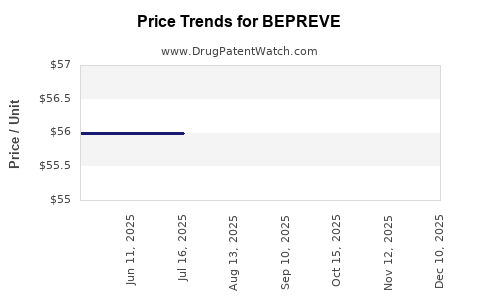
Revenue exposure is seasonal because allergic conjunctivitis demand often rises during pollen seasons. Net sales are also affected by gross-to-net deductions, rebates, wholesaler discounts, copay assistance, and channel mix. A company can preserve reported revenue for a period through pricing or contracting even while prescription volume declines.
Bepreve is unlikely to be a material driver of Bausch + Lomb’s consolidated valuation relative to larger ophthalmology products, surgical systems, contact-lens-care products, and other prescription medicines. Its strategic value is more likely to come from portfolio breadth, prescriber relationships, and cash generation than from high-growth potential.
What generic launch risks exist for Bepreve?
The principal generic launch scenarios are:
Early entry after successful challenge
An ANDA applicant obtains approval after invalidating or avoiding listed patents. This scenario can produce rapid branded share loss, particularly where pharmacy substitution is permitted.
Entry after patent expiry
The generic receives approval after all relevant regulatory protections expire. The brand may retain a limited share through physician loyalty, supply reliability, or patient preference.
Delayed or limited generic entry
Manufacturing complexity, low expected margins, formulation development, or regulatory deficiencies reduce the number of viable applicants. This can preserve branded pricing longer than the patent record alone would suggest.
Authorized generic or brand-price defense
The sponsor or a licensee may commercialize an authorized generic, offer contracting concessions, or reposition the brand. These measures can protect volume but generally reduce net price.
Ophthalmic products face additional substitution considerations because state pharmacy laws, prescriber instructions, preservative sensitivity, bottle design, and patient experience can affect switching.
How does Bepreve compare with Pataday and Lastacaft?
Bepreve has a less favorable commercial position than leading once-daily or widely distributed allergy products when judged on dosing convenience and consumer awareness. Pataday benefits from strong brand recognition and OTC availability. Lastacaft competes with once-daily dosing. Bepreve’s advantages are its established prescription history, pediatric labeling, and inclusion in a specialized eye-care portfolio.
| Factor |
Bepreve |
Pataday |
Lastacaft |
| Active ingredient |
Bepotastine |
Olopatadine |
Alcaftadine |
| Typical dosing |
Twice daily |
Once daily for common formulations |
Once daily |
| Market channel |
Prescription brand |
OTC and prescription channels |
OTC and prescription-related competition |
| Generic pressure |
High |
High |
High |
| Consumer recognition |
Lower than leading OTC brands |
High |
Moderate |
| Commercial differentiation |
Prescription ophthalmic antihistamine |
Brand scale and convenience |
Once-daily convenience |
What licensing deals affect Bepreve?
Bepreve originated in the ISTA Pharmaceuticals ophthalmology portfolio before Bausch + Lomb acquired ISTA in 2012. The acquisition transferred Bepreve and related ophthalmic assets into Bausch + Lomb’s commercial portfolio. (Bausch & Lomb, 2012)
No major standalone licensing transaction is required to explain the product’s current ownership. Any generic commercialization, regional licensing, or supply arrangement should be verified against FDA sponsor records, company filings, and product labeling.
What is the FDA regulatory status of Bepreve?
Bepreve remains an FDA-approved ophthalmic antihistamine product under NDA 22-135. The current label covers allergic-conjunctivitis itching in adults and pediatric patients two years and older. FDA regulatory risk is concentrated in manufacturing compliance, postmarketing surveillance, labeling changes, and generic approvals rather than in a pending new indication. (FDA, 2023)
The product’s regulatory profile is comparatively mature. Its future commercial performance will depend more on access, substitution, and portfolio economics than on additional label expansion.
Key Takeaways
- Bepreve is bepotastine besilate ophthalmic solution 1.5%, approved by the FDA in 2009.
- Pediatric labeling expanded the indicated population to patients two years and older in 2017.
- Bausch + Lomb does not publicly disclose standalone Bepreve revenue or profitability.
- The product competes with olopatadine, alcaftadine, ketotifen, and azelastine therapies.
- Generic risk is material because Bepreve is a mature small-molecule ophthalmic solution.
- The decisive legal records are the current Orange Book patent listings, expiration dates, Paragraph IV certifications, and litigation outcomes.
- Formulation and sterile-manufacturing requirements can delay entry but are unlikely to create a durable biologic-like barrier.
- Bepreve is more likely to be a mature cash-generating portfolio product than a major growth asset.
Frequently Asked Questions
Is Bepreve still available in the United States?
Bepreve remains an FDA-approved product marketed within the U.S. ophthalmology market, subject to commercial availability and sponsor supply decisions.
Is bepotastine the same as olopatadine?
No. Bepotastine and olopatadine are different topical antihistamine active ingredients used to treat ocular allergy symptoms.
Can pharmacies automatically substitute a generic for Bepreve?
Automatic substitution depends on whether an FDA-approved therapeutically equivalent generic is available and on applicable state pharmacy-substitution rules.
Does Bepreve have orphan-drug exclusivity?
No orphan-drug exclusivity is associated with Bepreve’s allergic-conjunctivitis indication.
Is Bepreve a biologic or biosimilar product?
No. Bepreve is a conventional small-molecule ophthalmic drug. Biosimilar pathways do not apply; potential competitors would generally use the ANDA pathway for a therapeutically equivalent generic.
References
-
Bausch & Lomb. (2012). Bausch + Lomb completes acquisition of ISTA Pharmaceuticals. Company press release.
-
Bausch + Lomb Corporation. (2023). Annual report on Form 10-K for the fiscal year ended December 31, 2023. U.S. Securities and Exchange Commission.
-
U.S. Food and Drug Administration. (2009). Bepreve ophthalmic solution 1.5%: Approval letter and prescribing information. NDA 22-135.
-
U.S. Food and Drug Administration. (2017). Bepreve: Pediatric labeling supplement. NDA 22-135.
-
U.S. Food and Drug Administration. (2023). Bepreve prescribing information. NDA 22-135.
-
U.S. Food and Drug Administration. (2024a). Approved drug products with therapeutic equivalence evaluations. Center for Drug Evaluation and Research.