Last updated: September 24, 2026
Atripla, the once-daily fixed-dose combination of efavirenz, emtricitabine and tenofovir disoproxil fumarate, moved from a leading U.S. HIV product to a largely legacy therapy after 2016. Its commercial decline resulted from generic competition, newer integrase inhibitor regimens, safety and tolerability concerns associated with efavirenz, and the shift from tenofovir disoproxil fumarate to tenofovir alafenamide.
Atripla generated substantial revenue for Gilead Sciences, Bristol-Myers Squibb and Merck during its peak years, but the product did not have a durable standalone financial trajectory after the mid-2010s. Generic entry and therapeutic substitution sharply reduced its strategic value.
What is Atripla and who developed it?
Atripla is a three-drug antiretroviral tablet containing:
| Component |
Drug class |
Original developer or principal commercial holder |
| Efavirenz |
Non-nucleoside reverse transcriptase inhibitor |
Merck |
| Emtricitabine |
Nucleoside reverse transcriptase inhibitor |
Gilead |
| Tenofovir disoproxil fumarate |
Nucleotide reverse transcriptase inhibitor |
Gilead |
The U.S. Food and Drug Administration approved Atripla on July 12, 2006, as a complete HIV-1 treatment regimen for adults and adolescents weighing at least 40 kilograms. It was the first once-daily single-tablet regimen for HIV treatment in the United States (FDA, 2006).
Atripla was commercialized through a collaboration among Gilead Sciences, Bristol-Myers Squibb and Merck. Gilead supplied and held rights associated with emtricitabine and tenofovir disoproxil fumarate. Bristol-Myers Squibb developed and commercialized efavirenz under the Sustiva brand before Merck acquired that business. The parties shared economics under collaboration and supply arrangements rather than treating Atripla as a single-company product.
How did Atripla become a leading HIV treatment?
Atripla’s initial market position came from three commercial advantages:
- It combined three established antiretroviral agents into one tablet.
- It reduced pill burden and simplified adherence.
- It had broad clinical use before integrase inhibitor regimens became preferred first-line therapy.
Atripla became a major product in the U.S. HIV market during the late 2000s and early 2010s. Its adoption was supported by treatment guidelines that accepted efavirenz-based regimens for treatment-naive patients. The product also benefited from the established clinical records of its individual components.
Its main limitations were known early in the product life cycle. Efavirenz was associated with central nervous system adverse effects, including vivid dreams, dizziness and neuropsychiatric symptoms. Tenofovir disoproxil fumarate was associated with renal and bone safety concerns. These issues became commercially more important as alternative single-tablet regimens entered the market.
What was Atripla’s financial trajectory?
Atripla’s financial performance followed the standard pattern for an early market-leading combination product: rapid adoption, sustained peak sales, then accelerated erosion from newer branded therapies and generic competition.
Gilead reported Atripla product sales of approximately $3.6 billion in 2013, according to its annual report. Sales declined to approximately $2.9 billion in 2014, approximately $2.0 billion in 2015, and approximately $1.4 billion in 2016 (Gilead Sciences, 2014, 2015, 2016, 2017). The decline continued as Gilead’s newer products, particularly Stribild, Genvoya and Biktarvy, displaced Atripla.
| Year |
Approximate Atripla sales reported by Gilead |
Main commercial condition |
| 2013 |
$3.6 billion |
Peak-era product |
| 2014 |
$2.9 billion |
Early substitution by newer regimens |
| 2015 |
$2.0 billion |
Stribild and other alternatives gained share |
| 2016 |
$1.4 billion |
Strong decline in U.S. and international demand |
| 2017 onward |
Not a major growth product |
Product increasingly treated as mature or legacy therapy |
The reported figures are Gilead’s product sales and do not represent total economic value captured by every collaboration participant. Atripla’s financial contribution to Gilead was materially larger than its contribution to a conventional single-brand portfolio because the product contained two Gilead-origin components and was sold through a strategic collaboration.
Atripla did not retain a meaningful growth role after Gilead’s HIV franchise shifted toward tenofovir alafenamide and integrase inhibitor combinations. Biktarvy, approved in 2018, became the principal growth product in Gilead’s HIV portfolio.
When did Atripla lose market exclusivity?
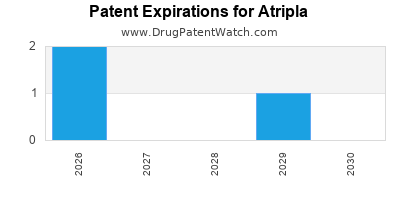
Atripla lost commercial exclusivity in stages rather than on one universal date. The relevant dates differ by jurisdiction, patent, pediatric extension and generic product.
| Event |
Timing |
Market effect |
| U.S. approval |
July 2006 |
Beginning of commercial protection and branded launch |
| Core compound and formulation patent period |
Primarily late 2010s to early 2020s |
Limited generic access before patent expiry |
| First U.S. generic approvals |
2018 period |
Entry by authorized or conventional generic suppliers |
| Broad generic erosion |
2018 onward |
Rapid price and volume pressure |
| Current status |
Mature generic market |
Limited branded growth and low strategic value |
The commercial loss of exclusivity occurred before the final expiration of every patent potentially relevant to one of the three active ingredients. Generic companies could pursue approval through Paragraph IV certifications, litigation settlements, license arrangements or expiry-based launches.
The distinction matters because the branded Atripla product depended on the combined protection of multiple active ingredients, formulation rights, regulatory exclusivity and collaboration rights. Expiration of one patent did not automatically eliminate every barrier, but the market became vulnerable once generic manufacturers could lawfully supply an equivalent fixed-dose combination.
What patents protected Atripla?
Atripla’s protection depended on a layered estate covering the active ingredients, combinations, crystalline forms, formulations and manufacturing processes. The relevant intellectual property did not consist of one universally controlling “Atripla patent.”
The principal patent categories were:
Combination and formulation patents
These patents covered the fixed-dose combination of efavirenz, emtricitabine and tenofovir disoproxil fumarate, along with tablet composition, dosage strength and pharmaceutical formulation.
Active-ingredient patents
Separate patents protected efavirenz, emtricitabine and tenofovir-related compounds. Some component patents were held by different companies and had different expiration dates.
Manufacturing patents
Process patents could cover preparation of the active ingredients, intermediates, salt forms or solid-state forms. These patents were more relevant to supplier strategy and manufacturing design than to the basic approval of a therapeutically equivalent tablet.
Regulatory exclusivity
Atripla benefited from FDA approval-era exclusivity, but that protection expired long before the product’s commercial decline. Patent protection, rather than FDA exclusivity, controlled the later generic-entry timetable.
Because the Orange Book listing can change through patent delisting, expiration, pediatric extensions and litigation settlements, exact patent-by-patent conclusions require a date-specific Orange Book review. Product-level market analysis supports the conclusion that Atripla’s practical U.S. exclusivity ended in the late 2010s.
What was Atripla’s Orange Book and Paragraph IV exposure?
Atripla was listed in the FDA Orange Book under NDA 021937. Generic applicants seeking approval could file an ANDA with Paragraph IV certifications against listed patents. A Paragraph IV filing is a legal assertion that the relevant patent is invalid, unenforceable or not infringed.
The commercial consequences were significant:
- A successful first-filer could obtain 180-day generic exclusivity.
- The branded companies could file patent litigation within the statutory period.
- Litigation could delay approval or produce a settlement date.
- A settlement could permit an earlier authorized or conventional generic launch.
- Generic entry could reduce net price even before full substitution occurred.
Atripla’s generic exposure was more complex than exposure for a single-molecule product because the ANDA applicant needed to demonstrate pharmaceutical equivalence and bioequivalence for a three-component tablet. The technical requirement increased development complexity but did not create a durable barrier once the formulation and manufacturing pathway were established.
How did generic competition change Atripla’s market?
Generic competition changed Atripla from a premium branded regimen into a price-sensitive mature product. The main erosion mechanisms were:
- Direct substitution at the pharmacy level.
- Institutional and public-payer procurement discounts.
- Physician migration to newer branded single-tablet regimens.
- Reduced use of efavirenz-based treatment in treatment guidelines.
- Conversion from tenofovir disoproxil fumarate to tenofovir alafenamide.
- Greater use of integrase inhibitor combinations.
Atripla retained some demand in cost-sensitive markets, international procurement programs and patients stable on treatment. That residual demand did not offset the loss of U.S. branded volume.
The fixed-dose combination retained manufacturing value because a single tablet can reduce distribution and adherence costs. Its clinical disadvantages, however, limited its ability to compete with newer regimens on safety, tolerability and guideline preference.
Which drugs displaced Atripla?
Atripla faced competition from both newer branded products and generic component regimens.
| Product |
Key components |
Competitive effect |
| Stribild |
Elvitegravir, cobicistat, emtricitabine, tenofovir disoproxil fumarate |
Offered an alternative single-tablet regimen |
| Genvoya |
Elvitegravir, cobicistat, emtricitabine, tenofovir alafenamide |
Improved renal and bone profile relative to TDF-based therapy |
| Odefsey |
Rilpivirine, emtricitabine, tenofovir alafenamide |
Provided a TAF-based single-tablet option |
| Biktarvy |
Bictegravir, emtricitabine, tenofovir alafenamide |
Became a leading first-line and switch regimen |
| Triumeq |
Dolutegravir, abacavir, lamivudine |
Competing integrase inhibitor single-tablet regimen |
| Dovato |
Dolutegravir and lamivudine |
Two-drug regimen with lower pill burden |
| Generic efavirenz, emtricitabine and TDF combinations |
Same or similar active ingredients |
Created direct price competition |
The largest strategic threat was not one generic product. It was the migration of HIV treatment toward integrase inhibitor-based regimens, especially bictegravir and dolutegravir combinations. U.S. Department of Health and Human Services guidelines have generally favored integrase inhibitor-based initial therapy over efavirenz-based treatment (DHHS, 2024).
How strong is Atripla’s patent estate?
Atripla’s patent estate was commercially strong during the first decade after approval but is weak as a current barrier to competition.
| Patent-strength factor |
Assessment |
| Product differentiation |
Low today; multiple equivalent or superior regimens exist |
| Formulation complexity |
Moderate; three active ingredients require coordinated manufacturing |
| Clinical switching barrier |
Low to moderate; stable patients can remain on therapy, but alternatives are widely available |
| Generic manufacturing barrier |
Moderate initially, low after process validation |
| Remaining U.S. blocking power |
Low |
| International protection |
Fragmented and largely expired or commercially diminished |
| Lifecycle-management value |
Limited |
Formulation patents could delay a technically equivalent fixed-dose product, but they did not prevent substitution through separate generic components or newer combinations. The product’s weak current patent position is reinforced by clinical obsolescence relative to newer regimens.
What is Atripla’s FDA regulatory status?
Atripla remains an FDA-approved antiretroviral product, but it is no longer a leading preferred regimen in U.S. HIV treatment. FDA approval does not guarantee active commercial promotion, broad formulary access or guideline preference.
The regulatory position includes:
- Original NDA approval in 2006.
- Continued availability as a fixed-dose combination product.
- Generic ANDA competition.
- No biosimilar pathway because Atripla is a small-molecule drug, not a biologic.
- Ongoing relevance of labeling, bioequivalence and manufacturing compliance.
Biosimilar risk is therefore not applicable. The competitive risk is conventional generic substitution and therapeutic substitution by branded or generic integrase inhibitor regimens.
What licensing deals affected Atripla?
Atripla was built on collaboration and licensing arrangements among Gilead, Bristol-Myers Squibb and Merck. The commercial structure linked Gilead’s nucleoside and nucleotide products with efavirenz, which was controlled through the Merck and Bristol-Myers Squibb legacy businesses.
These arrangements affected:
- Product supply responsibilities.
- Regional commercial rights.
- Revenue sharing.
- Patent enforcement coordination.
- Authorized-generic and settlement strategy.
- Post-expiry economics.
The collaboration was commercially rational when a once-daily three-drug tablet represented a major improvement in convenience. Its value declined as each participant developed or acquired competing therapies with stronger clinical and commercial positioning.
What litigation and settlements affected Atripla?
Atripla’s generic-entry risk centered on ANDA litigation and Paragraph IV challenges against Orange Book-listed patents. Public commercial data show that generic entry occurred during the late 2010s, after which branded sales declined sharply.
The litigation significance was concentrated in:
- Whether listed combination or formulation patents were valid.
- Whether an ANDA product infringed the relevant claims.
- The date of permitted generic launch.
- Whether a first-filer secured 180-day exclusivity.
- Whether authorized generic supply altered the economics of entry.
Settlement terms for individual generic applicants can differ by manufacturer and may include confidential commercial provisions. The market outcome is clear: generic access was established, and Atripla no longer has meaningful ability to preserve premium branded pricing.
What generic launch scenarios existed for Atripla?
Atripla’s principal launch scenarios were:
Early settlement launch
A generic applicant enters before all asserted patents expire under a settlement with the brand owners. This outcome can preserve some residual branded value while accelerating generic access.
Litigation victory for the generic
A court invalidates or finds non-infringement of the asserted patents. This can produce rapid multi-generic entry and severe price compression.
Patent-expiry launch
Generic approval is delayed until the relevant patents expire. This normally produces concentrated entry around the expiry date.
Authorized-generic launch
A brand-linked generic enters through the originator or a licensee. This can reduce the first-filer’s economic advantage and allow the originator to retain part of the post-exclusivity market.
Atripla’s actual commercial trajectory indicates that generic availability and therapeutic substitution both contributed to the decline. Patent expiration alone does not explain the erosion because the product was already losing share to newer HIV regimens.
What is Atripla’s current revenue exposure?
Current revenue exposure is limited. Atripla is no longer a material growth driver for Gilead’s HIV business. The company’s HIV revenue is concentrated in newer products, including Biktarvy and other treatment combinations, while Atripla has become a mature or legacy product.
The financial risk from Atripla’s decline was absorbed over time through portfolio replacement. Gilead’s strategy reduced dependence on the product by shifting patients to newer fixed-dose regimens before generic erosion became dominant.
For investors and licensing counterparties, Atripla should be analyzed as:
- A historical cash-flow asset.
- A low-growth genericized product.
- A source of residual supply and manufacturing demand.
- A precedent for fixed-dose combination lifecycle management.
- A product with negligible current patent-driven upside.
How does Atripla compare with Biktarvy?
| Metric |
Atripla |
Biktarvy |
| Approval |
2006 |
2018 |
| Core regimen |
Efavirenz, FTC, TDF |
Bictegravir, FTC, TAF |
| Mechanism profile |
NNRTI plus two NRTIs |
Integrase inhibitor plus two NRTIs |
| Dosing |
Once daily |
Once daily |
| Renal and bone profile |
Less favorable because of TDF |
Improved relative to TDF-based therapy |
| Neuropsychiatric burden |
Greater efavirenz-related concern |
Generally lower |
| Patent position |
Mature and substantially eroded |
Active branded estate during the 2020s |
| Commercial status |
Legacy and genericized |
Major branded HIV product |
| Guideline position |
Generally displaced |
Preferred or widely favored option |
Biktarvy’s success reflects clinical and commercial advantages that Atripla could not match. The newer regimen uses bictegravir, avoids efavirenz, and uses tenofovir alafenamide. It also benefited from launch timing when integrase inhibitor regimens had become central to HIV treatment.
Key Takeaways
- Atripla was approved by the FDA in 2006 and became a leading once-daily HIV regimen.
- Gilead reported approximately $3.6 billion in Atripla sales in 2013, followed by steep annual declines.
- The product lost practical U.S. exclusivity during the late 2010s as generic competition emerged.
- Its patent estate included combination, formulation, component and manufacturing protections.
- Paragraph IV litigation and generic-entry settlements shaped the timing of competition.
- Generic erosion was compounded by therapeutic substitution into integrase inhibitor regimens.
- Tenofovir alafenamide products and Biktarvy displaced much of Atripla’s commercial role.
- Atripla has no biosimilar risk because it is a small-molecule product.
- Current revenue exposure is limited, and the product has little remaining strategic patent value.
- The key commercial lesson is that a successful fixed-dose combination can lose value rapidly when both patent protection and clinical preference shift.
FAQs About Atripla Patents, Generics and Market Value
Is Atripla still sold in the United States?
Atripla remains an FDA-approved product, but U.S. use is limited relative to its peak period. Generic products and newer antiretroviral regimens have reduced branded demand.
Does Atripla have biosimilar competition?
No. Atripla is a small-molecule combination drug. Its competitors use the ANDA generic-drug pathway rather than the biosimilar pathway.
What replaced Atripla in HIV treatment?
Biktarvy, Genvoya, Odefsey, Triumeq, Dovato and other integrase inhibitor-based or tenofovir alafenamide-based regimens replaced substantial Atripla volume.
Did Gilead own all Atripla patents?
No. Atripla incorporated compounds associated with different companies and collaboration partners. Patent ownership and enforcement rights were distributed across the participating businesses.
Is Atripla still commercially important to Gilead?
No. Atripla is a legacy product with limited current revenue importance. Gilead’s HIV economics are concentrated in newer products, particularly Biktarvy and other current-generation regimens.
References
-
Food and Drug Administration. (2006). FDA approves first once-daily three-drug combination for HIV treatment: Atripla. U.S. Department of Health and Human Services.
-
Gilead Sciences, Inc. (2014). 2013 annual report. Foster City, CA.
-
Gilead Sciences, Inc. (2015). 2014 annual report. Foster City, CA.
-
Gilead Sciences, Inc. (2016). 2015 annual report. Foster City, CA.
-
Gilead Sciences, Inc. (2017). 2016 annual report. Foster City, CA.
-
U.S. Department of Health and Human Services. (2024). Guidelines for the use of antiretroviral agents in adults and adolescents with HIV. ClinicalInfo.HIV.gov.
-
U.S. Food and Drug Administration. (2024). Orange Book: Approved drug products with therapeutic equivalence evaluations. U.S. Department of Health and Human Services.