Last Updated: June 6, 2026

ASTEPRO ALLERGY Drug Patent Profile


✉ Email this page to a colleague

« Back to Dashboard


Which patents cover Astepro Allergy, and what generic alternatives are available?

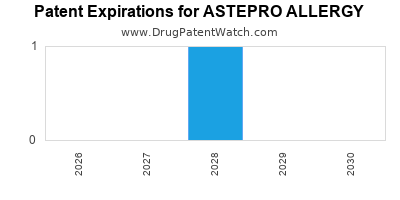
Astepro Allergy is a drug marketed by Bayer Hlthcare and is included in one NDA. There is one patent protecting this drug.

This drug has fifty patent family members in twenty-four countries.

The generic ingredient in ASTEPRO ALLERGY is azelastine hydrochloride. There are twelve drug master file entries for this compound. Twenty-two suppliers are listed for this compound. Additional details are available on the azelastine hydrochloride profile page.

DrugPatentWatch® Litigation and Generic Entry Outlook for Astepro Allergy

A generic version of ASTEPRO ALLERGY was approved as azelastine hydrochloride by APOTEX INC on April 30th, 2009.

  Start Trial

AI Deep Research
Questions you can ask:
  • What is the 5 year forecast for ASTEPRO ALLERGY?
  • What are the global sales for ASTEPRO ALLERGY?
  • What is Average Wholesale Price for ASTEPRO ALLERGY?
Summary for ASTEPRO ALLERGY
Recent Clinical Trials for ASTEPRO ALLERGY

Identify potential brand extensions & 505(b)(2) entrants

SponsorPhase
University of ChicagoPhase 4
Novella ClinicalPhase 4
Meda PharmaceuticalsPhase 4

See all ASTEPRO ALLERGY clinical trials

Pharmacology for ASTEPRO ALLERGY

US Patents and Regulatory Information for ASTEPRO ALLERGY

ASTEPRO ALLERGY is protected by one US patents.

Applicant Tradename Generic Name Dosage NDA Approval Date TE Type RLD RS Patent No. Patent Expiration Product Substance Delist Req. Exclusivity Expiration
Bayer Hlthcare ASTEPRO ALLERGY azelastine hydrochloride SPRAY, METERED;NASAL 213872-001 Jun 17, 2021 OTC Yes Yes 8,071,073 ⤷  Start Trial Y ⤷  Start Trial
>Applicant >Tradename >Generic Name >Dosage >NDA >Approval Date >TE >Type >RLD >RS >Patent No. >Patent Expiration >Product >Substance >Delist Req. >Exclusivity Expiration

Expired US Patents for ASTEPRO ALLERGY

Applicant Tradename Generic Name Dosage NDA Approval Date Patent No. Patent Expiration
Bayer Hlthcare ASTEPRO ALLERGY azelastine hydrochloride SPRAY, METERED;NASAL 213872-001 Jun 17, 2021 8,518,919 ⤷  Start Trial
Bayer Hlthcare ASTEPRO ALLERGY azelastine hydrochloride SPRAY, METERED;NASAL 213872-001 Jun 17, 2021 9,919,050 ⤷  Start Trial
>Applicant >Tradename >Generic Name >Dosage >NDA >Approval Date >Patent No. >Patent Expiration

International Patents for ASTEPRO ALLERGY

See the table below for patents covering ASTEPRO ALLERGY around the world.

Country Patent Number Title Estimated Expiration
Denmark 2522365 ⤷  Start Trial
Turkey 201820559 ⤷  Start Trial
Spain 2617255 ⤷  Start Trial
Japan 2013047253 COMPOSITION COMPRISING AZELASTINE AND METHOD OF USE THEREOF ⤷  Start Trial
European Patent Office 2486942 COMPOSITIONS COMPORTANT DE L'AZELASTINE ET LEURS PROCEDES D'UTILISATION (COMPOSITIONS COMPRISING AZELASTINE AND METHODS OF USE THEREOF) ⤷  Start Trial
Australia 2012201428 Compositions comprising azelastine and methods of use thereof ⤷  Start Trial
Lithuania 2486942 ⤷  Start Trial
>Country >Patent Number >Title >Estimated Expiration

Supplementary Protection Certificates for ASTEPRO ALLERGY

Patent Number Supplementary Protection Certificate SPC Country SPC Expiration SPC Description
1519731 C300740 Netherlands ⤷  Start Trial PRODUCT NAME: AZELASTINE OF EEN; NAT. REGISTRATION NO/DATE: RVG114215 20141125; FIRST REGISTRATION: 2011/07125-REG 20130215
0316633 99C0012 Belgium ⤷  Start Trial PRODUCT NAME: AZELASTINE HYDROCHLORIDE; NAT. REGISTRATION NO/DATE: 31 IS 113 F 13 19981021; FIRST REGISTRATION: GB PL 08336/0083 19980218
1519731 13C0067 France ⤷  Start Trial PRODUCT NAME: AZELASTINE OU SES SELS PHARMACEUTIQUEMENT ACCEPTABLES ET UN ESTER PHARMACEUTIQUEMENT ACCEPTABLE DE FLUTICASONE; NAT. REGISTRATION NO/DATE: NL41755 20130925; FIRST REGISTRATION: SK - 24/0055/13-S 20130215
1519731 92269 Luxembourg ⤷  Start Trial PRODUCT NAME: AZELASTINE,OU UN SEL PHARMACEUTIQUEMENT ACCEPTABLE DE CELUICI,ET UN ESTER PHARMACEUTIQUEMENT ACCEPTABLE DE FLUTICASONE
>Patent Number >Supplementary Protection Certificate >SPC Country >SPC Expiration >SPC Description

ASTEPRO ALLERGY: Market Dynamics and Financial Trajectory

Last updated: February 19, 2026

Astpro Allergy, a prescription nasal spray containing the corticosteroid azelastine hydrochloride, has established a distinct market position. Its efficacy in treating allergic rhinitis symptoms drives sales, while ongoing patent challenges and the introduction of generic alternatives present financial considerations.

What is the current market landscape for Astpro Allergy?

The market for allergic rhinitis treatments is substantial and competitive. Astpro Allergy competes with other intranasal corticosteroids, antihistamines, and combination therapies. Key market drivers include the prevalence of allergic rhinitis, increasing awareness of treatment options, and the demand for effective symptom relief. Market penetration is influenced by physician prescribing habits, formulary coverage by payers, and direct-to-consumer advertising.

The global allergic rhinitis market was valued at approximately $16.2 billion in 2022 and is projected to reach $22.5 billion by 2028, growing at a compound annual growth rate (CAGR) of 5.6% [1]. Astpro Allergy operates within this segment, facing competition from established brands and emerging generics.

What are the key intellectual property considerations for Astpro Allergy?

The patent protection for Astpro Allergy is critical to its financial performance. The drug's primary patent was set to expire in 2024 [2]. However, the landscape of patent protection for pharmaceuticals is complex, involving base patents, formulation patents, and method-of-use patents.

Challenges to patent validity and the emergence of Paragraph IV certifications for generic drug applications can significantly impact market exclusivity and revenue. Companies seeking to introduce generic versions of Astpro Allergy must navigate these patent barriers.

A critical factor is the outcome of patent litigation. Legal challenges can result in early generic entry, thereby eroding market share and price for the branded product. Conversely, successful defense of patents extends exclusivity.

How have generic entries impacted Astpro Allergy's market share and pricing?

The introduction of generic versions of azelastine hydrochloride nasal spray is a direct threat to Astpro Allergy's market share and revenue. Generic competition typically leads to a significant decrease in the price of the drug. Pharmaceutical companies often see revenue decline by 70-90% within the first year of generic entry [3].

Data on specific Astpro Allergy generic entry dates and their precise market impact is proprietary and not publicly available. However, industry trends indicate that once generic azelastine hydrochloride products become available, payers often favor the lower-cost alternatives, leading to reduced prescriptions for the branded product.

The financial trajectory of Astpro Allergy will be heavily influenced by the timing and extent of generic erosion. Companies must strategize for this inevitable shift, which may involve portfolio diversification or life-cycle management initiatives.

What is the financial trajectory of Astpro Allergy?

The financial trajectory of Astpro Allergy is characterized by an initial period of strong sales driven by market exclusivity, followed by a projected decline due to generic competition.

Prior to significant generic entry, sales are typically driven by physician adoption, marketing efforts, and patient demand. For instance, prescription data from the U.S. shows Astpro Allergy has achieved a notable number of prescriptions annually [4]. However, this trend is expected to reverse as generic alternatives gain traction.

Sales figures for Astpro Allergy are reported by its manufacturer, Bausch Health Companies Inc. (formerly Valeant Pharmaceuticals International, Inc.). While specific quarterly or annual sales figures for Astpro Allergy are often aggregated within broader product category reports, the impact of generic competition on similar products has been consistently negative for branded revenues. For example, during the exclusivity period of other branded nasal sprays, peak sales were achieved, followed by sharp declines post-generic entry.

The company's financial reports will provide the most accurate, albeit often aggregated, data. Investors and analysts closely monitor patent expiration dates and generic approval timelines as key indicators of future revenue streams.

What are the future market and financial outlooks for Astpro Allergy?

The future outlook for Astpro Allergy is characterized by a decline in revenue driven by the increasing presence of generic azelastine hydrochloride nasal sprays. The market will likely shift towards cost-effective generic options as payers and patients seek to reduce healthcare expenditures.

Bausch Health may pursue strategies to mitigate this decline, such as focusing on other product lines, seeking new indications, or engaging in aggressive marketing for remaining branded market share among specific patient demographics or in regions with delayed generic entry.

The market for allergic rhinitis treatments will continue to grow, but this growth will predominantly benefit generic manufacturers and newer, differentiated branded products with extended patent protection. Astpro Allergy’s financial performance is expected to contract significantly post-generic entry.

Key Takeaways

  • Astpro Allergy is a prescription nasal spray for allergic rhinitis, operating in a competitive market.
  • Its patent protection is a critical factor, with expiration and subsequent generic entry poised to significantly impact market exclusivity and revenue.
  • Generic competition typically leads to substantial price erosion and loss of market share for branded drugs.
  • The financial trajectory of Astpro Allergy is expected to shift from growth during its exclusivity period to a decline following generic market entry.
  • Future market and financial outlooks indicate a contraction in revenue for Astpro Allergy due to generic alternatives.

Frequently Asked Questions

  1. When did the primary patent for Astpro Allergy expire or is scheduled to expire? The primary patent for Astpro Allergy was scheduled to expire in 2024. Specific details of patent extensions or early terminations are subject to legal proceedings and are not always publicly disclosed until finalized.

  2. What are the main symptoms of allergic rhinitis that Astpro Allergy treats? Astpro Allergy treats symptoms of allergic rhinitis, including nasal congestion, runny nose, sneezing, and itchy nose.

  3. Are there currently any approved generic versions of Astpro Allergy available in the United States? Information regarding specific generic approvals can be found through the U.S. Food and Drug Administration's (FDA) database. The availability of generics depends on successful patent challenges and regulatory approval.

  4. How does Astpro Allergy compare in efficacy to other intranasal corticosteroids? Clinical trials and head-to-head comparisons typically inform the relative efficacy of Astpro Allergy against other intranasal corticosteroids. Efficacy profiles can vary in terms of onset of action, duration of relief, and specific symptom control.

  5. What is Bausch Health's strategy for managing the lifecycle of Astpro Allergy in the face of generic competition? While specific company strategies are often proprietary, typical approaches include focusing on specific patient segments, leveraging marketing and physician relationships, or seeking to extend market exclusivity through new formulations or indications.

Citations

[1] Grand View Research. (2023). Allergic Rhinitis Market Size, Share & Trends Analysis Report. [2] U.S. Patent and Trademark Office. (n.d.). Patent Database Search. (Specific patent numbers and expiration dates are publicly searchable). [3] Pharmaceutical Research and Manufacturers of America. (n.d.). The Value of Biopharmaceuticals: Innovation that Benefits Patients. [4] IQVIA. (n.d.). Prescription Data Analytics. (Specific prescription data is proprietary and accessed through market research firms).

More… ↓

⤷  Start Trial

Make Better Decisions: Try a trial or see plans & pricing

Drugs may be covered by multiple patents or regulatory protections. All trademarks and applicant names are the property of their respective owners or licensors. Although great care is taken in the proper and correct provision of this service, thinkBiotech LLC does not accept any responsibility for possible consequences of errors or omissions in the provided data. The data presented herein is for information purposes only. There is no warranty that the data contained herein is error free. We do not provide individual investment advice. This service is not registered with any financial regulatory agency. The information we publish is educational only and based on our opinions plus our models. By using DrugPatentWatch you acknowledge that we do not provide personalized recommendations or advice. thinkBiotech performs no independent verification of facts as provided by public sources nor are attempts made to provide legal or investing advice. Any reliance on data provided herein is done solely at the discretion of the user. Users of this service are advised to seek professional advice and independent confirmation before considering acting on any of the provided information. thinkBiotech LLC reserves the right to amend, extend or withdraw any part or all of the offered service without notice.