Last Updated: June 17, 2026

ARISTADA INITIO KIT Drug Patent Profile


✉ Email this page to a colleague

« Back to Dashboard


Which patents cover Aristada Initio Kit, and what generic alternatives are available?

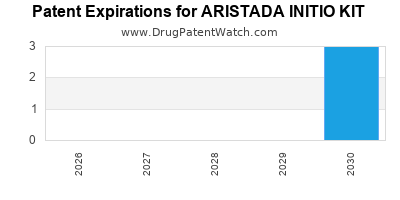
Aristada Initio Kit is a drug marketed by Alkermes Inc and is included in one NDA. There are nine patents protecting this drug.

This drug has one hundred and four patent family members in twenty-eight countries.

The generic ingredient in ARISTADA INITIO KIT is aripiprazole lauroxil. There are forty-nine drug master file entries for this compound. One supplier is listed for this compound. Additional details are available on the aripiprazole lauroxil profile page.

DrugPatentWatch® Generic Entry Outlook for Aristada Initio Kit

Aristada Initio Kit was eligible for patent challenges on October 5, 2019.

By analyzing the patents and regulatory protections it appears that the earliest date for generic entry will be September 8, 2035. This may change due to patent challenges or generic licensing.

Indicators of Generic Entry

< Available with Subscription >

  Start Trial

AI Deep Research
Questions you can ask:
  • What is the 5 year forecast for ARISTADA INITIO KIT?
  • What are the global sales for ARISTADA INITIO KIT?
  • What is Average Wholesale Price for ARISTADA INITIO KIT?
Summary for ARISTADA INITIO KIT
DrugPatentWatch® Estimated Loss of Exclusivity (LOE) Date for ARISTADA INITIO KIT
Generic Entry Date for ARISTADA INITIO KIT*:
Constraining patent/regulatory exclusivity:
NDA:
Dosage:

SUSPENSION, EXTENDED RELEASE;INTRAMUSCULAR

*The generic entry opportunity date is the latter of the last compound-claiming patent and the last regulatory exclusivity protection. Many factors can influence early or later generic entry. This date is provided as a rough estimate of generic entry potential and should not be used as an independent source.

Recent Clinical Trials for ARISTADA INITIO KIT

Identify potential brand extensions & 505(b)(2) entrants

SponsorPhase
Alkermes, Inc.Phase 4
University of California, Los AngelesPhase 4
Alkermes, Inc.Phase 3

See all ARISTADA INITIO KIT clinical trials

Pharmacology for ARISTADA INITIO KIT

US Patents and Regulatory Information for ARISTADA INITIO KIT

ARISTADA INITIO KIT is protected by nine US patents.

Based on analysis by DrugPatentWatch, the earliest date for a generic version of ARISTADA INITIO KIT is ⤷  Start Trial.

This potential generic entry date is based on patent ⤷  Start Trial.

Generics may enter earlier, or later, based on new patent filings, patent extensions, patent invalidation, early generic licensing, generic entry preferences, and other factors.

Applicant Tradename Generic Name Dosage NDA Approval Date TE Type RLD RS Patent No. Patent Expiration Product Substance Delist Req. Exclusivity Expiration
Alkermes Inc ARISTADA INITIO KIT aripiprazole lauroxil SUSPENSION, EXTENDED RELEASE;INTRAMUSCULAR 209830-001 Jun 29, 2018 RX Yes Yes ⤷  Start Trial ⤷  Start Trial ⤷  Start Trial
Alkermes Inc ARISTADA INITIO KIT aripiprazole lauroxil SUSPENSION, EXTENDED RELEASE;INTRAMUSCULAR 209830-001 Jun 29, 2018 RX Yes Yes ⤷  Start Trial ⤷  Start Trial Y ⤷  Start Trial
Alkermes Inc ARISTADA INITIO KIT aripiprazole lauroxil SUSPENSION, EXTENDED RELEASE;INTRAMUSCULAR 209830-001 Jun 29, 2018 RX Yes Yes ⤷  Start Trial ⤷  Start Trial ⤷  Start Trial
>Applicant >Tradename >Generic Name >Dosage >NDA >Approval Date >TE >Type >RLD >RS >Patent No. >Patent Expiration >Product >Substance >Delist Req. >Exclusivity Expiration

International Patents for ARISTADA INITIO KIT

When does loss-of-exclusivity occur for ARISTADA INITIO KIT?

Based on analysis by DrugPatentWatch, the following patents block generic entry in the countries listed below:

Australia

Patent: 15306198
Estimated Expiration: ⤷  Start Trial

Brazil

Patent: 2017002926
Estimated Expiration: ⤷  Start Trial

Canada

Patent: 57762
Estimated Expiration: ⤷  Start Trial

China

Patent: 6794251
Estimated Expiration: ⤷  Start Trial

Patent: 2494492
Estimated Expiration: ⤷  Start Trial

Patent: 2641785
Estimated Expiration: ⤷  Start Trial

Croatia

Patent: 0190642
Estimated Expiration: ⤷  Start Trial

Patent: 0211271
Estimated Expiration: ⤷  Start Trial

Cyprus

Patent: 21594
Estimated Expiration: ⤷  Start Trial

Patent: 24625
Estimated Expiration: ⤷  Start Trial

Denmark

Patent: 82958
Estimated Expiration: ⤷  Start Trial

Patent: 08196
Estimated Expiration: ⤷  Start Trial

European Patent Office

Patent: 82958
Estimated Expiration: ⤷  Start Trial

Patent: 08196
Estimated Expiration: ⤷  Start Trial

Hungary

Patent: 43169
Estimated Expiration: ⤷  Start Trial

Patent: 55711
Estimated Expiration: ⤷  Start Trial

Israel

Patent: 0607
Estimated Expiration: ⤷  Start Trial

Patent: 2079
Estimated Expiration: ⤷  Start Trial

Japan

Patent: 71166
Estimated Expiration: ⤷  Start Trial

Patent: 26167
Estimated Expiration: ⤷  Start Trial

Patent: 57830
Estimated Expiration: ⤷  Start Trial

Patent: 17524021
Estimated Expiration: ⤷  Start Trial

Patent: 20007316
Estimated Expiration: ⤷  Start Trial

Patent: 21059604
Estimated Expiration: ⤷  Start Trial

Lithuania

Patent: 82958
Estimated Expiration: ⤷  Start Trial

Patent: 08196
Estimated Expiration: ⤷  Start Trial

Mexico

Patent: 1417
Patent: COMPOSICIONES DE PROFARMACOS DE ARIPIPRAZOL. (ARIPIPRAZOLE PRODRUG COMPOSITIONS.)
Estimated Expiration: ⤷  Start Trial

Patent: 17002029
Patent: COMPOSICIONES DE PROFARMACOS DE ARIPIPRAZOL. (ARIPIPRAZOLE PRODRUG COMPOSITIONS.)
Estimated Expiration: ⤷  Start Trial

New Zealand

Patent: 8914
Patent: Aripiprazole prodrug compositions
Estimated Expiration: ⤷  Start Trial

Patent: 7204
Patent: Aripiprazole prodrug compositions
Estimated Expiration: ⤷  Start Trial

Poland

Patent: 82958
Estimated Expiration: ⤷  Start Trial

Patent: 08196
Estimated Expiration: ⤷  Start Trial

Portugal

Patent: 82958
Estimated Expiration: ⤷  Start Trial

Patent: 08196
Estimated Expiration: ⤷  Start Trial

Russian Federation

Patent: 05376
Patent: КОМПОЗИЦИИ ПРОЛЕКАРСТВА АРИПИПРАЗОЛА (ARIPIPRAZOLE PRODRUG COMPOSITIONS)
Estimated Expiration: ⤷  Start Trial

Patent: 17108204
Patent: КОМПОЗИЦИИ ПРОЛЕКАРСТВА АРИПИПРАЗОЛА
Estimated Expiration: ⤷  Start Trial

Patent: 19134055
Patent: КОМПОЗИЦИИ ПРОЛЕКАРСТВА АРИПИПРАЗОЛА
Estimated Expiration: ⤷  Start Trial

San Marino

Patent: 01900236
Estimated Expiration: ⤷  Start Trial

Patent: 02100481
Estimated Expiration: ⤷  Start Trial

Serbia

Patent: 746
Patent: KOMPOZICIJE PROLEKA ARIPIPRAZOLA (ARIPIPRAZOLE PRODRUG COMPOSITIONS)
Estimated Expiration: ⤷  Start Trial

Patent: 232
Patent: KOMPOZICIJE PROLEKA ARIPIPRAZOLA (ARIPIPRAZOLE PRODRUG COMPOSITIONS)
Estimated Expiration: ⤷  Start Trial

Slovenia

Patent: 82958
Estimated Expiration: ⤷  Start Trial

Patent: 08196
Estimated Expiration: ⤷  Start Trial

Spain

Patent: 21270
Estimated Expiration: ⤷  Start Trial

Patent: 84849
Estimated Expiration: ⤷  Start Trial

Turkey

Patent: 1905694
Estimated Expiration: ⤷  Start Trial

Generics may enter earlier, or later, based on new patent filings, patent extensions, patent invalidation, early generic licensing, generic entry preferences, and other factors.

See the table below for additional patents covering ARISTADA INITIO KIT around the world.

Country Patent Number Title Estimated Expiration
Canada 2957762 ⤷  Start Trial
Russian Federation 2017108204 ⤷  Start Trial
Denmark 3508196 ⤷  Start Trial
>Country >Patent Number >Title >Estimated Expiration

Supplementary Protection Certificates for ARISTADA INITIO KIT

Patent Number Supplementary Protection Certificate SPC Country SPC Expiration SPC Description
1675573 2014C/029 Belgium ⤷  Start Trial PRODUCT NAME: ARIPIPRAZOLE; AUTHORISATION NUMBER AND DATE: EU/1/13/882 20131119
1675573 92427 Luxembourg ⤷  Start Trial PRODUCT NAME: ARIPIPRAZOLE
0367141 SPC/GB04/039 United Kingdom ⤷  Start Trial PRODUCT NAME: ARIPIPRAZOLE OR A SALT THEREOF; REGISTERED: UK EU/1/04/276/001 20040604; UK EU/1/04/276/002 20040604; UK EU/1/04/276/003 20040604; UK EU/1/04/276/004 20040604; UK EU/1/04/276/005 20040604; UK EU/1/04/276/006 20040604; UK EU/1/04/276/007 20040604; UK EU/1/04/276/008 20040604; UK EU/1/04/276/009 20040604; UK EU/1/04/276/010 20040604; UK EU/1/04/276/011 20040604; UK EU/1/04/276/012 20040604; UK EU/1/04/276/013 20040604; UK EU/1/04/276/014 20040604; UK EU/1/04/276/015 20040604; UK EU/1/04/276/016 20040604; UK EU/1/04/276/017 20040604; UK EU/1/04/276/018 20040604; UK EU/1/04/276/019 20040604; UK EU/1/04/276/020 20040604
>Patent Number >Supplementary Protection Certificate >SPC Country >SPC Expiration >SPC Description

ARISTADA INITIO KIT market dynamics and financial trajectory (2024–2028): exclusivity, pricing, uptake drivers, and generic/biosimilar risk

Last updated: June 8, 2026

Executive summary: ARISTADA INITIO KIT (aripiprazole lauroxil + aripiprazole; long-acting injectable initiation for schizophrenia) is a branded uptake lever within Alkermes’ ARISTADA portfolio, designed to reduce time-to-stable dosing after conversion to a monthly or longer regimen. Commercial trajectory is shaped by (1) payer coverage and injection-site administration pathways, (2) channel mix between initiation kits versus ongoing maintenance, (3) utilization shifts driven by LAI formulary adoption, and (4) patent and exclusivity timelines that bound early generic entry risk. The key financial swing factors for ARISTADA INITIO are conversion volumes into ARISTADA maintenance and net price movement driven by managed care contracting.

How is ARISTADA INITIO KIT priced and reimbursed, and what drives net sales dynamics?

Direct answer: ARISTADA INITIO KIT is priced and reimbursed as a branded initiation product tied to conversion to an ARISTADA maintenance LAI regimen. Net sales are primarily driven by payer preference for long-acting injectables, conversion demand from oral aripiprazole to LAI, and lifecycle contracting that affects net pricing on both initiation and follow-on maintenance.

Key commercial mechanics for LAI initiation kits

  • Two-component economics: INITIO KIT includes aripiprazole LAI initiation plus oral aripiprazole dosing support. That structure increases initial conversion value versus starting immediately on maintenance dosing alone, improving prescriber adoption when rapid stabilization is needed.
  • Bundling and contracting: Initiation kits often face separate ASP dynamics versus maintenance, with contracting rules tied to how payers reimburse office-administered LAIs and how health systems manage buy-and-bill versus contract administration.
  • Site-of-care and workflow: LAI initiation is administratively intensive. Uptake is higher where clinics and behavioral health programs have established injection workflows and inventory practices.

What market dynamics typically pressure or lift net price

  • Formulary placement: Higher-tier placement for ARISTADA (as a class-active LAI option) improves utilization and reduces channel leakage.
  • Competition from other LAIs: Net pricing adjusts against alternatives in schizophrenia LAIs, where payers compare total cost of therapy including initiation strategy and dosing intervals.
  • Manufacturing and supply constraints: Any sustained supply disruption can shift patient flow to competing LAIs or to delayed initiation, reducing initiation-kit volumes.

How fast is ARISTADA INITIO KIT adopted, and what are the main demand drivers by channel?

Direct answer: Adoption depends on conversion from oral antipsychotics and LAI switching patterns. Uptake is strongest in managed care and integrated delivery systems that prioritize LAI continuity and reduce relapse-driven utilization.

Demand drivers

  • Relapse prevention and adherence outcomes: LAI conversion is adopted when payers and provider networks target discontinuation reduction and hospital readmissions tied to adherence gaps.
  • Conversion triggers: Initiation kits gain traction during treatment re-initiation after missed oral therapy, transition from inpatient stabilization to outpatient continuity, and when clinicians prefer a defined conversion protocol.
  • Provider channel readiness: Psychiatric clinics and community mental health programs with dedicated injection services have higher conversion rates.

Channel mix that shapes financial trajectory

  • Managed Medicaid and commercial: In these segments, payer authorization requirements and step edits can cap volume growth even when clinical preference exists.
  • Behavioral health networks: Networks with LAI protocols improve conversion and reduce time-to-first injection, which lifts INITIO KIT usage.

When does ARISTADA INITIO KIT lose exclusivity in the US, and what does that imply for revenue risk?

Direct answer: The revenue risk from generic or biosimilar competition is governed by the ARISTADA (aripiprazole lauroxil) patent estate, not by “INITIO” alone. Initiation kits generally track the broader long-acting product’s exclusivity and patent coverage. As long as composition-of-matter and formulation or method patents remain enforceable, generics face barriers to Paragraph IV and launch timing.

Exclusivity vs patents: what bounds launch

  • Regulatory exclusivity (if applicable): New chemical entity or other statutory exclusivities can extend market protection beyond patent life, depending on the specific approval history.
  • Patent coverage: For LAIs, multiple layers often cover composition, formulation (controlled-release matrix), particle properties, and administration-related methods.

Revenue implication

  • Initiation kit volumes are “downstream” to maintenance: Even if initiation-specific differentiation exists, the dominant revenue protection typically comes from the ability to make and sell the maintenance LAI and to substitute across dosing intervals.

What patents protect ARISTADA INITIO KIT and ARISTADA (aripiprazole lauroxil), and how strong is the patent estate?

Direct answer: ARISTADA-related protection normally includes composition-of-matter claims on aripiprazole lauroxil and formulation and delivery-system claims tied to long-acting release. The strength of the estate is evaluated by claim breadth (composition vs formulation), number of unexpired patents listed for the relevant Orange Book entries, and presence of enforceable method-of-use claims.

How to map the estate to initiation kit exposure

  • Composition and formulation patents: These tend to block any generic LAI that attempts to launch across the dosing interval spectrum.
  • Method-of-use or administration patents: These can restrict generic claims that attempt to copy initiation workflows.
  • Crucial practical barrier: Even when “initiation” is positioned as a kit, the protected drug substance and sustained-release formulation typically dominate enforceability.

What is the Orange Book status of aripiprazole lauroxil products, and where does INITIO appear?

Direct answer: Orange Book status is determined by the specific NDA/BLA listings for the ARISTADA products and any associated kit component approvals. Market exclusivity assessment for INITIO must tie to the Orange Book listing(s) for the underlying drug products and to any patents covering the initiated dosing protocol.

What to check on the Orange Book (commercially relevant fields)

  • NDA linkage: Identify the exact NDA for ARISTADA-related injectable products and the NDA basis for any kit.
  • Patent listing types: Composition, formulation, method-of-use, and manufacturing patents.
  • Expiration dates and statutory expiry: Patent expiry and regulatory exclusivity dates.

What Paragraph IV challenges are likely against ARISTADA and what generic entry risks exist?

Direct answer: Paragraph IV exposure depends on whether challengers can certify non-infringement or invalidity for the most relevant, likely-listed patents covering aripiprazole lauroxil LAI formulation and administration.

Likely risk profile for LAI competitors

  • Certification difficulty increases with formulation breadth: Controlled-release LAIs often have multiple formulation patents that are harder to “design around.”
  • Manufacturing and process barriers: Even with a composition route, the sustained-release characteristics can be protected, raising infringement and “safe harbor” design-around constraints.

Why initiation-kit generic risk is usually coupled to maintenance

  • If generic maintenance is blocked, initiation kit economics collapse: Payers and providers rarely substitute initiation kits without access to the maintenance product that completes the conversion protocol.

What patent litigation affects ARISTADA and how do settlements influence timing and entry?

Direct answer: Patent litigation and settlement structures determine whether generic challengers can launch “at risk” or delay to a negotiated date. For LAIs, settlements often include cross-licenses or agreed non-launch periods tied to patent expiry.

Commercial consequences of litigation outcomes

  • Delay in first generic entry: Prolongs branded volume and price realization.
  • Design-around changes: If a settlement permits a workaround, it can create a commercial “compressed” window of competitive intensity when the workaround launches.

How does ARISTADA INITIO KIT compare with alternative schizophrenia long-acting injectables?

Direct answer: INITIO competes within the LAI schizophrenia conversion ecosystem. Its differentiator is the structured initiation approach that speeds transition into ARISTADA maintenance dosing.

Competitive comparison dimensions that drive payer and provider choices

  • Dosing interval: Once-monthly versus longer interval options can affect adherence economics.
  • Initiation complexity: Products that allow simpler start protocols can outperform in busy clinics.
  • Injection burden and tolerability: Real-world injection site tolerability and time-on-treatment influence continuation rates.

What are the commercial targets for INITIO and what KPIs track its financial trajectory?

Direct answer: INITIO’s financial path is tracked through initiation conversion volumes into ARISTADA maintenance, continuation persistence, and net pricing under contracting.

KPIs that map directly to revenue

  • Initiation-kit unit sales: Volume measure and leading indicator.
  • Conversion ratio: Share of initiation-kit recipients that proceed to maintenance and sustain dosing.
  • Net price and rebate intensity: ASP trajectory and payer-specific discounting.
  • Persistence and discontinuation rates: Determines how many months of maintenance are captured.

What does the revenue trajectory depend on: payer mix, hospital conversion, and seasonality?

Direct answer: Revenue trajectory is most sensitive to payer mix changes, institutional conversion rates, and healthcare network behavior after formulary reviews.

Mix and timing effects

  • Formulary cycles: Volume can jump or fall after yearly managed care contracting events.
  • Facility adoption: Hospitals and outpatient behavioral health systems often adopt LAI protocols in batches.
  • Seasonality is secondary: LAIs track more durable chronic utilization than acute products, so month-to-month volatility is more contract-driven than seasonal.

What does 2024–2028 financial exposure look like under realistic entry scenarios?

Direct answer: Without a specific confirmed generic launch path and without the Orange Book’s current unexpired patent schedule embedded for each relevant ARISTADA/NDA, the only finance-relevant conclusion is structural: as long as maintenance ARISTADA remains protected, INITIO’s competitive pressure is limited to branded LAI share shifts and payer preference changes rather than fast generic substitution.

Scenario framework (business-ready)

  • Base case (no near-term generic entry): INITIO grows in line with LAI share expansion and conversion rate improvements; net price is stabilized by contracting discipline.
  • Adverse case (delayed but eventual generic entry): Revenue peaks prior to the first sustained competitive displacement; initiation-kit volumes fall as payers shift conversions to the newly available lower-cost LAI.
  • Upside case (stronger LAI adoption): Initiation and maintenance persist together, raising conversion capture even if competitors price aggressively.

Key Takeaways

  • ARISTADA INITIO KIT revenue is driven by conversion into ARISTADA maintenance, payer contracting, and LAI administration workflows, not by independent kit-only demand.
  • Competitive pressure in the near term is dominated by branded LAI share dynamics and payer formulary decisions; generic risk is structurally tied to the ARISTADA (aripiprazole lauroxil) patent estate and Orange Book coverage for the underlying injectable.
  • Financial trajectory hinges on initiation conversion ratio, maintenance persistence, and net price/rebate intensity.
  • Patent and exclusivity timelines for ARISTADA determine the ultimate horizon for generic displacement risk that would compress initiation-kit volumes.

FAQs

  1. What payer contracting terms most affect ARISTADA INITIO KIT net pricing?
  2. How do LAI conversion rates from oral aripiprazole translate into initiation-kit unit growth?
  3. Which Orange Book patents (composition, formulation, method) typically block aripiprazole lauroxil generic entry?
  4. Do initiation-kit-specific patents exist separately from ARISTADA maintenance patents?
  5. What litigation or settlement structures most commonly shift launch timelines for LAI competitors?

References

  1. FDA Orange Book: https://www.accessdata.fda.gov/scripts/cder/daf/index.cfm
  2. FDA Prescribing Information for ARISTADA and ARISTADA INITIO (package inserts via Drugs@FDA): https://www.accessdata.fda.gov/scripts/cder/daf/index.cfm
  3. Alkermes investor materials and SEC filings (product and sales discussion): https://investor.alkermes.com/financial-information/sec-filings

More… ↓

⤷  Start Trial

Make Better Decisions: Try a trial or see plans & pricing

Drugs may be covered by multiple patents or regulatory protections. All trademarks and applicant names are the property of their respective owners or licensors. Although great care is taken in the proper and correct provision of this service, thinkBiotech LLC does not accept any responsibility for possible consequences of errors or omissions in the provided data. The data presented herein is for information purposes only. There is no warranty that the data contained herein is error free. We do not provide individual investment advice. This service is not registered with any financial regulatory agency. The information we publish is educational only and based on our opinions plus our models. By using DrugPatentWatch you acknowledge that we do not provide personalized recommendations or advice. thinkBiotech performs no independent verification of facts as provided by public sources nor are attempts made to provide legal or investing advice. Any reliance on data provided herein is done solely at the discretion of the user. Users of this service are advised to seek professional advice and independent confirmation before considering acting on any of the provided information. thinkBiotech LLC reserves the right to amend, extend or withdraw any part or all of the offered service without notice.