Share This Page
ARANELLE Drug Patent Profile
✉ Email this page to a colleague
Which patents cover Aranelle, and what generic alternatives are available?
Aranelle is a drug marketed by Barr and is included in one NDA.
The generic ingredient in ARANELLE is ethinyl estradiol; norethindrone. There is one drug master file entry for this compound. Fourteen suppliers are listed for this compound. Additional details are available on the ethinyl estradiol; norethindrone profile page.
AI Deep Research
Questions you can ask:
- What is the 5 year forecast for ARANELLE?
- What are the global sales for ARANELLE?
- What is Average Wholesale Price for ARANELLE?
Summary for ARANELLE
| US Patents: | 0 |
| Applicants: | 1 |
| NDAs: | 1 |
| Finished Product Suppliers / Packagers: | 1 |
| Raw Ingredient (Bulk) Api Vendors: | 6 |
| Patent Applications: | 219 |
| Drug Prices: | Drug price information for ARANELLE |
| DailyMed Link: | ARANELLE at DailyMed |
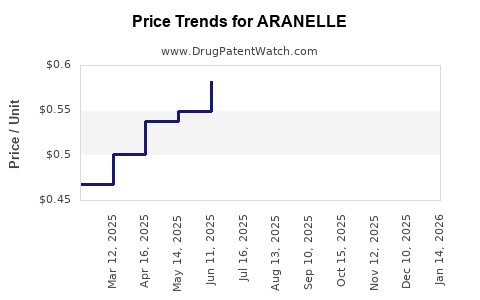
US Patents and Regulatory Information for ARANELLE
| Applicant | Tradename | Generic Name | Dosage | NDA | Approval Date | TE | Type | RLD | RS | Patent No. | Patent Expiration | Product | Substance | Delist Req. | Exclusivity Expiration |
|---|---|---|---|---|---|---|---|---|---|---|---|---|---|---|---|
| Barr | ARANELLE | ethinyl estradiol; norethindrone | TABLET;ORAL-28 | 076783-001 | Sep 29, 2004 | AB | RX | No | No | ⤷ Start Trial | ⤷ Start Trial | ⤷ Start Trial | |||
| >Applicant | >Tradename | >Generic Name | >Dosage | >NDA | >Approval Date | >TE | >Type | >RLD | >RS | >Patent No. | >Patent Expiration | >Product | >Substance | >Delist Req. | >Exclusivity Expiration |
Aranelle Market Dynamics, Financial Trajectory, Patent Status, and Generic Competition
Aranelle is a legacy combined oral contraceptive containing norethindrone and ethinyl estradiol, with ferrous fumarate tablets in the 28-day pack. Its commercial position has weakened substantially because the product is mature, therapeutically substitutable, and reported as discontinued in the U.S. market. No reliable public source reports standalone Aranelle revenue, current unit volume, or a continuing brand-level financial forecast. Its economic value is therefore tied to residual brand demand, generic-equivalent sales, supply continuity, and the broader U.S. oral contraceptive market rather than to an active patent-protected franchise.
What is Aranelle and who marketed the drug?
Aranelle is a prescription estrogen-progestin oral contraceptive. The active hormonal ingredients are norethindrone and ethinyl estradiol. Ferrous fumarate tablets are included in the pack as nonhormonal tablets intended to maintain the daily dosing sequence.[1]
| Attribute | Aranelle |
|---|---|
| Active ingredients | Norethindrone and ethinyl estradiol |
| Dosage form | Oral tablet, 28-day pack |
| Therapeutic category | Combined hormonal contraceptive |
| Primary indication | Prevention of pregnancy |
| FDA regulatory pathway | Original U.S. New Drug Application |
| Market status | Legacy product; reported as discontinued in U.S. commercial references |
| Primary competition | Generic norethindrone/ethinyl estradiol products and other combined oral contraceptives |
| Biologic status | Not applicable |
| Biosimilar exposure | None |
| Patent-driven exclusivity | No apparent current commercial significance |
Historical FDA records identify Aranelle as an older approved oral contraceptive product. Public commercial references have listed the product as discontinued, although discontinuation of a brand does not mean that the active ingredients or equivalent dosage forms have left the market.[2]
The commercial distinction is important. Aranelle-specific brand demand may have disappeared or become negligible, while prescriptions can continue to be filled with equivalent norethindrone/ethinyl estradiol products.
When did Aranelle lose exclusivity?
Aranelle is a legacy small-molecule product whose original regulatory and patent exclusivity periods expired decades ago. The product does not have the characteristics of a current protected launch: it is not a new molecular entity, it has no biologic exclusivity period, and its competitive set includes generic oral contraceptives.
The original active-ingredient protection is no longer a meaningful barrier. Any remaining rights would have to arise from later patents covering a specific formulation, manufacturing process, delivery system, or method of use. No such active patent position is publicly associated with Aranelle as a significant commercial barrier.
Aranelle exclusivity timeline
| Period | Commercial significance |
|---|---|
| Original approval period | Brand oral contraceptive sold under FDA approval |
| Post-approval patent term | Original product and composition protection matured and expired |
| Generic-entry period | Equivalent norethindrone/ethinyl estradiol products entered the market |
| Current period | Product is commercially obsolete or discontinued in the U.S.; no meaningful patent moat |
An exact original patent-expiration date cannot be treated as the current commercial decision point. For a product of Aranelle’s age, the relevant question is whether any later-listed patent remains enforceable against an equivalent product. Public FDA and commercial records do not indicate that Aranelle retains a material Orange Book patent position.
What is the Orange Book status of Aranelle?
The FDA Orange Book distinguishes between approved applications, discontinued products, and listed patents. Aranelle’s commercial profile is consistent with an old approved product that no longer has an active brand franchise. The FDA’s discontinued-drug status does not itself revoke the underlying approval or prohibit equivalent products from being marketed under separate approvals.[3]
The practical Orange Book conclusions are:
- Aranelle is not a current high-value patent estate.
- No active Orange Book-listed patent is widely recognized as blocking generic norethindrone/ethinyl estradiol products.
- The product’s discontinued status reduces the relevance of an Aranelle-specific Paragraph IV dispute.
- Generic products can compete based on their own abbreviated new drug applications, labeling, manufacturing capability, and pharmacy contracting.
Orange Book status should be separated from commercial availability. A product may remain in regulatory records after a manufacturer stops selling it. Conversely, a generic equivalent can remain available even after the reference brand disappears.
What patents protect Aranelle?
No current patent portfolio is publicly associated with Aranelle that would support meaningful market exclusivity. The product’s original composition and formulation rights are long past the ordinary patent term. There is no apparent patent barrier comparable to the estates surrounding recently launched specialty medicines.
Formulation patents
Aranelle uses a conventional oral-tablet platform. Its formulation does not rely on a complex drug-delivery system, depot technology, transdermal system, implant, or extended-release mechanism. That limits the potential value of formulation-specific protection.
Any historical formulation patents would be unlikely to prevent competition from products containing the same active ingredients in therapeutically equivalent oral dosage forms. A generic manufacturer can often avoid a legacy formulation claim by using a different excipient system while preserving the same active ingredients, strength, dosage form, and labeling.
Method-of-use patents
Aranelle’s use is contraception, a broad and established indication. A method-of-use patent would have limited blocking value against a product marketed with standard contraceptive labeling unless the claim covered a narrow patient population, dosing regimen, or clinical use. No commercially significant active method-of-use patent is associated with Aranelle.
Manufacturing and supply-chain barriers
Manufacturing barriers are low relative to biologics and complex drug products. Oral contraceptive tablets require controlled handling of potent hormones, validated content uniformity, stability testing, packaging controls, and compliance with current good manufacturing practices. Those requirements create operational obligations but not a durable exclusionary moat.
The principal manufacturing risks are:
- Active pharmaceutical ingredient supply disruption.
- Batch failures involving low-dose hormone uniformity.
- Packaging and labeling errors in 28-day blister or calendar packs.
- Regulatory observations at contract manufacturing sites.
- Voluntary recalls or product discontinuations caused by low commercial margins.
These risks can affect availability without creating patent-based pricing power.
Are there Paragraph IV challenges to Aranelle?
No active, commercially material Paragraph IV challenge is associated with Aranelle. Paragraph IV litigation is generally relevant when a generic applicant challenges an unexpired Orange Book patent. Aranelle’s relevant product and composition protection are mature, and equivalent products have been commercially available.
For a legacy contraceptive, generic entry typically occurs through an abbreviated new drug application referencing the approved product or its therapeutic equivalent. Litigation risk would arise only if a new patent were listed or asserted against a specific generic product. There is no public indication that Aranelle supports such a current dispute.
What is the financial trajectory for Aranelle?
A standalone Aranelle financial trajectory cannot be derived from public company filings because manufacturers generally do not report revenue, gross margin, prescription volume, or cash flow for this individual legacy product. The appropriate assessment is a qualitative trajectory supported by product lifecycle and market structure.
| Financial driver | Direction | Effect on Aranelle |
|---|---|---|
| Brand price realization | Down | Generic substitution limits pricing |
| Prescription volume | Down or negligible | Brand discontinuation and therapeutic substitution |
| Gross margin | Down | Low-volume manufacturing and distribution costs |
| Promotional investment | Down | Limited return on brand promotion |
| Patent value | Negligible | No meaningful remaining exclusivity |
| Generic competition | High | Multiple substitute products |
| Supply-chain value | Moderate only if scarce | Availability can create temporary demand |
| Licensing value | Low | No apparent proprietary technology |
| Litigation value | Low | No active patent conflict identified |
Aranelle’s likely commercial trajectory is therefore:
- Initial brand growth following launch.
- Erosion after generic and substitute oral contraceptive products became available.
- Declining brand utilization as prescribers and pharmacies switched to lower-cost equivalents.
- Discontinuation or near-zero brand revenue.
- Residual economic activity shifting to generic active-ingredient products rather than the Aranelle name.
The product has limited value as a standalone licensing asset. Its value would be higher only if a buyer acquired an established regulatory file, manufacturing slot, supply contract, or rights in a market with limited local competition.
How does Aranelle compare with competing contraceptives?
Aranelle competes in a crowded market that includes generic norethindrone/ethinyl estradiol tablets, other combined oral contraceptives, progestin-only pills, long-acting reversible contraceptives, emergency contraceptives, vaginal rings, patches, and injectable products.
| Competitive category | Competitive advantage over Aranelle |
|---|---|
| Generic norethindrone/ethinyl estradiol | Lower price and pharmacy substitution |
| Other combined oral contraceptives | Broader dosing and progestin choices |
| Extended-cycle pills | Fewer scheduled withdrawal bleeds |
| Progestin-only pills | Option for patients who cannot use estrogen |
| Intrauterine systems | Long duration and reduced adherence burden |
| Subdermal implants | Multi-year contraception |
| Vaginal rings and patches | Alternative administration routes |
| Branded newer contraceptives | Differentiated positioning, packaging, or patient support |
Aranelle’s main weakness is the absence of a strong product differentiator. A conventional oral formulation has low switching costs. Prescribers can select another combined oral contraceptive based on price, formulary status, tolerability, adherence profile, or patient preference.
What is the FDA regulatory status of Aranelle?
Aranelle is an FDA-approved prescription contraceptive product, but public drug databases identify the product as discontinued in the U.S. The FDA’s discontinued designation does not establish a safety withdrawal. It generally indicates that the product is no longer being marketed or is no longer commercially available from the listed sponsor.[2,4]
A discontinued product can still have:
- An historical NDA record.
- Archived labeling.
- Historical safety information.
- Reference-product relevance for generic development.
- A continuing market presence through equivalent products.
No biosimilar pathway applies because Aranelle is a chemically synthesized small molecule. Regulatory competition is governed by generic-drug requirements, including pharmaceutical equivalence, bioequivalence, quality systems, and approved labeling.
Which companies are challenging or replacing Aranelle?
No current company appears to be pursuing an Aranelle-specific patent challenge of material commercial importance. Replacement has occurred through ordinary generic competition and therapeutic substitution.
The relevant competitive groups are:
- Generic manufacturers of norethindrone/ethinyl estradiol tablets.
- Manufacturers of alternative combined oral contraceptives.
- Long-acting contraceptive manufacturers.
- Retail and mail-order pharmacies using formulary substitution.
- Contract manufacturers supplying low-cost oral contraceptive products.
Company-level market share is difficult to attribute to Aranelle because prescriptions are often recorded under active ingredients, generic product names, or different brand names. A manufacturer may sell the same hormonal combination without using the Aranelle trademark.
What generic launch risks exist for Aranelle?
Generic launch risk is effectively realized rather than prospective. The key risk is not a future first generic launch but continuing substitution among existing generic suppliers.
For a manufacturer considering reintroducing Aranelle, the principal risks would be:
- Low reimbursement and limited brand recognition.
- Pharmacy substitution.
- Price compression.
- Contract-manufacturing minimums.
- Limited prescriber loyalty.
- Commodity-level competition.
- Potential shortages if only a few suppliers remain.
- Regulatory costs disproportionate to expected sales.
A relaunch could gain temporary value if generic supply becomes constrained or if the brand has residual patient recognition. That opportunity would be operational rather than patent-driven.
How strong is the Aranelle patent estate?
The Aranelle patent estate is weak for commercial purposes.
| Patent-estate factor | Assessment |
|---|---|
| Composition-of-matter protection | Expired |
| Original formulation protection | Expired or commercially immaterial |
| Method-of-use protection | No material active position identified |
| Delivery-system protection | Not applicable to the conventional tablet |
| Orange Book blocking power | No material current barrier identified |
| Paragraph IV leverage | Low |
| Licensing attractiveness | Low |
| Litigation leverage | Low |
| Geographic exclusivity | No meaningful U.S. exclusivity; foreign status must be assessed country by country |
Geographic rights may differ by country because approvals, trademarks, patents, and marketing status are jurisdiction-specific. The U.S. record does not establish availability or protection in Canada, Europe, Latin America, or other markets. In each jurisdiction, the relevant issues would be local registration status, national patent term, trademark ownership, pricing controls, and generic substitution rules.
Key Takeaways
- Aranelle is a legacy norethindrone/ethinyl estradiol oral contraceptive with ferrous fumarate tablets.
- The product is reported as discontinued in the U.S. commercial market.
- No reliable public source reports standalone Aranelle revenue or current prescription volume.
- Its original patent and regulatory exclusivity are no longer commercially meaningful.
- No material current Orange Book patent barrier or Aranelle-specific Paragraph IV dispute is evident.
- Generic and therapeutic substitution dominate the market.
- The product has low licensing, litigation, and relaunch value unless supply scarcity or a specific geographic opportunity changes the economics.
- Any continuing revenue associated with the active ingredients is more likely to accrue to generic manufacturers than to the Aranelle brand.
FAQs About Aranelle Market and Patent Status
Is Aranelle still available in the United States?
Public drug references report Aranelle as discontinued in the U.S. Equivalent norethindrone/ethinyl estradiol oral contraceptives may remain available under generic or other brand names.
Does Aranelle have an active U.S. patent?
No commercially significant active U.S. patent position is publicly associated with Aranelle. Its original product protection is mature.
Can a generic manufacturer launch Aranelle without a Paragraph IV filing?
A generic manufacturer generally competes through an abbreviated new drug application referencing the applicable approved product and addressing any listed patents. Because Aranelle has no apparent active blocking patent position, a current Paragraph IV dispute is unlikely to be central.
Is Aranelle interchangeable with all birth-control pills?
No. Aranelle is therapeutically substitutable only within the limits of the prescribed active ingredients, strengths, formulation, labeling, and patient-specific clinical considerations. Other contraceptives may contain different hormones or use different delivery systems.
Does Aranelle have biosimilar competition?
No. Biosimilars apply to biological products. Aranelle is a chemically synthesized small-molecule oral contraceptive and competes through generic-drug pathways.
References
-
DailyMed. (n.d.). Aranelle-28: Norethindrone and ethinyl estradiol tablet; ferrous fumarate tablet labeling. U.S. National Library of Medicine. https://dailymed.nlm.nih.gov/
-
Drugs.com. (n.d.). Aranelle drug information. https://www.drugs.com/
-
U.S. Food and Drug Administration. (n.d.). Orange Book: Approved drug products with therapeutic equivalence evaluations. https://www.accessdata.fda.gov/scripts/cder/ob/
-
U.S. Food and Drug Administration. (n.d.). Drugs@FDA: FDA-approved drugs database. https://www.accessdata.fda.gov/scripts/cder/daf/
More… ↓
