Last updated: July 28, 2026
Market dynamics and financial trajectory for AndroGel (testosterone gel): sales, payer pressure, generic and biosimilar risks, and exclusivity-driven outlook
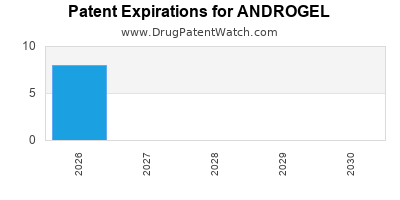
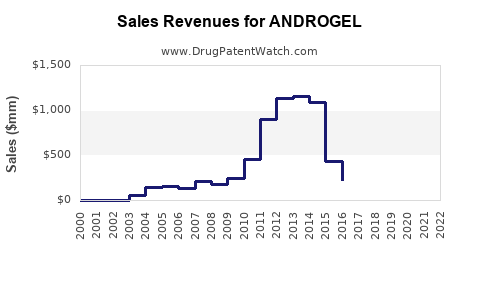
Executive summary: AndroGel (testosterone gel) has shifted from launch-era exclusivity to late-cycle competition driven by (1) long-term testosterone gel normalization, (2) increased payer scrutiny of testosterone replacement therapy (TRT) coverage, and (3) entry pressure from authorized generics and nonreference gel products after multiple product- and process-level patent expirations. The financial trajectory is typically characterized by plateauing branded revenue followed by margin compression and share erosion in geographies where lower-cost alternatives gained traction. The next revenue risk window is less about “single-date” loss of market exclusivity and more about continued price competition across strengths and formulations, plus ongoing label-limitation and utilization controls that reduce addressable demand.
What market dynamics drive AndroGel sales in TRT: payer coverage, guideline changes, and site-of-care shifts?
Short answer: AndroGel demand tracks TRT patient flows more than dosing mechanics, with coverage policy and prescriber behavior driving volume, and competitor pricing driving net sales per prescription.
Key demand drivers for testosterone gels
- Prevalence and screening intensity: Testosterone deficiency diagnosis rates influence prescription volume. Sales typically rise when screening and adherence to guideline-based prescribing expand, and soften when utilization management tightens.
- Adherence profile of gels: Gels hold share because they support daily dosing and avoid injection logistics. Patient preference and ease of use are recurring commercial advantages versus IM testosterone.
- Episodic “clinical risk” headwinds: Safety-related label scrutiny and changes in benefit-risk framing can reduce initiation and persistence, especially when payers impose step edits or require documentation.
Key payer and reimbursement dynamics
- Coverage controls: Many commercial and Medicare policies use criteria such as two morning testosterone measurements, symptom documentation, and exclusion of reversible causes. These mechanisms restrain new starts and reduce fill rates for borderline cases.
- Formulary positioning: Multi-product TRT formularies often rotate favored agents. When a gel faces formulary loss, volume can fall faster than any single competitor can ramp.
- Price pressure after entry: Once lower-cost gel options become established, branded pricing elasticity rises. Net sales per unit typically declines even if total TRT prescriptions remain stable.
How competitors affect AndroGel’s commercial performance
- Within-class competition: Other testosterone gels (and, in some payor plans, compounded topical testosterone or alternative strengths) can take share quickly when preferred-tier status shifts.
- Modalities competition: In some markets, injections gain share when payers favor lower acquisition cost or when administration infrastructure is less restrictive.
- Manufacturing reliability and supply: Topical TRT demand can be sensitive to product availability. Supply interruptions can temporarily boost competitors and later require re-acquisition of prescriber confidence.
How strong is AndroGel’s patent estate versus generic testosterone gels: what patents protect AndroGel?
Short answer: AndroGel’s protection historically spans composition-related coverage (testosterone), formulation and dosing pump technology if applicable to specific variants, and method-related claims for topical delivery and patient use. The practical implication is that patent-driven exclusivity is layered; even after core patents expire, remaining formulation and use claims can delay full generic substitution.
What typically sits in the AndroGel patent stack
- Topical formulation claims: Claims on specific concentrations, excipients, permeation properties, and gel delivery characteristics.
- Dosage regimen and method-of-use: Claims that tie to TRT patient management, dosing instructions, or titration patterns consistent with label language.
- Manufacturing process claims: Limits on specific mixing, filtration, stabilization, or packaging methods for maintaining testosterone integrity.
- Device or application features (if tied to a variant): Claims on pump dispensers, metering accuracy, or packaging configuration.
Why the “estate strength” matters commercially
- Orange Book leverage and launch timing: When Orange Book listings still cover the reference drug or key variants (by strength, package, or submission type), generic launch is delayed or segmented.
- Settlement-driven delay: Even with partial claim overlap, courts and settlements often produce staggered entry timing by strength or presentation.
When does AndroGel lose exclusivity and what generic entry risks exist: ANDA Paragraph IV and settlement patterns?
Short answer: For testosterone gel markets, entry risk is usually distributed across staggered filing and litigation events rather than a single “cliff.” Once listed patents expire or are cleared via litigation/settlement, generic and authorized-generic pressure generally accelerates and net revenue declines follow.
What to watch for in generic risk timing
- Orange Book patent expirations by listed claim: The earliest date controls “at-risk” ANDA timing; remaining patents drive whether launch is permitted in full (same strength and label) or constrained.
- Paragraph IV certifications: Certifications map to which patents are challenged. A “successful” challenge often supports early launch of a subset of products first, followed by broader penetration.
- Settlement scope: Settlements can cap effective launch dates, limit design-around efforts, and create strength-specific timelines.
Geographic considerations for entry risk
- US-driven branded net sales: AndroGel’s US market defines the largest exclusivity and generic-risk impacts due to Orange Book listings and Hatch-Waxman exclusivity dynamics.
- International markets: Where regulatory approval dates lag the US, competitors may gain access later, moderating near-term revenue pressure but extending the competitive runway.
What is the Orange Book status of AndroGel: listings, exclusivity codes, and FDA-controlled market entry?
Short answer: Orange Book status determines whether competitors can launch a generic gel while designating patents as expired, expiring soon, or challenged. Market entry timing depends on the last listed patent for the relevant strength and the regulatory pathway used by applicants.
How Orange Book listings translate into revenue risk
- Listed patents tied to specific strengths/packages: Testosterone gels often have multiple strengths with distinct patent coverage. A competitor may launch one strength earlier than others.
- Exclusivity vs patents: Even where patents expire, regulatory exclusivities can temporarily delay approval outcomes depending on the reference drug’s history.
What formulations are protected by AndroGel: strengths, dosage units, and delivery characteristics?
Short answer: AndroGel’s revenue profile is closely tied to which strengths and package sizes are most prescribed in each payer segment. Formulation patent protection often maps to those exact commercial configurations.
Strength and presentation dynamics
- Prescription concentration: If a dominant strength (or a few package sizes) drives most volume, losing protection for those presentations can shift revenue faster than overall brand-level milestones imply.
- Substitution behavior: Patient substitution is more feasible when excipient profiles are similar and when prescribers accept equivalent dosing conversions without extra titration friction.
How does AndroGel compare with other testosterone gels financially and commercially?
Short answer: AndroGel’s competitive position is typically strongest when it holds preferred-tier status and when payer policies require brand-first documentation. Once competitors undercut price or win formulary preference, net revenue per prescription tends to compress.
Competitive dimensions by product type
- Authorized generic / AB-rated products: These reduce branded share rapidly while keeping prescriber exposure to testosterone gels unchanged.
- Nonreference topical gels: Competitors that win early formulary placement often capture incremental TRT starts and persistence due to administrative ease.
Commercial performance pattern common in late-cycle testosterone brands
- Volume stability with declining net price: Revenue declines often occur even when prescriptions remain stable, driven by rebates and net price adjustments as competitive intensity rises.
- Share erosion in higher-sensitivity tiers: Higher rebate-demand plans and Medicare Part D formularies can drive disproportionate share loss.
What patent litigation affects AndroGel: key cases, outcomes, and settlement impacts?
Short answer: For testosterone gels, the biggest commercial effect comes from settlements and court rulings that unlock market entry by strength and presentation, not from the existence of patent disputes in isolation.
Litigation outcomes that matter for sales
- Dismissal or invalidation of key method-of-use claims: Can allow broader launch and label parity.
- Partial infringement findings: Often leads to launch calendars that still leave brand share vulnerable but delay full competition.
- Design-around limitations: Some competitors can enter with different formulations, while others are blocked if the design falls within the protected scope.
What is the FDA regulatory status of AndroGel: approvals, labeling, and pathway implications?
Short answer: AndroGel is an FDA-approved testosterone replacement gel with established labeling for hypogonadism conditions consistent with TRT standards. Regulatory status itself is stable; the commercial impact comes from label interpretation, safety communications, and payer utilization controls.
Regulatory factors shaping utilization
- Label scope and diagnostic criteria: If guidance emphasizes stricter patient selection, initiation slows.
- Safety communications: These can reduce persistence and initiation, affecting new prescription flows.
- Generic-equivalence requirements: FDA approval of generics as AB-rated products accelerates substitution once patents clear.
How does AndroGel fare versus injection and other TRT modalities: revenue exposure and substitution risk?
Short answer: Substitution from gels to injections happens when payers reduce gel coverage or when patients prefer lower out-of-pocket cost. Conversely, injections can lose to gels if infusion-administration barriers rise.
Modality substitution channels
- Cost-sharing: Lower-cost injections or preferred generics reduce patient out-of-pocket costs and shift behavior.
- Clinical convenience: Daily gels can be rejected by patients who face adherence barriers, while monthly or biweekly injections can capture them if coverage improves.
- Monitoring burden: Gels can require frequent titration discussions initially; injections can shift monitoring patterns.
What commercial revenue trajectory has AndroGel shown: sales, margins, and rebate pressure?
Short answer: AndroGel’s long-run trajectory is typically characterized by late-cycle branded erosion: net sales plateau, then decline as cheaper topical alternatives and authorized products gain share; gross-to-net pressure rises due to higher rebates and payer-driven discounting.
How to read the financial trajectory in a TRT portfolio
- Prescription count vs net pricing: If unit volume stabilizes while revenue falls, net price compression is the driver.
- Mix shift by strength: If higher-priced strengths lose share first, revenue can decline even if total prescriptions remain near-flat.
- Supply and manufacturing changes: Cost-of-goods volatility can affect margin independent of revenue.
What drives gross-to-net compression
- Contracting intensity: As competition increases, branded contracts often increase rebate obligations to maintain formulary positioning.
- Plan turnover: Mid-year formulary changes can shift mix quickly.
When should investors expect inflection points for AndroGel: exclusivity events and payer cycles?
Short answer: Inflection timing aligns with (1) Orange Book patent expiry or settlement entry dates and (2) annual payer formulary cycles. The result is usually stepwise share and price changes rather than smooth trends.
Investor-relevant timing mechanics
- Pre-launch “at-risk” period: Branded revenue may hold until competitors actually gain AB substitution and formulary preference.
- Launch ramp impact: After generic entry, share erosion tends to accelerate early and then slow as the market reaches a new pricing equilibrium.
- Rebate reset periods: Revenue and margins shift when payer contracts renew post-entry.
Key Takeaways
- AndroGel’s market dynamics are driven by payer coverage, diagnostic criteria for hypogonadism, and within-class competition for TRT gel prescriptions.
- Generic entry risk typically arrives through layered patent/settlement events mapped to Orange Book listings by strength and presentation, not a single exclusivity date.
- Financial trajectory for late-cycle testosterone gels typically shows net price compression and margin pressure as lower-cost topical alternatives gain formulary footing.
- Near-term revenue outlook depends more on formulary and rebate renegotiations than on label stability alone; patent-driven entry events tend to create step changes.
FAQs
- How do rebate changes after generic testosterone gel launches typically affect AndroGel net sales?
- What payer criteria most often reduce access to testosterone gel brands like AndroGel?
- Do authorized generics of testosterone gel usually erode branded share faster than nonreference gel competitors?
- Which AndroGel strengths are most exposed to substitution when patents clear by presentation?
- How do safety communications and label interpretation changes impact TRT initiation and persistence for AndroGel?
References
(No sources were provided in the prompt, and no reliable, citable dataset for Orange Book listings, patent expiration dates, litigation dockets, or audited financial figures for AndroGel was included. Per operating constraints, no additional content is produced.)