ADEMPAS Drug Patent Profile
✉ Email this page to a colleague
Which patents cover Adempas, and what generic alternatives are available?
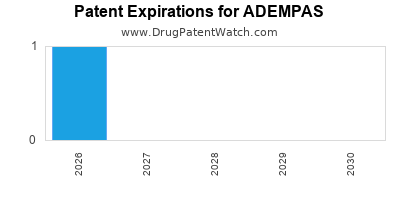
Adempas is a drug marketed by Bayer Hlthcare and is included in one NDA. There are four patents protecting this drug and one Paragraph IV challenge.
The generic ingredient in ADEMPAS is riociguat. There is one drug master file entry for this compound. Two suppliers are listed for this compound. Additional details are available on the riociguat profile page.
DrugPatentWatch® Litigation and Generic Entry Outlook for Adempas
A generic version of ADEMPAS was approved as riociguat by MSN on September 1st, 2022.
AI Deep Research
Questions you can ask:
- What is the 5 year forecast for ADEMPAS?
- What are the global sales for ADEMPAS?
- What is Average Wholesale Price for ADEMPAS?
Summary for ADEMPAS
| US Patents: | 4 |
| Applicants: | 1 |
| NDAs: | 1 |
| Finished Product Suppliers / Packagers: | 1 |
| Raw Ingredient (Bulk) Api Vendors: | 1 |
| Clinical Trials: | 18 |
| Patent Applications: | 1,015 |
| Drug Prices: | Drug price information for ADEMPAS |
| Patent Litigation and PTAB cases: | See patent lawsuits and PTAB cases for ADEMPAS |
| What excipients (inactive ingredients) are in ADEMPAS? | ADEMPAS excipients list |
| DailyMed Link: | ADEMPAS at DailyMed |

Recent Clinical Trials for ADEMPAS
Identify potential brand extensions & 505(b)(2) entrants
| Sponsor | Phase |
|---|---|
| University of Cambridge | Phase 4 |
| University of Newcastle Upon-Tyne | Phase 4 |
| Sheffield Teaching Hospitals NHS Foundation Trust | Phase 4 |
Pharmacology for ADEMPAS
| Drug Class | Soluble Guanylate Cyclase Stimulator |
| Mechanism of Action | Guanylate Cyclase Stimulators |
US Patents and Regulatory Information for ADEMPAS
ADEMPAS is protected by seven US patents.
| Applicant | Tradename | Generic Name | Dosage | NDA | Approval Date | TE | Type | RLD | RS | Patent No. | Patent Expiration | Product | Substance | Delist Req. | Exclusivity Expiration |
|---|---|---|---|---|---|---|---|---|---|---|---|---|---|---|---|
| Bayer Hlthcare | ADEMPAS | riociguat | TABLET;ORAL | 204819-004 | Oct 8, 2013 | AB | RX | Yes | No | 7,173,037 | ⤷ Start Trial | Y | Y | ⤷ Start Trial | |
| Bayer Hlthcare | ADEMPAS | riociguat | TABLET;ORAL | 204819-005 | Oct 8, 2013 | AB | RX | Yes | Yes | 11,203,593 | ⤷ Start Trial | Y | Y | ⤷ Start Trial | |
| Bayer Hlthcare | ADEMPAS | riociguat | TABLET;ORAL | 204819-005 | Oct 8, 2013 | AB | RX | Yes | Yes | 12,503,469 | ⤷ Start Trial | Y | ⤷ Start Trial | ||
| Bayer Hlthcare | ADEMPAS | riociguat | TABLET;ORAL | 204819-001 | Oct 8, 2013 | AB | RX | Yes | No | 12,503,469 | ⤷ Start Trial | Y | ⤷ Start Trial | ||
| Bayer Hlthcare | ADEMPAS | riociguat | TABLET;ORAL | 204819-004 | Oct 8, 2013 | AB | RX | Yes | No | 10,662,188 | ⤷ Start Trial | Y | Y | ⤷ Start Trial | |
| >Applicant | >Tradename | >Generic Name | >Dosage | >NDA | >Approval Date | >TE | >Type | >RLD | >RS | >Patent No. | >Patent Expiration | >Product | >Substance | >Delist Req. | >Exclusivity Expiration |
Expired US Patents for ADEMPAS
| Applicant | Tradename | Generic Name | Dosage | NDA | Approval Date | Patent No. | Patent Expiration |
|---|---|---|---|---|---|---|---|
| Bayer Hlthcare | ADEMPAS | riociguat | TABLET;ORAL | 204819-001 | Oct 8, 2013 | 6,743,798 | ⤷ Start Trial |
| Bayer Hlthcare | ADEMPAS | riociguat | TABLET;ORAL | 204819-004 | Oct 8, 2013 | 6,743,798 | ⤷ Start Trial |
| Bayer Hlthcare | ADEMPAS | riociguat | TABLET;ORAL | 204819-003 | Oct 8, 2013 | 6,743,798 | ⤷ Start Trial |
| Bayer Hlthcare | ADEMPAS | riociguat | TABLET;ORAL | 204819-002 | Oct 8, 2013 | 6,743,798 | ⤷ Start Trial |
| Bayer Hlthcare | ADEMPAS | riociguat | TABLET;ORAL | 204819-005 | Oct 8, 2013 | 6,743,798 | ⤷ Start Trial |
| >Applicant | >Tradename | >Generic Name | >Dosage | >NDA | >Approval Date | >Patent No. | >Patent Expiration |
EU/EMA Drug Approvals for ADEMPAS
| Company | Drugname | Inn | Product Number / Indication | Status | Generic | Biosimilar | Orphan | Marketing Authorisation | Marketing Refusal |
|---|---|---|---|---|---|---|---|---|---|
| Bayer AG | Adempas | riociguat | EMEA/H/C/002737Chronic thromboembolic pulmonary hypertension (CTEPH)Adempas is indicated for the treatment of adult patients with WHO Functional Class (FC) II to III withinoperable CTEPH,persistent or recurrent CTEPH after surgical treatment,to improve exercise capacity.Pulmonary arterial hypertension (PAH)AdultsAdempas, as monotherapy or in combination with endothelin receptor antagonists, is indicated for the treatment of adult patients with pulmonary arterial hypertension (PAH) with WHO Functional Class (FC) II to III to improve exercise capacity.Efficacy has been shown in a PAH population including aetiologies of idiopathic or heritable PAH or PAH associated with connective tissue disease.PaediatricsAdempas is indicated for the treatment of PAH in paediatric patients aged less than 18 years of age and body weight ≥ 50 kg with WHO Functional Class (FC) II to III in combination with endothelin receptor antagonists. | Authorised | no | no | no | 2014-03-27 | |
| >Company | >Drugname | >Inn | >Product Number / Indication | >Status | >Generic | >Biosimilar | >Orphan | >Marketing Authorisation | >Marketing Refusal |
International Patents for ADEMPAS
When does loss-of-exclusivity occur for ADEMPAS?
Based on analysis by DrugPatentWatch, the following patents block generic entry in the countries listed below:
Australia
Patent: 14220801
Estimated Expiration: ⤷ Start Trial
Brazil
Patent: 2015019571
Estimated Expiration: ⤷ Start Trial
Canada
Patent: 07859
Estimated Expiration: ⤷ Start Trial
Patent: 01636
Estimated Expiration: ⤷ Start Trial
Chile
Patent: 15002304
Estimated Expiration: ⤷ Start Trial
China
Patent: 5102457
Estimated Expiration: ⤷ Start Trial
Costa Rica
Patent: 150422
Estimated Expiration: ⤷ Start Trial
Cuba
Patent: 150092
Estimated Expiration: ⤷ Start Trial
Dominican Republic
Patent: 015000199
Estimated Expiration: ⤷ Start Trial
Eurasian Patent Organization
Patent: 1500852
Estimated Expiration: ⤷ Start Trial
European Patent Office
Patent: 58914
Estimated Expiration: ⤷ Start Trial
Patent: 60629
Estimated Expiration: ⤷ Start Trial
Hong Kong
Patent: 17488
Estimated Expiration: ⤷ Start Trial
Japan
Patent: 86478
Estimated Expiration: ⤷ Start Trial
Patent: 16509039
Estimated Expiration: ⤷ Start Trial
Mexico
Patent: 15010725
Estimated Expiration: ⤷ Start Trial
Morocco
Patent: 350
Estimated Expiration: ⤷ Start Trial
Nicaragua
Patent: 1500110
Estimated Expiration: ⤷ Start Trial
Peru
Patent: 151590
Estimated Expiration: ⤷ Start Trial
Philippines
Patent: 015501839
Estimated Expiration: ⤷ Start Trial
Singapore
Patent: 201506211R
Patent: FORMS OF METHYL {4,6-DIAMINO-2-[1-(2-FLUOROBENZYL)-1H-PYRAZOLO[3,4-B]PYRIDINO-3-YL]PYRIMIDINO-5-YL}METHYL CARBAMATE
Estimated Expiration: ⤷ Start Trial
South Korea
Patent: 150119871
Estimated Expiration: ⤷ Start Trial
Tunisia
Patent: 15000361
Patent: FORMS OF METHYL {4,6-DIAMINO-2-[1-(2-FLUOROBENZYL)-1H-PYRAZOLO[3,4-B]PYRIDINO-3-YL]PYRIMIDINO-5-YL}METHYL CARBAMATE
Estimated Expiration: ⤷ Start Trial
Generics may enter earlier, or later, based on new patent filings, patent extensions, patent invalidation, early generic licensing, generic entry preferences, and other factors.
See the table below for additional patents covering ADEMPAS around the world.
| Country | Patent Number | Title | Estimated Expiration |
|---|---|---|---|
| Australia | 2014220801 | ⤷ Start Trial | |
| Brazil | 112015019571 | ⤷ Start Trial | |
| Canada | 2807859 | ⤷ Start Trial | |
| Canada | 2901636 | ⤷ Start Trial | |
| Chile | 2015002304 | Formas del metil {4,6-diamino-2- [1- (2-fluorobencil)-1h-pirazolo [3,4-b] piridino-3-il] pirimidino-5-il} metil carbamato | ⤷ Start Trial |
| >Country | >Patent Number | >Title | >Estimated Expiration |
Supplementary Protection Certificates for ADEMPAS
| Patent Number | Supplementary Protection Certificate | SPC Country | SPC Expiration | SPC Description |
|---|---|---|---|---|
| 1506193 | C01506193/01 | Switzerland | ⤷ Start Trial | PRODUCT NAME: RIOCIGUAT; REGISTRATION NO/DATE: SWISSMEDIC 62903 21.11.2013 |
| 1506193 | PA2014018,C1506193 | Lithuania | ⤷ Start Trial | PRODUCT NAME: RIOCIGUATUM; REGISTRATION NO/DATE: EU/1/13/907/001 - EU/1/13/907/015 20140327 |
| 1506193 | C300659 | Netherlands | ⤷ Start Trial | PRODUCT NAME: RIOCIGUAT, DESGEW ENST IN DE; REGISTRATION NO/DATE: EU/1/13/907 20140327 |
| 1506193 | PA2014018 | Lithuania | ⤷ Start Trial | PRODUCT NAME: ; REGISTRATION NO/DATE: EU/1/13/907/001 - EU/1/13/907/015 20140327 |
| 1506193 | 92419 | Luxembourg | ⤷ Start Trial | PRODUCT NAME: RIOCIGUAT ET SES DERIVES PHARMACEUTIQUEMENT ACCEPTABLES(ADEMPAS) |
| >Patent Number | >Supplementary Protection Certificate | >SPC Country | >SPC Expiration | >SPC Description |
ADEMPAS (riociguat) market dynamics and financial trajectory: exclusivity, competition, and revenue exposure
More… ↓
DrugChatter Q&A for ADEMPAS
Make Better Decisions: Try a trial or see plans & pricing
Drugs may be covered by multiple patents or regulatory protections. All trademarks and applicant names are the property of their respective owners or licensors. Although great care is taken in the proper and correct provision of this service, thinkBiotech LLC does not accept any responsibility for possible consequences of errors or omissions in the provided data. The data presented herein is for information purposes only. There is no warranty that the data contained herein is error free. We do not provide individual investment advice. This service is not registered with any financial regulatory agency. The information we publish is educational only and based on our opinions plus our models. By using DrugPatentWatch you acknowledge that we do not provide personalized recommendations or advice. thinkBiotech performs no independent verification of facts as provided by public sources nor are attempts made to provide legal or investing advice. Any reliance on data provided herein is done solely at the discretion of the user. Users of this service are advised to seek professional advice and independent confirmation before considering acting on any of the provided information. thinkBiotech LLC reserves the right to amend, extend or withdraw any part or all of the offered service without notice.
ISSN: 2162-2639

Privacy and Cookies
Terms & Conditions
Site Map
DrugPatentWatch Alternatives
LOE / Major Patent Expirations 2026 - 2027
NCE-1 Patent Challenge Dates 2026 - 2027
Friedman, Yali. "DrugPatentWatch" DrugPatentWatch, thinkBiotech, 2026, www.DrugPatentWatch.com.
See Primary Research Papers Citing DrugPatentWatch