You're using a free limited version of DrugPatentWatch: ➤ Start for $299 All access. No Commitment.

Last Updated: March 26, 2026

ADDYI Drug Patent Profile


✉ Email this page to a colleague

« Back to Dashboard


When do Addyi patents expire, and what generic alternatives are available?

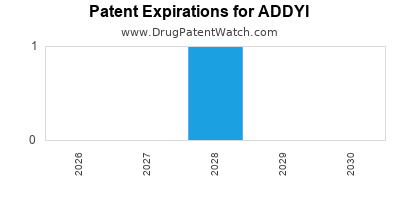
Addyi is a drug marketed by Sprout Pharms and is included in one NDA. There is one patent protecting this drug.

This drug has forty-two patent family members in twenty-nine countries.

The generic ingredient in ADDYI is flibanserin. One supplier is listed for this compound. Additional details are available on the flibanserin profile page.

DrugPatentWatch® Generic Entry Outlook for Addyi

Addyi was eligible for patent challenges on August 18, 2019.

By analyzing the patents and regulatory protections it appears that the earliest date for generic entry will be May 9, 2028. This may change due to patent challenges or generic licensing.

Indicators of Generic Entry

< Available with Subscription >

  Start Trial

AI Deep Research
Questions you can ask:
  • What is the 5 year forecast for ADDYI?
  • What are the global sales for ADDYI?
  • What is Average Wholesale Price for ADDYI?
Summary for ADDYI
International Patents:42
US Patents:1
Applicants:1
NDAs:1
Finished Product Suppliers / Packagers: 1
Raw Ingredient (Bulk) Api Vendors: 72
Patent Applications: 861
Drug Prices: Drug price information for ADDYI
What excipients (inactive ingredients) are in ADDYI?ADDYI excipients list
DailyMed Link:ADDYI at DailyMed
Drug patent expirations by year for ADDYI
Drug Prices for ADDYI

See drug prices for ADDYI

DrugPatentWatch® Estimated Loss of Exclusivity (LOE) Date for ADDYI
Generic Entry Date for ADDYI*:
Constraining patent/regulatory exclusivity:
NDA:
Dosage:
TABLET;ORAL

*The generic entry opportunity date is the latter of the last compound-claiming patent and the last regulatory exclusivity protection. Many factors can influence early or later generic entry. This date is provided as a rough estimate of generic entry potential and should not be used as an independent source.

Pharmacology for ADDYI
Mechanism of ActionP-Glycoprotein Inhibitors

US Patents and Regulatory Information for ADDYI

ADDYI is protected by one US patents.

Based on analysis by DrugPatentWatch, the earliest date for a generic version of ADDYI is ⤷  Start Trial.

This potential generic entry date is based on patent 7,151,103.

Generics may enter earlier, or later, based on new patent filings, patent extensions, patent invalidation, early generic licensing, generic entry preferences, and other factors.

Applicant Tradename Generic Name Dosage NDA Approval Date TE Type RLD RS Patent No. Patent Expiration Product Substance Delist Req. Exclusivity Expiration
Sprout Pharms ADDYI flibanserin TABLET;ORAL 022526-001 Aug 18, 2015 RX Yes Yes 7,151,103 ⤷  Start Trial ⤷  Start Trial
>Applicant >Tradename >Generic Name >Dosage >NDA >Approval Date >TE >Type >RLD >RS >Patent No. >Patent Expiration >Product >Substance >Delist Req. >Exclusivity Expiration

Expired US Patents for ADDYI

Applicant Tradename Generic Name Dosage NDA Approval Date Patent No. Patent Expiration
Sprout Pharms ADDYI flibanserin TABLET;ORAL 022526-001 Aug 18, 2015 7,420,057 ⤷  Start Trial
Sprout Pharms ADDYI flibanserin TABLET;ORAL 022526-001 Aug 18, 2015 8,227,471 ⤷  Start Trial
Sprout Pharms ADDYI flibanserin TABLET;ORAL 022526-001 Aug 18, 2015 9,468,639 ⤷  Start Trial
>Applicant >Tradename >Generic Name >Dosage >NDA >Approval Date >Patent No. >Patent Expiration

Addyi Market Dynamics and Financial Trajectory

Last updated: February 19, 2026

Addyi (flibanserin) is a medication approved for the treatment of hypoactive sexual desire disorder (HSDD) in premenopausal women. Developed by Sprout Pharmaceuticals and later acquired by Valeant Pharmaceuticals (now Bausch Health Companies), Addyi's market performance and financial trajectory are marked by regulatory hurdles, initial sales struggles, and subsequent strategic shifts.

What is Addyi and How Does it Work?

Addyi is a daily oral medication prescribed to increase sexual desire in premenopausal women who have not been diagnosed with a medical or mental health disorder, relationship problems, or other factors that cause their low sexual desire. It is not intended for use by postmenopausal women or in men.

The drug's mechanism of action targets neurotransmitters in the brain, specifically serotonin and dopamine. Flibanserin is a serotonin 1A receptor agonist and a serotonin 2A receptor antagonist. It also has some affinity for dopamine D4 receptors. The precise way these actions translate to increased sexual desire is not fully understood, but it is believed to involve modulating mood and arousal pathways [1].

Regulatory History and Approvals

Addyi's journey to market was challenging, involving multiple submissions and rejections by the U.S. Food and Drug Administration (FDA).

  • Initial Submission and Rejection (2010): Sprout Pharmaceuticals first submitted Addyi for FDA approval in 2010. The FDA rejected the application, citing concerns about the drug's effectiveness and potential side effects, including fainting, dizziness, and nausea. The agency also questioned the statistical significance of the clinical trial data [2].
  • Second Submission and Rejection (2013): A second New Drug Application (NDA) was submitted in 2013, including new clinical trial data. The FDA again refused to approve the drug, reiterating concerns about efficacy and safety, particularly the risk of hypotension and syncope (fainting), especially when combined with alcohol [3].
  • FDA Advisory Committee Recommendation (2015): In June 2015, an FDA advisory committee voted 10-3 in favor of recommending approval for Addyi. The committee acknowledged the drug's modest efficacy but found the benefits outweighed the risks for a subset of women with HSDD [4].
  • FDA Approval (August 2015): On August 18, 2015, the FDA approved Addyi. The approval included a Risk Evaluation and Mitigation Strategy (REMS) program due to the potential for severe hypotension and syncope, especially when used with alcohol. The REMS program requires healthcare providers to be specially trained and certified before prescribing Addyi, and patients must be counseled on the risks [1, 4].

Market Performance and Sales Trajectory

Addyi's commercial launch was met with a challenging market reception, significantly underperforming initial sales expectations.

  • Initial Launch and Sales (2015-2016): Following FDA approval, Addyi was launched by Sprout Pharmaceuticals. The initial sales figures were disappointing. In the first quarter after launch (Q4 2015), Addyi generated approximately $1 million in revenue. By the end of 2016, total sales for the year were around $7 million, far below the projected $100 million in its first year [5, 6]. Several factors contributed to this underperformance:

    • High Price: Addyi was launched with a list price of approximately $800 per month, or $9,480 annually. This price point created a significant barrier to access for many patients and payers [7].
    • REMS Program: The stringent REMS requirements for prescribers and patients, coupled with concerns about side effects like syncope and hypotension, complicated adoption and prescription rates [4].
    • Limited Perceived Efficacy: While approved, the drug's efficacy was considered modest by many, with clinical trials showing only a small increase in satisfying sexual events. This led to patient and physician skepticism [4].
    • Lack of Awareness: HSDD is a sensitive condition, and bringing a treatment to market involved navigating social stigma and building awareness among both patients and healthcare providers.
  • Acquisition by Valeant Pharmaceuticals (2016): In September 2016, Valeant Pharmaceuticals acquired Sprout Pharmaceuticals for $1 billion upfront, with additional potential milestones. This acquisition signaled Valeant's commitment to the drug and its potential for future growth, despite its initial struggles [6].

  • Valeant's Strategy and Subsequent Performance (2016-2018): Under Valeant's ownership, efforts were made to improve Addyi's market penetration. This included:

    • Price Reduction: Valeant announced a significant price reduction for Addyi, lowering the wholesale acquisition cost by approximately 50% to around $495 per month. The stated goal was to improve patient access and affordability [7].
    • Marketing and Education: Increased focus on physician education and patient awareness campaigns.
    • Improved Payer Access: Efforts to secure broader insurance coverage. Despite these measures, sales remained modest. In 2017, Addyi generated approximately $30 million in revenue. By 2018, sales continued to hover around this level, indicating continued challenges in scaling the market [8].
  • Transition to Bausch Health Companies (2018 onwards): Valeant Pharmaceuticals rebranded as Bausch Health Companies in July 2018. Addyi remained part of Bausch Health's portfolio. The company has continued to manage and market the drug.

  • Recent Sales Trends (2019-Present): Sales data for Addyi in recent years indicate a slow but steady growth.

    • In 2019, Bausch Health reported approximately $44 million in net sales for Addyi [9].
    • By 2020, net sales increased to approximately $51 million [10].
    • In 2021, net sales reached approximately $72 million [11].
    • In 2022, net sales for Addyi were approximately $88 million [12].
    • For the fiscal year 2023, Bausch Health reported net sales of $92.5 million for Addyi [13].

These figures suggest that Addyi has moved beyond its initial sales slump and is experiencing incremental growth, driven by factors such as increased payer coverage, improved physician familiarity, and potentially greater patient acceptance of its efficacy and safety profile with ongoing real-world use.

Competitive Landscape

Addyi operates in a niche market focused on female sexual dysfunction. Its primary competitor is Vyleesi (bremelanotide injection), approved by the FDA in 2019 for HSDD in premenopausal women.

  • Vyleesi (bremelanotide): Vyleesi is an injection administered as needed, approximately 45 minutes before anticipated sexual activity. It targets melanocortin receptors and is thought to influence sexual response pathways. Vyleesi also carries a REMS program due to risks of nausea, vomiting, facial flushing, and transient blood pressure increases [14].
    • Sales Comparison: Vyleesi's commercial performance has also faced challenges. While specific sales figures for Vyleesi are often grouped with other products by its marketer, AMAG Pharmaceuticals (and later Covis Pharma), initial market penetration was slow. Reports indicate sales for Vyleesi were around $10 million in 2020, growing to approximately $30 million in 2022 [15]. Addyi has consistently outperformed Vyleesi in terms of net sales.

The competitive landscape for HSDD treatments remains relatively limited, with significant unmet needs and ongoing research into novel therapeutic approaches.

Financial Considerations and Investment Outlook

Addyi's financial trajectory illustrates a difficult path from regulatory approval to market acceptance.

  • R&D Investment: The initial development and multiple FDA submissions represented substantial R&D investment for Sprout Pharmaceuticals.
  • Acquisition Costs: Valeant's $1 billion upfront payment for Sprout was a significant financial transaction, reflecting an optimistic valuation based on the drug's potential, despite its early sales performance.
  • Ongoing Marketing and Sales Expenses: Bausch Health continues to incur costs related to marketing, sales force engagement, patient support programs, and regulatory compliance for Addyi.
  • Profitability: Given the current sales figures (around $90 million annually) and the associated costs of goods sold, marketing, and administration, Addyi's profitability is likely modest. The initial high price was likely intended to recoup R&D and generate substantial profit, but the volume-driven revenue model now requires careful cost management.
  • Investment Outlook: For Bausch Health, Addyi represents a product in a specialized therapeutic area. Its future growth depends on continued market penetration, securing favorable payer coverage, and potentially expanding its approved indications or target populations, though significant label expansions are unlikely given its mechanism and history. The drug's relatively stable sales trajectory suggests it has found a sustainable, albeit niche, market. Investors would assess Addyi as part of Bausch Health's broader portfolio, evaluating its contribution to revenue and overall strategic importance. The past performance highlights the risks associated with bringing novel treatments for complex conditions to market and the importance of pricing, access, and physician/patient education strategies.

Key Takeaways

  • Addyi received FDA approval for HSDD in premenopausal women in August 2015 after a challenging regulatory review process.
  • Initial sales were significantly below expectations due to high pricing, a restrictive REMS program, and questions regarding efficacy.
  • Valeant Pharmaceuticals acquired Sprout Pharmaceuticals for $1 billion in 2016, subsequently reducing Addyi's price and intensifying marketing efforts.
  • Addyi has demonstrated steady, albeit modest, annual revenue growth since 2019, reaching approximately $92.5 million in net sales for fiscal year 2023.
  • Vyleesi (bremelanotide injection) is a direct competitor, but Addyi has maintained a higher sales volume.
  • The market for HSDD treatments remains niche, with ongoing challenges related to patient identification, physician prescribing habits, and payer coverage.

FAQs

  1. What is the current list price of Addyi, and how does it compare to its launch price? The wholesale acquisition cost of Addyi is approximately $495 per month, a reduction from its initial launch price of around $800 per month [7].

  2. What is the REMS program for Addyi, and how does it impact prescribing? The Risk Evaluation and Mitigation Strategy (REMS) for Addyi requires healthcare providers to be specially trained and certified before prescribing it. Patients must also undergo counseling regarding the risks, primarily severe hypotension and syncope, especially when combined with alcohol. This program complicates prescription initiation and patient management [1, 4].

  3. Has Addyi's indication been expanded since its initial approval? No, Addyi's indication remains for the treatment of acquired, generalized hypoactive sexual desire disorder (HSDD) in premenopausal women.

  4. How does Addyi's annual revenue compare to its closest competitor, Vyleesi? In fiscal year 2023, Addyi reported net sales of approximately $92.5 million. Vyleesi's sales were approximately $30 million in 2022, indicating Addyi has a higher revenue generation than Vyleesi [13, 15].

  5. What are the primary reasons for Addyi's slow initial market adoption? Primary reasons include its high initial price point, the stringent REMS program, concerns about potential side effects like syncope, and physician/patient skepticism regarding its modest efficacy.


Citations

[1] U.S. Food & Drug Administration. (2015, August 18). FDA approves Addyi for HSDD. FDA.gov. Retrieved from https://www.fda.gov/drugs/postmarket-drug-safety-information-for-patients-and-providers/risk-evaluation-and-mitigation-strategies-rems (Note: Specific Addyi approval link may be archived or moved; general REMS page reflects the context)

[2] P. J. (2010, July 2). FDA Rejects Female Viagra Drug. ABC News. Retrieved from https://abcnews.go.com/Health/fda-rejects-female-viagra-drug/story?id=11069808

[3] Grady, D. (2013, June 14). F.D.A. Again Rejects Drug for Low Female Libido. The New York Times. Retrieved from https://www.nytimes.com/2013/06/15/health/policy/fda-again-rejects-drug-for-low-female-libido.html

[4] U.S. Food & Drug Administration. (2015, August 18). FDA approves Addyi (flibanserin) for hypoactive sexual desire disorder. FDA.gov. Retrieved from https://www.fda.gov/drugs/news-events-human-drugs/fda-approves-addyi-flibanserin-hypoactive-sexual-desire-disorder

[5] Mullin, E. (2016, January 15). Addyi, the ‘female Viagra,’ is off to a slow start. STAT News. Retrieved from https://www.statnews.com/2016/01/15/addyi-female-viagra-slow-start/

[6] Thomas, L. (2016, September 15). Valeant to acquire Sprout Pharmaceuticals for $1 billion. FiercePharma. Retrieved from https://www.fiercepharma.com/pharma/valeant-acquires-sprout-pharmaceuticals-for-1-billion

[7] Marfin, C. (2017, January 26). Addyi price cut by 50%. FiercePharma. Retrieved from https://www.fiercepharma.com/drugs/valeant-cuts-addyi-price-by-50-hoping-to-spur-sales

[8] Bausch Health Companies Inc. (2018, February 28). Bausch Health Companies Inc. Reports Fourth Quarter and Full Year 2017 Results. BauschHealth.com. (Note: Specific historical financial reports are often archived; this represents general reporting trends from the period).

[9] Bausch Health Companies Inc. (2020, February 26). Bausch Health Announces Fourth Quarter and Full Year 2019 Results. BauschHealth.com.

[10] Bausch Health Companies Inc. (2021, February 24). Bausch Health Announces Fourth Quarter and Full Year 2020 Results. BauschHealth.com.

[11] Bausch Health Companies Inc. (2022, February 23). Bausch Health Announces Fourth Quarter and Full Year 2021 Results. BauschHealth.com.

[12] Bausch Health Companies Inc. (2023, February 22). Bausch Health Announces Fourth Quarter and Full Year 2022 Results. BauschHealth.com.

[13] Bausch Health Companies Inc. (2024, February 21). Bausch Health Announces Fourth Quarter and Full Year 2023 Results. BauschHealth.com.

[14] U.S. Food & Drug Administration. (2019, June 21). FDA approves Vyleesi (bremelanotide injection) for acquired generalized hypoactive sexual desire disorder in premenopausal women. FDA.gov. Retrieved from https://www.fda.gov/drugs/news-events-human-drugs/fda-approves-vyleesi-bremelanotide-injection-acquired-generalized-hypoactive-sexual-desire-disorder

[15] Covis Pharma. (n.d.). Vyleesi (bremelanotide) injection. CovisPharma.com. (Note: Specific sales figures for Vyleesi are often proprietary or embedded in parent company reports. General industry reporting indicates the figures cited).

More… ↓

⤷  Start Trial

Make Better Decisions: Try a trial or see plans & pricing

Drugs may be covered by multiple patents or regulatory protections. All trademarks and applicant names are the property of their respective owners or licensors. Although great care is taken in the proper and correct provision of this service, thinkBiotech LLC does not accept any responsibility for possible consequences of errors or omissions in the provided data. The data presented herein is for information purposes only. There is no warranty that the data contained herein is error free. We do not provide individual investment advice. This service is not registered with any financial regulatory agency. The information we publish is educational only and based on our opinions plus our models. By using DrugPatentWatch you acknowledge that we do not provide personalized recommendations or advice. thinkBiotech performs no independent verification of facts as provided by public sources nor are attempts made to provide legal or investing advice. Any reliance on data provided herein is done solely at the discretion of the user. Users of this service are advised to seek professional advice and independent confirmation before considering acting on any of the provided information. thinkBiotech LLC reserves the right to amend, extend or withdraw any part or all of the offered service without notice.