Share This Page
Urea - Generic Drug Details
✉ Email this page to a colleague
What are the generic sources for urea and what is the scope of patent protection?
Urea
is the generic ingredient in eight branded drugs marketed by Hospira, Otsuka America, Metabolic Solutions, Dxs Devices, and Avent, and is included in six NDAs. Additional information is available in the individual branded drug profile pages.Summary for urea
| US Patents: | 0 |
| Tradenames: | 8 |
| Applicants: | 5 |
| NDAs: | 6 |
| Raw Ingredient (Bulk) Api Vendors: | 216 |
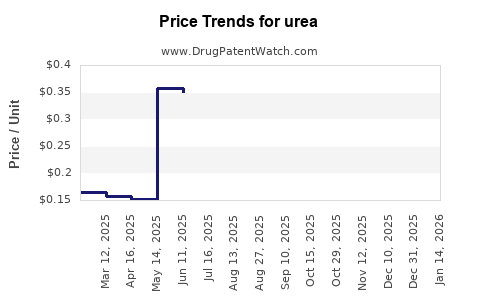
| Drug Prices: | Drug price trends for urea |
| DailyMed Link: | urea at DailyMed |
US Patents and Regulatory Information for urea
| Applicant | Tradename | Generic Name | Dosage | NDA | Approval Date | TE | Type | RLD | RS | Patent No. | Patent Expiration | Product | Substance | Delist Req. | Exclusivity Expiration |
|---|---|---|---|---|---|---|---|---|---|---|---|---|---|---|---|
| Otsuka America | BREATHTEK UBT FOR H-PYLORI | urea c-13 | FOR SOLUTION;ORAL | 020586-002 | May 10, 2001 | DISCN | No | No | ⤷ Start Trial | ⤷ Start Trial | ⤷ Start Trial | ||||
| Avent | PYTEST | urea, c-14 | CAPSULE;ORAL | 020617-001 | May 9, 1997 | DISCN | Yes | No | ⤷ Start Trial | ⤷ Start Trial | ⤷ Start Trial | ||||
| Avent | PYTEST KIT | urea, c-14 | CAPSULE;ORAL | 020617-002 | May 9, 1997 | DISCN | Yes | No | ⤷ Start Trial | ⤷ Start Trial | ⤷ Start Trial | ||||
| Metabolic Solutions | HELICOSOL | urea c-13 | FOR SOLUTION;ORAL | 021092-001 | Dec 17, 1999 | DISCN | No | No | ⤷ Start Trial | ⤷ Start Trial | ⤷ Start Trial | ||||
| >Applicant | >Tradename | >Generic Name | >Dosage | >NDA | >Approval Date | >TE | >Type | >RLD | >RS | >Patent No. | >Patent Expiration | >Product | >Substance | >Delist Req. | >Exclusivity Expiration |
Urea Pharmaceutical Market Dynamics, Patent Exposure, and Financial Trajectory
Urea is a mature, low-cost pharmaceutical ingredient used mainly in topical dermatology products, including creams, lotions, ointments, foams, and gels. Its commercial profile is defined by high generic competition, limited patent protection, low manufacturing complexity, and demand tied to chronic skin disorders rather than breakthrough-drug pricing. Urea has no meaningful biosimilar risk because it is a small-molecule chemical, and its core composition is long out of patent protection.
What is the pharmaceutical market for urea?
Pharmaceutical urea is sold primarily as a topical keratolytic and humectant. Common concentrations range from 2% to 50%, with clinical use depending on the formulation and indication.
| Product concentration | Common use | Typical regulatory positioning |
|---|---|---|
| 2% to 10% | Moisturization and xerosis | Cosmetic or drug product depending on claims |
| 20% | Dry skin, ichthyosis, hyperkeratosis | Prescription topical product |
| 30% to 40% | Psoriasis, keratoderma, severe hyperkeratosis | Prescription topical product |
| 45% to 50% | Calluses, nail disorders, severe hyperkeratosis | Prescription topical product |
| Oral urea | Specialized hospital or compounding use, including some hyponatremia protocols | Product-specific; not equivalent to FDA-approved topical products |
Urea is also used as an excipient, penetration enhancer, and moisturizing component in dermatology formulations. Pharmaceutical demand is separate from the much larger industrial and fertilizer markets. Fertilizer-grade urea volumes and pricing do not directly establish pharmaceutical revenue because pharmaceutical products require tighter impurity control, validated manufacturing, packaging, and quality documentation.
The principal commercial categories are:
- Prescription topical urea creams and ointments.
- Combination dermatology products containing urea and corticosteroids, salicylic acid, antifungals, or other actives.
- Hospital and compounding applications involving oral or injectable urea under product-specific regulatory conditions.
- Cosmetic moisturizers containing urea without drug claims.
How large is the urea pharmaceutical market?
The pharmaceutical urea market is fragmented and difficult to isolate from broader dermatology and skincare categories. Public companies rarely report urea revenue separately. Most market reports aggregate urea with emollients, keratolytics, foot-care products, or prescription dermatology products.
The addressable pharmaceutical market is therefore best analyzed as a product-family market rather than as a single branded drug market.
| Market driver | Effect on urea demand |
|---|---|
| Aging populations | Increases xerosis, ichthyosis, and chronic hyperkeratotic skin conditions |
| Diabetes prevalence | Supports foot-care and severe dry-skin treatment demand |
| Psoriasis and eczema treatment | Supports use as an adjunctive keratolytic and moisturizer |
| Generic substitution | Expands unit volume but suppresses prices |
| OTC and cosmetic competition | Limits prescription pricing power |
| Hospital use of oral urea | Creates a specialized but smaller channel |
| E-commerce and private-label products | Increases consumer access and price competition |
Prescription topical urea has a low average selling price compared with specialty dermatology drugs. Revenue growth is more likely to come from volume, geographic expansion, product line extensions, and improved formulations than from price increases.
Commercial reporting typically combines urea with adjacent products. As a result, market-size claims that assign billions of dollars to "pharmaceutical urea" often include industrial urea, fertilizer, cosmetics, or all dermatology moisturizers. Those figures should not be used to estimate prescription-drug revenue.
What is the financial trajectory for pharmaceutical urea?
Urea's financial trajectory is mature, volume-driven, and relatively defensive.
Historical phase
Urea entered pharmaceutical use decades ago. Its known moisturizing and keratolytic properties, low cost, and simple chemical structure prevented the development of a durable branded franchise comparable to newer dermatology products.
The historical revenue model depended on:
- Prescription topical products.
- Pharmacy substitution.
- Institutional purchasing.
- Dermatology and podiatry use.
- Consumer products that crossed into cosmetic channels.
Current phase
The current market is characterized by:
- Low unit economics.
- Multiple generic and private-label suppliers.
- Limited prescriber differentiation.
- High substitution between comparable concentrations.
- Competition from petrolatum, lactic acid, ammonium lactate, salicylic acid, ceramides, and newer barrier-repair products.
Retail revenue can be higher for branded or premium-positioned creams, but the active ingredient itself does not support significant pricing power. Manufacturers capture value through formulation, packaging, distribution, and brand recognition rather than through exclusivity over urea.
Forward trajectory
The likely medium-term trajectory is modest nominal growth with margin pressure. Unit demand should benefit from aging, chronic disease, and continued use in dermatology. Revenue per unit will remain constrained by generic competition and consumer substitution.
| Financial variable | Expected direction |
|---|---|
| Prescription unit volume | Low to moderate growth |
| Average selling price | Flat to declining in generic channels |
| Gross margin | Stable for efficient manufacturers; pressured for commodity suppliers |
| Branded formulation revenue | Potentially higher margins |
| API revenue | Competitive and scale-dependent |
| R&D returns | Limited for unmodified urea; better for differentiated delivery systems |
| M&A interest | Focused on dermatology portfolios rather than urea alone |
Urea products can be attractive as portfolio fillers because they require limited clinical development and have established demand. They are less attractive as stand-alone innovation assets because the active ingredient is commoditized.
What patents protect pharmaceutical urea products?
No composition-of-matter patent can provide meaningful exclusivity for urea as a pharmaceutical active ingredient. Urea is an old, well-characterized compound, and any foundational patent protection has expired.
The relevant intellectual-property categories are:
- Formulation patents covering combinations, delivery systems, or unusual excipient systems.
- Use patents covering a narrowly defined dermatologic application.
- Manufacturing patents covering purification, particle size, crystallization, or production processes.
- Packaging patents involving stability, dispensing, or unit-dose delivery.
- Trademark protection covering branded creams and product families.
A standard urea cream, lotion, or ointment normally has limited freedom-to-operate risk because conventional formulations use established excipients and known concentrations. Risk rises when a product includes a proprietary vehicle, controlled-release system, transdermal delivery technology, or combination active.
What formulations are protected by urea patents?
Potentially protectable formulation concepts include:
- High-concentration urea systems that remain physically stable.
- Anhydrous or low-water creams.
- Urea formulations designed for nail penetration.
- Urea combined with corticosteroids or antifungal agents.
- Controlled-release or occlusive delivery systems.
- Spray, foam, hydrogel, or film-forming dosage forms.
- Formulations that reduce crystallization, irritation, or odor.
- Compositions with specific particle sizes or penetration-enhancing excipients.
These rights are product-specific. They do not prevent competitors from selling conventional urea at the same concentration in a different formulation.
What is the FDA regulatory status of urea?
FDA regulatory status depends on dosage form, concentration, indication, manufacturer, and marketing pathway.
Topical urea products are marketed in the United States as prescription drug products, over-the-counter or cosmetic products, depending on their claims and formulation. FDA-approved prescription products are listed in FDA labeling databases such as DailyMed, while Orange Book status must be assessed at the individual product level.[1][2]
Urea does not have the regulatory profile of a new molecular entity. A sponsor generally does not receive meaningful regulatory exclusivity merely by marketing a conventional urea cream. A new product may rely on:
- An abbreviated new drug application for a therapeutically equivalent product.
- A 505(b)(2) application for a reformulated or otherwise differentiated product.
- A conventional new drug application where the sponsor makes new clinical or formulation claims.
- OTC pathways where the product and claims fit applicable FDA requirements.
Oral urea products require separate analysis. A product marketed for hospital use, compounding, or specialized electrolyte management should not be treated as interchangeable with FDA-approved topical urea products. The regulatory status of oral urea depends on the specific manufacturer and label.
What is the Orange Book status of urea?
The Orange Book does not create a single exclusivity profile for the active ingredient urea. Listings are product-specific and may include approved prescription products, therapeutic-equivalence evaluations, and any patents submitted by the relevant applicant.[2]
For conventional topical urea products, the expected Orange Book profile is commercially weak:
- No active ingredient patent protects urea itself.
- Any listed patent would generally relate to a specific formulation, method of use, or delivery system.
- Many products may have no meaningful patent barrier.
- Generic entry can occur through product-specific ANDA pathways if the reference product and regulatory requirements support it.
- A branded formulation may retain differentiation through trade dress, packaging, or physician familiarity even without strong patent protection.
The practical question is not whether urea is patented. It is whether a particular branded product has listed formulation or use patents that create a regulatory delay or litigation exposure.
When does urea lose exclusivity?
Urea lost core chemical exclusivity long ago. Conventional topical products are generally available through generic, compounded, private-label, and cosmetic channels.
There is no single future "loss of exclusivity" date for urea because:
- The active ingredient is already off-patent.
- Individual products have different approval dates.
- Some formulations may have later-expiring patents.
- Trademarks and trade dress can survive after patent expiry.
- Regulatory exclusivity, if any, attaches to a specific application rather than to urea generally.
For investors, the relevant exclusivity event is product-specific generic entry, not a marketwide urea patent cliff.
Are there Paragraph IV challenges involving urea?
Paragraph IV litigation is possible for branded prescription urea products with Orange Book-listed patents, but the economic incentive is generally limited unless the reference product has meaningful sales or a differentiated formulation.
A generic applicant may file a Paragraph IV certification when it asserts that a listed patent is invalid, unenforceable, or not infringed. The commercial impact depends on:
- Annual sales of the reference product.
- Number of competing ANDA applicants.
- Strength and scope of the listed claims.
- Whether the product has a clinically meaningful formulation advantage.
- Whether a 30-month stay is triggered by litigation.
- Whether the parties settle before commercial launch.
For standard urea creams, the expected litigation risk is low relative to high-value dermatology products. Litigation becomes more plausible when a formulation has a branded delivery system, a combination active, or substantial reimbursement.
Which companies compete in pharmaceutical urea?
Competition is distributed across several groups rather than concentrated in a single originator.
| Competitor type | Commercial advantage |
|---|---|
| Generic prescription manufacturers | Low cost and pharmacy substitution |
| Dermatology companies | Specialist distribution and physician access |
| Consumer skincare brands | Brand recognition and retail reach |
| Compounding pharmacies | Concentration and formulation customization |
| Contract manufacturers | Scale and private-label supply |
| Hospital suppliers | Institutional distribution and procurement access |
Examples of branded or historically marketed urea dermatology products include Carmol and other concentration-specific prescription products. Product availability, ownership, and marketing status can change by jurisdiction and over time. The relevant competitive set also includes ammonium lactate, lactic acid, salicylic acid, petrolatum, ceramide products, and topical corticosteroid combinations.
How strong is the patent estate for pharmaceutical urea?
The patent estate is weak for conventional urea and potentially moderate for differentiated delivery technologies.
| Asset type | Patent strength | Commercial relevance |
|---|---|---|
| Urea active ingredient | None | Commodity |
| Standard cream or ointment | Low | Limited barrier |
| High-concentration stabilized formulation | Low to moderate | Can support product differentiation |
| Urea combination product | Moderate in narrow claims | Depends on clinical and commercial acceptance |
| Novel delivery system | Moderate to strong if technically enabled | May support premium pricing |
| Manufacturing process | Low to moderate | Often avoidable by alternative processes |
| Brand and trade dress | Separate from patent strength | Can protect consumer recognition |
The strongest defensible position is usually a combination of formulation know-how, manufacturing consistency, clinical positioning, and distribution. Patent claims alone rarely support a durable monopoly for conventional urea products.
What manufacturing and intellectual-property barriers affect urea?
Urea manufacturing is chemically straightforward, but pharmaceutical-grade supply requires quality control. Relevant barriers include:
- Control of biuret and other impurities.
- Particle-size consistency.
- Water content and crystallization control.
- Microbial quality for semisolid products.
- Preservative compatibility.
- Stability under heat and humidity.
- Uniformity at high concentrations.
- Tube, pump, jar, and sachet compatibility.
- Reliable API and excipient sourcing.
The manufacturing barrier is therefore operational rather than fundamental. A new entrant can generally source urea API from established chemical manufacturers, but it must qualify suppliers, validate the process, demonstrate stability, and comply with current good manufacturing practice requirements.[3]
What generic launch scenarios exist for urea?
Conventional topical cream
Generic entry is relatively straightforward where an approved reference product exists and the proposed product matches the relevant quality, strength, dosage form, route, and labeling requirements.
Differentiated foam, spray, or gel
Entry may require more extensive formulation, device, stability, and possibly clinical work. Patent risk is higher, but the product may achieve better margins.
Combination product
A combination containing urea and another active can face separate patent, exclusivity, labeling, and bioequivalence issues. The commercial opportunity is greater when the combination addresses a defined condition and reduces treatment complexity.
Oral urea
Oral urea has a smaller and more specialized market. Hospital purchasing, compounding, clinical protocol adoption, and regulatory positioning matter more than mass-market branding.
How does urea compare with competing dermatology ingredients?
| Ingredient | Primary role | Pricing power | Patent exposure | Main competitive threat |
|---|---|---|---|---|
| Urea | Humectant and keratolytic | Low | Low | Private-label and generic products |
| Ammonium lactate | Humectant and keratolytic | Low to moderate | Low | Generic substitution |
| Salicylic acid | Keratolytic | Low | Low | OTC and generic competition |
| Ceramides | Barrier repair | Moderate in branded products | Formulation-dependent | Brand and formulation competition |
| Topical corticosteroids | Anti-inflammatory | Moderate | Mostly mature | Potency and combination products |
| Novel biologic dermatology drugs | Targeted immunology | High | Strong | Clinical differentiation rather than price |
Urea competes effectively where low cost, broad tolerability, and moisturization are priorities. It is less competitive when prescribers seek disease-modifying treatment, rapid anti-inflammatory activity, or premium barrier-repair positioning.
What licensing deals and commercial transactions involve urea?
Urea itself is unlikely to generate material standalone licensing economics. Licensing activity is more likely to involve:
- A proprietary topical vehicle.
- A combination dermatology formulation.
- A branded product portfolio.
- A contract manufacturing arrangement.
- Regional distribution rights.
- A delivery technology that uses urea as one component.
A transaction based only on conventional urea API would generally be procurement or supply-chain oriented rather than an innovation license. Deal value depends on formulation differentiation, regulatory status, reimbursement, geographic rights, and manufacturing capacity.
What geographic markets offer the greatest opportunity?
Urea is globally adaptable because it is inexpensive, chemically stable, and used for common dermatologic conditions. The commercial model differs by region.
- United States: fragmented prescription, OTC, cosmetic, compounding, and specialty channels.
- Europe: strong pharmacy and dermatology distribution, with country-specific reimbursement and regulatory classification.
- Japan and South Korea: established skincare markets with demand for high-concentration and cosmetic urea products.
- China and India: large patient populations and expanding dermatology access, but intense price competition.
- Latin America: demand supported by dermatology, podiatry, and pharmacy channels.
- Middle East and Africa: climate-related xerosis and pharmacy demand, constrained by distribution and procurement economics.
Geographic expansion is more likely to increase volume than margins. Local registration, claims rules, reimbursement, and distributor economics determine profitability.
Key Takeaways
- Urea is a mature pharmaceutical ingredient with no meaningful core patent protection.
- The main market is topical dermatology, not oral systemic treatment.
- Revenue growth is volume-driven and generally low margin.
- Conventional urea creams face generic, private-label, compounding, and cosmetic competition.
- Formulation, delivery technology, packaging, and brand are more defensible than the active ingredient.
- Paragraph IV and Orange Book risks are product-specific and generally limited for standard urea creams.
- No biosimilar threat exists because urea is a small-molecule chemical.
- The best commercial opportunities are differentiated formulations, combination products, and regional distribution rather than standalone urea API sales.
- Pharmaceutical urea revenue should not be conflated with fertilizer or industrial urea market estimates.
FAQs
Is urea a generic drug?
Urea is an established active pharmaceutical ingredient used in multiple topical prescription and nonprescription products. It is not a single generic product with one approval or one exclusivity date.
Can a company patent a new urea cream?
A company may patent a novel formulation, delivery system, combination, manufacturing process, or narrowly defined use. It cannot obtain new broad composition protection over the old urea molecule.
Is pharmaceutical urea profitable?
It can be profitable at scale, particularly through branded formulations, contract manufacturing, private-label supply, and efficient distribution. Conventional generic creams generally have limited pricing power.
Does urea have biosimilar competition?
No. Biosimilars apply to biological products. Urea is a small-molecule chemical and competes through generic and formulation-based pathways.
Is oral urea FDA approved?
FDA status must be evaluated by the specific oral product and labeling. Oral urea products marketed for hospital, compounding, or specialized electrolyte uses should not be assumed to have the same approval status as prescription topical urea products.
References
- National Library of Medicine. (n.d.). DailyMed: Urea topical product labeling. https://dailymed.nlm.nih.gov/
- U.S. Food and Drug Administration. (2024). Approved drug products with therapeutic equivalence evaluations. https://www.fda.gov/drugs/drug-approvals-and-databases/orange-book
- U.S. Food and Drug Administration. (2016). Current good manufacturing practice for drugs. https://www.fda.gov/drugs/pharmaceutical-quality-resources/current-good-manufacturing-practice-cgmp-regulations
- National Library of Medicine. (n.d.). Urea: PubChem compound summary. https://pubchem.ncbi.nlm.nih.gov/compound/Urea
- U.S. Food and Drug Administration. (2024). Abbreviated new drug application approvals. https://www.fda.gov/drugs/types-applications/abbreviated-new-drug-application-anda-technological-review-approach-goals-and-metrics-reports
More… ↓
