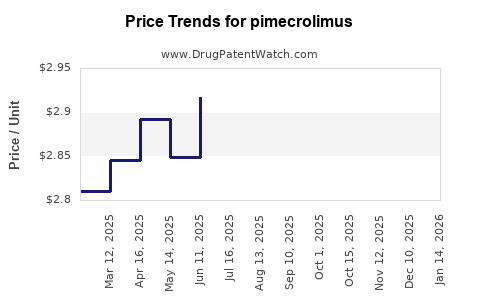
Last updated: August 18, 2026
Executive summary: Pimecrolimus is a mature topical dermatology drug with limited remaining exclusivity and low structural barriers to generic competition. The 1% cream, marketed originally as Elidel, received FDA approval in 2001 for mild-to-moderate atopic dermatitis in patients aged 2 years and older. Its commercial trajectory shifted from branded specialty dermatology to a multisource generic market after core patent and regulatory protections expired. Revenue is now driven by prescription volume, payer coverage, generic pricing, and international brand retention rather than exclusivity.
Pimecrolimus Market Dynamics, Patent Expiration, Generic Competition, and Financial Trajectory
What is pimecrolimus and how is it used?
Pimecrolimus is a topical calcineurin inhibitor used to treat mild-to-moderate atopic dermatitis. It is available primarily as a 1% cream and is applied to affected skin areas for short-term or intermittent treatment when topical corticosteroids are unsuitable or insufficient.
The drug inhibits T-cell activation and inflammatory cytokine release through inhibition of calcineurin. Unlike topical corticosteroids, pimecrolimus does not cause steroid-related skin atrophy when used as directed. Its commercial positioning has therefore focused on sensitive areas, including the face, eyelids, neck, and skin folds.
The original branded product was Elidel Cream 1%. The active ingredient is pimecrolimus, a macrolactam derivative related to the ascomycin class of immunomodulators.
| Attribute |
Pimecrolimus |
| Active ingredient |
Pimecrolimus |
| Primary dosage form |
Topical cream |
| Commercial strength |
1% |
| Initial U.S. approval |
December 2001 |
| Original brand |
Elidel |
| FDA indication |
Mild-to-moderate atopic dermatitis |
| U.S. pediatric population |
Patients aged 2 years and older |
| Drug class |
Topical calcineurin inhibitor |
| Biologic status |
Not applicable |
| Current market structure |
Brand plus generic topical products |
The FDA label includes a boxed warning concerning rare reports of malignancy, including lymphoma and skin cancer. The label states that a causal relationship has not been established, but the warning has affected prescribing behavior and commercial positioning.[1]
When did pimecrolimus lose exclusivity?
Pimecrolimus lost practical U.S. market exclusivity after expiration of its core composition-of-matter and formulation patent protection, followed by the entry of generic cream products. The original Elidel regulatory exclusivity period also expired many years ago.
| Exclusivity category |
Status |
| New chemical entity exclusivity |
Expired |
| Pediatric exclusivity |
Expired |
| Core U.S. patent protection |
Expired |
| FDA-approved generic competition |
Present |
| Current branded exclusivity |
None identified |
| Orphan-drug exclusivity |
Not applicable |
| Biosimilar exclusivity |
Not applicable |
The key commercial event was not a single loss-of-exclusivity date but the transition from a protected branded product to an abbreviated new drug application, or ANDA, market. Generic pimecrolimus cream products can reference the listed drug through the FDA’s generic-drug pathway, subject to pharmaceutical equivalence and bioequivalence requirements.
The original patent estate covered pimecrolimus and related macrolactam compounds, pharmaceutical compositions, and dermatological use. Those rights no longer provide a meaningful barrier to standard generic entry in the United States.
What patents protect pimecrolimus?
The original patent estate protected the active compound and topical pharmaceutical formulations. The relevant patent strategy was typical of an innovative small-molecule dermatology product:
- Composition-of-matter claims covering pimecrolimus and related analogues.
- Pharmaceutical-composition claims covering cream formulations.
- Method-of-treatment claims covering topical use for inflammatory skin conditions.
- Manufacturing and intermediate claims covering synthesis of the macrolactam compound.
Those patent families have reached the end of their effective commercial life in the United States. Later patents, if any, would need to cover a distinct formulation, delivery system, concentration, manufacturing process, or clinical use. Such claims would not automatically block a conventional pimecrolimus 1% cream.
Are formulation patents still a major barrier?
Formulation patents are unlikely to create a substantial barrier for ordinary pimecrolimus cream products. The marketed dosage form is a conventional topical cream, and generic manufacturers can develop substantially equivalent formulations without copying every inactive ingredient or manufacturing parameter.
A formulation patent could matter if it covered a specific delivery technology, improved stability profile, non-irritating vehicle, or enhanced skin penetration system. No such later-generation formulation has achieved the commercial scale or regulatory importance of Elidel’s original product.
The primary remaining barriers are technical and commercial:
- Maintaining uniform drug distribution in the cream.
- Matching rheology, spreadability, particle size, and preservative performance.
- Demonstrating acceptable topical performance under FDA requirements.
- Establishing manufacturing scale and reliable supply.
- Securing payer placement against low-cost alternatives.
These factors can delay a generic launch, but they do not recreate pharmaceutical exclusivity.
What is the FDA and Orange Book status of pimecrolimus?
Pimecrolimus remains an FDA-approved prescription topical drug. Elidel is the reference listed drug for pimecrolimus cream 1% in the United States. Generic versions are approved through the ANDA pathway and are listed in FDA drug databases and the Orange Book where applicable.[2][3]
The product does not have a biosimilar pathway because pimecrolimus is a chemically synthesized small molecule rather than a biologic. FDA competition is therefore based on generic equivalence, not biosimilar interchangeability.
| Regulatory issue |
Current position |
| FDA approval |
Yes |
| Reference product |
Elidel Cream 1% |
| Generic pathway |
ANDA |
| Biosimilar pathway |
No |
| Therapeutic equivalence analysis |
Applicable to approved generics |
| Pediatric approval |
Yes, age 2 and older |
| Prescription status |
Prescription-only |
| REMS program |
No product-specific REMS identified |
| Boxed warning |
Yes, malignancy warning |
The FDA label also directs clinicians to use pimecrolimus as second-line therapy for short-term and noncontinuous chronic treatment in patients who have not responded adequately to other topical prescription treatments or when those treatments are not advisable.[1] This labeling limits the product’s positioning as a first-line therapy.
Which companies are challenging the pimecrolimus market?
Competition comes from generic manufacturers and from alternative atopic-dermatitis therapies rather than from a single high-profile patent challenger.
Generic manufacturers
Multiple manufacturers and contract manufacturers can compete in pimecrolimus cream once patent barriers have expired. The economic model is generally unattractive for a large branded pharmaceutical company because the product has:
- Low unit value.
- Limited differentiation.
- Modest market size relative to mass-market generic drugs.
- Payer pressure.
- Manufacturing complexity associated with semisolid topical products.
Generic competition is likely to remain fragmented. Manufacturers with established topical manufacturing platforms, dermatology portfolios, or pharmacy distribution relationships have the strongest commercial position.
Therapeutic competitors
Pimecrolimus competes with:
- Generic topical corticosteroids.
- Tacrolimus ointment, another topical calcineurin inhibitor.
- Crisaborole ointment.
- Ruxolitinib cream.
- Topical roflumilast products.
- Dupilumab and other systemic biologic therapies for moderate-to-severe disease.
- Nonprescription emollients and barrier-repair products.
Tacrolimus is the closest pharmacologic competitor. Tacrolimus ointment is generally used for atopic dermatitis and is available in multiple strengths and generic versions. Pimecrolimus cream has a cosmetic and tolerability advantage for some patients, particularly on the face, but tacrolimus has stronger positioning for more persistent or severe disease.
How does pimecrolimus compare with tacrolimus and newer atopic-dermatitis drugs?
| Product |
Drug class |
Typical disease positioning |
Exclusivity profile |
Commercial pressure |
| Pimecrolimus cream |
Topical calcineurin inhibitor |
Mild-to-moderate disease, sensitive sites |
Expired |
High generic pressure |
| Tacrolimus ointment |
Topical calcineurin inhibitor |
Mild-to-moderate disease, broader use |
Expired in core forms |
High generic pressure |
| Crisaborole |
PDE-4 inhibitor |
Mild-to-moderate disease |
Brand and formulation protection historically stronger |
Moderate |
| Ruxolitinib cream |
JAK inhibitor |
Atopic dermatitis and other inflammatory conditions |
Active branded estate in relevant markets |
Lower near term |
| Dupilumab |
Monoclonal antibody |
Moderate-to-severe disease |
Biologic patent and regulatory protections |
Biosimilar risk later |
| Topical corticosteroids |
Multiple classes |
Broad disease severity range |
Mostly generic |
Very high |
Pimecrolimus has a lower price than newer branded agents but faces a clinical positioning problem. Generic topical steroids are less expensive and familiar to prescribers. Newer nonsteroidal products offer more aggressive commercial investment, broader promotional activity, or treatment access through specialty dermatology channels.
What is the financial trajectory of pimecrolimus?
Pimecrolimus has followed the standard financial trajectory of a mature small-molecule dermatology product:
2001 to late 2000s: branded growth
Elidel entered the market as a branded nonsteroidal treatment for atopic dermatitis. Early commercial value came from its steroid-sparing profile and use on sensitive skin areas. Sales were constrained by the FDA boxed warning and the label’s second-line positioning.
Late 2000s to mid-2010s: brand erosion
The product faced increasing competition from generic topical steroids, tacrolimus, and payer restrictions. The boxed warning reduced physician willingness to use pimecrolimus broadly. Commercial rights changed among pharmaceutical and specialty dermatology companies during the product’s mature-brand period, reducing the likelihood of sustained global promotional investment.
Mid-2010s onward: generic-market economics
After patent expiration and generic entry, net prices declined sharply. The market shifted toward:
- Low-price generic prescriptions.
- Residual branded demand.
- Pharmacy benefit substitution.
- Regional differences in reimbursement.
- Contract manufacturing and distributor economics.
Standalone revenue for pimecrolimus is not generally reported by major pharmaceutical companies. Public companies typically include the product within broader dermatology or established-brands portfolios, preventing a reliable current revenue figure from audited company filings.
The market is therefore better measured through prescription volume and product share than through reported brand sales. Financial value remains positive but is likely concentrated among generic suppliers, distributors, and manufacturers with efficient topical production.
What generic entry risks exist for pimecrolimus?
Generic entry risk is high because the core intellectual-property barriers have expired and the product has a straightforward small-molecule regulatory pathway.
| Risk factor |
Assessment |
| Patent blocking risk |
Low |
| Paragraph IV litigation risk |
Low for the mature market |
| Formulation complexity |
Moderate |
| Manufacturing scale risk |
Moderate |
| Price erosion risk |
High |
| Substitution risk from tacrolimus |
High |
| Substitution risk from newer brands |
Moderate to high |
| Reimbursement risk |
High |
| Supply disruption risk |
Moderate |
Are Paragraph IV challenges still relevant?
Paragraph IV challenges are most relevant before or during the initial generic-entry window, when an ANDA applicant asserts that a listed patent is invalid, unenforceable, or not infringed. For pimecrolimus, the commercial significance of Paragraph IV litigation has largely passed because the core U.S. patent estate has expired.
Any later challenge would need to address a newly listed patent covering a specific formulation or use. Such a patent would not necessarily block all pimecrolimus generic products. No major current Paragraph IV dispute is a central driver of the pimecrolimus market.
What patent litigation and settlement agreements affect pimecrolimus?
Pimecrolimus does not have a current litigation profile comparable to high-value branded drugs with active Orange Book patent estates. The central legal issues have historically involved patent validity, infringement, and the timing of generic entry, but those issues no longer define the market.
No widely reported current settlement agreement appears to control generic pimecrolimus access in the United States. The absence of an active settlement framework supports continued generic availability and price competition.
What is the geographic coverage of pimecrolimus patents and products?
Core patent protection has expired in the major regulated markets, including the United States and Europe. Market access now depends on national registrations, local formulation approvals, reimbursement rules, and distributor agreements.
Pimecrolimus remains commercially relevant in countries where:
- Atopic dermatitis prevalence is high.
- Topical calcineurin inhibitors are reimbursed.
- Generic registration is established.
- Dermatology specialists influence prescribing.
- Brand loyalty persists despite generic availability.
Emerging-market performance can be more dependent on local brand names, physician promotion, and pharmacy substitution rules than on patent protection.
How strong is the pimecrolimus patent estate?
The current patent estate is weak as a commercial exclusivity asset. Its historical composition-of-matter protection was important, but it no longer prevents generic competition.
| Patent-estate dimension |
Current strength |
| Core molecule protection |
Expired |
| Basic cream formulation |
Expired or commercially nonblocking |
| Method-of-use protection |
Limited practical value |
| Manufacturing protection |
Potentially relevant only to specific processes |
| Device or delivery protection |
Limited |
| Ability to block standard generic cream |
Low |
| Licensing leverage |
Low |
| Litigation leverage |
Low |
The strongest remaining commercial assets are regulatory approvals, manufacturing know-how, supply reliability, and distribution access. Those assets can support a profitable generic position but do not justify premium pricing.
What are the likely future market scenarios for pimecrolimus?
Base case
Pimecrolimus remains a stable, low-growth generic dermatology product. Volume is supported by chronic atopic dermatitis prevalence, while price declines offset prescription growth.
Downside case
Greater substitution to generic tacrolimus, topical corticosteroids, crisaborole, ruxolitinib, or biologics reduces pimecrolimus volume. Payers place the product in unfavorable formulary tiers, and manufacturers exit because of low margins.
Upside case
A manufacturer captures share through reliable supply, competitive pricing, strong pharmacy distribution, or a differentiated vehicle. Growth would likely come from volume rather than pricing or new patent protection.
The product has little prospect of a major revenue reacceleration without a new formulation, expanded indication, or a commercially meaningful delivery innovation.
Key Takeaways
- Pimecrolimus is an FDA-approved topical calcineurin inhibitor marketed originally as Elidel Cream 1%.
- Core patent and regulatory exclusivity have expired.
- Generic pimecrolimus cream competition is established, making price erosion the main financial pressure.
- No biosimilar pathway applies because pimecrolimus is a small molecule.
- The FDA boxed warning and second-line label positioning limit broad first-line use.
- Tacrolimus, topical corticosteroids, crisaborole, ruxolitinib, and dupilumab define the competitive landscape.
- Current standalone revenue is not disclosed reliably by major pharmaceutical companies.
- The remaining value lies in generic manufacturing efficiency, supply reliability, payer access, and distribution.
- Patent litigation, Paragraph IV challenges, and settlement agreements are not currently major market drivers.
- Pimecrolimus is likely to remain a stable but low-growth mature dermatology product.
FAQs
Is pimecrolimus cream still patented?
Core patents covering pimecrolimus and its original cream formulation have expired in major markets, including the United States. Later patents would need to cover a distinct formulation, manufacturing process, or delivery system.
Is pimecrolimus available as a generic in the United States?
Yes. Generic pimecrolimus cream 1% products are approved through the FDA ANDA pathway and compete with the Elidel reference product.
Is pimecrolimus safer than topical steroids?
Pimecrolimus avoids corticosteroid-associated skin atrophy, but it carries an FDA boxed warning concerning rare malignancy reports. The FDA label positions it as a second-line treatment for short-term and intermittent use.[1]
Can pimecrolimus be substituted for tacrolimus?
Both are topical calcineurin inhibitors, but they are not identical products. They differ in dosage form, strength, labeling, tolerability, and clinical positioning. Substitution depends on the prescriber, payer rules, and the specific approved product.
Could a new pimecrolimus formulation regain market exclusivity?
A new formulation could receive patent protection if it satisfies patentability requirements and offers a distinct technical or clinical benefit. Such protection would apply to the patented formulation, not automatically to all pimecrolimus products.
References
-
U.S. Food and Drug Administration. (2023). Elidel (pimecrolimus) cream, 1%: Prescribing information. https://www.accessdata.fda.gov/drugsatfda_docs/label/
-
U.S. Food and Drug Administration. (2024). Drugs@FDA: FDA-approved drugs. https://www.accessdata.fda.gov/scripts/cder/daf/
-
U.S. Food and Drug Administration. (2024). Approved drug products with therapeutic equivalence evaluations, Orange Book. https://www.accessdata.fda.gov/scripts/cder/ob/
-
U.S. Food and Drug Administration. (2024). Approved drug product list and generic drug resources. https://www.fda.gov/drugs/generic-drugs
-
American Academy of Dermatology Association. (2023). Atopic dermatitis clinical guidelines. https://www.aad.org/member/clinical-quality/guidelines/atopic-dermatitis