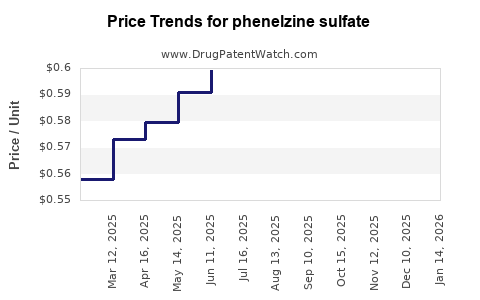
Last updated: August 9, 2026
Phenelzine sulfate is a mature, low-volume generic monoamine oxidase inhibitor sold primarily as 15 mg tablets. Its commercial profile is defined by limited clinical use, few manufacturers, intermittent supply constraints, and minimal patent protection. The product has no meaningful remaining originator exclusivity, no biosimilar exposure, and limited visibility in public company revenue disclosures.
The market is unlikely to expand materially. Revenue can rise temporarily when competitors leave the market or supply shortages permit price increases, but long-term volume growth is constrained by the availability of newer antidepressants and the clinical burden of MAOI therapy.
What is phenelzine sulfate and how is it used?
Phenelzine sulfate is the active pharmaceutical ingredient in Nardil, an irreversible, nonselective monoamine oxidase inhibitor. The FDA-approved indication is the treatment of depression in patients who have not responded adequately to other antidepressants or who cannot tolerate them.[1]
Phenelzine is generally positioned as a later-line treatment because of:
- Tyramine-related hypertensive crisis risk
- Numerous food and drug interactions
- Risk of serotonin syndrome
- Need for medication washout periods
- Orthostatic hypotension and weight gain
- Clinician reluctance to initiate older MAOIs
- Limited primary-care familiarity
The marketed dosage form is an immediate-release 15 mg tablet. Unlike several newer antidepressants, phenelzine does not have an extended-release product, depot formulation, transdermal formulation, or approved pediatric indication.
What therapeutic category does phenelzine sulfate compete in?
Phenelzine competes indirectly with selective serotonin reuptake inhibitors, serotonin-norepinephrine reuptake inhibitors, atypical antidepressants, tricyclic antidepressants, and newer therapies such as esketamine.
Its closest pharmacologic competitors are tranylcypromine and selegiline, although selegiline is marketed in a transdermal system with different dietary restrictions at lower doses. Phenelzine retains a role in treatment-resistant or atypical depression, but it is not a high-volume first-line product.
| Attribute |
Phenelzine sulfate |
Tranylcypromine |
Selegiline transdermal |
| Drug class |
Irreversible, nonselective MAOI |
Irreversible, nonselective MAOI |
MAOI |
| Common dosage form |
15 mg tablet |
Tablet |
Transdermal patch |
| Primary commercial position |
Later-line depression |
Later-line depression |
Depression, differentiated delivery |
| Food restrictions |
Significant |
Significant |
Dose-dependent |
| Patent-growth potential |
Low |
Low to moderate, depending on product |
Higher because of delivery-system protection |
| Generic or price pressure |
High |
High |
More substantial brand/generic dynamics |
When did phenelzine sulfate lose exclusivity?
Phenelzine’s original pharmaceutical patents and Nardil market exclusivity expired decades ago. The product was first approved in the United States in the early 1960s, placing it well beyond the term of any original composition-of-matter or basic formulation patent.[1]
There is no commercially relevant modern patent barrier protecting the phenelzine molecule itself. The product is therefore exposed to generic competition and does not benefit from:
- New chemical entity exclusivity
- Orphan-drug exclusivity
- Pediatric exclusivity
- Modern formulation exclusivity
- A current patent term extension
- A meaningful Orange Book patent estate
The product’s commercial protection is operational rather than legal. Supply continuity, manufacturing capability, API access, regulatory compliance, and inventory management matter more than patent exclusion.
What is the FDA regulatory status of phenelzine sulfate?
Phenelzine sulfate is an FDA-approved prescription drug. The reference product is Nardil, historically associated with Parke-Davis and later Pfizer-related product portfolios. The product is available in generic form from manufacturers that have obtained abbreviated new drug applications or otherwise market approved generic presentations.
The FDA label identifies phenelzine sulfate tablets as a treatment for depression in patients who have not responded to other antidepressants or who have had unacceptable adverse reactions.[1]
Phenelzine is subject to standard prescription-drug controls. It is not a controlled substance under the federal Controlled Substances Act, but its prescribing restrictions arise from pharmacology, drug interactions, and safety monitoring.
What is the Orange Book status of phenelzine sulfate?
The Orange Book framework is commercially less important for phenelzine than for recently approved branded drugs. The relevant product is an old small-molecule prescription drug with generic competition and no material remaining patent exclusivity.
An Orange Book review should distinguish among:
- The historical Nardil reference listed drug.
- Approved generic phenelzine sulfate tablets.
- Any discontinued or withdrawn product listings.
- Current marketing status for each manufacturer and strength.
The absence of a meaningful patent estate limits the value of Paragraph IV litigation. Generic applicants generally do not need to challenge a dense set of formulation or method-of-use patents to enter the market.
What patents protect phenelzine sulfate?
No commercially significant active patent estate is known to protect phenelzine sulfate as a molecule or its conventional 15 mg tablet. The original compound and basic oral dosage form are long outside ordinary U.S. patent terms.
Potentially relevant intellectual-property categories would include:
| IP category |
Commercial relevance |
| Phenelzine composition patent |
Expired |
| Basic tablet formulation |
Expired or commercially immaterial |
| Method-of-use patents |
No material modern estate identified |
| Delivery-system patents |
None associated with the standard tablet |
| Manufacturing patents |
Potentially confidential but unlikely to block generic entry |
| Packaging or stability technology |
Limited value and generally nonexclusive |
| Salt or polymorph patents |
No known current barrier of consequence |
The absence of patent protection does not eliminate market defensibility. A manufacturer can still create practical barriers through validated manufacturing processes, approved facilities, qualified API suppliers, stability data, and reliable distribution.
How many manufacturers compete in the phenelzine sulfate market?
The competitive field is narrow relative to high-volume antidepressants. Generic availability has varied by time and supplier, and product listings can change as manufacturers discontinue or relaunch products.
The market has historically included generic suppliers and authorized or legacy brand channels rather than a large group of continuously active competitors. Publicly available FDA and DailyMed records should be used to verify current manufacturer, NDC, marketing status, and label information before a transaction or supply agreement.[2][3]
The effective competitor count is lower than the number of historical approvals because:
- Some approved products are not actively marketed.
- Some companies maintain dormant applications.
- API supply may be concentrated.
- Low demand reduces the economic value of maintaining multiple production lines.
- Manufacturers may exit after recurring shortage or compliance problems.
- Pharmacy purchasing often depends on wholesaler availability rather than nominal approval count.
What drives phenelzine sulfate market dynamics?
Limited clinical demand
Phenelzine is prescribed mainly after treatment failure with newer antidepressants. The addressable population is therefore small compared with patients receiving SSRIs or SNRIs.
Demand is supported by:
- Treatment-resistant depression
- Atypical depression
- Patients with prior response to phenelzine
- Specialist psychiatry use
- Patients who cannot tolerate other antidepressants
Demand is restrained by dietary restrictions, interaction management, adverse effects, and the availability of safer first-line therapies.
Low-volume generic economics
Phenelzine has the typical economics of an old generic with limited demand. The market can generate low absolute revenue but still impose meaningful operational costs because manufacturers must maintain:
- FDA-compliant production
- Pharmacovigilance
- Stability testing
- API qualification
- Label maintenance
- Inventory and shortage-management systems
A low-volume drug can become commercially unattractive when these fixed costs exceed gross profit.
Supply concentration and shortage risk
The most important market risk is supply disruption. A small number of manufacturers can create a fragile market in which the loss of one supplier causes pharmacy-level shortages.
Shortage drivers can include:
- API scarcity
- Manufacturing-site changes
- Quality-control failures
- Contract-manufacturing interruptions
- Packaging component shortages
- Low production priority
- Unexpected demand from competing-product shortages
ASHP and FDA shortage databases are the most relevant sources for tracking supply conditions, although shortage status can change quickly.[4][5]
What is the financial trajectory of phenelzine sulfate?
No major public company reports phenelzine sulfate as a separate revenue line. Standalone U.S. sales, prescription volume, gross margin, and market share are therefore generally not disclosed in public filings.
The most defensible financial view is qualitative:
| Period |
Likely financial profile |
| Historical branded period |
Higher unit economics with limited volume |
| Early generic period |
Price compression and fragmented supply |
| Mature generic period |
Low revenue, low growth, periodic price volatility |
| Shortage periods |
Temporary price and revenue uplift for available suppliers |
| Long term |
Stable-to-declining volume with episodic supply-driven revenue |
The product is unlikely to be a strategic growth asset for a large pharmaceutical company. It may have value for a specialty-generic manufacturer if the company can maintain supply while competitors exit. The asset’s economics depend more on manufacturing reliability and net pricing than on prescription growth.
What revenue exposure does phenelzine sulfate create?
For large diversified pharmaceutical companies, phenelzine-related revenue exposure is likely immaterial. For a small generic manufacturer, however, the product can have disproportionate operational value if it is one of a limited number of active suppliers.
Revenue exposure can arise through:
- Temporary price increases during shortages
- Preferred wholesaler positioning
- Hospital and specialty-pharmacy contracts
- Reduced competition after a manufacturer exit
- Inventory availability when competing NDCs are unavailable
The same conditions can increase regulatory and reputational risk. A supplier that raises prices sharply during a shortage may attract customer scrutiny and lose long-term account relationships when supply normalizes.
Are there Paragraph IV challenges for phenelzine sulfate?
Paragraph IV litigation is unlikely to be a meaningful current issue. Phenelzine’s basic patents expired long ago, and a new generic applicant would not confront the type of active patent thicket associated with a recent branded drug.
The principal entry risks are regulatory and commercial rather than patent-related:
- FDA approval delays
- Bioequivalence or manufacturing deficiencies
- Difficulty securing qualified API
- Low expected return on investment
- Limited pharmacy demand
- Existing suppliers with established distribution
- Uncertain pricing after launch
A generic applicant could still make a Paragraph IV certification against any listed patent if one were present, but the commercial value of such a challenge would be limited absent a live blocking patent.
What formulations and methods of use are protected?
The conventional phenelzine sulfate product is a 15 mg immediate-release tablet. No major formulation differentiation is evident in the standard product.
Potential formulation opportunities include:
- Reduced-interaction dosage forms
- Modified-release tablets
- Improved tolerability profiles
- Alternative salt or solid-state forms
- Combination products
- Specialty packaging with dietary and interaction guidance
These concepts would face substantial clinical and commercial hurdles. A new formulation would need to demonstrate a meaningful advantage over an inexpensive generic tablet, while also addressing the core pharmacologic risks of irreversible MAOI therapy.
Method-of-use patents could theoretically target treatment-resistant depression, atypical depression, or biomarker-selected patients. Such patents would face enforceability and prescribing-practice challenges because phenelzine has been used clinically for decades and its therapeutic applications are well established.
Which companies are challenging or competing with phenelzine sulfate?
Competition comes from therapeutic substitutes rather than patent challengers. The main alternatives are:
- SSRIs such as sertraline, fluoxetine, and escitalopram
- SNRIs such as venlafaxine and duloxetine
- Bupropion and mirtazapine
- Tricyclic antidepressants
- Tranylcypromine
- Selegiline transdermal systems
- Esketamine products for treatment-resistant depression
- Electroconvulsive therapy and other non-drug interventions
Generic manufacturers compete primarily on supply reliability, price, wholesaler access, and regulatory execution. Brand manufacturers compete through differentiated delivery systems, clinical positioning, and reimbursement support.
What generic entry risks exist for phenelzine sulfate?
Generic-entry risk is structurally high because patent barriers are weak. However, the market may not support unlimited entrants.
High-risk factors for incumbent suppliers
- New generic approvals can compress prices.
- A competitor can capture contracts through lower pricing.
- Pharmacy substitution can shift volume rapidly.
- A manufacturer may lose share after a temporary supply disruption.
- A new supplier can use an existing FDA-approved manufacturing platform.
Barriers to new entrants
- Low and uncertain market size
- Difficult API sourcing
- Limited return on regulatory investment
- Need for reliable long-term production
- Potential shortage-management obligations
- Complex interaction and safety labeling
- Lack of premium pricing outside shortage conditions
This creates a market with low legal barriers but meaningful economic barriers.
How strong is the phenelzine sulfate patent estate?
The patent estate is weak from a pharmaceutical exclusivity perspective. The relevant value lies in regulatory status and supply capability, not in enforceable exclusion rights.
| Strength dimension |
Assessment |
| Composition-of-matter protection |
None of commercial significance |
| Formulation protection |
Weak or absent for standard tablets |
| Method-of-use protection |
Weak or absent |
| Orange Book leverage |
Low |
| Generic-entry resistance |
Low legally; moderate economically |
| Manufacturing know-how |
Potentially useful but generally nonexclusive |
| Supply-chain defensibility |
Material for active suppliers |
| Litigation value |
Low |
A buyer should value phenelzine as a mature specialty-generic product, not as a patent-protected asset.
What licensing deals affect phenelzine sulfate?
No major recent licensing transaction is central to phenelzine sulfate’s commercial position. The product’s historical brand ownership and generic commercialization arrangements are more relevant than contemporary innovation licensing.
Potential transaction value would most likely involve:
- Acquisition of an approved generic application
- Transfer of an NDC and product rights
- Contract manufacturing
- API supply agreements
- Portfolio transactions involving multiple legacy products
- Authorized-generic or distribution arrangements
Any transaction analysis should separate product rights from manufacturing rights. An approved application without reliable production capacity may have limited value, while a qualified manufacturing platform can support continued sales even without patent protection.
What is the outlook for phenelzine sulfate?
The base-case outlook is stable to declining demand with intermittent revenue volatility. Prescription volume is unlikely to grow materially because the product occupies a narrow later-line treatment segment. Revenue can increase temporarily when competing suppliers experience shortages or exit the market.
The most likely commercial scenarios are:
| Scenario |
Market result |
| Stable multi-supplier availability |
Low pricing, modest predictable revenue |
| One major supplier exits |
Shortage risk and temporary price expansion |
| New generic entrant launches |
Lower prices and incumbent share loss |
| API disruption occurs |
Reduced volume, higher spot pricing |
| Differentiated formulation launches |
Limited uptake unless safety or adherence improves |
| Broader MAOI use increases |
Unlikely without new clinical evidence or guidelines |
Key Takeaways
- Phenelzine sulfate is an old, genericized MAOI with no material remaining composition or formulation exclusivity.
- Its FDA-approved use is later-line treatment of depression.
- The commercial market is small because newer antidepressants have replaced MAOIs in routine practice.
- The primary business risk is supply disruption, not patent litigation.
- Public companies generally do not disclose phenelzine revenue separately.
- Financial performance is likely low-growth and volume-constrained, with temporary upside during shortages.
- The product may be valuable to a specialty-generic company that can maintain reliable manufacturing and distribution.
- New entrants face low patent barriers but uncertain returns, API constraints, and limited demand.
- Biosimilar risk is irrelevant because phenelzine is a synthetic small molecule, not a biologic.
- A transaction should be valued on approved regulatory assets, supplier reliability, net pricing, and shortage exposure rather than patent life.
FAQs
Is phenelzine sulfate still commercially available?
Phenelzine sulfate remains an FDA-approved prescription product, but availability can vary by manufacturer, NDC, wholesaler, and time period. Generic supply has historically been vulnerable to interruptions.
Is phenelzine sulfate a branded or generic drug?
Nardil is the historical branded product. Phenelzine sulfate tablets are primarily evaluated today as a mature generic product.
Can phenelzine sulfate be substituted automatically at the pharmacy?
Substitution depends on state law, prescriber instructions, pharmacist authority, and whether an FDA-equivalent generic product is available. The pharmacist and prescriber determine the applicable substitution outcome.
Does phenelzine sulfate have biosimilar competition?
No. Phenelzine sulfate is a chemically synthesized small molecule. Its competitive exposure comes from generic drugs, not biosimilars.
Could a new phenelzine formulation create a valuable patent position?
A new formulation could create patentable subject matter if it provides a non-obvious technical or clinical advantage. Commercial value would depend on proving that the formulation improves safety, adherence, tolerability, or administration enough to justify a premium over generic tablets.
References
- U.S. Food and Drug Administration. (2018). Nardil (phenelzine sulfate) tablets prescribing information. FDA.
- U.S. Food and Drug Administration. (n.d.). Approved drug products with therapeutic equivalence evaluations. FDA.
- National Library of Medicine. (n.d.). DailyMed: Phenelzine sulfate tablet labeling. U.S. National Library of Medicine.
- American Society of Health-System Pharmacists. (n.d.). Drug shortages resource center. ASHP.
- U.S. Food and Drug Administration. (n.d.). Drug shortages. FDA.