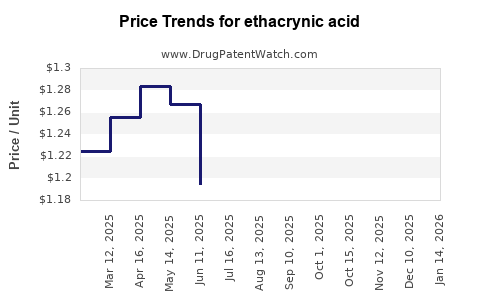
Last updated: August 8, 2026
Ethacrynic acid is a mature, low-volume loop diuretic with limited commercial growth prospects. The drug is marketed primarily as Edecrin tablets and injectable ethacrynate sodium for patients who cannot use sulfonamide-containing loop diuretics or who require an alternative diuretic. Its patent estate is effectively expired, FDA market exclusivity is long gone, and generic competition is permitted. Commercial value is supported by clinical differentiation, hospital availability requirements, and limited competition rather than intellectual-property protection.
Public companies do not separately disclose revenue for ethacrynic acid. The available evidence supports a niche-product profile with modest revenue, periodic supply constraints, and pricing that can be high relative to the drug's development cost because demand is limited and manufacturing scale is small.
What is ethacrynic acid and how is it used?
Ethacrynic acid is a loop diuretic that inhibits sodium and chloride reabsorption in the ascending loop of Henle. Unlike furosemide, bumetanide, and torsemide, it is not a sulfonamide derivative. That distinction gives it a role in patients with serious sulfonamide hypersensitivity concerns.
The FDA-approved product is used to treat edema associated with:
- Congestive heart failure
- Hepatic cirrhosis
- Renal disease, including nephrotic syndrome
- Other conditions requiring diuresis
The marketed oral product is Edecrin, generally supplied as 25 mg tablets. Injectable ethacrynate sodium is used when oral administration is not practical or when rapid diuresis is required. The drug is potent but has a recognized risk of ototoxicity, particularly at high doses, with rapid intravenous administration, renal impairment, or concomitant use of other ototoxic medicines. [1]
Ethacrynic acid is not a first-line loop diuretic for most patients. Furosemide, torsemide, and bumetanide have broader routine use, stronger generic supply, and greater prescriber familiarity.
What is the FDA regulatory status of ethacrynic acid?
Ethacrynic acid was approved in the United States in the 1960s. The original Edecrin approval predates the modern Hatch-Waxman framework and current FDA exclusivity categories.
| Regulatory item |
Status |
| Active ingredient |
Ethacrynic acid |
| Primary product |
Edecrin tablets |
| Common strength |
25 mg |
| Injectable form |
Ethacrynate sodium |
| Therapeutic class |
Loop diuretic |
| Original U.S. approval |
1960s |
| Current FDA pathway |
Approved prescription drug |
| New chemical entity exclusivity |
Expired |
| Orphan-drug exclusivity |
None identified |
| Pediatric exclusivity |
None identified |
| Biosimilar pathway |
Not applicable |
| Orange Book patent barrier |
No meaningful unexpired patent barrier identified in public records through 2024 |
FDA product labeling identifies ethacrynic acid as a loop diuretic with indications for edema and warnings concerning ototoxicity, electrolyte depletion, dehydration, and excessive diuresis. [1]
What is the Orange Book status of Edecrin and ethacrynic acid?
The commercial protection for Edecrin is not based on an active patent estate. The underlying composition-of-matter and product patents, if any, expired decades ago. No current patent protection appears to prevent an ANDA applicant from seeking approval for an equivalent ethacrynic acid product.
The relevant commercial protection is therefore regulatory and operational rather than patent-based:
- FDA approval and bioequivalence requirements.
- Manufacturing controls for a low-volume product.
- Stable sourcing of active pharmaceutical ingredient.
- Hospital and pharmacy formulary relationships.
- Product availability and supply continuity.
- Limited but clinically meaningful demand from patients who need a nonsulfonamide loop diuretic.
The absence of an active Orange Book patent barrier materially lowers the legal threshold for generic entry. A prospective generic manufacturer would not normally face a Paragraph IV patent challenge against an unprotected product. The principal filing route would be an ANDA supported by pharmaceutical equivalence and bioequivalence data.
When did ethacrynic acid lose exclusivity?
Ethacrynic acid lost meaningful exclusivity many years ago. The drug's original approval occurred before the current five-year new chemical entity exclusivity system. Any original patent protection would have expired long before the present market period.
| Protection type |
Current position |
| Original compound patent |
Expired |
| Original formulation patents |
Expired or commercially irrelevant |
| New chemical entity exclusivity |
Not available for this legacy product |
| Orphan exclusivity |
None |
| Pediatric exclusivity |
None |
| Market exclusivity for Edecrin |
Expired |
| Current patent-based launch barrier |
None identified |
The absence of exclusivity means that a generic manufacturer can compete on price if it can meet FDA requirements and sustain commercial supply.
How many patents cover ethacrynic acid?
No material number of unexpired U.S. patents appears to protect the active ingredient, conventional 25 mg tablets, or the core injectable formulation. Legacy patents associated with ethacrynic acid do not create a current market monopoly.
Potentially relevant patents could still arise around:
- Modified-release formulations
- Combination products
- New dosing regimens
- Ototoxicity mitigation
- Specialized hospital delivery systems
- New therapeutic uses
No such patent category has created a recognized commercial barrier around the conventional Edecrin product through the public records reviewed for this analysis.
This patent position contrasts with newer branded medicines, where composition, formulation, method-of-use, and manufacturing patents can delay generic entry for years. Ethacrynic acid has none of those protections at a commercially significant level.
Which companies market ethacrynic acid?
Edecrin has been associated with legacy branded pharmaceutical ownership and later specialty or generic-market commercialization. Bausch Health has been identified in U.S. labeling and product-distribution materials in connection with Edecrin. Generic or authorized-generic availability has varied by period, dosage form, and distributor.
The competitive structure is fragmented compared with high-volume diuretics. The relevant participants may include:
- The branded Edecrin supplier
- Generic tablet manufacturers
- Contract manufacturers
- Specialty pharmaceutical distributors
- Hospital wholesalers
- Compounding pharmacies in limited circumstances
The number of active suppliers can change because ethacrynic acid is a small market. A manufacturer may discontinue the product if production, quality-control, or distribution costs exceed expected sales.
What formulations are protected by ethacrynic acid patents?
No active patent protection has been identified for the standard Edecrin tablet formulation or the conventional injectable ethacrynate sodium product. The principal dosage forms are:
| Formulation |
Commercial role |
Patent position |
| 25 mg oral tablet |
Main chronic-use formulation |
No meaningful unexpired protection identified |
| Injectable ethacrynate sodium |
Hospital and acute-care use |
No meaningful unexpired protection identified |
| Compounded formulations |
Limited, pharmacy-specific use |
Not a branded patent franchise |
The oral tablet is commercially more important for outpatient treatment. The injectable product has greater strategic importance in hospitals because substitutions may be limited when a patient needs a nonsulfonamide loop diuretic and cannot take oral medication.
Are there Paragraph IV challenges against Edecrin?
A conventional Paragraph IV campaign does not appear to be a major feature of the ethacrynic acid market. Paragraph IV litigation is most relevant when a branded drug has listed, unexpired Orange Book patents. Ethacrynic acid's principal patents expired decades ago, eliminating the economic rationale for a large patent challenge.
Generic entry would more likely proceed through:
- ANDA submission without a patent challenge
- Paragraph III certification if a residual patent were listed
- A commercial launch after FDA approval
- Authorized-generic distribution by the incumbent supplier
The absence of patent litigation does not eliminate market-entry risk. A generic applicant would still face bioequivalence, stability, manufacturing, pharmacovigilance, and supply-chain requirements.
What regulatory and manufacturing barriers affect generic entry?
Ethacrynic acid has low legal barriers but meaningful operating barriers. The key constraints are economic.
A generic manufacturer must establish:
- Consistent active pharmaceutical ingredient supply
- Validated tablet or injectable manufacturing
- Compliance with current good manufacturing practice
- Demonstrated content uniformity and dissolution
- Injectable sterility and endotoxin controls, where applicable
- Stability data supporting the proposed shelf life
- Reliable distribution through wholesalers and hospitals
The product's small addressable market can make those fixed costs difficult to recover. A market with one or two suppliers may support elevated pricing, but it may not support several durable competitors. Low demand also raises the risk that a manufacturer will rationalize the product portfolio after quality events, facility changes, or contract losses.
For injectable products, the manufacturing barrier is higher than for tablets because sterile production, vial or ampoule filling, inspection, and hospital supply requirements add cost. This can preserve a practical supply advantage for an incumbent despite the absence of patents.
What is the competitive landscape for ethacrynic acid?
Ethacrynic acid competes primarily with generic furosemide, torsemide, and bumetanide.
| Drug |
Sulfonamide-related structure |
Typical market position |
Relative commercial scale |
| Ethacrynic acid |
No |
Alternative for selected patients |
Low |
| Furosemide |
Yes |
Standard first-line loop diuretic |
Very high |
| Torsemide |
Yes |
Chronic heart-failure and edema treatment |
High and growing in some segments |
| Bumetanide |
Yes |
Potent alternative loop diuretic |
Moderate |
Ethacrynic acid's differentiation is narrow. It is not generally selected because of superior overall efficacy or convenience. Its value is concentrated in patients for whom sulfonamide-related concerns, prior reactions, or clinical circumstances limit use of other loop diuretics.
This creates a defensive market position. Physicians and hospitals may retain access to Edecrin even when sales volume is low because the product fills a specific clinical need.
What is the financial trajectory of ethacrynic acid?
No public financial filing identified in the standard company-reporting record separately discloses Edecrin or ethacrynic acid revenue. The product is generally grouped within broader branded, legacy, hospital, or specialty-product categories.
The likely financial trajectory is:
1960s through 1990s: mature branded product
The product benefited from first-mover status in a specialized loop-diuretic segment. Revenue was supported by the lack of a direct nonsulfonamide substitute, although the broader diuretic market was dominated by furosemide.
2000s through 2010s: generic and portfolio transition
The product moved into a legacy-drug environment. Generic entry and low prescription volume reduced the opportunity for conventional brand growth. Ownership and distribution changes became more important than clinical expansion.
2020s: stable niche demand with price and supply volatility
Demand is likely relatively stable or slowly declining in unit terms. Revenue can fluctuate because of:
- Price increases in a low-volume market
- Product shortages
- Hospital purchasing contracts
- Generic supplier entry or withdrawal
- Changes in branded-product ownership
- Formulary substitutions
- Changes in the number of patients with suspected sulfonamide intolerance
The product is more likely to generate episodic pricing power than sustained volume growth. It does not have the characteristics of a high-growth pharmaceutical asset.
How much revenue is exposed to ethacrynic acid?
Company-level revenue exposure is likely immaterial for diversified pharmaceutical companies but potentially significant for a small specialty manufacturer or distributor holding a narrow portfolio.
| Financial factor |
Assessment |
| Publicly disclosed product revenue |
Not separately reported |
| Volume growth |
Limited |
| Price sensitivity |
High because the market is small |
| Generic erosion risk |
High in principle |
| Actual substitution risk |
Moderate, because the product has a narrow clinical role |
| Supply disruption risk |
Meaningful |
| Commercial scale |
Niche |
| Strategic value |
Higher for a specialty or hospital-focused portfolio than for a large pharmaceutical company |
An acquiring company would need to value the product on contribution margin, supply reliability, customer concentration, and manufacturing cost rather than headline prescription volume. A low-volume legacy product can have positive cash flow if pricing is adequate and production is efficient. It can also become loss-making quickly after a quality remediation, API price increase, or sterile-manufacturing interruption.
What generic launch scenarios exist for ethacrynic acid?
The most likely scenarios are:
| Scenario |
Market effect |
Probability assessment |
| Additional tablet generic approval |
Lower price and greater pharmacy substitution |
Commercially plausible |
| Generic injectable approval |
Greater hospital competition |
More difficult because of sterile manufacturing |
| Incumbent authorized generic |
Limits third-party pricing opportunity |
Plausible |
| Supplier withdrawal |
Temporary shortage and price increase |
Material risk in a small market |
| No new durable entrant |
Continued niche pricing with limited volume change |
Also plausible |
| Reformulated product with new patent |
Potentially higher-value product |
No established commercial example identified |
The principal risk to the incumbent is not a blockbuster generic wave. It is the entry or re-entry of one capable supplier that can meet demand at a lower price. The principal risk to a new entrant is insufficient volume to cover regulatory and manufacturing costs.
What patent litigation and settlement agreements affect ethacrynic acid?
No major current U.S. patent litigation or settlement agreement appears to control the conventional ethacrynic acid market. The product's commercial history is primarily a legacy-drug and supply-chain story, not a patent-litigation story.
That distinction matters for transaction analysis. A buyer should focus on:
- FDA warning letters and inspection history
- Product recalls
- Drug-shortage records
- API supplier concentration
- Manufacturing-site ownership
- Wholesaler contracts
- Reimbursement and formulary placement
- Product-liability exposure related to ototoxicity and electrolyte effects
Patent diligence is still necessary, but it is unlikely to determine near-term market access for the conventional product.
What is the biosimilar risk for ethacrynic acid?
There is no biosimilar risk because ethacrynic acid is a small-molecule drug, not a biologic. Competition occurs through the abbreviated new drug application pathway, not the biosimilar pathway.
The relevant competitive risks are generic tablets, generic injectable products, authorized generics, and therapeutic substitution with other loop diuretics.
How strong is the ethacrynic acid patent estate?
The patent estate is weak from a market-exclusivity perspective. It has no identified unexpired composition-of-matter protection, no recognized formulation moat around the standard product, and no current patent litigation barrier.
Its commercial defensibility comes from clinical positioning and supply economics:
- Nonsulfonamide chemistry
- Established FDA labeling
- Hospital familiarity
- Limited patient population
- Potential supplier scarcity
- Practical switching concerns in sensitive patients
This is a low-patent, moderate-supply-risk asset. It is not a strong platform for lifecycle management unless a company develops and patents a genuinely differentiated formulation, delivery system, or clinical use.
Key Takeaways
- Ethacrynic acid is a mature loop diuretic marketed mainly as Edecrin.
- Its principal clinical distinction is the absence of a sulfonamide group.
- Original patents and regulatory exclusivities expired decades ago.
- No material current Orange Book patent barrier has been identified.
- Paragraph IV litigation is not a central market issue.
- Generic entry is legally feasible but economically constrained by low demand.
- Injectable supply has higher manufacturing barriers than tablets.
- Public companies do not separately disclose ethacrynic acid revenue.
- The product's financial profile is likely stable but small, with price volatility tied to supply conditions.
- Commercial value is based on niche clinical need and product availability, not patent strength.
- The main investment risks are generic entry, supplier withdrawal, manufacturing disruption, and therapeutic substitution.
FAQs About Ethacrynic Acid Commercialization and Exclusivity
Is Edecrin still protected by patents?
No material unexpired U.S. patent protection has been identified for the conventional Edecrin tablet product through public records available through 2024.
Can a generic manufacturer launch ethacrynic acid without a Paragraph IV challenge?
Yes. Because the core product protection has expired, an ANDA applicant may not need to challenge a currently blocking patent. The exact filing strategy depends on any patents listed at the time of submission.
Why is ethacrynic acid commercially available if cheaper loop diuretics exist?
It addresses a narrow patient population needing a nonsulfonamide loop diuretic. That clinical niche supports continued hospital and specialty-pharmacy demand.
Is ethacrynic acid a shortage-prone drug?
Small-market products can be vulnerable to shortages because few manufacturers may support commercial production. Sterile injectable supply is generally more exposed than conventional tablets.
Could a reformulated ethacrynic acid product obtain new patent protection?
Yes. A genuinely novel formulation, delivery system, or method of use could potentially receive patent protection. That would create a new product-specific estate rather than restore exclusivity to conventional ethacrynic acid.
References
- U.S. Food and Drug Administration. (2023). Edecrin (ethacrynic acid) tablets: Prescribing information.
- U.S. Food and Drug Administration. (2024). Approved drug products with therapeutic equivalence evaluations.
- U.S. National Library of Medicine. (2024). DailyMed: Edecrin and ethacrynate sodium labeling.
- U.S. Food and Drug Administration. (2024). Drugs@FDA: FDA-approved drug database.
- U.S. Food and Drug Administration. (2024). Drug shortages database.