Share This Page
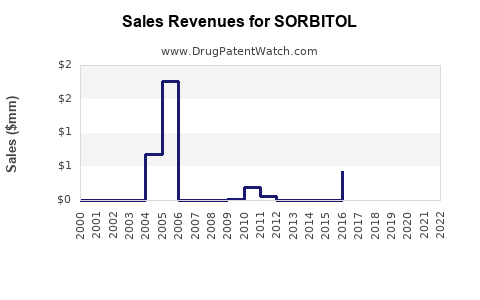
SORBITOL - Generic Drug Details
✉ Email this page to a colleague
What are the generic sources for sorbitol and what is the scope of freedom to operate?
Sorbitol
is the generic ingredient in two branded drugs marketed by Baxter Hlthcare and B Braun, and is included in three NDAs. Additional information is available in the individual branded drug profile pages.One supplier is listed for this compound.
Summary for SORBITOL
| US Patents: | 0 |
| Tradenames: | 2 |
| Applicants: | 2 |
| NDAs: | 3 |
| Finished Product Suppliers / Packagers: | 1 |
| Raw Ingredient (Bulk) Api Vendors: | 143 |
| Clinical Trials: | 40 |
| What excipients (inactive ingredients) are in SORBITOL? | SORBITOL excipients list |
| DailyMed Link: | SORBITOL at DailyMed |
Recent Clinical Trials for SORBITOL
Identify potential brand extensions & 505(b)(2) entrants
| Sponsor | Phase |
|---|---|
| Applied Therapeutics, Inc. | PHASE3 |
| Sunnybrook Health Sciences Centre | PHASE3 |
| Empros Pharma AB | PHASE2 |
Medical Subject Heading (MeSH) Categories for SORBITOL
Anatomical Therapeutic Chemical (ATC) Classes for SORBITOL
US Patents and Regulatory Information for SORBITOL
| Applicant | Tradename | Generic Name | Dosage | NDA | Approval Date | TE | Type | RLD | RS | Patent No. | Patent Expiration | Product | Substance | Delist Req. | Exclusivity Expiration |
|---|---|---|---|---|---|---|---|---|---|---|---|---|---|---|---|
| Baxter Hlthcare | SORBITOL 3% IN PLASTIC CONTAINER | sorbitol | SOLUTION;IRRIGATION | 018512-001 | May 27, 1982 | DISCN | No | No | ⤷ Start Trial | ⤷ Start Trial | ⤷ Start Trial | ||||
| B Braun | SORBITOL 3.3% IN PLASTIC CONTAINER | sorbitol | SOLUTION;IRRIGATION | 016741-001 | Approved Prior to Jan 1, 1982 | RX | No | No | ⤷ Start Trial | ⤷ Start Trial | ⤷ Start Trial | ||||
| Baxter Hlthcare | SORBITOL 3% IN PLASTIC CONTAINER | sorbitol | SOLUTION;IRRIGATION | 017863-001 | Approved Prior to Jan 1, 1982 | RX | No | No | ⤷ Start Trial | ⤷ Start Trial | ⤷ Start Trial | ||||
| >Applicant | >Tradename | >Generic Name | >Dosage | >NDA | >Approval Date | >TE | >Type | >RLD | >RS | >Patent No. | >Patent Expiration | >Product | >Substance | >Delist Req. | >Exclusivity Expiration |
Sorbitol Pharmaceutical Market Dynamics, Financial Trajectory, Patents, and Generic Risk
Sorbitol is a mature, low-cost polyol used in pharmaceuticals as an excipient, osmotic laxative, humectant, sweetener, and vehicle. It is not a single branded pharmaceutical product with a discrete patent cliff. The commercial market is driven by bulk ingredient supply, pharmaceutical-grade quality, formulation demand, and manufacturing economics rather than exclusivity.
The market has low patent protection, multiple global suppliers, limited regulatory barriers for conventional formulations, and strong substitution risk from mannitol, xylitol, glycerin, polyethylene glycol, and other excipients. Public companies generally do not report sorbitol revenue separately, preventing a reliable standalone revenue forecast.
What is sorbitol used for in pharmaceutical products?
Sorbitol is a six-carbon sugar alcohol derived primarily from glucose. Pharmaceutical applications include:
| Application | Function | Commercial relevance |
|---|---|---|
| Oral liquids | Sweetener, humectant, viscosity modifier, vehicle | High-volume use in syrups, solutions, and suspensions |
| Chewable tablets | Bulking agent and taste-masking excipient | Used where sugar-free formulations are required |
| Osmotic laxatives | Active ingredient or supporting excipient | Sold in oral and rectal products, depending on formulation |
| Capsules and solid doses | Filler and stabilizer | Lower-value use than liquid formulations |
| Dental and throat products | Non-cariogenic sweetener and moisture-retention agent | Used in oral-care and lozenge products |
| Biologic and injectable formulations | Stabilizer or tonicity modifier in selected products | Smaller volume but higher quality requirements |
| Topical products | Humectant and texture modifier | Used in creams, gels, and liquid preparations |
Pharmaceutical-grade sorbitol is commonly supplied as crystalline powder, granular material, or aqueous solution, including approximately 70% sorbitol solutions. The required specification depends on the route of administration and dosage form.
How large is the pharmaceutical sorbitol market?
The pharmaceutical segment is part of a broader sorbitol market that includes food, oral care, cosmetics, industrial chemicals, and vitamin products. Public market studies estimate the overall sorbitol market in the billions of dollars, but reported figures differ because analysts apply different definitions, geographies, and inclusion rules.
No major public supplier discloses a separately audited pharmaceutical-sorbitol revenue line. Roquette, Ingredion, ADM, Cargill, Gulshan Polyols, and Asian producers report broader sweetener, polyol, starch, or specialty-ingredient categories rather than sorbitol alone.[1][2]
The commercial market can be divided into three tiers:
- Bulk commodity sorbitol: Primarily used in food, toothpaste, and industrial applications. Price and capacity determine competitiveness.
- Pharmaceutical-grade sorbitol: Requires compliance with pharmacopeial specifications, validated production, controlled impurities, and supply documentation.
- Specialty grades and solutions: Include low-endotoxin, injectable-compatible, customized concentration, and application-specific products.
Pharmaceutical-grade material has higher qualification barriers than food-grade sorbitol, but the underlying molecule remains commoditized. Margin expansion depends on quality systems, reliable supply, regulatory support, and customer switching costs.
What is the financial trajectory for sorbitol suppliers?
The likely financial trajectory is stable volume growth with limited structural pricing power. Sorbitol demand benefits from:
- Growth in generic oral liquids and pediatric medicines.
- Expansion of sugar-free formulations.
- Increased use of excipients in emerging pharmaceutical markets.
- Demand for oral-care products and pharmaceutical syrups.
- Broader use of plant-derived and fermentation-based ingredients.
Profitability is constrained by:
- Glucose or starch feedstock prices.
- Hydrogenation energy costs.
- Freight and packaging expenses.
- Competition from Chinese, Indian, Indonesian, and European producers.
- Substitution by mannitol, glycerin, polyethylene glycol, and other excipients.
- Customer pressure to dual-source and reduce ingredient costs.
Sorbitol producers with integrated glucose, starch, or corn-processing operations have an advantage because feedstock conversion and logistics represent a significant portion of total cost. Producers that purchase feedstock externally face greater exposure to agricultural prices.
Revenue exposure of major suppliers
| Supplier | Public sorbitol disclosure | Strategic position |
|---|---|---|
| Roquette | Not separately disclosed in public reporting | Major global polyol and pharmaceutical excipient supplier |
| Ingredion | Not separately disclosed | Integrated starch and sweetener producer with pharmaceutical capabilities |
| ADM | Not separately disclosed | Large agricultural processor with relevant carbohydrate feedstocks |
| Cargill | Private; sorbitol revenue not separately disclosed | Global food and specialty-ingredient supplier |
| Gulshan Polyols | Product-level visibility is limited | Indian producer with polyol and sweetener exposure |
| Ecogreen Oleochemicals | Private-company disclosure is limited | Large Asian polyol supplier |
| PT Sorini Agro Asia Corporindo | Limited public standalone disclosure | Indonesian sorbitol and polyol producer |
A supplier’s sorbitol earnings are usually more sensitive to utilization rates and feedstock spreads than to pharmaceutical patent events. The most likely financial outcome is modest market expansion, stable competition, and periodic margin volatility.
What regulatory status does sorbitol have with the FDA?
Sorbitol is recognized in the United States as an established excipient and food ingredient. FDA’s Inactive Ingredient Database lists sorbitol across multiple dosage forms and routes, subject to concentration and product-specific conditions.[3]
Its regulatory position includes:
- Use as an inactive ingredient in approved drug products.
- Use in over-the-counter and prescription oral formulations.
- Use as a sweetener, humectant, bulking agent, and vehicle.
- Use in selected products as an osmotic laxative.
- Food and pharmaceutical applications governed by separate regulatory frameworks.
Sorbitol is also covered by pharmacopeial standards, including United States Pharmacopeia-National Formulary specifications. Pharmaceutical manufacturers typically qualify the supplier, grade, concentration, impurity profile, microbial quality, and documentation package before use.[4]
The FDA’s inactive-ingredient listing does not constitute approval of every concentration, route, or formulation. A manufacturer must still demonstrate that the finished product is safe, effective, and compliant with applicable quality requirements.
What is the Orange Book status of sorbitol?
Sorbitol itself does not have a meaningful standalone Orange Book patent estate. The FDA Orange Book lists approved drug products and certain patents or exclusivity information associated with those products, not every excipient sold into the pharmaceutical supply chain.[5]
The practical consequences are:
- No molecule-level Orange Book exclusivity for sorbitol.
- No branded sorbitol innovator product comparable to a new chemical entity.
- No general sorbitol patent cliff.
- Orange Book risk must be assessed product by product.
- Patents may cover a finished formulation, dosing regimen, delivery device, or combination rather than sorbitol itself.
A generic applicant using sorbitol in a formulation may face patents covering the finished product, but those patents do not create broad exclusivity over sorbitol supply.
What patents protect pharmaceutical sorbitol products?
Most broad composition-of-matter protection for sorbitol is unavailable because the compound has been known and commercially used for decades. Patent activity is more likely to concern:
- Specific liquid formulations.
- Stabilized oral solutions.
- Low-calorie or sugar-free dosage forms.
- Controlled-release preparations.
- Combination laxative products.
- Taste-masking systems.
- Sorbitol-containing ophthalmic or topical formulations.
- Manufacturing methods that improve purity, crystallinity, or particle size.
- Packaging systems that limit degradation or microbial growth.
A formulation patent must satisfy novelty, non-obviousness, enablement, and written-description requirements. The presence of sorbitol in a claim does not automatically create a commercially meaningful barrier if alternative excipients can produce the same result.
Patent strength by claim category
| Claim category | Typical strength | Generic or competitor risk |
|---|---|---|
| Sorbitol molecule | Very low | Very high |
| Pharmaceutical-grade purity specification | Low to moderate | High if specifications are routine |
| Broad oral syrup containing sorbitol | Low | High |
| Narrow concentration and stabilizer combination | Moderate | Moderate |
| Controlled-release sorbitol formulation | Moderate to high if technically supported | Depends on design-around options |
| Manufacturing process | Moderate | Competitors may use different processes |
| Device or packaging claim | Moderate | Depends on product architecture |
| Method-of-use claim | Variable | Depends on indication and claim scope |
Patent expiration dates cannot be assigned to “pharmaceutical sorbitol” as a category. They must be linked to a specific patent family and product. Many historical patents covering conventional sorbitol formulations are likely expired or near the end of their terms, while newer formulation patents may remain in force.
Are there Paragraph IV challenges involving sorbitol?
There is no broad Paragraph IV campaign directed at sorbitol as an active ingredient. Paragraph IV litigation would arise only where an abbreviated new drug application challenges an Orange Book-listed patent for a specific sorbitol-containing drug product.
The risk profile is therefore product-specific:
- Standard sorbitol oral solutions generally have low patent exposure.
- Branded combination laxatives may carry formulation or method-of-use patents.
- Complex dosage forms can create greater certification and litigation risk.
- A generic applicant may use a Paragraph IV certification, a Section VIII statement, or a non-infringing formulation depending on the listed claims.
The absence of a molecule-level patent does not eliminate litigation involving a particular finished product.
When does sorbitol lose exclusivity?
Sorbitol has no single exclusivity-loss date. Its core chemical and excipient use is already off-patent and open to competition.
For a particular sorbitol-containing drug, relevant dates may include:
- New chemical entity exclusivity, if the product contains a different active ingredient.
- Pediatric exclusivity.
- Orphan-drug exclusivity.
- New formulation or new indication exclusivity.
- Orange Book patent expiration.
- Regulatory exclusivity tied to the finished product.
In most conventional sorbitol products, market entry is controlled by formulation development, abbreviated approval requirements, manufacturing qualification, and commercial distribution rather than active-ingredient exclusivity.
What generic entry risks exist for sorbitol products?
Generic entry risk is high for simple oral solutions, syrups, and conventional laxatives. Development costs are comparatively low, and the active ingredient is widely available from qualified suppliers.
Risk rises when the product has:
- A proprietary delivery device.
- A complex suspension or emulsion.
- Controlled release.
- Narrow impurity limits.
- Sterile manufacturing requirements.
- A difficult taste or stability profile.
- A combination of active ingredients.
- A narrow method-of-use claim.
- A supplier-specific grade that is difficult to replace.
Generic competitors may also avoid a patent by replacing sorbitol with mannitol, glycerin, maltitol, polyethylene glycol, or another functionally equivalent excipient, provided the finished product meets regulatory requirements.
How does sorbitol compare with competing excipients?
| Excipient | Main advantages | Main disadvantages | Competitive effect |
|---|---|---|---|
| Sorbitol | Sweet, water-soluble, low cost, useful in liquids | Gastrointestinal tolerance limits at high doses | Strong in oral liquids and sugar-free products |
| Mannitol | Low hygroscopicity, useful in tablets and lyophilized products | Less sweet, higher cost in some grades | Strong substitute in solid and injectable applications |
| Glycerin | Effective humectant and solvent | Taste, viscosity, and handling limitations | Competes in liquids and topical products |
| Polyethylene glycol | Strong osmotic and solubilizing properties | Different sensory and formulation profile | Competes in laxatives and liquid formulations |
| Xylitol | Sweet, cooling sensation, dental benefits | Cost and gastrointestinal tolerance | Competes in oral care and sugar-free products |
| Sucrose | Strong taste profile and low cost | Caloric, cariogenic, unsuitable for some patients | Remains a benchmark in oral syrups |
Sorbitol’s competitive position is strongest where sweetness, water solubility, moisture retention, and cost must be combined. It is weaker where low hygroscopicity, high chemical stability, or specialized parenteral performance is required.
What manufacturing and intellectual-property barriers affect sorbitol?
Sorbitol is manufactured mainly by catalytic hydrogenation of glucose or glucose-containing intermediates. Key manufacturing requirements include:
- Consistent feedstock quality.
- Hydrogenation catalyst control.
- Removal of residual impurities.
- Control of mannitol and other polyol byproducts.
- Crystallization or solution-concentration control.
- Microbial and endotoxin management where required.
- Compliance with GMP and pharmacopeial standards.
- Batch traceability and change-control systems.
The main barriers are operational rather than patent-based. A new supplier may produce chemically acceptable sorbitol but still fail pharmaceutical qualification because of inconsistent impurities, documentation gaps, manufacturing changes, or inadequate regulatory support.
Customers often qualify more than one supplier, but switching can require stability work, regulatory filings, validation, and quality audits. That creates a moderate commercial barrier even when legal exclusivity is absent.
What licensing deals and litigation affect sorbitol?
Sorbitol is generally sold through supply agreements, quality agreements, and distribution arrangements rather than high-value pharmaceutical licensing deals. Publicly disclosed milestone-based licensing transactions centered specifically on sorbitol are uncommon.
Commercial agreements typically address:
- Minimum purchase volumes.
- Price adjustment formulas.
- Feedstock or energy pass-through mechanisms.
- Geographic supply rights.
- Pharmaceutical-grade change control.
- Audit rights.
- Regulatory documentation.
- Continuity-of-supply obligations.
Litigation risk is more likely to involve product liability, supply interruption, specification disputes, or finished-drug formulation patents than ownership of the sorbitol molecule.
Is there biosimilar risk for sorbitol?
No. Sorbitol is a small-molecule chemical and excipient, not a biologic. Biosimilar pathways do not apply.
The relevant competitive threats are:
- Generic finished drugs.
- Alternative excipients.
- Private-label laxative products.
- Contract manufacturers.
- Regional pharmaceutical suppliers.
- Food-grade material entering lower-risk applications.
- Vertical integration by large carbohydrate processors.
What generic launch scenarios are most likely?
Scenario 1: Conventional oral solution
This is the highest-risk segment for incumbent branded products. A competitor can source sorbitol from multiple suppliers and develop a relatively simple aqueous formulation.
Scenario 2: Branded combination laxative
Entry depends on the combination, labeling, Orange Book patents, and whether the generic can match the reference product’s formulation and dosing instructions.
Scenario 3: Sterile or specialty formulation
Entry is slower because of facility requirements, microbial controls, stability testing, and more demanding regulatory documentation.
Scenario 4: Pharmaceutical-grade ingredient supply
Competition is continuous rather than cliff-based. Customers may dual-source, but qualified suppliers retain value through consistency, regulatory support, and supply reliability.
How strong is the overall sorbitol patent estate?
The estate is weak at the molecule level and moderate only in narrow formulation, manufacturing, or delivery applications. No single patent family is likely to control the global pharmaceutical sorbitol market.
| Factor | Assessment |
|---|---|
| Composition-of-matter protection | Weak or unavailable |
| Broad excipient claims | Weak |
| Narrow formulation claims | Variable |
| Manufacturing-process claims | Moderate in limited cases |
| Regulatory barriers | Moderate for pharmaceutical grade |
| Supplier concentration | Meaningful but regionally variable |
| Generic substitution risk | High |
| Biosimilar risk | Not applicable |
| Pricing power | Limited |
| Long-term demand | Stable to moderately growing |
Key Takeaways
- Sorbitol is a mature pharmaceutical excipient and laxative ingredient, not a single protected drug franchise.
- No standalone Orange Book exclusivity or molecule-level patent cliff controls the market.
- Pharmaceutical-grade supply has higher qualification barriers than food-grade supply, but the molecule is widely available.
- Simple oral liquids and conventional laxatives face high generic and substitution risk.
- Supplier economics depend on glucose feedstock, manufacturing utilization, energy, logistics, and quality systems.
- Public companies do not generally report sorbitol revenue separately, so standalone financial forecasts are not verifiable from public filings.
- Formulation, manufacturing, packaging, and method-of-use patents may affect individual products but do not broadly protect sorbitol.
- No biosimilar pathway applies because sorbitol is a small-molecule chemical.
- The most defensible commercial assets are reliable pharmaceutical-grade production, regulatory documentation, dual-site capacity, and customer qualification status.
FAQs
Is sorbitol an active pharmaceutical ingredient or an excipient?
It can be either. In many products it is an inactive excipient used for sweetness, viscosity, moisture retention, or formulation stability. In selected laxative products, it can function as the active osmotic ingredient.
Can a company patent sorbitol for pharmaceutical use?
A company generally cannot obtain broad new patent protection over the known sorbitol molecule. It may obtain narrower patents covering a specific formulation, manufacturing process, delivery system, concentration, or therapeutic use if the claims meet patentability standards.
Which companies are major pharmaceutical-grade sorbitol suppliers?
Major global and regional suppliers include Roquette, Ingredion, Cargill, ADM, Gulshan Polyols, Ecogreen Oleochemicals, and PT Sorini, although product-level market shares and pharmaceutical revenue are not generally disclosed.
Is pharmaceutical-grade sorbitol interchangeable with food-grade sorbitol?
Not automatically. Pharmaceutical use requires appropriate specifications, GMP controls, documentation, impurity limits, and regulatory qualification. A food-grade material may not meet the requirements for a particular drug product.
What is the main investment risk in the sorbitol market?
The principal risk is commoditization. Excess capacity, low switching costs, alternative excipients, agricultural feedstock volatility, and limited patent protection can constrain margins even when demand grows.
References
- Ingredion Incorporated. (2024). 2023 annual report.
- Archer-Daniels-Midland Company. (2024). 2023 annual report.
- U.S. Food and Drug Administration. (2024). Inactive Ingredient Database.
- United States Pharmacopeial Convention. (2024). United States Pharmacopeia and National Formulary.
- U.S. Food and Drug Administration. (2024). Approved drug products with therapeutic equivalence evaluations: Orange Book.
More… ↓
