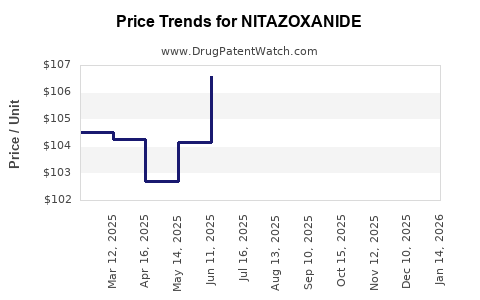
Last updated: September 28, 2026
Nitazoxanide is an established antiparasitic drug with limited patent protection, broad generic availability, and a mature commercial profile. Its approved U.S. uses are narrow: treatment of diarrhea caused by Giardia lamblia or Cryptosporidium parvum in patients at least 1 year old. The original U.S. product, Alinia, was developed by Romark Laboratories and received FDA approval in 2002.[1]
The commercial market is driven by low-cost generic tablets and oral suspension, institutional demand, pediatric use, travel-related infections, and periodic interest in off-label antiviral applications. Nitazoxanide has no current large-scale indication comparable with a primary-care anti-infective or chronic therapy. Public filings do not provide audited, standalone global revenue for nitazoxanide or Alinia.
What is nitazoxanide approved to treat?
Nitazoxanide is a thiazolide anti-infective. Its active metabolite is tizoxanide. The FDA-approved indications are:
| Parameter |
U.S. status |
| Active ingredient |
Nitazoxanide |
| Original brand |
Alinia |
| U.S. sponsor |
Romark Laboratories |
| Initial FDA approval |
2002 |
| Approved indications |
Diarrhea caused by Giardia lamblia or Cryptosporidium parvum |
| Approved age |
Adults and children at least 1 year old |
| Dosage forms |
500 mg tablet; 100 mg/5 mL oral suspension |
| Standard adult regimen |
500 mg every 12 hours for three days with food |
| Pediatric regimen |
Weight- and age-based oral suspension dosing |
| FDA regulatory pathway |
New drug application, followed by abbreviated new drug applications for generics |
The drug is not FDA-approved for COVID-19, influenza, hepatitis, cancer, or other proposed repurposing uses. Clinical investigations in these areas have not converted into a major approved commercial indication.[1,2]
When did nitazoxanide lose exclusivity?
Nitazoxanide lost its core U.S. small-molecule exclusivity years ago. The original product has moved from branded innovation to generic competition.
Nitazoxanide exclusivity timeline
| Event |
Approximate timing |
| Foundational U.S. patent filings |
Late 1990s |
| Alinia FDA approval |
2002 |
| Core composition and use patent period |
Primarily expired during the 2010s |
| Generic FDA approvals |
Subsequent to expiration or certification against listed patents |
| Current market position |
Mature generic market |
The key commercial protection was based on older thiazolide patents, including U.S. patents associated with nitazoxanide composition and therapeutic use. The principal patent estate is no longer a meaningful barrier to ordinary generic entry.
Patent term can differ by patent, jurisdiction, patent-term adjustment, pediatric exclusivity, and regulatory exclusivity. For practical market analysis, however, the relevant conclusion is that nitazoxanide does not have an active U.S. composition-of-matter monopoly comparable with a recently launched specialty drug.
What patents protect nitazoxanide?
The original patent estate covered thiazolide compounds, pharmaceutical compositions, and antiparasitic uses. The commercial value of those patents has declined because the relevant U.S. terms have ended.
Patent categories associated with nitazoxanide
| Patent category |
Commercial relevance |
| Composition of matter |
Historical protection for nitazoxanide and related thiazolides |
| Pharmaceutical composition |
Protection for formulations containing the active ingredient |
| Method of treatment |
Historical protection for treatment of protozoal and parasitic infections |
| Oral suspension formulation |
Potential formulation differentiation, but generally weak against standard generic products |
| Manufacturing process |
May protect specific routes or intermediates, but does not normally block alternative generic manufacture |
The principal historical U.S. patent family is associated with Romark and thiazolide chemistry, including U.S. Patent No. 5,968,961. Its commercial life was tied to the original Alinia development program. Later formulation or process patents would need separate analysis for claim scope, expiration, terminal disclaimers, and Orange Book listing.
How strong is the current nitazoxanide patent estate?
The estate is weak for blocking standard generic entry. Three factors drive that assessment:
- The active ingredient is an old small molecule.
- Tablets and oral suspensions are conventional dosage forms.
- The approved indications are narrow and readily described in generic labeling.
Residual patent risk would be concentrated in a genuinely differentiated product, such as a new pediatric delivery system, extended-release dosage form, fixed-dose combination, or new approved indication. Those products would require claim scope that does more than cover ordinary nitazoxanide tablets or suspension.
What is the Orange Book status of nitazoxanide?
Nitazoxanide is represented in FDA drug databases through Alinia and approved generic products. The Orange Book is the controlling source for current listed patents, therapeutic-equivalence codes, and reference-listed-drug information.[3]
The practical Orange Book analysis is:
| Issue |
Assessment |
| Reference product |
Alinia tablets and oral suspension |
| Patent barrier |
No major active composition patent barrier expected |
| Generic pathway |
ANDA approval |
| Therapeutic-equivalence relevance |
Important for substitution and payer preference |
| Current commercial risk |
Price competition, not patent exclusion |
| Formulation risk |
Higher for suspension, pediatric delivery, and differentiated products |
An Orange Book-listed patent can produce a Paragraph IV notice and litigation even after a product has become mature. For nitazoxanide, the more significant risk is likely to arise from product-specific formulation or method-of-use claims rather than from the original molecule.
Which companies are challenging or competing with Alinia?
Nitazoxanide competition is fragmented among generic manufacturers, contract manufacturers, distributors, and regional pharmaceutical companies. The competitive field varies by country and dosage form.
U.S. competitive structure
The U.S. market generally includes:
- Romark’s Alinia brand;
- ANDA-approved generic nitazoxanide tablets;
- generic oral suspension products;
- institutional and specialty distributors;
- compounding or extemporaneous pharmacy alternatives in limited settings.
The identity and number of active suppliers change as manufacturers enter, withdraw, or experience shortages. FDA Drugs@FDA, the Orange Book, and DailyMed provide the most reliable product-level data.[3,4]
There is no material biosimilar risk because nitazoxanide is a chemically synthesized small molecule, not a biologic. Competition occurs through ANDAs, therapeutic equivalence, manufacturing cost, supply reliability, and contracting.
What generic entry risks exist for nitazoxanide?
Generic entry risk is already realized rather than prospective. The principal market risks are:
| Risk |
Impact |
| Multiple ANDA suppliers |
High downward pressure on price |
| Commodity active pharmaceutical ingredient |
Low manufacturing differentiation |
| Narrow approved indications |
Limits premium pricing |
| Generic substitution |
Reduces brand retention |
| Small pediatric market |
Limits scale economies |
| Oral suspension complexity |
Creates some supply and quality barriers |
| Reimbursement controls |
Compresses net pricing |
| Distributor concentration |
Can increase channel pressure |
Tablets are the most exposed to commodity generic competition. Oral suspension has somewhat higher operational complexity because it requires powder formulation, reconstitution performance, taste acceptability, packaging, and stability controls. Those factors can support limited supplier persistence but do not recreate strong patent protection.
What formulations are protected by nitazoxanide patents?
The main commercial formulations are the 500 mg tablet and 100 mg/5 mL oral suspension. The suspension is commercially important because the approved population includes young children.
Tablet versus oral suspension
| Attribute |
Tablet |
Oral suspension |
| Primary users |
Adults and older children |
Young children and patients unable to swallow tablets |
| Manufacturing complexity |
Low to moderate |
Moderate |
| Generic competition |
Strong |
Moderate |
| Differentiation potential |
Limited |
Higher through taste, stability, and delivery |
| Pricing power |
Low |
Low to moderate |
| Regulatory burden |
Conventional ANDA |
More formulation and device considerations |
A new suspension could potentially obtain formulation or device patents, but those patents would need to protect a commercially meaningful technical feature. Taste masking alone may have limited blocking value unless the claims are technically specific and difficult to design around.
What patent litigation affects nitazoxanide?
Nitazoxanide has not developed a high-profile patent litigation profile comparable with blockbuster antiviral, oncology, or biologic products. The major commercial dispute pattern has been generic entry and product competition rather than sustained litigation over a valuable remaining patent estate.
Potential litigation would most likely involve:
- Paragraph IV challenges to a listed formulation or use patent;
- ANDA certification disputes;
- manufacturing-process claims;
- trade-secret disputes involving intermediates or synthesis;
- product liability or labeling disputes unrelated to patent exclusivity.
No major current U.S. patent dispute appears to define the commercial outlook for standard nitazoxanide products. FDA approval status and active Orange Book listings remain the operative sources for any current Paragraph IV assessment.[3]
What is the financial trajectory for nitazoxanide?
Nitazoxanide has a mature, low-growth financial profile. The market is unlikely to generate blockbuster economics without a new approved use or differentiated delivery technology.
Financial trajectory
| Period |
Commercial profile |
| 2002 to late 2000s |
Branded launch and physician adoption for protozoal diarrhea |
| 2010s |
Generic entry, declining brand pricing power, broader international availability |
| 2020 to 2022 |
Temporary interest from COVID-19 repurposing studies and speculative demand |
| 2023 onward |
Mature generic market with demand tied to infectious-disease incidence and procurement |
| Long-term |
Stable low-value anti-infective unless supported by a new indication |
Romark is privately held, and public sources do not disclose audited standalone Alinia revenue. Manufacturer-level revenue cannot be used as a reliable proxy because companies commonly report portfolios rather than individual generic products.
Main revenue drivers
Nitazoxanide revenue is influenced by:
- incidence of giardiasis and cryptosporidiosis;
- pediatric prescribing;
- outbreaks linked to contaminated water or food;
- international procurement;
- generic reimbursement;
- supply availability;
- seasonal and travel-related infection patterns;
- continued demand for oral suspension.
The drug has limited pricing leverage. A manufacturer can improve economics through reliable supply, efficient API sourcing, private-label distribution, and differentiated packaging. It is difficult to sustain premium pricing for ordinary 500 mg tablets.
How does nitazoxanide compare with competing antiparasitic drugs?
Nitazoxanide competes clinically with several agents, although the choice depends on organism, patient age, geography, and local treatment guidelines.
| Drug |
Main relevant use |
Commercial comparison |
| Nitazoxanide |
Giardiasis and cryptosporidiosis |
Broad pediatric formulation availability; mature generic pricing |
| Metronidazole |
Giardiasis and anaerobic infections |
Large generic market and broad prescriber familiarity |
| Tinidazole |
Giardiasis and other protozoal infections |
Often used in shorter regimens |
| Paromomycin |
Selected intestinal protozoal infections |
More specialized positioning |
| Albendazole |
Helminth infections; some protozoal use |
Larger antiparasitic market but different primary indications |
Nitazoxanide’s commercial advantage is its labeled role in cryptosporidiosis and availability as a pediatric suspension. Its limitation is the narrow market and competition from inexpensive alternatives in giardiasis.
What is the FDA regulatory outlook for nitazoxanide?
The FDA regulatory outlook is stable rather than expansionary. No major new regulatory exclusivity platform is apparent for conventional nitazoxanide products.
Future commercial opportunities would require one of four developments:
- FDA approval for a new infectious disease indication.
- A differentiated pediatric or modified-release formulation.
- A combination product with clinically demonstrated benefit.
- A new delivery system that improves adherence or tolerability.
Repurposing studies alone do not create commercial exclusivity. A new indication would require adequate clinical evidence, FDA review, labeling approval, and a defensible patent or regulatory-exclusivity strategy.
What manufacturing and intellectual-property barriers exist?
The active pharmaceutical ingredient is a synthetic thiazolide. Manufacturing barriers are therefore more operational than proprietary.
Key barriers include:
- consistent API purity;
- control of polymorphic or solid-state properties;
- tablet dissolution;
- suspension particle size and redispersibility;
- taste masking;
- packaging stability;
- global quality-system compliance;
- reliable supply of pediatric presentations.
Process patents can create incremental protection, but competitors can often design around them if the claims cover only a particular synthetic route. A company seeking durable value would need an integrated formulation, manufacturing, and regulatory strategy rather than reliance on the expired core molecule.
What is the geographic coverage of the nitazoxanide market?
Nitazoxanide is marketed in the United States and multiple international markets, with availability varying by regulatory approval, local disease burden, and national procurement.
The strongest commercial logic exists in markets with:
- high rates of intestinal protozoal infection;
- pediatric demand;
- limited access to diagnostic testing;
- public-health purchasing;
- established generic manufacturing;
- waterborne disease outbreaks.
International pricing is generally lower than U.S. branded pricing. Local registration, pharmacovigilance, import controls, and tender participation can matter more than patent protection.
Key Takeaways
- Nitazoxanide is an established antiparasitic drug approved in the U.S. for giardiasis and cryptosporidiosis.
- Alinia was approved in 2002, and the core patent estate is no longer a meaningful barrier to ordinary generic entry.
- The U.S. market is governed by generic competition, therapeutic equivalence, supply reliability, and reimbursement.
- Oral suspension has more formulation complexity and modestly greater commercial defensibility than tablets.
- Nitazoxanide has no biosimilar risk because it is a small molecule.
- Publicly disclosed standalone revenue for Alinia or global nitazoxanide sales is unavailable.
- The financial profile is mature and low growth unless a new FDA-approved indication or differentiated formulation is developed.
- COVID-19 repurposing interest did not create an approved new commercial franchise.
- Current legal exposure is more likely to involve formulation, process, or labeling issues than foundational molecule patents.
FAQs About Nitazoxanide Market and Patent Risk
Is nitazoxanide still under patent protection?
The core U.S. composition and original-use patent protection has expired or is no longer commercially effective against standard generic entry. Product-specific formulation or process patents require separate review.
Is Alinia still commercially relevant?
Yes, but its role is primarily as the reference brand and originator product. Generic nitazoxanide limits Alinia’s pricing power and market share.
Can a company obtain new patents on nitazoxanide?
Yes. New patents could cover a novel formulation, delivery system, combination, manufacturing process, or approved method of use. A patent on the old molecule itself would not ordinarily be available.
Does nitazoxanide have biosimilar competition?
No. Biosimilars apply to biologic products. Nitazoxanide competes through generic small-molecule products approved under the ANDA pathway.
Could nitazoxanide become a high-growth drug again?
Only if a new indication or differentiated formulation produces substantial clinical and regulatory value. Existing approved uses support a mature specialty-generic market rather than rapid revenue expansion.
References
- U.S. Food and Drug Administration. (2023). Alinia (nitazoxanide) prescribing information.
- Centers for Disease Control and Prevention. (2024). Parasites: Giardia and Cryptosporidium.
- U.S. Food and Drug Administration. (2024). Approved drug products with therapeutic equivalence evaluations: Orange Book.
- U.S. Food and Drug Administration. (2024). Drugs@FDA: FDA-approved drugs database.
- U.S. Patent and Trademark Office. (1999). U.S. Patent No. 5,968,961: Thiazolide compounds and methods of use.