Share This Page
GENTIAN VIOLET - Generic Drug Details
✉ Email this page to a colleague
What are the generic drug sources for gentian violet and what is the scope of freedom to operate?
Gentian violet
is the generic ingredient in two branded drugs marketed by Savage Labs and Key Pharms, and is included in two NDAs. Additional information is available in the individual branded drug profile pages.Summary for GENTIAN VIOLET
| US Patents: | 0 |
| Tradenames: | 2 |
| Applicants: | 2 |
| NDAs: | 2 |
| Raw Ingredient (Bulk) Api Vendors: | 179 |
| Clinical Trials: | 6 |
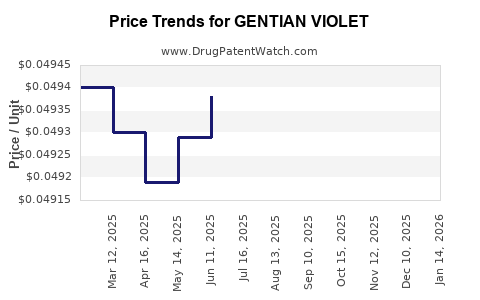
| Drug Prices: | Drug price trends for GENTIAN VIOLET |
| DailyMed Link: | GENTIAN VIOLET at DailyMed |
Recent Clinical Trials for GENTIAN VIOLET
Identify potential brand extensions & 505(b)(2) entrants
| Sponsor | Phase |
|---|---|
| Wake Forest University Health Sciences | Phase 2 |
| Assiut University | N/A |
| Khon Kaen Hospital | N/A |
Medical Subject Heading (MeSH) Categories for GENTIAN VIOLET
US Patents and Regulatory Information for GENTIAN VIOLET
| Applicant | Tradename | Generic Name | Dosage | NDA | Approval Date | TE | Type | RLD | RS | Patent No. | Patent Expiration | Product | Substance | Delist Req. | Exclusivity Expiration |
|---|---|---|---|---|---|---|---|---|---|---|---|---|---|---|---|
| Savage Labs | GVS | gentian violet | SUPPOSITORY;VAGINAL | 083513-001 | Approved Prior to Jan 1, 1982 | DISCN | No | No | ⤷ Start Trial | ⤷ Start Trial | ⤷ Start Trial | ||||
| Key Pharms | GENAPAX | gentian violet | TAMPON;VAGINAL | 085017-001 | Approved Prior to Jan 1, 1982 | DISCN | No | No | ⤷ Start Trial | ⤷ Start Trial | ⤷ Start Trial | ||||
| >Applicant | >Tradename | >Generic Name | >Dosage | >NDA | >Approval Date | >TE | >Type | >RLD | >RS | >Patent No. | >Patent Expiration | >Product | >Substance | >Delist Req. | >Exclusivity Expiration |
Gentian Violet Market Dynamics, Patent Status, Regulatory Risk, and Financial Trajectory
Gentian violet is a low-cost, off-patent antiseptic, antifungal, dye, and laboratory reagent with no meaningful branded-pharmaceutical revenue base. Its commercial use has shifted away from human medicine toward laboratory staining, veterinary applications, aquaculture-related research, and specialty chemical distribution. Regulatory concern over potential carcinogenicity has weakened the human and animal-health markets, while the absence of composition patents, Orange Book listings, and meaningful exclusivity prevents premium pricing.
What is gentian violet and how is it used?
Gentian violet, also called methylrosaniline chloride, crystal violet, or methyl violet 10B, is a triphenylmethane dye with antiseptic and antifungal activity. It has been used in topical products for oral thrush, skin infections, minor wounds, and mucosal candidiasis. It is also used as a biological stain and indicator in laboratory applications.
| Attribute | Data |
|---|---|
| Active ingredient | Gentian violet, methylrosaniline chloride |
| Common chemical name | Crystal violet |
| CAS number | 548-62-9 |
| Primary historical uses | Topical antiseptic, antifungal, treatment of thrush |
| Non-pharmaceutical uses | Gram staining, microbiology, tissue staining, research |
| Dosage forms | Topical solution, aqueous solution, laboratory reagent |
| Prescription status | No major current prescription-drug franchise |
| Patent position | Historical patents expired; no meaningful composition exclusivity |
| Orange Book position | No major FDA-approved human drug listing identified |
| Commercial profile | Commodity or specialty chemical rather than branded pharmaceutical |
The product is inexpensive to manufacture and distribute. Its medical value has historically depended on availability and low price rather than proprietary formulation, clinical differentiation, or physician-driven prescribing.
What is the FDA regulatory status of gentian violet?
Gentian violet does not have a substantial current FDA-approved human-drug franchise comparable to a prescription product. Products sold in the United States may be marketed through legacy, compounding, laboratory, veterinary, or specialty channels, but the presence of a commercial product does not establish FDA approval.
FDA has evaluated gentian violet in the context of unapproved drug products and safety concerns. The agency’s OTC drug framework generally requires an active ingredient to meet the conditions of an applicable monograph or receive approval through a new drug application. Gentian violet has not developed into a modern FDA-approved human therapy supported by current clinical evidence and a formal exclusivity period.
The FDA’s National Toxicology Program has reported carcinogenicity concerns in animal studies involving gentian violet and related compounds. The safety issue is commercially important because the product historically relied on routine topical use, including use on mucosal tissue and in infants. [1]
Does gentian violet have FDA approval for thrush?
Gentian violet has been used historically for oral candidiasis, but it does not have the commercial regulatory position of approved antifungal products such as nystatin, fluconazole, or clotrimazole. Clinicians and compounding pharmacies may encounter it as a legacy treatment, but its use has declined because of irritation, staining, limited clinical evidence, and safety concerns.
The FDA-approved treatment market for oral thrush is therefore dominated by products with clearer regulatory status and stronger clinical support. Gentian violet competes mainly on price and availability, not on regulatory or clinical advantages.
What is the Orange Book status of gentian violet?
Gentian violet has no major Orange Book-listed drug product that creates a conventional reference-product exclusivity structure. As a result, the principal Hatch-Waxman mechanisms are not central to its market.
| Orange Book issue | Gentian violet status |
|---|---|
| Listed reference drug | No significant listing identified |
| Approved NDA franchise | No major current franchise |
| Listed patents | No meaningful patent estate identified |
| Paragraph IV exposure | Not a material commercial issue |
| 30-month stay risk | Not applicable without a relevant listed NDA |
| ANDA competition | Not the main competitive pathway |
| Market access | Product-specific regulatory and distribution rules apply |
The absence of an Orange Book-listed reference product means that a competitor generally does not need to challenge a branded gentian violet NDA through a conventional Paragraph IV filing. Competition occurs through chemical supply, formulation sales, compounding, laboratory distribution, and product-specific regulatory channels.
What patents protect gentian violet?
No active composition-of-matter patent is known to protect gentian violet as a pharmaceutical active ingredient. The compound has been used for more than a century, placing any original composition patents far beyond their enforceable terms.
Potentially protectable subject matter could include:
- A new topical formulation
- A controlled-release delivery system
- A specific combination with another antimicrobial
- A manufacturing or purification process
- A defined method of treatment
- Packaging that limits staining, degradation, or contamination
Those categories would require separate patent claims and would not restore exclusivity to gentian violet itself. A formulation patent could protect a particular product but would not prevent competitors from selling the active ingredient in other formulations.
How strong is the patent estate for gentian violet?
The patent estate is weak from a pharmaceutical commercialization perspective.
| Patent factor | Assessment |
|---|---|
| Composition patent | Expired or unavailable |
| Core therapeutic patent | Expired or unavailable |
| Formulation patent | Possible in principle, no major estate identified |
| Manufacturing patent | Commodity chemistry limits differentiation |
| Method-of-use patent | Commercially narrow and vulnerable to prior art |
| Patent term runway | None for the historical active ingredient |
| Freedom-to-operate risk | Generally low for the legacy compound |
| Patent-based pricing power | Minimal |
The principal barriers are regulatory status, safety perception, channel restrictions, and customer demand. Patent litigation is not the primary risk.
When did gentian violet lose exclusivity?
Gentian violet lost practical pharmaceutical exclusivity decades ago. Its use predates the modern U.S. patent and drug-approval systems, and the active ingredient has been commercially available as a chemical and dye for generations.
No modern exclusivity period comparable to the following is material to the product:
- New chemical entity exclusivity
- Orphan-drug exclusivity
- Pediatric exclusivity
- New clinical investigation exclusivity
- Biologic exclusivity
- Patent-based Hatch-Waxman exclusivity
The product’s economics are therefore determined by manufacturing cost, quality specifications, regulatory compliance, distribution, and application-specific demand.
What regulatory concerns affect gentian violet demand?
Safety concerns are the main factor weakening the medical market. Health Canada advised consumers to stop using certain gentian violet products because of a potential cancer risk. The warning covered products used on skin, in the mouth, and in other topical settings. [2]
The risk profile has several commercial effects:
- Hospitals and clinicians have alternatives with clearer regulatory support.
- Parents and caregivers are less likely to accept use in infants.
- Retailers face product-liability and reputational concerns.
- Veterinary and aquaculture users face residue and compliance restrictions.
- Manufacturers may avoid investing in new clinical development.
The staining effect also limits acceptance. Gentian violet can permanently discolor skin, clothing, oral tissue, and equipment. Irritation and ulceration have been reported with topical and oral use, particularly at higher concentrations or with prolonged exposure.
What is the veterinary and aquaculture status of gentian violet?
Gentian violet has historical relevance in animal health and aquaculture, but regulatory controls have constrained those markets. FDA identifies gentian violet among unapproved animal drugs associated with aquaculture and residue concerns. The agency has taken enforcement action against the use of unapproved drugs in food-producing animals and fish. [3]
This is important because gentian violet is not only evaluated as a therapeutic product. Regulators also evaluate residues in edible tissues. That creates a higher compliance burden than in laboratory or industrial applications.
Which markets remain commercially viable?
The most durable demand is likely to come from non-therapeutic applications:
| Market | Commercial outlook |
|---|---|
| Laboratory staining | Relatively durable, application-specific demand |
| Research reagents | Stable but fragmented |
| Industrial dye use | Dependent on technical specifications |
| Human topical medicine | Declining or niche |
| Oral thrush treatment | Declining, replaced by alternatives |
| Veterinary medicine | Restricted and fragmented |
| Food-animal aquaculture | High regulatory risk |
| Compounding | Limited and dependent on clinical acceptance |
| Consumer online sales | Available in some channels but exposed to enforcement and safety concerns |
Laboratory and research users generally purchase based on purity, concentration, lot consistency, and certificate-of-analysis documentation. Those customers are less sensitive to pharmaceutical patent status but more sensitive to chemical quality and supply continuity.
How does gentian violet compare with competing antifungal products?
Gentian violet competes against products with superior regulatory positioning, cleaner administration, and stronger clinical acceptance.
| Product | Primary use | Regulatory and commercial position |
|---|---|---|
| Gentian violet | Topical antifungal and antiseptic | Legacy, low-cost, safety-constrained |
| Nystatin | Oral and topical candidiasis | Established prescription and nonprescription use |
| Fluconazole | Systemic and mucosal candidiasis | Approved systemic therapy with broad clinical use |
| Clotrimazole | Topical and oral candidiasis | Established topical and troche markets |
| Miconazole | Topical and oral fungal infections | Broad consumer and clinical distribution |
| Povidone-iodine | Antiseptic | Widely used, with clearer antiseptic positioning |
| Chlorhexidine | Antiseptic | Institutional and consumer use, but separate safety limitations |
Gentian violet’s advantages are low cost, simple chemistry, and broad antimicrobial activity. Its disadvantages are staining, tolerability problems, uncertain regulatory status, limited modern clinical development, and carcinogenicity concerns.
What is the financial trajectory of gentian violet?
Gentian violet does not have publicly reported revenue comparable to a marketed prescription drug. It is sold through numerous chemical, laboratory, compounding, veterinary, and online channels, making product-level revenue difficult to isolate in public filings.
The financial trajectory is best characterized as follows:
| Period | Market direction | Financial driver |
|---|---|---|
| Historical medical use | Broad but informal | Low manufacturing cost and clinical familiarity |
| Late 20th century | Gradual substitution | Growth of approved antifungals and antiseptics |
| 2010s | Increasing regulatory pressure | Safety review and alternative treatments |
| 2020s | Niche and fragmented | Laboratory demand, specialty supply, reduced medical use |
| Forward outlook | Flat to declining in human medicine | Safety restrictions and limited innovation |
The product has no visible blockbuster exposure, no major licensing stream, and no high-value patent cliff. Financial downside is therefore concentrated in distributors and manufacturers with inventory or channel exposure rather than in an originator pharmaceutical company.
What revenue exposure exists for manufacturers?
Revenue exposure is generally modest and dispersed. A chemical or laboratory supplier may sell gentian violet as one product among thousands. A manufacturer focused on legacy topical medicines could face a higher concentration risk, but public company filings generally do not report gentian violet as a separate material revenue category.
The main financial risks are:
- Product withdrawal or retailer delisting
- Regulatory enforcement
- Liability claims
- Declining use by clinicians
- Substitution by approved antifungals
- Loss of veterinary or aquaculture customers
- Higher compliance costs for quality and labeling
The main residual opportunity is in laboratory-grade products, where customers value supply reliability and technical documentation more than therapeutic branding.
Which companies are challenging gentian violet?
No major branded company appears to be pursuing a conventional Paragraph IV challenge against a gentian violet reference product. The competitive field is fragmented and includes:
- Chemical manufacturers
- Laboratory reagent suppliers
- Compounding pharmacies
- Veterinary product distributors
- Online retailers
- Industrial dye suppliers
- Specialty pharmaceutical manufacturers
Competition is based on purity, concentration, packaging, documentation, price, and regulatory channel. It is not based on patent litigation against an originator.
What patent litigation and settlement agreements affect gentian violet?
No material patent litigation or settlement agreement is associated with the core gentian violet market. The compound’s age, lack of active composition patents, and absence of a major listed FDA reference product make a conventional patent dispute unlikely.
Potential disputes could arise over:
- Misbranding or unapproved drug claims
- Product liability
- Veterinary residue violations
- Trademark or packaging practices
- Purity and contamination claims
- Contractual supply obligations
Those matters would be regulatory, commercial, or product-liability disputes rather than classic pharmaceutical patent litigation.
What generic launch scenarios exist for gentian violet?
A conventional generic launch scenario is not the main pathway. The likely market scenarios are:
Scenario 1: Continued niche laboratory demand
Laboratory and research applications remain available through reagent suppliers. This scenario supports stable but low-value demand, with pricing determined by purity, packaging, and certification.
Scenario 2: Further decline in human medical use
Clinicians continue replacing gentian violet with nystatin, azoles, antiseptics, and other products. This scenario reduces demand for pharmaceutical-grade topical products.
Scenario 3: Regulatory contraction in animal health
Additional residue or safety enforcement reduces veterinary and aquaculture use. This scenario could remove an important niche without affecting laboratory demand.
Scenario 4: Reformulation into a protected specialty product
A company could attempt to develop a gentian violet formulation with improved tolerability or controlled delivery. Commercial success would require clinical evidence, regulatory approval, and a credible safety position. No major program of this type is publicly established.
What manufacturing and intellectual-property barriers exist?
Manufacturing barriers are moderate for pharmaceutical-grade material but low for the basic chemical. Producers must control:
- Assay and purity
- Residual solvents and impurities
- Heavy metals
- Microbial contamination
- Batch consistency
- Packaging stability
- Certificates of analysis
- Applicable good manufacturing practice requirements
The active ingredient itself is not difficult to source relative to modern small-molecule medicines. The commercial barrier is regulatory acceptability, not chemical complexity.
Geographic coverage is broad because chemical and laboratory suppliers can distribute the material internationally. Actual sale for human or animal treatment depends on each jurisdiction’s rules. Canada has issued specific safety communications, and U.S. agencies have raised concerns involving unapproved uses and animal residues. [2,3]
Key Takeaways
- Gentian violet is an old, low-cost compound with no meaningful current pharmaceutical exclusivity.
- Its core composition patents are expired or commercially irrelevant.
- It has no major Orange Book-listed reference product and no material Paragraph IV challenge landscape.
- Human medical use is declining because of staining, irritation, limited modern evidence, and potential carcinogenicity.
- Veterinary and aquaculture use faces regulatory and residue restrictions.
- Laboratory and research applications are the most durable commercial segments.
- No major branded company, licensing platform, or patent litigation program drives the market.
- Publicly reported revenue is not available at the product level; financial exposure is fragmented among suppliers and distributors.
- The forward market is likely flat to declining in therapeutic applications, with residual demand in laboratory and specialty chemical channels.
FAQs
Is gentian violet still sold in the United States?
Yes. It may be available through laboratory, chemical, compounding, veterinary, and online channels. Commercial availability does not establish FDA approval for every intended use.
Is gentian violet banned worldwide?
No single global ban governs all uses. Regulation varies by jurisdiction and by application. Human, veterinary, aquaculture, laboratory, and industrial uses may be treated differently.
Can gentian violet be patented today?
The old active ingredient cannot be re-patented as a new composition merely because it is old. A novel formulation, manufacturing process, delivery system, or treatment method could be patentable if it meets applicable novelty and inventive-step requirements.
Is gentian violet a pharmaceutical or a chemical product?
It can be either, depending on the product’s labeling, quality standard, intended use, and regulatory pathway. In current commerce, it is often sold as a specialty chemical or laboratory reagent rather than as a modern approved pharmaceutical.
Why has gentian violet lost medical market share?
Approved antifungals and antiseptics offer stronger clinical positioning, while gentian violet creates staining and tolerability problems and carries regulatory concern related to potential carcinogenicity.
References
-
National Toxicology Program. (2016). Report on carcinogens, fourteenth edition: Gentian violet. U.S. Department of Health and Human Services. https://ntp.niehs.nih.gov/
-
Health Canada. (2019). Health Canada advises Canadians to stop using gentian violet products due to potential cancer risk. Government of Canada. https://www.canada.ca/
-
U.S. Food and Drug Administration. (2023). Aquaculture and aquatic animal drug approvals and compliance information. U.S. Department of Health and Human Services. https://www.fda.gov/animal-veterinary/aquaculture
-
U.S. Food and Drug Administration. (2024). Electronic Orange Book: Approved drug products with therapeutic equivalence evaluations. U.S. Department of Health and Human Services. https://www.accessdata.fda.gov/scripts/cder/ob/
-
U.S. Food and Drug Administration. (2024). OTC drug review and nonprescription drug regulation. U.S. Department of Health and Human Services. https://www.fda.gov/drugs/over-counter-otc-nonprescription-drugs
More… ↓
