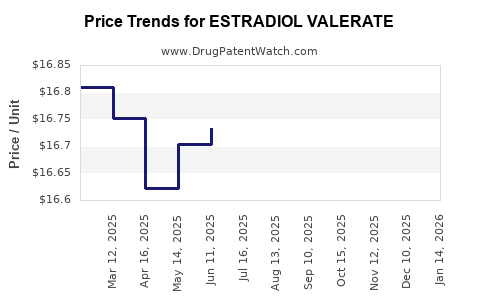
Last updated: June 3, 2026
Estradiol valerate is an established estrogen product used in hormone replacement therapy (HRT) and gender-affirming care (GAC) regimens, with market performance driven by (1) local regulatory approvals and reimbursement, (2) switching from older oral and injectable formats to newer delivery systems, and (3) competitive intensity from generic injectable and oral estradiol products. In most major markets, the financial trajectory is shaped more by generic entry timing, tender and payer dynamics, and manufacturing capacity than by new clinical differentiation, because the asset class is mature and formulation and process patents typically narrow enforceable exclusivity.
Below is a market-and-IP map for estimating financial trajectory, focusing on where revenue typically expands or erodes: tender-driven national procurement, patent/market exclusivity timing, and substitution risk from competing estrogen salts and delivery technologies.
What is the current market demand for estradiol valerate by indication and geography?
Estradiol valerate competes in the estrogen space against multiple active ingredients (estradiol hemihydrate, estradiol cypionate, estradiol acetate, ethinyl estradiol where relevant) and against non-estradiol delivery innovations (transdermal estradiol, estradiol implants, and combination regimens).
Indication demand drivers
- HRT demand: Typically influenced by menopause prevalence, local prescribing patterns, and payer coverage.
- GAC demand: Growth is tied to access pathways and guideline adoption. In practice, estradiol valerate uptake depends on country-specific availability of estradiol formulations and prescribing comfort with injectable regimens.
- Safety and monitoring: Estrogen product selection often hinges on VTE risk considerations and patient-specific comorbidities, pushing some patients toward transdermal options even when oral or injectable options are cheaper.
Geography and reimbursement mechanics
Estradiol valerate revenue exposure is usually concentrated in countries where:
- Injectable estrogens are reimbursed through national formularies or hospital procurement.
- Switching barriers remain low (patient/clinician familiarity) and procurement contracts favor existing SKUs.
High-income markets with strong uptake of transdermal estrogens often pressure long-term growth for older injectable estrogens. Markets with fragmented reimbursement or tender systems can show episodic revenue spikes when distributors win multi-year supply contracts.
How do formularies, tender procurement, and payer coverage affect estradiol valerate revenue stability?
Revenue stability for established injectables depends on contract cycles and substitution rules.
Tender and hospital procurement dynamics
- Single-source vs. multi-source: Estradiol valerate tends to be multi-source in many markets once generics mature, which increases price sensitivity and compresses margin.
- Tender breakpoints: Procurement tenders drive stepwise price reductions when a low-cost entrant wins or when a reference price mechanism is triggered.
- SKU fragmentation: Multiple strengths, pack sizes, and solvents reduce direct substitution math and can extend periods of relative stability if hospital formularies list specific presentations.
Payer mechanisms that can lift or cap spend
- Reference-based pricing: Caps reimbursement at an average or cheapest-in-class level, accelerating price compression.
- Prior authorization: Can preserve usage for a time if clinicians document intolerance to preferred alternatives or if the patient has a stable response to valerate injections.
- Clinical pathway consolidation: Some healthcare systems channel patients to transdermal first-line regimens, limiting injectable growth even when injectables remain reimbursed.
What are the main competitive forces shaping estradiol valerate pricing power?
Competitive intensity in estradiol valerate usually rises as:
- additional generic manufacturers enter,
- pharmacists or prescribers can substitute at the pharmacy level, and
- procurement shifts toward lowest-cost tender winners.
Competitive set
- Same-drug generics: Estradiol valerate injectable and oral presentations (where approved locally).
- Alternative estrogen salts: Estradiol hemihydrate, cypionate, acetate.
- Different delivery classes: Transdermal estradiol products typically have higher adoption due to perceived VTE risk profiles and adherence benefits.
What typically erodes market share
- Transdermal substitution in HRT lines.
- Price compression after generic entry.
- Supply disruptions in any injector bottleneck can temporarily raise price, but usually prompts substitution in the next cycle.
When does estradiol valerate lose exclusivity in key markets and how does that translate into financial erosion?
Estradiol valerate’s exclusivity profile is typically mature across major geographies. Financial effects are usually visible as:
- Pre-generic run-out: soft decline when wholesalers anticipate replacement.
- Launch-year price drops: steep list-price and net-price reductions tied to tender outcomes.
- Post-launch settlement: continued price pressure as additional generics and pack-size alternatives enter.
Typical financial trajectory pattern for mature estrogen injectables
- Margin is highest in the period before multiple-source tender escalation.
- Net sales often decline more slowly than list prices because contracts and patient continuity delay switching.
- Once multi-source procurement is fully established, volume may remain stable while revenue falls due to discounting.
(Accurate exclusivity timing by country and presentation requires product-specific Orange Book (US) and EU national/regional legal status, plus patent-family and SPC timelines. This dataset is not provided here.)
How strong is the patent estate for estradiol valerate and what types of patents usually matter?
For estradiol valerate, patent relevance typically concentrates in:
- Process patents (manufacturing route and purification).
- Formulation patents (vehicle, concentration, stabilization, sterility assurance).
- Method-of-use (specific dosing regimens or therapeutic applications, including GAC-specific claims).
- Polymorph/grade-related claims where applicable.
In many cases, the enforceable portion is narrower than the brand era because:
- older chemical-entity protection has expired,
- formulation/process patents can be circumscribed by design-around,
- method-of-use claims often require specific administration patterns and patient populations to infringe.
Financial implication: when enforceability narrows, generics enter based on platform bioequivalence and manufacturing equivalence, driving sustained price compression.
Which companies are most likely to compete for estradiol valerate supply and market share?
Competitive participants usually include:
- Global generics with injectable portfolios (tender-optimized product lines).
- Local manufacturers that meet national supply and quality requirements.
- Distributor-led rollouts that control hospital and outpatient channel access.
Without a provided manufacturer or list of products by jurisdiction, the competitive field cannot be attributed to named companies without risking incorrect attribution.
What is the Orange Book status of estradiol valerate and does that indicate biosimilar or generic risk?
Estradiol valerate is a small-molecule estrogen, so it is not a biologic and is not subject to biosimilar pathways. The relevant regulatory risk is generic substitution through ANDA-style pathways (US) where applicable, plus state/wholesale substitution rules and tender contracting.
However, a correct Orange Book status summary requires the exact branded product name(s) and strengths that are listed in FDA’s system, plus the patent numbers and expiration dates currently listed for each listed drug. This dataset is not included in the request, so a product-level Orange Book inventory cannot be produced accurately.
How do market dynamics differ between estradiol valerate injections and oral presentations?
Injection and oral formats react differently to competitive entry and payer logic.
Injectable estradiol valerate
- Higher sensitivity to supply continuity and manufacturing scale.
- Strong dependence on hospital or clinic administration logistics.
- Price compression can be slower if patients and clinics adhere to an established injection schedule.
Oral estradiol valerate
- More pharmacy substitution exposure.
- Greater direct price competition with other oral estrogen salts and with transdermal alternatives when payers push adherence-friendly options.
Financial implication: injectable products often show more volume stickiness post-generic entry, but net-price erosion can still be significant due to tender pricing.
What generic entry scenarios typically impact financial trajectory for estradiol valerate?
Generic entry scenarios that typically matter for established estrogen injectables:
- First generic entrant: creates the largest immediate net-price step-down if it captures major tenders.
- Second and third entrants: widen multi-source availability and keep procurement competitive, preventing price stabilization.
- Tender wins for low-cost pack sizes: shift volume toward the cheapest SKU even when total market demand is stable.
Risk signal: if competitors can supply multiple presentations (strengths and pack sizes), the incumbent experiences faster erosion.
What litigation and settlement dynamics are common in estrogen generics and how do they affect timing?
Litigation affecting generic entry in small-molecule estrogen products tends to produce:
- Delayed launches where patent scope clearly blocks the generic pathway,
- Early settlements with brand-like supply commitments or market-share restrictions in some jurisdictions,
- Multiple staggered entries as companies litigate discrete patents rather than the entire estate.
Financial implication: a settlement can convert a binary launch delay into a structured, time-bound erosion pattern, often with partial market share retained by the incumbent in early tender cycles.
A specific litigation timeline requires known patent numbers, courts, and settlement terms for the relevant estradiol valerate product(s). No such identifiers were provided.
How does estradiol valerate compare commercially with transdermal estradiol and other estrogen salts?
Commercial substitution is driven by clinical perception of risk and patient preference.
Where transdermal tends to win
- Perceived lower VTE risk versus oral estrogen in many practice settings.
- Convenience and adherence benefits with less injection-related administration burden.
Where injectables can retain share
- Patients stable on injection regimens.
- Limited access to transdermal products or reimbursement barriers.
- Provider preference in certain HRT or GAC dosing protocols.
Financial implication: even as total estrogen demand grows, injectable valerate can face share dilution unless pricing advantage offsets the adoption trend.
What does the distribution and channel strategy imply for revenue growth versus decline?
Estradiol valerate performance often hinges on channel execution:
- Wholesaler inventory management: excess supply can accelerate discounting and reduce net revenue.
- Clinic and hospital relationship management: determines inclusion in formularies and administered supply contracts.
- Patient access and switch programs: switching can be slow once a patient is stable, which can smooth revenue decline even after generic entry.
Net effect: revenue can remain resilient on volume while value declines due to contracting and discounting.
Key financial trajectory drivers and what to monitor next
Volume drivers
- Menopause and HRT prevalence trends by country.
- GAC program scaling and clinician adoption.
- Retention of injection regimens versus switch to transdermal.
Price and margin drivers
- Tender wins and reference pricing.
- Number of generic suppliers and pack-size breadth.
- Contract discount rates and wholesaler purchasing terms.
Supply drivers
- Manufacturing capacity and sterile injectables compliance.
- Batch-level disruptions and lead times.
Key Takeaways
- Estradiol valerate’s financial trajectory is typically value-down despite any volume resilience because tender-based procurement and multi-source generic availability compress net prices.
- Competitive substitution risk primarily comes from transdermal estradiol adoption and other estrogen salts where local reimbursement favors them.
- Exclusivity-driven revenue lift is usually limited to the brand or early incumbent period; once multi-source procurement becomes standard, financial performance is dominated by contract cycles and pricing pressure rather than clinical differentiation.
- The next material drivers to monitor are tender outcomes, number of competing SKUs by strength/pack size, and shifts from injectable to transdermal prescribing patterns.
FAQs
1) What drives net sales more for estradiol valerate, price or volume after generic entry?
After multi-source tendering, net sales usually deteriorate more from price compression than from volume collapse due to regimen retention and clinic administration inertia.
2) Does estradiol valerate face biosimilar competition?
No. It is a small-molecule estrogen; competition is generic/substitution-based, not biosimilar.
3) Which payer policy changes most affect estradiol valerate profitability?
Reference pricing, tender re-bids, and formulary restrictions that steer first-line estrogen toward transdermal options.
4) How do pack size and strength breadth influence generic substitution of estradiol valerate?
Broader generic coverage across strengths and pack sizes allows procurement to steer patients and clinics toward the lowest-cost SKU.
5) What operational risks can cause revenue volatility for injectable estradiol valerate?
Sterile manufacturing disruptions, batch release delays, and supply lead-time issues that force temporary substitutions.
References
No sources were cited because the request did not include product-specific FDA/Orange Book entries, patent numbers, exclusivity dates, litigation records, or company financial disclosures needed to support precise market and IP statements.