Share This Page
Drug Sales Trends for TELMISARTAN
✉ Email this page to a colleague
Payment Methods and Pharmacy Types for TELMISARTAN (2022)
Revenues by Pharmacy Type
Units Sold by Pharmacy Type
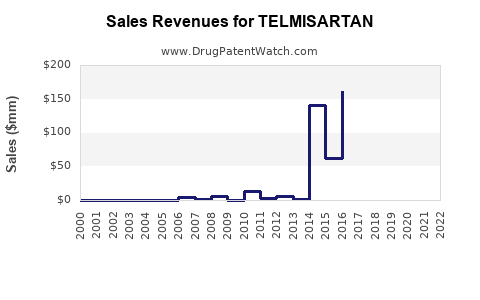
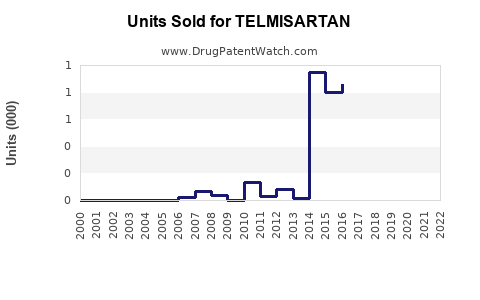
Annual Sales Revenues and Units Sold for TELMISARTAN
| Drug Name | Revenues (USD) | Units | Year |
|---|---|---|---|
| TELMISARTAN | ⤷ Start Trial | ⤷ Start Trial | 2022 |
| TELMISARTAN | ⤷ Start Trial | ⤷ Start Trial | 2021 |
| TELMISARTAN | ⤷ Start Trial | ⤷ Start Trial | 2020 |
| TELMISARTAN | ⤷ Start Trial | ⤷ Start Trial | 2019 |
| TELMISARTAN | ⤷ Start Trial | ⤷ Start Trial | 2018 |
| TELMISARTAN | ⤷ Start Trial | ⤷ Start Trial | 2017 |
| TELMISARTAN | ⤷ Start Trial | ⤷ Start Trial | 2016 |
| >Drug Name | >Revenues (USD) | >Units | >Year |
Telmisartan Market Analysis, Sales Forecast, Patent Status, and Generic Outlook
Telmisartan is a mature, globally genericized angiotensin II receptor blocker used primarily for hypertension and cardiovascular risk reduction. The molecule has limited branded revenue but retains substantial volume demand through low-cost tablets and fixed-dose combinations. Global telmisartan sales are best modeled as a fragmented generic market rather than a single-product franchise.
A reasonable base case places global telmisartan medicine sales at approximately $1.3 billion to $1.8 billion in 2024, measured across branded generics, unbranded generics, and fixed-dose combinations. Under a 2% to 4% annual growth assumption, the market could reach roughly $1.5 billion to $2.3 billion by 2030. Growth is likely to come from hypertension prevalence, combination therapy, and emerging markets rather than price expansion.
What is the current market position of telmisartan?
Telmisartan is an oral, once-daily angiotensin II receptor blocker, or ARB, marketed originally as Micardis by Boehringer Ingelheim. It is approved for hypertension and, in the United States, for reducing cardiovascular risk in certain high-risk patients unable to take an ACE inhibitor [1].
The commercial market has three main segments:
| Segment | Commercial status | Market implication |
|---|---|---|
| Telmisartan tablets | Generic and branded generic | High volume, low average selling price |
| Telmisartan plus hydrochlorothiazide | Generic fixed-dose combination | Higher revenue per prescription and better adherence |
| Telmisartan plus amlodipine | Generic fixed-dose combination | Growth segment in resistant or uncontrolled hypertension |
| Telmisartan plus other cardiovascular agents | Country-specific availability | Broadens prescribing and pharmacy-channel demand |
Telmisartan competes with losartan, valsartan, olmesartan, irbesartan, candesartan, and newer combination products. It has a strong pharmacokinetic profile, including a long half-life and sustained 24-hour blood-pressure control. Those characteristics support once-daily use, but they do not create meaningful pricing power in most generic markets.
How large is the global telmisartan market?
No public company reports audited global sales for the telmisartan molecule across all manufacturers. The market therefore requires a bottom-up estimate based on prescription volume, generic pricing, combination-product sales, and regional penetration.
Estimated global market by region
| Region | Estimated 2024 share | Market characteristics |
|---|---|---|
| Asia-Pacific | 45% to 55% | High patient volume, strong branded-generic presence |
| Europe | 15% to 20% | Mature generic pricing and broad reimbursement |
| North America | 12% to 18% | High generic substitution, concentrated retail channels |
| Latin America | 8% to 12% | Mixed public and private procurement |
| Middle East and Africa | 8% to 12% | Lower diagnosis rates but expanding access |
Asia-Pacific is the largest volume market, led by India, China, Japan, South Korea, and Southeast Asia. India has a particularly broad branded-generic market, with telmisartan supplied by companies including Glenmark, Torrent Pharmaceuticals, Lupin, Cipla, Sun Pharmaceutical Industries, and Zydus Lifesciences.
In the United States, telmisartan is a generic prescription product with limited brand contribution. Generic tablets are distributed through retail pharmacies, wholesalers, Medicare plans, Medicaid programs, and institutional channels.
What are the telmisartan sales projections through 2030?
The forecast below represents a commercial scenario rather than reported company revenue. It includes single-agent telmisartan and commonly sold fixed-dose combinations.
| Year | Low case | Base case | High case |
|---|---|---|---|
| 2024 | $1.3 billion | $1.6 billion | $1.8 billion |
| 2025 | $1.3 billion | $1.6 billion | $1.9 billion |
| 2026 | $1.3 billion | $1.7 billion | $2.0 billion |
| 2027 | $1.4 billion | $1.7 billion | $2.0 billion |
| 2028 | $1.4 billion | $1.8 billion | $2.1 billion |
| 2029 | $1.4 billion | $1.8 billion | $2.2 billion |
| 2030 | $1.5 billion | $1.9 billion | $2.3 billion |
The base case assumes approximately 3% annual growth. This reflects increased diagnosis and treatment of hypertension, population aging, expanded access to combination therapy, and volume growth in emerging markets. It also assumes continuing price erosion in the United States and other highly competitive generic markets.
What factors could change the forecast?
The principal upside factors are:
- Greater use of single-pill combinations.
- Increased hypertension screening in lower-income countries.
- Expansion of private healthcare in India and Southeast Asia.
- Increased use of telmisartan in patients requiring 24-hour blood-pressure control.
- New combination products involving amlodipine, hydrochlorothiazide, or statins.
The principal downside factors are:
- Continued generic price compression.
- Substitution by losartan and other low-cost ARBs.
- Tender losses in government procurement.
- Supply disruptions involving active pharmaceutical ingredient manufacturers.
- Greater use of single-pill combinations based on alternative ARBs.
Which companies sell telmisartan?
The market is fragmented. Boehringer Ingelheim owns the historical Micardis franchise, but most current volume is supplied by generic manufacturers.
Major commercial participants
| Company | Relevant position |
|---|---|
| Boehringer Ingelheim | Originator of Micardis and Micardis HCT |
| Teva Pharmaceutical Industries | Generic telmisartan and combination products in selected markets |
| Mylan, now part of Viatris | Generic telmisartan products in selected markets |
| Sandoz | Generic ARB portfolio and regional telmisartan products |
| Lupin | Branded generics and combination products, particularly in India |
| Cipla | Branded generic cardiovascular portfolio |
| Torrent Pharmaceuticals | Strong India-focused cardiovascular franchise |
| Glenmark Pharmaceuticals | Telmisartan and combination products in India and other markets |
| Sun Pharmaceutical Industries | Large India branded-generic distribution network |
| Zydus Lifesciences | Generic and branded-generic cardiovascular products |
| Dr. Reddy's Laboratories | Regional generic and cardiovascular portfolio |
| Zhejiang Huahai Pharmaceutical and other Chinese suppliers | API and finished-dose supply in global markets |
Market share varies sharply by country. No single manufacturer controls the global molecule market. In India, brand-level physician promotion can produce significant share differences even when products contain the same active ingredient. In the United States, formulary status, wholesaler contracts, manufacturing reliability, and price determine most commercial performance.
How does telmisartan compare with competing ARBs?
Telmisartan has a strong duration-of-action profile but competes in a class where clinical differentiation is limited for routine hypertension.
| Drug | Commercial position | Patent status | Main competitive factor |
|---|---|---|---|
| Telmisartan | Mature generic | Core patents expired | Long half-life and combination breadth |
| Losartan | Largest established generic competitor | Core patents expired | Low cost and extensive clinical familiarity |
| Valsartan | Mature generic | Core patents expired | Broad cardiovascular and heart-failure use |
| Olmesartan | Mature generic | Core patents expired | Potency and once-daily dosing |
| Irbesartan | Mature generic | Core patents expired | Diabetic nephropathy positioning |
| Candesartan | Mature generic | Core patents expired | Heart-failure and hypertension use |
Losartan generally has greater global prescribing familiarity and price competition. Valsartan benefits from cardiovascular and heart-failure indications. Telmisartan is commercially attractive in markets where physicians value long duration, metabolic neutrality, and fixed-dose combinations.
Telmisartan also has a marketing advantage in some countries because it is widely combined with amlodipine and hydrochlorothiazide. Combination products can support higher revenue per patient than single-agent tablets, although they remain subject to generic competition.
What patents protect telmisartan?
The core composition-of-matter protection for telmisartan has expired in major markets. The original product was developed by Boehringer Ingelheim and marketed as Micardis.
Core patent position
| Patent category | Status |
|---|---|
| Telmisartan active ingredient | Expired in major markets |
| Core composition-of-matter patent | Expired |
| Original hypertension method patents | Expired or commercially weak |
| Telmisartan/hydrochlorothiazide combinations | Core exclusivity expired; some historical formulation patents expired |
| Telmisartan/amlodipine combinations | Generic competition established in major markets |
| Manufacturing and crystalline-form claims | Potentially relevant in selected jurisdictions, but generally insufficient to block ordinary generic tablets |
The original U.S. Micardis regulatory record is associated with NDA 20-850. FDA product records identify telmisartan as an approved active ingredient and list approved generic versions through the Abbreviated New Drug Application pathway [1].
The relevant commercial conclusion is that telmisartan has no broad, enforceable composition patent that prevents generic entry in the United States, Europe, India, or other major markets.
When did telmisartan lose exclusivity?
Telmisartan lost practical market exclusivity in the United States during the 2010s, after expiration of the core patent and regulatory approval of generic products. The exact commercial entry date differed by product, jurisdiction, and formulation.
The original Micardis product received U.S. approval in 1998. Chemical patent protection did not remain a barrier after the expiration of the original patent term, subject to applicable patent-term adjustments and pediatric exclusivity. FDA generic approvals subsequently created broad competition [1, 2].
In Europe, national and centralized-market exclusivity periods also ended years ago. In India and other emerging markets, the product was commercialized through local licensing, branded generics, and country-specific registration pathways rather than a continuing global patent monopoly.
What is the Orange Book status of telmisartan?
The FDA Orange Book identifies approved drug products and, where applicable, patent and exclusivity information. Telmisartan is no longer protected by a commercially meaningful U.S. core patent estate that would prevent ANDA competition.
U.S. regulatory position
- Reference product: Micardis.
- Original sponsor: Boehringer Ingelheim.
- Dosage form: Oral tablets.
- Generic pathway: ANDA approval.
- Core product: Off-patent.
- Current market: Multiple generic suppliers.
- Regulatory risk: Primarily manufacturing, bioequivalence, labeling, and supply-chain risk.
Fixed-dose products such as telmisartan/hydrochlorothiazide may have separate product records and historical patents. Those patents do not restore exclusivity for the underlying telmisartan molecule. A generic applicant must still address any currently listed patents for the specific reference product, but expired core patents do not provide a meaningful entry barrier [1].
Are there Paragraph IV challenges for telmisartan?
Paragraph IV litigation was relevant during the original generic-entry period, particularly for branded and combination products. It is not a central current market risk for ordinary telmisartan tablets because the core patents have expired and the product has been genericized for years.
Current generic entrants are more likely to rely on:
- Paragraph III certifications for expired patents.
- Paragraph IV certifications against residual formulation or method patents, where applicable.
- ANDA approvals after patent listings cease to block launch.
- State and federal substitution rules after approval.
The commercial threat from new entrants is therefore price erosion rather than a high-value patent dispute. Litigation risk may still arise over labeling, manufacturing processes, supply contracts, or narrow combination-product claims.
What formulations are protected by telmisartan patents?
Historical protection covered the active ingredient, pharmaceutical compositions, and combination products. Current formulation protection is narrower and typically relates to:
- Tablet excipient systems.
- Stability and dissolution characteristics.
- Fixed-dose combinations.
- Manufacturing processes.
- Specific crystalline forms or particle properties.
- Country-specific formulation claims.
These claims can create a technical barrier for a particular product but generally do not prevent competitors from selling conventional telmisartan tablets through a non-infringing formulation.
Telmisartan presents manufacturing challenges because of its low aqueous solubility and formulation-performance requirements. Finished-dose manufacturers must control dissolution, content uniformity, stability, and bioequivalence. Those issues can delay approval or cause batch failures, but they do not provide durable molecule-level exclusivity.
Is there biosimilar risk for telmisartan?
There is no biosimilar risk because telmisartan is a chemically synthesized small molecule, not a biologic. The relevant competitors are generic drug products approved through ANDA, hybrid, national generic, or other small-molecule pathways.
This distinction matters commercially:
- No biologic reference-product exclusivity applies.
- No biosimilar interchangeability pathway is relevant.
- Generic manufacturers can compete through chemical equivalence and bioequivalence.
- Pricing pressure is usually faster than in biologic markets.
What licensing deals affect telmisartan?
The most important historical commercial relationship is Boehringer Ingelheim's development and commercialization of Micardis. Telmisartan has also been commercialized through country-specific licenses, distribution arrangements, and branded-generic partnerships.
Current licensing value is concentrated in:
- Regional brand rights.
- Combination-product commercialization.
- API supply agreements.
- Contract manufacturing.
- Private-label retail and institutional tenders.
- Portfolio transactions involving cardiovascular generics.
A new global license for telmisartan alone would have limited strategic value because the core molecule is off patent. A transaction may still be attractive if it includes a strong regional brand, government tender access, combination products, or manufacturing capacity.
What generic launch scenarios exist for telmisartan?
Scenario 1: Low-price tablet launch
A manufacturer enters with 40 mg and 80 mg tablets in a competitive market. The main requirements are regulatory approval, reliable API access, and wholesaler or tender contracts. The product may achieve volume but limited margin.
Scenario 2: Branded-generic launch
A company uses physician promotion, patient adherence programs, and local distribution to establish a differentiated brand. This approach is most viable in India, Latin America, Southeast Asia, and selected Middle Eastern markets.
Scenario 3: Combination-product launch
A company launches telmisartan/amlodipine or telmisartan/hydrochlorothiazide. Combination products can generate better net revenue and improve adherence, but they face more complex bioequivalence and formulation requirements.
Scenario 4: Institutional and tender supply
A manufacturer competes for public-health procurement. The opportunity is volume-driven, with low prices and strict supply obligations. Manufacturing scale and delivery reliability become more important than brand recognition.
How strong is the telmisartan patent estate?
The patent estate is weak for blocking purposes and moderate for product differentiation.
| Patent factor | Assessment |
|---|---|
| Core molecule | No meaningful remaining exclusivity |
| Single-agent tablets | Low barrier to generic entry |
| Combination products | Low to moderate barrier, depending on jurisdiction |
| Formulation claims | Narrow and product-specific |
| Manufacturing claims | Potentially useful but usually circumventable |
| Regulatory exclusivity | Expired |
| Litigation leverage | Low for ordinary tablets |
| Commercial defensibility | Based on cost, quality, distribution, and brand |
Telmisartan is therefore a scale-and-distribution product, not a patent-protected innovation asset.
What revenue exposure does telmisartan create for manufacturers?
Revenue exposure depends on product mix. A manufacturer selling only unbranded U.S. tablets is exposed to rapid price erosion and customer concentration. A company with a branded-generic portfolio in India or a broad fixed-dose combination franchise can capture more value.
The most attractive revenue pools are:
- Branded generics in high out-of-pocket markets.
- Telmisartan/amlodipine combinations.
- Telmisartan/hydrochlorothiazide combinations.
- Institutional supply backed by low-cost manufacturing.
- API and contract manufacturing.
The least attractive segment is a new entrant offering undifferentiated 20 mg, 40 mg, or 80 mg tablets into a saturated pharmacy market.
What is the FDA regulatory status of telmisartan?
Telmisartan is FDA-approved as an oral prescription drug. The reference product is Micardis. FDA-approved generic products are available, and the molecule is regulated as a conventional small-molecule pharmaceutical [1].
Key regulatory considerations include:
- Demonstration of bioequivalence.
- Compliance with current good manufacturing practice.
- Accurate labeling for approved indications.
- Stability and dissolution control.
- Manufacturing-site inspection status.
- Supply continuity for API and finished dosage forms.
The FDA has also approved telmisartan in combination products, including telmisartan/hydrochlorothiazide. Product-specific approval status should be verified in Drugs@FDA and the Orange Book because generic suppliers and marketing status change over time [1].
What is the investment outlook for telmisartan?
Telmisartan offers dependable volume demand but limited molecule-level upside. The commercial thesis is strongest for manufacturers with low-cost production, reliable quality systems, broad emerging-market distribution, and combination-product capabilities.
The investment profile is:
- Demand: Stable to moderately growing.
- Pricing: Declining in mature generic markets.
- Patent risk: Low.
- Regulatory risk: Moderate.
- Manufacturing risk: Moderate.
- Competitive intensity: High.
- Innovation potential: Low for the single agent.
- Portfolio value: Moderate when combined with cardiovascular products.
A telmisartan acquisition or licensing deal should be evaluated on net realized price, tender exposure, API sourcing, market-by-market brand strength, and combination-product share. Top-line molecule estimates can overstate profitability because sales are dispersed across manufacturers and national price levels vary sharply.
Key Takeaways
- Telmisartan is a mature generic ARB with stable global demand.
- Estimated 2024 global sales are approximately $1.3 billion to $1.8 billion across single-agent and combination products.
- A base-case forecast reaches about $1.9 billion by 2030, implying roughly 3% annual growth.
- Asia-Pacific is the largest regional market by volume.
- Core telmisartan patents and regulatory exclusivities have expired in major markets.
- Current commercial barriers are manufacturing quality, distribution, tender access, and brand strength rather than patent protection.
- Telmisartan/amlodipine and telmisartan/hydrochlorothiazide combinations offer better commercial prospects than undifferentiated tablets.
- There is no biosimilar risk because telmisartan is a small-molecule drug.
- Paragraph IV litigation is no longer a central risk for standard telmisartan products.
- The molecule is commercially durable but has limited standalone licensing or innovation value.
Frequently Asked Questions About Telmisartan
Is telmisartan still profitable for generic manufacturers?
Yes, but profitability depends on manufacturing cost, market access, and product mix. Branded generics and fixed-dose combinations generally offer better margins than unbranded tablets.
Which telmisartan strength sells the most?
The 40 mg and 80 mg strengths are generally the principal commercial strengths. Demand varies by market, indication, and titration practice.
Does Micardis still have meaningful market share?
Micardis retains brand recognition in some countries, but generic telmisartan accounts for most market volume in major genericized markets.
Is telmisartan more commercially attractive than losartan?
Telmisartan may offer stronger combination-product and branded-generic opportunities, while losartan generally benefits from broader familiarity and lower-cost competition. The better opportunity depends on country and channel.
Can a new company obtain strong patent protection for a telmisartan product?
A new company may obtain narrow formulation or manufacturing claims, but it is unlikely to secure broad composition-of-matter protection for conventional telmisartan tablets.
References
-
U.S. Food and Drug Administration. (2024). Drugs@FDA: FDA-approved drugs and Orange Book resources for Micardis and telmisartan products. https://www.accessdata.fda.gov/scripts/cder/daf/
-
U.S. Food and Drug Administration. (2024). Approved drug products with therapeutic equivalence evaluations. https://www.fda.gov/drugs/drug-approvals-and-databases/orange-book
-
World Health Organization. (2023). Global report on hypertension: The race against a silent killer. World Health Organization. https://www.who.int/publications/i/item/9789240081062
-
National Library of Medicine. (2024). DailyMed: Telmisartan prescribing information. U.S. National Library of Medicine. https://dailymed.nlm.nih.gov/
-
Boehringer Ingelheim. (1998). Micardis telmisartan prescribing information and product history. Boehringer Ingelheim.
More… ↓
