Share This Page
Drug Sales Trends for MUPIROCIN
✉ Email this page to a colleague
Payment Methods and Pharmacy Types for MUPIROCIN (2022)
Revenues by Pharmacy Type
Units Sold by Pharmacy Type
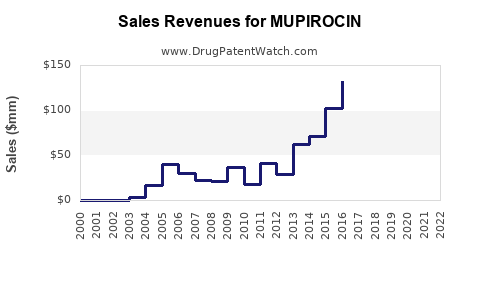
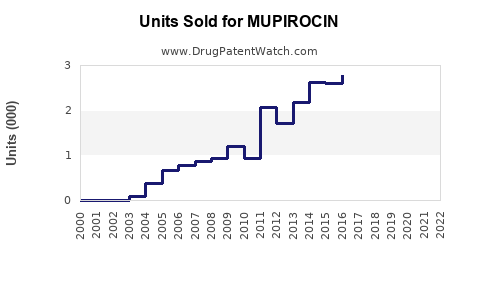
Annual Sales Revenues and Units Sold for MUPIROCIN
| Drug Name | Revenues (USD) | Units | Year |
|---|---|---|---|
| MUPIROCIN | ⤷ Start Trial | ⤷ Start Trial | 2022 |
| MUPIROCIN | ⤷ Start Trial | ⤷ Start Trial | 2021 |
| MUPIROCIN | ⤷ Start Trial | ⤷ Start Trial | 2020 |
| MUPIROCIN | ⤷ Start Trial | ⤷ Start Trial | 2019 |
| MUPIROCIN | ⤷ Start Trial | ⤷ Start Trial | 2018 |
| >Drug Name | >Revenues (USD) | >Units | >Year |
Mupirocin Market Analysis, Patent Status, Competitive Landscape, and Sales Projections
Mupirocin is a mature generic topical antibiotic with broad global availability, limited remaining intellectual-property protection, and low barriers to substitution. The market is supported by continued demand for treatment of impetigo, localized bacterial skin infections, and nasal decolonization of Staphylococcus aureus, including methicillin-resistant S. aureus (MRSA). Revenue growth is likely to come from volume, geographic expansion, hospital protocols, and formulation access rather than price increases.
Public sources do not provide a single audited global sales figure for all mupirocin products. The market includes prescription ointments, creams, nasal products, hospital purchases, private-label generics, and country-specific brands. The projections below therefore use a scenario-based model rather than a single reported market consensus.
What is mupirocin used for and how large is the addressable market?
Mupirocin is a topical antibiotic derived from the bacterium Pseudomonas fluorescens. It inhibits bacterial isoleucyl-transfer RNA synthetase and is active primarily against gram-positive organisms, including Staphylococcus aureus and Streptococcus pyogenes.
The principal commercial indications are:
| Use | Typical product | Market role |
|---|---|---|
| Impetigo | 2% topical ointment or cream | Primary outpatient use |
| Localized skin infection | 2% ointment or cream | Primary-care and dermatology use |
| MRSA decolonization | 2% nasal ointment | Hospital and infection-control use |
| Surgical decolonization protocols | Nasal ointment, often with chlorhexidine | Institutional purchasing |
| Veterinary and non-U.S. uses | Country-specific formulations | Smaller regional opportunity |
In the United States, topical mupirocin is generally a prescription product. The FDA-approved U.S. products include mupirocin ointment, cream, and nasal ointment formulations marketed under the Bactroban brand and by generic manufacturers.[1]
Demand is driven by:
- High incidence of impetigo and uncomplicated skin infections.
- Continued MRSA surveillance and hospital infection-control programs.
- Low treatment cost relative to systemic antibiotics.
- Familiarity among primary-care physicians and dermatologists.
- Use in pediatric patients, where topical treatment can avoid oral antibiotic exposure.
Demand is constrained by antimicrobial stewardship, resistance concerns, limited treatment duration, and substitution with other topical or systemic therapies.
What is the current mupirocin market size?
The global mupirocin market is generally estimated by commercial market-research providers to be in the hundreds of millions of dollars annually, but estimates vary materially because some reports include only branded and generic pharmaceutical sales while others include hospital procurement, contract manufacturing, and nonprescription international markets.
A practical 2024 market range is approximately $450 million to $750 million globally on a manufacturer-sales basis. This range is an analytical estimate, not a reported figure from a single audited database.
| Market segment | Estimated 2024 share | Commercial characteristics |
|---|---|---|
| United States | 25%-35% | High prescription volume, heavy generic penetration |
| Europe | 20%-30% | Country-specific reimbursement and stewardship controls |
| Asia-Pacific | 25%-35% | Volume growth, lower average selling prices |
| Latin America, Middle East and Africa | 10%-20% | Private-market and hospital demand, uneven registration |
The United States is likely to generate a larger share of revenue than volume because prices and reimbursement remain higher than in many emerging markets. Asia-Pacific is more likely to account for incremental unit growth, particularly where branded generics and hospital use are expanding.
What are the mupirocin sales projections through 2030?
The base case assumes low-single-digit market growth, with volume expansion offset partly by generic price erosion. Under that model, the global market increases from an estimated $450 million-$750 million in 2024 to approximately $550 million-$950 million by 2030.
| Scenario | 2024 estimated market | Annual growth assumption | 2030 projected market |
|---|---|---|---|
| Downside | $450 million | 0%-1.5% | $450 million-$490 million |
| Base case | $600 million | 3%-4% | $720 million-$760 million |
| Upside | $750 million | 5%-6% | $1.0 billion-$1.06 billion |
The base-case midpoint implies approximately 3.5% compound annual growth from 2024 to 2030.
Key sales drivers
The strongest positive driver is continued demand for low-cost topical treatment in outpatient care. Hospital use for nasal decolonization can support higher-value contracts than routine skin treatment, although institutional protocols vary and antimicrobial stewardship can limit broad prophylactic use.
International expansion is another growth channel. Mupirocin has a well-established clinical profile, and local manufacturers can register generic formulations without overcoming the development risk associated with a new antibiotic.
Key sales constraints
Generic competition limits pricing power. Payers and pharmacies can substitute among manufacturers with little clinical differentiation. Resistance also creates a ceiling on use. The Infectious Diseases Society of America has recommended limiting mupirocin use when resistance or repeated exposure reduces expected benefit.[2]
How does mupirocin compare with competing topical antibiotics?
Mupirocin competes with fusidic acid, retapamulin, ozenoxacin, bacitracin, polymyxin-containing combinations, and oral antibiotics used for more extensive infections.
| Product | Main advantage | Main limitation | Competitive position |
|---|---|---|---|
| Mupirocin | Strong familiarity and activity against S. aureus | Resistance and generic price pressure | Leading established option |
| Fusidic acid | Broad international availability | Resistance concerns; limited U.S. role | Important outside the U.S. |
| Retapamulin | Alternative topical mechanism | Limited commercial scale and indication breadth | Niche |
| Ozenoxacin | Newer nonfluorinated quinolone | Higher price and narrower commercial base | Premium alternative |
| Bacitracin combinations | Low cost and OTC availability in some markets | Allergy and variable bacterial coverage | Consumer and minor-injury segment |
| Oral cephalexin or clindamycin | Useful for extensive infection | Systemic adverse effects and stewardship concerns | Substitute for more severe cases |
Mupirocin is strongest where clinicians need a familiar anti-staphylococcal topical product with established pediatric and outpatient use. Its position is weaker in markets where fusidic acid is widely reimbursed or where hospitals have reduced routine nasal decolonization.
What patents protect mupirocin products?
The original mupirocin composition and early Bactroban patent estate are expired. Mupirocin is therefore a mature generic product in the United States and major international markets.
The relevant protection historically covered:
- The mupirocin active ingredient and related pseudomonic acid chemistry.
- Pharmaceutical compositions containing mupirocin.
- Topical ointment formulations.
- Nasal delivery and decolonization uses.
- Manufacturing and purification processes.
The original compound and product patents were filed decades ago and no longer create meaningful blocking protection for standard 2% mupirocin ointment or cream. Generic manufacturers can market approved products after satisfying FDA requirements for quality, bioequivalence or pharmaceutical equivalence, labeling, and manufacturing controls.[1]
What formulations are protected by mupirocin patents?
The commercially important formulations are:
- Mupirocin ointment, 2%.
- Mupirocin cream, 2%.
- Mupirocin calcium ointment, 2%, equivalent to 2% mupirocin.
- Mupirocin calcium nasal ointment, 2%.
Any later patent protection would need to focus on a specific formulation, device, delivery system, or manufacturing process. Such patents would not automatically block conventional generic ointments and creams.
When does mupirocin lose exclusivity?
Mupirocin lost meaningful U.S. market exclusivity years ago. The original branded Bactroban products no longer benefit from an effective composition patent or regulatory exclusivity period that would prevent generic competition.
The commercial exclusivity timeline is:
| Milestone | Approximate timing |
|---|---|
| Original mupirocin development and patenting | 1980s |
| Initial Bactroban U.S. approvals | Late 1980s |
| Original product-patent protection | Expired in the early 2000s |
| Generic U.S. competition | Established for many years |
| Current status | Mature, multisource generic market |
The exact legal expiry date depends on the patent, jurisdiction, patent-term adjustments, and the specific formulation. Those historic rights are not material barriers to current generic entry.
What is the Orange Book status of mupirocin?
The FDA Orange Book lists approved prescription drug products and identifies certain patent and exclusivity information for listed products. Mupirocin products appear through approved new drug applications and generic abbreviated new drug applications, including ointment, cream, and nasal formulations.[3]
The commercial Orange Book implications are:
- Generic manufacturers can reference approved mupirocin products through the ANDA pathway.
- Standard mupirocin products do not have a current Orange Book exclusivity position comparable to a newly approved branded medicine.
- Any patent certification issue depends on the specific reference product and listed patent, not on mupirocin as a molecule.
- The absence of meaningful current exclusivity makes Paragraph IV litigation less commercially important than it would be for a protected branded drug.
Which companies manufacture or market mupirocin?
The supplier base includes multinational generic companies, specialty pharmaceutical firms, regional manufacturers, and contract manufacturers. Historical and current market participation has included companies associated with the Bactroban brand and generic manufacturers such as Taro Pharmaceutical Industries, Glenmark Pharmaceuticals, Perrigo, Teva, and other regional suppliers, depending on country and formulation.
Market shares change frequently because:
- ANDA holders may not actively market every approved product.
- Retail pharmacies switch suppliers based on contract price and availability.
- Hospital tenders can move large volumes between manufacturers.
- Some companies sell under private-label or authorized-generic arrangements.
- Country-specific registrations do not establish a global commercial presence.
The competitive advantage is primarily supply reliability, cost position, regulatory compliance, and tender access. Clinical differentiation is limited for standard formulations.
Are there Paragraph IV challenges or mupirocin patent lawsuits?
Mupirocin is unlikely to generate significant current Paragraph IV litigation because the principal patents covering the established product have expired and multiple generic versions are already commercialized.
Historic litigation could have involved formulation, process, or reference-product patent rights. Those disputes do not create a current broad barrier to generic entry. Current litigation risk is more likely to involve:
- Manufacturing deviations.
- Product recalls.
- Drug shortages.
- Trademark disputes.
- Contract and distribution arrangements.
- Advertising or labeling issues.
- Patent claims directed to new delivery systems rather than standard mupirocin.
No biosimilar pathway applies because mupirocin is a small-molecule antibiotic, not a biologic. FDA regulatory exposure is therefore centered on ANDA approval, manufacturing quality, labeling, and post-market surveillance.
How strong is the mupirocin patent estate?
The patent estate is weak for conventional products and potentially moderate for narrowly defined reformulations.
| Asset category | Current strength | Commercial impact |
|---|---|---|
| Original mupirocin compound | Low | Expired |
| Standard 2% ointment | Low | Generic substitution available |
| Standard 2% cream | Low | Generic competition established |
| Nasal ointment | Low to moderate | Product-specific formulation and regulatory know-how may matter |
| New delivery device | Moderate if valid and enforceable | Could support limited differentiation |
| Manufacturing process | Moderate in a narrow scope | Usually avoidable through alternative processes |
| Combination or decolonization regimen | Limited | Method claims may be difficult to enforce broadly |
The practical moat is operational rather than patent-based. Manufacturers with validated suppliers, dependable active pharmaceutical ingredient procurement, low-cost filling operations, and established hospital contracts can maintain share despite an unprotected active ingredient.
What generic launch scenarios exist for mupirocin?
A new entrant would face low legal entry barriers but meaningful commercial execution requirements.
Standard retail launch
The entrant launches a 2% ointment or cream through wholesalers and pharmacy channels. The likely result is rapid price competition and modest market share unless the manufacturer has a cost or distribution advantage.
Hospital-focused launch
The entrant targets nasal ointment and institutional decolonization protocols. This strategy can generate higher-value accounts but requires tender participation, supply guarantees, and evidence of consistent quality.
Low-cost international launch
The manufacturer targets markets with limited local production and strong branded-generic demand. Regulatory requirements, local registration, and channel access become the main barriers.
Differentiated formulation launch
A company develops an improved vehicle, delivery device, longer shelf-life product, or combination regimen. This could support pricing above commodity generics, but clinical and regulatory development costs would be materially higher.
What revenue exposure does mupirocin create for manufacturers?
Mupirocin is usually a small product within a diversified generic portfolio. Revenue concentration can be higher for niche suppliers that depend on a limited number of topical products or hospital contracts.
For a manufacturer, the principal financial risks are:
- Wholesale price deflation.
- Loss of a pharmacy or hospital contract.
- Active pharmaceutical ingredient shortages.
- FDA warning letters or manufacturing observations.
- Product recalls caused by microbial contamination or fill-weight deviations.
- Resistance-driven reductions in clinical use.
- Reimbursement changes affecting topical prescriptions.
The principal upside is predictable recurring demand with low clinical development risk and relatively simple dosage-form manufacturing.
Key Takeaways
- Mupirocin is a mature, multisource generic antibiotic with no meaningful current composition-patent barrier.
- The global market is reasonably estimated at $450 million-$750 million in 2024, with a base-case midpoint of about $600 million.
- Base-case sales projections indicate a market of approximately $720 million-$760 million by 2030.
- Growth is likely to come from volume, hospital decolonization, and emerging markets rather than price expansion.
- U.S. and European markets face generic price pressure and antimicrobial-stewardship constraints.
- Standard 2% ointment and cream products have weak patent protection.
- Nasal formulations, manufacturing processes, and delivery systems may support narrower forms of differentiation.
- Paragraph IV and biosimilar risk are limited because the relevant patents are expired and mupirocin is a small molecule.
- The most durable competitive advantages are manufacturing reliability, regulatory compliance, hospital access, and supply economics.
FAQs About Mupirocin Market Growth and Commercial Risk
Is mupirocin still commercially attractive for generic manufacturers?
Yes, but mainly as a portfolio product. It offers established demand and limited clinical development risk, while pricing power is low.
Is mupirocin resistant to MRSA?
Resistance occurs and has been reported in both community and hospital settings. Repeated or widespread use can select for resistance, which limits the value of indiscriminate decolonization programs.[2]
Does mupirocin have over-the-counter status in the United States?
No. U.S. mupirocin products are prescription medicines, although regulatory status differs by country.
Can a new mupirocin formulation receive new patent protection?
Yes. A genuinely novel formulation, delivery device, manufacturing process, or method of use may be patentable if it satisfies applicable novelty, nonobviousness, written-description, and enablement requirements. Such protection would generally be narrower than a composition patent.
What is the biggest threat to mupirocin sales through 2030?
The main threat is generic price erosion combined with antimicrobial stewardship and resistance. Competitive substitution by fusidic acid, ozenoxacin, retapamulin, or oral antibiotics is secondary and depends on local treatment guidelines.
References
- U.S. Food and Drug Administration. (n.d.). Drugs@FDA: FDA-approved drugs and labeling for mupirocin products. https://www.accessdata.fda.gov/scripts/cder/daf/
- Infectious Diseases Society of America. (2014). Practice guidelines for the diagnosis and management of skin and soft tissue infections. Clinical Infectious Diseases, 59(2), e10-e52. https://doi.org/10.1093/cid/ciu296
- U.S. Food and Drug Administration. (n.d.). Approved drug products with therapeutic equivalence evaluations: Orange Book. https://www.accessdata.fda.gov/scripts/cder/ob/index.cfm
More… ↓
