Last updated: February 14, 2026
What is Thiothixene and Its Market Status?
Thiothixene is an antipsychotic medication belonging to the class of typical neuroleptics, primarily used for managing schizophrenia. Market data indicates its sales are declining, partly due to the rise of atypical antipsychotics. Its patent protection has expired, categorizing it as a generic drug, leading to downward pressure on prices worldwide.
Current Market Size and Trends
Global Market Valuation
The global antipsychotics market was valued at approximately USD 6.4 billion in 2022. Thiothixene, as a generic agent, accounts for a small fraction—estimated between USD 50 million and USD 100 million annually—focused mainly in North America and Europe.
Market Share Dynamics
- Older Typical Antipsychotics: Remaining active but diminished market share due to side effect profiles.
- Atypical Antipsychotics: Dominates the market, capturing over 80% of sales for schizophrenia treatments.
- Generic Thiothixene: Limited by prescriber preferences shifting toward newer agents; sales growth remains stagnant or declining.
Price Trends and Generic Competition
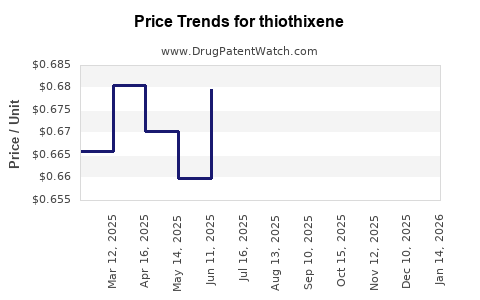
Average wholesale prices (AWP) for thiothixene tablets have decreased substantially over the past decade. In 2012, the estimated price per 10 mg tablet hovered around USD 0.50, whereas in 2022, it decreased to approximately USD 0.10 to USD 0.20, partly due to increasing generic competition and formulary preferences favoring atypicals.
Pharmaceutical and Regulatory Landscape
Patent and Exclusivity Status
Thiothixene's patent expiration occurred over a decade ago, facilitating generic manufacturing. No current market exclusivity or new formulations are in active development, influencing limited pricing power.
Regulatory Environment
Regulatory agencies facilitate rapid approval of generics, further intensifying competition, especially in mature markets. The US FDA classifies thiothixene as a standard generic with abbreviated new drug application (ANDA) pathways.
Price Projections and Future Outlook
Short-Term Forecast (Next 5 Years)
- Price Stabilization or Slight Decline: The price per 10 mg tablet is projected to remain in the USD 0.10–0.15 range, assuming no major regulatory or clinical shifts.
- Market Volume: Will likely continue declining as prescribers favor atypicals.
Long-Term Projections (Beyond 5 Years)
- Further Price Erosion: Driven by increased generic competition and potential healthcare policy shifts favoring cost-effective treatments.
- Market Disappearance: Possible transition to off-patent status leading to near-zero pricing unless repurposing or new indications are developed.
Factors Influencing Price Dynamics
| Factor |
Impact on Price |
Details |
| Generic Competition |
Drives prices down |
Increased manufacturing reduces unit cost |
| Prescriber Preference |
Reduces demand |
Shift towards atypicals like risperidone, olanzapine |
| Healthcare Policies |
May influence access and formulary placement |
Incentivize use of newer agents |
| Clinical Development |
No current new formulations |
Limits increased price potential |
Key Market Trends and Competitive Analysis
- Shift to Atypical Agents: Leads to revenue decline for older typicals.
- Limited Innovation: No new formulations or indications under development.
- Pricing Pressure: Driven by policy, managed care, and generic proliferation.
Summary
Thiothixene operates in a mature, declining segment of the antipsychotic market. Its prices have fallen significantly, with stable or decreasing trajectories expected over the next five years. Limited development interest and shifting prescriber patterns favor newer atypicals further reduce its market size and pricing prospects.
Key Takeaways
- The global market for thiothixene is primarily composed of generic sales, valued at USD 50-100 million annually.
- Average prices per 10 mg tablet have declined from USD 0.50 in 2012 to approximately USD 0.10-0.20 in 2022.
- No current patent protections or new formulations limit pricing.
- The market is forecasted to experience minimal price fluctuations, with continued demand decline.
- Competitive pressures from atypical antipsychotics dominate the schizophrenia treatment landscape.
FAQs
1. What factors primarily influence thiothixene's declining price?
The patent expiration, increased generic competition, and prescriber preference for newer atypical antipsychotics tend to decrease demand and price.
2. Are there any new formulations or indications for thiothixene?
No, there are no ongoing developments for new formulations or indications. It remains a legacy treatment.
3. How does thiothixene compare in cost to atypical antipsychotics?
Generic thiothixene costs significantly less—roughly USD 0.10-0.20 per 10 mg tablet—compared to newer atypicals, which can cost USD 5-20 per daily dose.
4. What is the outlook for generic manufacturing rights?
Generic manufacturing is well established, with multiple producers. No regulatory barriers currently restrict production or supply.
5. Will policy changes affect thiothixene's market future?
Potential policy shifts promoting cost-effective medications could further suppress demand for older typicals like thiothixene, unless new clinical evidence influences prescribing patterns.
References
[1] Grand View Research. "Antipsychotics Market Size, Share & Trends Analysis Report." 2023.
[2] IQVIA. "National Prescription Perspectives." 2022.
[3] FDA. "Approved Drug Products with Therapeutic Equivalent Records." 2023.
[4] MarketWatch. "Generic Drug Price Trends." 2022.