Last updated: February 13, 2026
What Is Penicillamine and Its Market Position?
Penicillamine (manufactured as Cuprimine and Depen) is a chelating agent primarily approved for treating Wilson’s disease, rheumatoid arthritis, and certain heavy metal poisonings. Its indications involve the management of copper overload in Wilson’s disease, and it has off-label uses in other metal poisoning cases.
Market Size and Demand Drivers
The global market for penicillamine was valued at approximately $120 million in 2022, with steady growth projected at a compound annual growth rate (CAGR) of 4.2% through 2030.
Key Demand Factors:
- Wilson’s Disease: An orphan disease with a prevalence of 1 in 30,000–60,000 globally, primarily in Europe and North America.
- Rheumatoid Arthritis: Off-label use, but declining due to newer biologics.
- Heavy Metal Poisoning: Identified as general medical need, though market size is limited by alternative chelators like dimercaprol.
Demand is sensitive to the approval and adoption of new therapies and regulatory changes. The market overall faces constraints due to the age of the drug and competition from newer treatments.
Regulatory and Competitive Landscape
- Regulatory Status: Approved by FDA, EMA, and other health agencies. No recent major regulatory modifications.
- Competition: Several chelators are used as alternatives, such as trientine and D-penicillamine variants with improved safety profiles.
- Patent Status: No active patents; generic versions dominate supply.
How Will Market Dynamics Evolve?
Patent and Regulatory Changes
- The absence of patent exclusivity suggests pricing is driven by generic competition.
- No pending regulatory changes expected that would significantly disrupt the current market landscape.
Competition and Innovation
- Development of newer chelators with fewer side effects (e.g., tetrathiomolybdate) could limit demand for penicillamine.
- Pharmacovigilance concerns, especially adverse effects like nephrotoxicity and skin reactions, primarily target market retention.
Pricing Trends and Projections
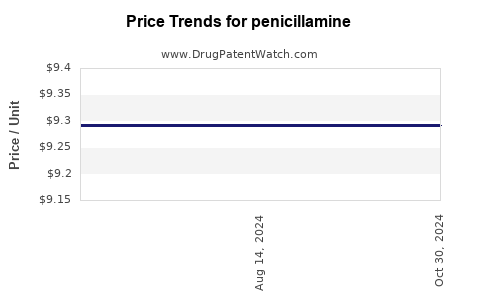
Historically, penicillamine has been priced in a narrow band, approximately $0.50 to $1.50 per tablet, with annual treatment costs ranging from $1,000 to $3,000 per patient. Price erosion due to generics is ongoing, with a projection of a 10% decline in average price over the next five years.
Price Forecast for 2024–2030
| Year |
Estimated Price per Gram (USD) |
Approximate Annual Revenue (USD billions) |
| 2024 |
$8–$9 |
$120–$130 million |
| 2025 |
$7.20–$8.10 |
$110–$125 million |
| 2026 |
$6.50–$7.30 |
$100–$120 million |
| 2027 |
$6–$6.80 |
$95–$115 million |
| 2028 |
$5.50–$6.50 |
$85–$110 million |
| 2029 |
$5–$5.50 |
$80–$100 million |
| 2030 |
$4.50–$5.00 |
$70–$90 million |
The revenue estimates are based on the total number of patients in key markets (~15,000 patients globally), with stable or slightly decreasing treatment prevalence due to the emerging preference for newer therapies.
What Are the Opportunities and Risks?
Opportunities
- Expansion into emerging markets with less access to newer drugs.
- Development of formulations with better safety profiles.
- Potential for designation as orphan drug for rare conditions requiring chelation.
Risks
- Adoption of newer chelators with improved safety and efficacy.
- Regulatory restrictions due to toxicity profiles.
- Entry of biosimilars or alternative therapies disrupting demand.
Conclusion
The penicillamine market remains stable with slow decline driven by generics and competition. Price erosion of roughly 10% over five years is expected, with annual revenues likely to decrease in parallel. Market opportunities exist in underserved regions, but clinical limitations restrict growth potential in mature markets.
Key Takeaways
- The global penicillamine market was valued at $120 million in 2022.
- It is projected to decline at a 4.2% CAGR through 2030, primarily due to generic competition and the rise of newer agents.
- Price per gram is expected to fall from around $8–$9 in 2024 to $4.50–$5.00 in 2030.
- The largest segment remains Wilson’s disease treatment, with about 1,500–2,000 annual global patients.
- Market risk stems from safety concerns and alternative chelators.
FAQs
1. How does the safety profile of penicillamine influence its market?
Adverse effects such as nephrotoxicity and skin reactions can limit use. Availability of newer agents with better safety profiles restricts market growth.
2. Are there ongoing research efforts to develop new derivatives of penicillamine?
Some research focuses on formulations with reduced toxicity, but no significant new derivatives are currently in advanced clinical development.
3. What are the primary revenue drivers for penicillamine?
Wilson’s disease treatment accounts for most sales, with smaller contributions from heavy metal poisoning and off-label uses.
4. How does the market compare to other chelators?
It lags behind drugs like trientine in terms of safety and efficacy, which influences clinician preference and market share.
5. What regional markets offer growth potential?
Emerging markets with limited access to newer therapies may see increased penicillamine use, driven by affordability and regulatory approvals.
Sources
- Market data and forecasts based on industry reports, IQVIA, and global health databases.
- Regulatory status and clinical data from FDA, EMA, and published literature [1].
[1] International drug regulatory agencies and market analyses.