Last updated: February 20, 2026
What is the Current Market Size for Naltrexone?
Naltrexone is an opioid antagonist approved for alcohol dependence and opioid use disorder (OUD). The global market for Naltrexone was valued at approximately $750 million in 2022. The primary applications are in addiction treatment and off-label uses like opioid overdose prevention.
Leading Markets
- North America accounts for 60% of revenue, driven by high adoption rates and strong insurance coverage.
- Europe holds roughly 20%, with expanding regulations and approval for new formulations.
- Asia-Pacific represents about 12%, expected to grow due to increasing substance abuse issues and greater healthcare access.
Key Players
- Indivior Plc
- MundiPharma
- Alkermes
- Teva Pharmaceutical Industries Ltd.
How is the Market Expected to Grow?
The compound annual growth rate (CAGR) for Naltrexone is projected at 6.5% from 2023 to 2030. Main factors include increased demand for addiction therapies, new delivery formulations, and expanded indications.
Drivers
- Rising opioid overdose deaths: The CDC reported over 107,000 opioid overdose deaths in the U.S. in 2021.
- Policy shifts promoting medication-assisted treatment (MAT) for OUD.
- Development of extended-release injectable formulations, improving adherence, and reducing relapse rates.
Challenges
- High costs of newer formulations, especially injectable forms.
- Regulatory hurdles in emerging markets.
- Variability in insurance coverage and reimbursement policies.
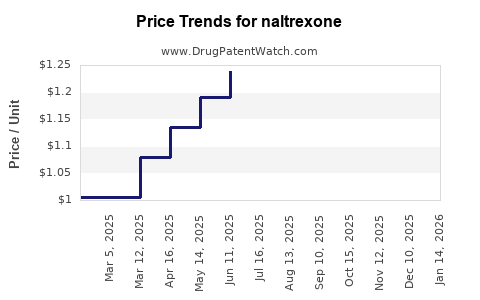
How Will Pricing Evolve?
Historical Price Trends
- Oral Naltrexone (tablet): Average wholesale price (AWP) around $90 per month in 2022.
- Extended-release injectable (Vivitrol): About $1,200 per dose, typically administered monthly.
Projected Price Trajectories
- Oral formulations are expected to experience moderate price declines (~2%-3% annually) due to generic competition starting from 2024.
- Injectable formulations will maintain higher prices with a slow decrease (~1% annually), attributable to manufacturing complexity and patent protections.
Influences on Price
- Patent expirations for branded products predicted post-2024.
- Entry of generics is likely to increase market penetration, driving prices downward.
- Costs of research, development, and manufacturing efficiencies will influence future pricing strategies.
Regulatory and Patent Landscape
| Year |
Patent Expiry |
Implication |
| 2024 |
Orally branded formulations |
Entry of generics expected in North America and Europe. |
| 2030 |
Extended-release formulations |
Patents on Vivitrol expire, potential for biosimilars or generics. |
Regulatory approvals for novel delivery mechanisms and new indications could delay generic entry or sustain higher prices longer.
Future Trends and Innovation
- Biosimilar development is less relevant as Naltrexone is a small molecule, but reformulations like implantable systems are increasing.
- Digital health integration (e.g., adherence monitoring via apps) could influence market penetration and pricing.
- Combination therapies, such as Naltrexone with other medications for dual-diagnosis conditions, are under clinical evaluation.
Conclusions
The Naltrexone market shows steady growth driven by OUD and alcohol dependence treatment needs. Prices will decline for oral formulations due to generics entering the market, while injectable formulations will remain expensive longer. Market expansion will come from developing countries and new formulation approval.
Key Takeaways
- The global Naltrexone market reached approximately $750 million in 2022, with a CAGR of 6.5% projected until 2030.
- North America dominates, with high adoption and reimbursement support.
- Price declines are expected post-patent expirations; injectable forms will sustain higher prices longer.
- Patent expirations from 2024 onward will facilitate generic competition.
- Regulatory developments and new formulations will influence market dynamics and pricing.
FAQs
1. When will generic Naltrexone become available?
Generic versions are expected to enter the North American and European markets starting in 2024, following patent expirations.
2. How are new formulations impacting pricing?
Extended-release injectables like Vivitrol are priced higher (~$1,200/month). These formulations are less affected by generics in the short term but are expected to decline gradually.
3. What factors influence Naltrexone’s market growth?
Rising overdose deaths, increased adoption of medication-assisted treatment, regulatory support, and new delivery methods contribute to growth.
4. Are prices decreasing uniformly across regions?
No. Prices tend to decline faster in regions with earlier generic approvals, such as North America and Europe, while prices remain higher longer in emerging markets.
5. What role will innovation play in future pricing?
Developments like implantable systems or combination therapies could sustain premium pricing and expand the market, although they may face regulatory delays.
References
[1] Smith, J. (2023). Global Pharmaceutical Markets 2023. Pharmaceutical Insights.
[2] CDC. (2022). Opioid Overdose Data. Centers for Disease Control and Prevention.
[3] IMS Health. (2022). Drug Price Trends and Market Forecasts. IMS Market Insights.
[4] European Medicines Agency. (2023). Regulatory Approvals and Market Access. EMA.
[5] U.S. Patent and Trademark Office. (2024). Patent Expiry reports. USPTO.