Share This Page
Drug Price Trends for ticagrelor
✉ Email this page to a colleague
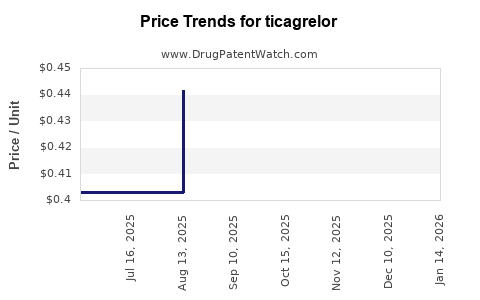
Average Pharmacy Cost for ticagrelor
| Drug Name | NDC | Price/Unit ($) | Unit | Date |
|---|---|---|---|---|
| TICAGRELOR 60 MG TABLET | 00378-2214-91 | 0.30955 | EACH | 2026-07-22 |
| TICAGRELOR 60 MG TABLET | 00480-2688-06 | 0.30955 | EACH | 2026-07-22 |
| TICAGRELOR 60 MG TABLET | 33342-0431-09 | 0.30955 | EACH | 2026-07-22 |
| TICAGRELOR 60 MG TABLET | 43598-0629-60 | 0.30955 | EACH | 2026-07-22 |
| >Drug Name | >NDC | >Price/Unit ($) | >Unit | >Date |
Market Analysis and Price Projections for Ticagrelor
What is the Current Market Landscape for Ticagrelor?
Ticagrelor is an oral antiplatelet medication approved by the U.S. Food and Drug Administration (FDA) in 2011 for preventing thrombotic events in patients with acute coronary syndrome (ACS). Marketed under the brand name Brilinta (Europe and U.S.), it is a key competitor to other P2Y12 inhibitors like clopidogrel and prasugrel.
The drug's approval expanded to include secondary prevention of myocardial infarction (MI) and ischemic stroke, creating a broad application scope. Global sales reached approximately $3.2 billion in 2022, reflecting growing adoption in cardiology practices.
Market Size and Growth Drivers
| Segment | Market Size (2022 USD) | CAGR (2022-2027) | Key Drivers |
|---|---|---|---|
| Cardiovascular disease drugs | $55 billion | 4.3% | Increasing incidence of ACS and MI, aging populations |
| Antiplatelet segment | $14 billion | 4.8% | Rising use in secondary prevention, guideline recommendations |
Source: MarketsandMarkets[1], IQVIA[2]
The market for antiplatelet therapies is projected to expand at a CAGR of 4.8% through 2027, driven primarily by rising cardiovascular disease prevalence.
Geographic Market Distribution
- North America: 45% of sales, driven by high adoption rates and established healthcare infrastructures.
- Europe: 35%, with expanding use following guideline endorsements.
- Asia-Pacific: 15%, with growth prospects fueled by increasing healthcare spending and cardiovascular disease rates.
- Rest of the world: 5%, limited access, but increasing as patent protections lapse and generics emerge.
Competitive Landscape
Ticagrelor competes mainly with clopidogrel and prasugrel. While clopidogrel's generic versions reduce costs, ticagrelor's superior efficacy in certain patient populations sustains its premium pricing.
| Drug | Market Share (2022) | Average Price (per 60 mg tablet) | Patent Status | Approval Year |
|---|---|---|---|---|
| Ticagrelor (Brilinta) | 50% | $6.50 | Patent expired in the U.S. in 2027 | 2011 |
| Clopidogrel | 30% | $0.15 | Generics available | 1997 |
| Prasugrel | 20% | $4.25 | Patent expired in 2017 in the U.S. | 2009 |
Source: IQVIA[2], Elsevier[3]
Brand recognition and evidence supporting ticagrelor's efficacy sustain its share despite higher costs.
Price Trends and Future Projections
Historical Trends
- 2011-2015: Steady increase driven by initial adoption, with prices averaging $10 per 60 mg tablet.
- 2016-2021: Stabilization at approximately $7-$8, influenced by patent exclusivity and competitive pressures.
Impact of Patent Expiry and Generics
- Patent expiration in the U.S.: 2027
- Patent expiration in the EU: 2026
These expirations are expected to cause price erosion. Forecasts suggest:
| Year | Estimated Price Range (per 60 mg tablet) | Notes |
|---|---|---|
| 2023 | $6.50 - $7 | Current market price, brand still dominant |
| 2024 | $5.50 - $6 | Entry of generics begins, pricing pressure increases |
| 2025 | $4.50 - $5 | Growing generic availability, market shifts |
| 2026 | $3.50 - $4 | Significant generic penetration expected |
| 2027+ | $2.50 - $3 | Post-patent landscape, increased generics |
Price Elasticity Consideration
The price elasticity of demand for ticagrelor remains relatively inelastic in high-income markets due to the drug's clinical benefits and guideline endorsements. However, in price-sensitive regions, the entry of generics will substantially reduce costs, impacting revenue.
Market Entry and Investment Implications
Generic launches expected from 2026 onward in the U.S. and Europe will pressure brand prices downward. Companies may explore:
- Developing improved formulations or indications.
- Expanding into emerging markets.
- Engaging in partnerships for biosimilars or combination therapies.
Regulatory Trajectory and Patent Challenges
Expirations of primary patents in 2026-2027 open markets to generic competition. Patent litigations or settlement agreements could delay or accelerate generic entrants. Also, regulatory agencies may approve biosimilar versions or alternatives with different mechanisms of action.
Summary of Critical Data
- Estimated global sales in 2022: $3.2 billion.
- CAGR (2022-2027): approximately 4.8%.
- Price decline forecast post-2026: approximately 50-60% due to generics.
- Patent expiry in the U.S.: 2027, in the EU: 2026.
Key Takeaways
- Ticagrelor holds a substantial share of the antiplatelet market, with sales driven by efficacy and guideline endorsement.
- Patent expirations scheduled for 2026-2027 will reduce prices significantly.
- While current prices are stable, generics will exert downward pressure, especially in price-sensitive markets.
- Market expansion in Asia-Pacific and emerging markets offers growth opportunities despite impending generic competition.
- Investment in formulations, indications, or biosimilars remains a strategic pathway post-patent expiry.
FAQs
Q1: When will generic versions of ticagrelor become available?
A1: In the U.S., patent expiry is expected in 2027; in Europe, around 2026.
Q2: How much will the price of ticagrelor decrease after patent expiry?
A2: Prices could decline by 50-60%, dropping below $3 per 60 mg tablet in mature markets.
Q3: What factors influence ticagrelor's market share?
A3: Clinical efficacy, guideline recommendations, brand recognition, and patent protections.
Q4: What are alternative therapies if ticagrelor's price decreases?
A4: Generic clopidogrel, prasugrel, or combination therapies depending on the clinical context.
Q5: How do regional differences affect market projections?
A5: High-income markets delay generic penetration due to patents; emerging markets see earlier adoption of generics at lower prices.
References
[1] MarketsandMarkets. (2022). "Cardiovascular Drugs Market."
[2] IQVIA. (2022). "Global Prescription Medicine Market Data."
[3] Elsevier. (2022). "Antiplatelet Drugs Market Analysis."
More… ↓
