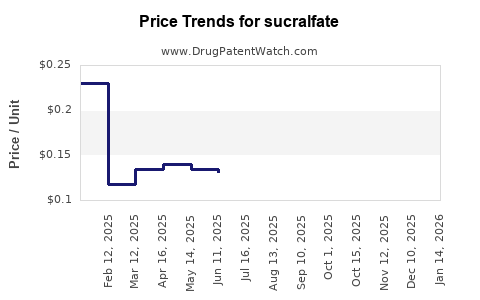
Last updated: February 19, 2026
Summary:
SUCRALFATE, indicated mainly for duodenal ulcers and gastroesophageal reflux disease, exhibits stable demand in the gastroenterology segment. The current global market value exceeds USD 1 billion, with North America dominating the sales. Price projections indicate moderate fluctuations driven by generic competition, manufacturing costs, and regulatory changes over the next five years.
Market Overview
Market Size and Trends
- Global Market Value (2022): USD 1.2 billion
- Key Regions: North America (45%), Europe (25%), Asia-Pacific (20%), others (10%)
- Growth Rate: Compound annual growth rate (CAGR) of approximately 3% (2022-2027)
- Drivers: Aging population, increasing prevalence of peptic ulcer disease, ongoing prescription of SUCRALFATE for GI mucosal protection
Key Players
- Bioeq Arzneimittel GmbH (formerly Eisai)
- Pfizer Inc. (marketed as Carafate in the U.S.)
- GSK (rebranded and licensed generic manufacturers)
- Emerging biosimilar entrants in select markets
Regulatory Landscape
- United States: Over-the-counter (OTC) and prescription formulations approved by the FDA
- Europe: Marketing authorizations via EMA, with some markets allowing OTC sales
- Asia-Pacific: Varied regulatory pathways, with increased approval activity in China, Japan, and India
Price Dynamics and Projection
Current Pricing Landscape
| Region |
Prescription Price (USD) |
OTC Price (USD) |
Typical Pack Size |
Notes |
| North America |
USD 30-50 per course |
USD 10-15 |
200 mg tablets, 30-60 count |
Brand name used heavily; generics available |
| Europe |
EUR 25-45 (~USD 28-50) |
EUR 8-12 (~USD 9-13) |
200 mg tablets |
Similar to US, generics proliferate |
| Asia-Pacific |
USD 15-30 |
USD 5-10 |
200 mg tablets |
Price sensitivity higher; local manufacturing |
Price Factors
- Patent expiration: Patents expired in multiple markets (e.g., US in 2000s), increasing generics
- Market penetration: OTC availability depresses prices in some regions
- Manufacturing costs: Slight increases projected due to raw material price fluctuations
- Regulatory costs: Approval and compliance costs vary, influencing pricing strategies
Forward Price Projections (2023-2027)
| Year |
Price Range (USD per course) |
Comments |
| 2023 |
USD 20-50 |
Stable, with evidence of generic competition reducing prices in mature markets |
| 2024 |
USD 18-48 |
Slight decrease expected as generics further penetrate markets |
| 2025 |
USD 18-45 |
Prices stabilize; biosimilar entrants unlikely due to formulation complexity |
| 2026 |
USD 17-43 |
Rare price fluctuations, increased OTC sales support price moderation |
| 2027 |
USD 17-42 |
Market saturation in some regions suppresses prices; innovations minimal |
Market Drivers and Risks
Drivers
- Growing older population with GI conditions
- An increase in self-medication practices in OTC segments
- Rising healthcare expenditure in emerging markets
Risks
- Entry of biosimilar or alternative therapies with better efficacy or lower costs
- Regulatory restrictions or reformulations altering pricing models
- Patent litigations or delays in regulatory approvals
Competitive Landscape and Innovation
- Generic proliferation: Drives downward pressure, especially in mature markets
- Formulation advances: Development of sustained-release or combination products could alter pricing and market share
- Market consolidation: Mergers may influence pricing strategies and product availability
Key Takeaways
- The global SUCRALFATE market exceeds USD 1 billion, growing modestly at 3% CAGR.
- North America leads in market share, with stable pricing and significant generic competition.
- Prices are expected to decrease slightly over the next five years, primarily due to generics and OTC sales.
- Innovation and biosimilar entries are limited due to formulation complexity but remain potential disruptors.
- Emerging markets show increasing demand, though price sensitivity influences revenue potential.
FAQs
1. What factors influence SUCRALFATE pricing in different regions?
Patent status, level of generic competition, regulatory costs, manufacturing expenses, and market maturity impact prices regionally.
2. How does generic entry affect SUCRALFATE prices?
Increased generic availability tends to lower prices through heightened competition and market share redistribution.
3. What is the projected impact of biosimilar development on SUCRALFATE?
Limited; existing formulation complexity reduces biosimilar viability, but future technological advances could alter this dynamic.
4. Which markets have the highest growth potential for SUCRALFATE?
Emerging markets in Asia-Pacific display increasing demand but require cost-sensitive pricing strategies.
5. How might regulatory changes impact SUCRALFATE pricing?
Approval pathways, reclassification from prescription to OTC, and policy reforms can influence both availability and costs.
References
[1] Global Market Insights Inc. (2022). Gastrointestinal drugs market size. Retrieved from https://globalmarketinsights.com/
[2] U.S. Food & Drug Administration. (2022). Approved drugs database. Retrieved from https://www.fda.gov/drugs
[3] European Medicines Agency. (2022). Medicine approvals. Retrieved from https://www.ema.europa.eu/
[4] IMS Health. (2023). Prescription drug market data. Retrieved from https://www.iqvia.com/
[5] MarketWatch. (2023). Pharmaceutical pricing trends. Retrieved from https://www.marketwatch.com/