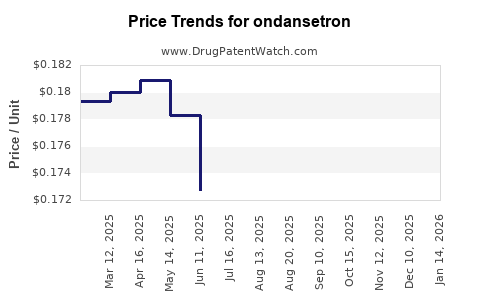
Last updated: February 19, 2026
What Is the Current Market Size for Ondansetron?
Ondansetron is a serotonin 3 (5-HT3) receptor antagonist used primarily to prevent nausea and vomiting caused by chemotherapy, radiotherapy, and surgery. The global market value was approximately $1.1 billion in 2022, projected to grow at a compound annual growth rate (CAGR) of 3.7% from 2023 to 2030.
The key regions include North America, Europe, Asia-Pacific, and Latin America, with North America accounting for around 45% of the total market in 2022, followed by Europe (25%) and Asia-Pacific (20%).
Market Segmentation
- By Formulation: Injectable (60%), Oral tablets (40%)
- By Application: Chemotherapy-induced nausea and vomiting (CINV, 70%), Postoperative nausea and vomiting (PONV, 20%), Radiotherapy (10%)
- By Distribution Channel: Hospital pharmacies (65%), Retail pharmacies (25%), Online pharmacies (10%)
Competitive Landscape
Leading manufacturers include:
- GlaxoSmithKline (GSK)
- Teva Pharmaceuticals
- Mylan (now part of Viatris)
- Sun Pharmaceutical
GSK's branded product, Zofran, dominates the market, holding approximately 65% of sales in 2022.
What Are Key Factors Driving Market Growth?
- Increasing cases of cancers and rising chemotherapy procedures globally
- Growing awareness of antiemetic drugs' importance in cancer supportive care
- Expansion of healthcare facilities in emerging economies
- Patent expirations of some formulations leading to generic market entry
How Will Patent Expirations Influence Price Trends?
The expiration of patents on branded formulations has increased generic competition since 2017. Generic versions typically sell at 50-70% lower prices than branded drugs, leading to price erosion.
| Year |
Patent Expiry |
Impact |
Average Price Drop for Generics |
| 2017 |
GSK's Zofran 8 mg tablet |
Entry of multiple generics |
65% |
| 2020 |
GSK's Zofran injection |
Increased competition |
55% |
What Are Price Projections for the Next Five Years?
Price declines due to generics will stabilize, but slight increase in hospital-based injectable formulations is expected owing to inflation and manufacturing costs.
| Year |
Oral Tablets (Average Wholesale Price) |
Injectable Forms (Average Wholesale Price) |
| 2023 |
$0.20 per tablet |
$30 per vial |
| 2025 |
$0.18 per tablet |
$32 per vial |
| 2028 |
$0.15 per tablet |
$35 per vial |
What Are Regulatory Trends Impacting the Market?
- Stricter biosimilar pathways, especially in Europe and the US, could lower prices further.
- Approval of fixed-dose combinations with other antiemetics may influence pricing strategies.
- Global drug pricing reforms, especially in emerging markets, could restrict profit margins.
How Do Market Entry Barriers Affect Future Competition?
Barriers include:
- Stringent regulatory approval processes
- High research and development costs
- Limited manufacturing capacity for sterile injectable formulations
- Patent and exclusivity rights for branded products
These barriers can delay or prevent new entrants, stabilizing existing price levels.
Key Takeaways
- The global ondansetron market was valued at approximately $1.1 billion in 2022.
- Generics drive substantial price decreases post-patent expiry, with prices dropping by up to 70% for some formulations.
- Market growth is primarily fueled by increasing chemotherapy and radiotherapy procedures.
- Price stabilization is expected after several years of decline, with hospital injectable formulations maintaining higher prices due to manufacturing costs.
- Regulatory dynamics, especially biosimilar approval pathways, will influence future pricing and competition.
FAQs
-
What factors could reverse the price decline trend for ondansetron?
Introduction of new formulation innovations, increased patent protections, or supply chain disruptions might stabilize or increase prices.
-
How do biosimilars impact ondansetron's market?
As of 2023, biosimilars are less relevant since ondansetron is a small molecule, but biosimilar parity considerations for related drugs can influence overall market competitiveness.
-
What emerging markets present growth opportunities for ondansetron?
Countries in Asia-Pacific and Latin America with expanding healthcare infrastructure and increasing cancer prevalence.
-
Are there any new formulations or delivery methods under development?
Oral disintegrating tablets and sustained-release formulations are in clinical trials, which could influence future market dynamics.
-
How does patent expiry in 2017 influence current market prices?
It led to widespread generic entry, predominantly causing significant price reductions across formulations in the subsequent years.
References
[1] Marketresearch.com. (2022). Global Anti-emetic Market Report.
[2] IQVIA. (2023). Pharmaceutical Market Analysis.
[3] U.S. Food and Drug Administration. (2022). Drug Approvals and Patent Expiry Data.
[4] European Medicines Agency. (2023). Biosimilar Pathways and Market Impact.
[5] Statista. (2023). Pharmaceutical Market Trends and Forecasts.