Last updated: February 12, 2026
Overview
Fluvoxamine maleate is a selective serotonin reuptake inhibitor (SSRI) primarily approved for treating obsessive-compulsive disorder (OCD). It has gained attention for off-label use in COVID-19 treatment, which influences its market dynamics. The drug’s patent status, competition, regulatory landscape, and manufacturing factors shape its market trajectory.
Market Size and Growth Drivers
- The global market for SSRIs, including fluvoxamine, was valued at approximately $2.5 billion in 2022.
- Off-label COVID-19 applications have historically increased demand, notably in 2020-2021, though its current levels depend on evolving clinical evidence and regulation.
- The OCD segment remains the primary revenue source, with an estimated compound annual growth rate (CAGR) of 2-3% through 2027.
Key Market Players and Supply Chain
- Major manufacturers include Solvay (original patent holder), Teva, Mylan (now part of Viatris), and Apotex.
- Generic versions dominate due to patent expiration, limiting price variability for branded formulations.
- Production capacity increased post-patent expiry, ensuring stable supply.
Regulatory Status and Patent Considerations
- Fluvoxamine was patent-protected until the early 2000s; generic versions entered markets worldwide afterward.
- No active patents restrict manufacturing, but some regional exclusivities or patents on formulations or new indications could impact pricing.
Price Trends and Forecasts
| Year |
Estimated Wholesale Price per 50 mg tablet |
Notes |
| 2022 |
$0.20 - $0.50 |
Wide variation based on region, brand, and generic. |
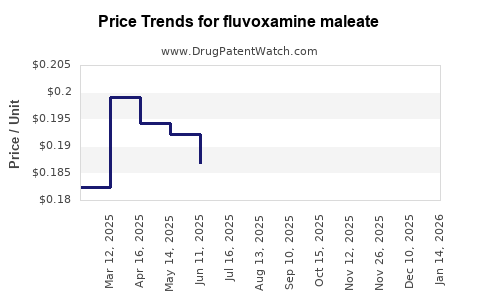
| 2025 |
$0.15 - $0.40 |
Price pressures lower due to increased generics. |
| 2030 |
$0.10 - $0.30 |
Continued generic proliferation, stable demand in OCD. |
- The average price decline for off-patent SSRIs is around 5-10% annually due to market saturation and generic competition.
- If off-label COVID-19 sales decrease, prices could stabilize or decline marginally.
Market Penetration and Pricing Influences
- COVID-19 indications initially drove demand, but recent clinical data and regulatory reviews have limited further off-label use.
- The primary revenue stems from OCD and other on-label psychiatric conditions.
- Insurance coverage, healthcare policies, and regional drug reimbursement policies influence patient access and pricing.
Future Price Projections Factors
- Patent and exclusivity status: No significant patent barriers exist as of 2023.
- Competition: Newer SSRIs with better tolerability profiles could erode market share.
- Regulatory changes: Approval for new indications or restrictions for off-label uses can alter demand.
- Manufacturing costs: Scale efficiencies and generic competition keep prices low.
Key Drivers and Risks
| Driver |
Impact |
Risk |
| Increase in OCD diagnoses |
Bolsters sustained demand |
Market saturation |
| Off-label COVID use decline |
Reduces demand |
Regulatory bans or negative studies |
| Generic market expansion |
Lowers prices |
None, as market is already saturated |
Key Takeaways
- Fluvoxamine maleate’s market is primarily driven by OCD treatment; COVID-19 off-label use has historically influenced demand.
- Price declines are expected to continue due to generic competition, with wholesale prices likely dropping to $0.10-$0.30 per 50 mg tablet by 2030.
- Limited patent protections and high generic availability reduce pricing power for branded versions.
- Clinical and regulatory developments substantially influence market dynamics.
- The overall market remains stable for OCD treatment but remains sensitive to regulatory and clinical shifts.
FAQs
-
What factors influence the price of fluvoxamine maleate?
Patent status, generic competition, regulatory approvals for new uses, and manufacturing costs.
-
Are there any patent protections remaining for fluvoxamine?
No, patents expired in the early 2000s; generic versions are widely available.
-
How does off-label COVID-19 use affect its market?
Initially increased demand; ongoing impact depends on clinical evidence and regulatory guidance.
-
What is the outlook for fluvoxamine prices over the next five years?
Prices are expected to decline gradually, stabilizing around $0.10-$0.30 per 50 mg tablet, influenced by generic competition.
-
Which regions are primary markets for fluvoxamine?
North America and Europe are leading markets, with growing access in parts of Asia-Pacific.
References
- MarketResearch.com, "Global SSRIs Market Report," 2022.
- U.S. Food and Drug Administration, Drug Approvals and Patent Data, 2023.
- IQVIA, "Pharmaceutical Market Trends," 2022-2023.
- EvaluatePharma, "2023 Forecasts on Psychiatric Drugs," 2023.
- ClinicalTrials.gov, "Fluvoxamine COVID-19 Trials," 2023.