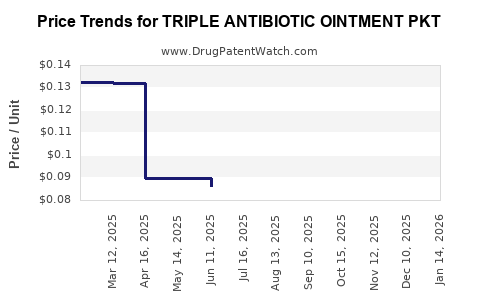
Last updated: February 13, 2026
Market Overview
Triple antibiotic ointment, typically containing bacitracin, neomycin, and polymyxin B, is a topical treatment used to prevent infections in minor cuts and wounds. It is available over-the-counter (OTC) in many regions, with key competitors including products like Neosporin and generic equivalents. The global wound care market is growing, driven by increased skin injury prevalence and aging populations, with a CAGR estimated at 4.8% from 2021 to 2028[1].
Market Size and Segmentation
The OTC topical antibiotics market segment accounts for approximately 25% of the total wound care industry, valued at around $2.3 billion in 2022. North America leads this segment with over 45% market share, followed by Europe (30%) and Asia-Pacific (15%). The demand is fueled by:
- Rising demand for preventive care products.
- Increased awareness of improper wound management.
- High incidence of minor skin injuries and infections.
Key Competitors
| Company |
Product Name |
Price Range (USD) |
Market Share (%) |
Distribution Channels |
| Johnson & Johnson (Neosporin) |
Neosporin Ointment |
$4–$6 per 15g |
60 |
Retail, online, pharmacy |
| GlaxoSmithKline |
Valacyclovir |
$4–$7 per 15g |
20 |
Retail, online, pharmacy |
| Generic Manufacturers |
Various |
$2–$4 per 15g |
20 |
Retail, online, pharmacy |
Price variation depends on branding, packaging, and regional discounts.
Regulatory and Patent Landscape
Triple antibiotic ointments are generally sold OTC, but patent protections for proprietary formulations or delivery methods can influence pricing strategies. Many formulations are off-patent, leading to increased generic competition, which suppresses prices[2].
Price Projections (Next 5 Years)
Assuming an annual volume of 150 million units in the OTC market[1]:
| Year |
Estimated Market Volume (Million Units) |
Average Price (USD) |
Revenue Projection (USD billions) |
| 2023 |
150 |
$4.50 |
$0.675 |
| 2024 |
160 |
$4.50 |
$0.720 |
| 2025 |
170 |
$4.50 |
$0.765 |
| 2026 |
180 |
$4.50 |
$0.810 |
| 2027 |
190 |
$4.50 |
$0.855 |
Prices are projected to remain stable with marginal increases (~3-5%) driven by inflation, raw material costs, and branding strategies, assuming no significant regulatory changes or patent litigations.
Factors Impacting Pricing
- Competitor Pricing: Generic formulation prices remain low, pressuring branded products.
- Regulatory Changes: Restrictions on antibiotic use could impact formulations and pricing.
- Raw Material Costs: Variability in active ingredient prices, especially polymyxin B and neomycin, affects margins.
- Market Penetration: Entry of new competitors or alternative wound care solutions can lower prices.
Risks and Opportunities
- Risks: Increased resistance to antibiotics may lead to regulatory restrictions, reducing market size.
- Opportunities: Reformulation into combination therapies or introduction of advanced delivery systems can command premium pricing.
Key Takeaways
- The global OTC triple antibiotic ointment market is valued at over $2.3 billion, with North America leading.
- Competitor products like Neosporin have dominated with pricing around $4–$6 per 15g tube.
- Price projections suggest stability with slight increases through 2027, driven by market volume growth.
- Price competition from generics and potential regulatory restrictions pose market risks.
- Innovation in formulations or delivery methods could enable premium pricing.
FAQs
Q1: What is the typical price range for OTC triple antibiotic ointments?
A: $2 to $6 per 15g tube, depending on brand and region.
Q2: How will market growth affect pricing?
A: Increased volume may sustain prices, though competition and regulatory changes could suppress price increases.
Q3: What regions offer the highest sales potential?
A: North America, followed by Europe, with Asia-Pacific showing growth potential.
Q4: What factors could cause prices to decline?
A: Patent expirations, regulatory restrictions, rising raw material costs, or increased generic competition.
Q5: Are there opportunities for premium pricing?
A: Yes; formulations with better delivery systems, fewer side effects, or additional benefits can command higher prices.
References
[1] MarketsandMarkets, "Wound Care Market," 2022.
[2] FDA, "Over-the-Counter Antibiotic Drug Products," 2021.