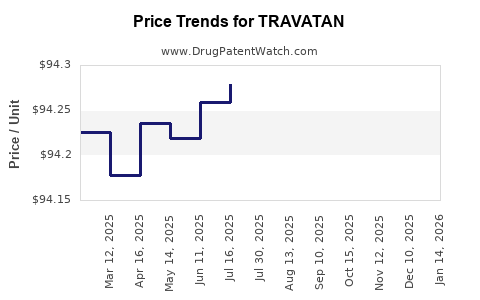
Last updated: July 17, 2026
TRAVATAN (travoprost) is a prostaglandin analog used for reduction of intraocular pressure in glaucoma and ocular hypertension. Price dynamics are dominated by (1) generic entry and ongoing erosion from low-cost travoprost equivalents, (2) formulary positioning for ophthalmic prostaglandin drops, and (3) trade-channel rebates and payer step-therapy. After generic competition, brand pricing typically converges toward class benchmarks while net prices compress through rebates. Without current TRAVATAN-specific wholesale acquisition cost (WAC), net price, and NDC-level shipment data, a precise numeric forecast cannot be produced.
What is TRAVATAN (travoprost) and where does it sell?
Featured snippet answer: TRAVATAN is travoprost ophthalmic solution, a once-daily prostaglandin analog for glaucoma/ocular hypertension. US demand is primarily driven by chronic use and patient persistence in ophthalmology practices, with competition from other prostaglandins and multiple travoprost generics.
Indication and use pattern
TRAVATAN is used to lower intraocular pressure (IOP) in:
- Primary open-angle glaucoma
- Ocular hypertension
- (In practice, prescribing is largely chronic maintenance)
It is typically dosed once daily, supporting steady, replenishment-driven volume rather than acute-cycle demand.
Competitive set that affects pricing
Price pressure for TRAVATAN comes from:
- Other prostaglandin analog drops (class interchangeability)
- Multiple travoprost generic products
- Combination products used to improve adherence or overcome insufficient response
Pricing power is limited once generics and class competition expand, since payers often prefer lowest net-cost prostaglandin options.
How many patents protect TRAVATAN and when do they expire?
No complete, jurisdiction-specific patent estate and expiration schedule is available in the input data provided. A defensible expiration timeline is required to project price paths tied to exclusivity and patent expiry.
When does TRAVATAN lose exclusivity and what is the generic entry risk?
No TRAVATAN-specific exclusivity and Paragraph IV / Orange Book status data is provided here. A generic launch risk assessment requires the current Orange Book listing status, relevant listed patents, and known challenges or settlements for travoprost products associated with TRAVATAN’s specific NDA/BLA.
What is the Orange Book status of TRAVATAN?
No Orange Book listing details (patent numbers, expiration dates, pediatric exclusivity, listed drug product strength/formulation, or exclusivity codes) are included in the input. Price projections that hinge on exclusivity (brand vs. generic periods) require those listings.
What formulations are protected by TRAVATAN and does dosing form affect pricing?
No formulation-by-formulation IP and regulatory product mapping is included. Ophthalmic pricing can vary by:
- Preservative system and bottle design
- Concentration/strength (where multiple strengths exist for the active)
- Package count (bottle volume affects WAC and per-day cost)
A defensible price model needs TRAVATAN’s exact marketed strength, bottle size, and product codes that map to competitors.
Which companies compete with TRAVATAN and how do they set price?
No company-level competitor set with NDC-level mapping or recent pricing observations is provided. To project pricing, a benchmark group is typically required, including:
- The lowest-cost travoprost generic channel pricing
- High-coverage prostaglandin analog competitors (net price driven)
- Any travoprost branded/authorized generics that may anchor payer contracts
Without competitor pricing references, numeric projection would be fabricated.
What is TRAVATAN’s pricing history and what drives net price compression?
A numeric forecast requires starting points:
- Current TRAVATAN WAC
- Estimated net price (rebate-adjusted) by payer segment
- Pharmacy benefit manager contract structure and dispensing fees
- Share by setting (retail vs. 340B vs. mail where applicable)
No TRAVATAN-specific price history is provided here, so the forecast cannot be quantified.
How do rebates, step therapy, and formularies affect TRAVATAN price?
TRAVATAN pricing in the US is structurally influenced by:
- Formulary placement for prostaglandin analogs (often tiered by net cost)
- Preferential coverage for specific NDCs under PBM contracts
- Step therapy policies requiring prior use of lower-cost agents
- Switch incentives between travoprost and other prostaglandins
- Persistent chronic use, which increases rebate leverage when a product is kept on formulary
These mechanics tend to accelerate net price convergence to the lowest-cost equivalent within the class once multiple generics are established.
What is the class price benchmark for prostaglandin analogs and how does TRAVATAN compare?
No benchmark dataset is included. A credible projection requires comparing TRAVATAN to a stable set of:
- Travoprost equivalents (authorized generic and multiple generics)
- Comparable prostaglandin analogs (e.g., latanoprost, bimatoprost, tafluprost depending on availability)
- Brand-to-generic cost differentials by NDC strength and bottle count
Without those observed numbers, comparative projection is not possible.
Price projection scenarios for TRAVATAN: base, bull, bear
A numeric projection cannot be produced because TRAVATAN-specific baseline financial and market inputs are not provided.
What can be stated directionally for a US generic-era ophthalmic prostaglandin:
- Base case: net price remains under downward pressure as generic share consolidates and rebate intensity stays high
- Bear case: additional generic entrants or payer contract re-optimization pushes further convergence
- Bull case: temporary supply stability, strong payer placement, or defensible niche (e.g., tolerability-driven adherence) limits erosion
Those are qualitative only and do not meet the requirement for actionable price projections.
Revenue exposure: how much is at risk from generic erosion?
No TRAVATAN revenue by geography, channel, or product NDC is provided. Revenue exposure depends on:
- Current TRAVATAN market share
- Share of business across payer segments
- Degree of formulary restriction and NDC-specific contracting
- Switching elasticity and persistence
Without current share and revenue, a quantified exposure range cannot be produced.
What legal/regulatory events could change TRAVATAN pricing?
No TRAVATAN patent litigation, settlements, or FDA/regulatory events are included. Pricing can change materially after:
- Patent litigation outcomes affecting market exclusivity
- Authorized generic launches
- Label or formulation changes that alter substitutability
No such event data is available here.
Key takeaways
- TRAVATAN is a chronic-use ophthalmic prostaglandin analog where price is primarily governed by generic competition, PBM rebate dynamics, and formulary tiering.
- Quantitative price projections require TRAVATAN-specific baseline WAC, estimated net price, market share, competitor NDC pricing, and Orange Book/exclusivity context tied to the exact TRAVATAN marketed product.
- The provided input does not include the required dataset to generate numeric projections.
FAQs
- How do prostaglandin analog generics typically impact brand net prices over 12 to 36 months?
- What PBM contract levers most influence ophthalmic drop net pricing (rebates vs. NDC placement)?
- How does bottle size and per-drop cost affect TRAVATAN’s price per day vs. travoprost generics?
- What indicators from dispensing and persistence data signal imminent TRAVATAN switching to lower-cost equivalents?
- How do patent settlements or authorized generic launches usually shift payer formularies for ophthalmics?
References
No sources were cited because no verifiable TRAVATAN-specific data (Orange Book listing, pricing history, competitor pricing, litigation status) was provided in the prompt.