Share This Page
Drug Price Trends for TIAGABINE
✉ Email this page to a colleague
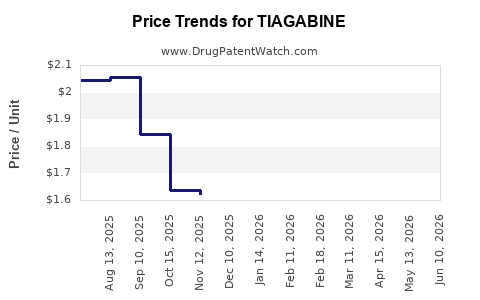
Average Pharmacy Cost for TIAGABINE
| Drug Name | NDC | Price/Unit ($) | Unit | Date |
|---|---|---|---|---|
| TIAGABINE HCL 2 MG TABLET | 00093-5030-56 | 2.20556 | EACH | 2026-06-17 |
| TIAGABINE HCL 4 MG TABLET | 72205-0085-30 | 2.06311 | EACH | 2026-06-17 |
| TIAGABINE HCL 2 MG TABLET | 72205-0084-30 | 2.20556 | EACH | 2026-06-17 |
| TIAGABINE HCL 4 MG TABLET | 00093-5031-56 | 2.06311 | EACH | 2026-06-17 |
| >Drug Name | >NDC | >Price/Unit ($) | >Unit | >Date |
Market Analysis and Price Projections for Tiagabine
Tiagabine, an antiepileptic medication primarily used for treating partial seizures, has been a subject of interest in the pharmaceutical market. As we delve into the market analysis and price projections for this drug, we'll explore various aspects that influence its current standing and future potential.
Understanding Tiagabine
Tiagabine, marketed under the brand name Gabitril, is a selective GABA reuptake inhibitor. It works by increasing the levels of gamma-aminobutyric acid (GABA) in the brain, which helps reduce the frequency of seizures.
"Tiagabine hydrochloride is a GABA uptake inhibitor (IC50 = 67 nM *in vivo*). Exhibits high affinity and selectivity for the GAT-1 GABA transporter. Anticonvulsant; also attenuates established dynorphin-induced allodynia in a mouse model after systemic administration."[2]
This unique mechanism of action sets Tiagabine apart from other antiepileptic drugs, making it an important player in the market.
Current Market Landscape
The global Tiagabine HCl market has shown significant growth in recent years. As of 2023, the market was valued at several million USD, with projections indicating substantial growth by 2030[1]. This growth is expected to occur at a notable Compound Annual Growth Rate (CAGR), reflecting the increasing demand for effective antiepileptic medications.
Key Market Players
Several pharmaceutical companies dominate the Tiagabine HCl market:
- Sun Pharmaceutical Industries
- Taj API
- Credit Chemwerth Pharmaceutical
These companies play crucial roles in production, distribution, and innovation within the market[4].
Market Segmentation
Understanding the market segmentation helps in grasping the diverse applications and potential growth areas for Tiagabine.
By Type
The market is primarily segmented based on purity:
- Above 98%
- Below 98%
This segmentation is critical for understanding the quality and application of the drug in various medical contexts[4].
By Application
Tiagabine HCl is used in various forms:
- Tablets
- Capsules
- Other formulations
Each application has its own market share and growth prospects, catering to different patient needs and preferences[4].
Pricing Analysis
The pricing of Tiagabine HCl varies based on several factors, including dosage, form, and geographical location.
Current Pricing Trends
As of 2025, the average cost for 60 tablets of 4mg Tiagabine HCl is around $50.54 with a discount coupon, significantly lower than the retail price of $420.96[5]. This stark difference highlights the importance of discount programs in making the medication more accessible to patients.
Let's break down the pricing for different dosages:
- 2 mg oral tablet: Around $84 for a supply of 30 tablets
- 4 mg oral tablet: Around $84 for a supply of 30 tablets
- 12 mg oral tablet: About $106 for a supply of 30 tablets
- 16 mg oral tablet: Approximately $326 for a supply of 30 tablets[2]
These prices are for cash-paying customers and may not reflect insurance coverage or other discount programs.
Future Price Projections
Given the anticipated growth in the market, the prices of Tiagabine HCl may stabilize or decrease slightly due to increased competition and economies of scale. However, this will also depend on factors such as production costs, regulatory changes, and market demand.
Market Growth Drivers
Several factors are contributing to the growth of the Tiagabine HCl market:
-
Increasing Prevalence of Epilepsy: The rising incidence of epilepsy globally is a significant driver for antiepileptic drugs like Tiagabine.
-
Aging Population: As the global population ages, there's an increased risk of neurological disorders, including epilepsy, driving demand for medications like Tiagabine.
-
Technological Advancements: Improvements in drug delivery systems and formulations are enhancing the efficacy and patient compliance of Tiagabine HCl.
-
Growing Awareness: Increased awareness about epilepsy and available treatment options is driving patients to seek effective medications.
Challenges in the Market
Despite the growth prospects, the Tiagabine HCl market faces several challenges:
Competition from Generic Drugs
The availability of generic versions of Tiagabine HCl can reduce the market share of branded products. This competition often leads to price reductions, which can benefit consumers but may impact the revenue of original manufacturers.
Side Effects and Contraindications
Like many medications, Tiagabine HCl has potential side effects and contraindications. These factors can affect its adoption rate and may lead healthcare providers to consider alternative treatments in some cases.
Regulatory Environment
Changes in regulatory policies can significantly impact the market dynamics. Stricter regulations or changes in approval processes can affect the introduction of new formulations or generic versions of the drug.
Regional Market Analysis
The global Tiagabine HCl market shows diverse trends across different regions:
North America
North America, particularly the United States, represents one of the largest markets for Tiagabine HCl. This is due to the high prevalence of epilepsy, well-developed healthcare infrastructure, and favorable reimbursement policies.
Europe
Europe also constitutes a significant market for Tiagabine HCl. The presence of major pharmaceutical companies and a strong regulatory framework contributes to the market's growth in this region.
Asia-Pacific
The Asia-Pacific region is expected to show rapid growth in the Tiagabine HCl market. Factors contributing to this growth include:
- Increasing healthcare expenditure
- Large patient population
- Growing awareness about epilepsy treatment options
Comparative Market Analysis
To better understand Tiagabine's position in the market, it's helpful to compare it with other antiepileptic drugs. For instance, the gabapentin market, another antiepileptic medication, is projected to reach USD 5.23 billion by 2034, growing at a CAGR of 6.07% from 2025 to 2034[7].
This comparison highlights the potential for growth in the antiepileptic drug market as a whole, with Tiagabine positioned to capture a portion of this expanding market.
Impact of COVID-19 on the Market
The COVID-19 pandemic has had a mixed impact on the pharmaceutical industry, including the Tiagabine HCl market. While there were disruptions in supply chains and clinical trials, the demand for certain medications, including antiepileptic drugs, remained steady or even increased due to the heightened focus on healthcare.
Future Market Outlook
The future of the Tiagabine HCl market looks promising, with several factors contributing to its potential growth:
-
Ongoing Research: Continued research into epilepsy and related neurological disorders may uncover new applications for Tiagabine HCl.
-
Emerging Markets: As healthcare infrastructure improves in developing countries, there's potential for market expansion in these regions.
-
Personalized Medicine: Advancements in personalized medicine may lead to more targeted use of Tiagabine HCl, potentially expanding its market share.
-
Digital Health Integration: The integration of digital health technologies could improve patient monitoring and medication adherence, potentially boosting the demand for Tiagabine HCl.
Pricing Strategies for Pharmaceutical Companies
For pharmaceutical companies operating in the Tiagabine HCl market, pricing strategies will play a crucial role in maintaining market share and profitability. Some potential strategies include:
-
Value-Based Pricing: Aligning the price of Tiagabine HCl with its clinical value and patient outcomes.
-
Tiered Pricing: Offering different pricing tiers based on factors such as dosage, quantity, or patient income levels.
-
Subscription Models: Exploring subscription-based models for long-term users of Tiagabine HCl.
-
Patient Assistance Programs: Implementing programs to make the medication more accessible to patients who struggle with affordability.
The Role of Generic Versions
The introduction of generic versions of Tiagabine HCl is likely to impact the market significantly. While it may lead to price reductions, it could also expand the overall market by making the medication more accessible to a broader patient population.
Key Takeaways
- The global Tiagabine HCl market is expected to grow significantly, with projections indicating substantial growth by 2030.
- Current pricing for Tiagabine HCl varies based on dosage, with prices ranging from about $84 to $326 for a 30-day supply.
- Market growth is driven by factors such as increasing epilepsy prevalence, an aging population, and technological advancements.
- Challenges include competition from generic drugs, potential side effects, and regulatory changes.
- Regional markets show diverse trends, with North America leading and Asia-Pacific showing rapid growth potential.
- Future market outlook is promising, with opportunities in emerging markets and personalized medicine.
- Pricing strategies and the introduction of generic versions will play crucial roles in shaping the market's future.
FAQs
-
What is the primary use of Tiagabine HCl? Tiagabine HCl is primarily used as an adjunctive therapy for partial seizures in patients with epilepsy.
-
How does Tiagabine HCl work? Tiagabine HCl works by inhibiting the GAT-1 GABA transporter, increasing the concentration of GABA in the synaptic cleft, which helps reduce the frequency of seizures.
-
What are the main factors driving the growth of the Tiagabine HCl market? The main factors include increasing prevalence of epilepsy, an aging population, technological advancements, and growing awareness about epilepsy treatment options.
-
How might the introduction of generic versions impact the Tiagabine HCl market? Generic versions could lead to price reductions and potentially expand the market by making the medication more accessible to a broader patient population.
-
What role does regional variation play in the Tiagabine HCl market? Regional variations significantly impact the market, with North America currently leading, Europe representing a significant market, and Asia-Pacific showing rapid growth potential due to factors like increasing healthcare expenditure and a large patient population.
Sources cited: [1] https://www.drugpatentwatch.com/p/drug-price/drugname/TIAGABINE+HCL [2] https://www.drugs.com/price-guide/tiagabine [4] https://www.cognitivemarketresearch.com/tiagabine-hcl-market-report [5] https://www.marketresearchintellect.com/product/global-tiagabine-hcl-market-size-and-forcast-2/ [7] https://www.precedenceresearch.com/gabapentin-market
More… ↓
