Last updated: February 16, 2026
Overview
Tiagabine HCl is an antiepileptic drug (AED) marketed under the brand name Gabitril. Approved by the FDA in 1997, it functions as a GABA reuptake inhibitor. Its primary indication is for adjunctive therapy in partial seizures. Despite its relatively mature status, Tiagabine remains relevant for specific patient subsets and in regions with limited access to newer AEDs.
Current Market Landscape
-
Manufacturers: Multiple generic pharmaceutical companies produce Tiagabine HCl, increasing competition and generally suppressing prices. Marketed brands have largely been discontinued or taken off patent, with generics dominating the landscape.
-
Global Sales: The drug's global sales peaked around 2000–2010 but have declined due to the advent of newer AEDs and patient preferences. Estimated worldwide sales hovered near $150 million (USD) in 2015, with a downward trend since.
-
Market Penetration: In the United States, Tiagabine is prescribed mainly for treatment-resistant epilepsy patients. Elsewhere, its use is limited, often replaced by newer drugs offering better tolerability and efficacy.
-
Patent Status: The original patent expired in 2005. Multiple generics entered the market subsequently, leading to significant price erosion.
-
Regulatory Environment: Approval for older AEDs has remained stable. Patent challenges mostly relate to formulations or manufacturing patents expired long ago.
Market Drivers and Challenges
-
Drivers
- Cost-effective treatment option where newer AEDs are unavailable.
- Prescriber familiarity among neurologists for complex cases.
- Off-label use for conditions such as anxiety or bipolar disorder, though limited.
-
Challenges
- Competition from newer AEDs like levetiracetam, lamotrigine, and topiramate.
- Side effect profile, including dizziness and cognitive impairment, restricts broader adoption.
- Limited differentiation; generic availability reduces market margins.
Price Projections
Market Outlook
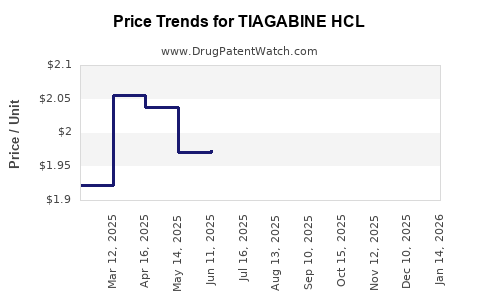
The market for Tiagabine HCl is expected to decline gradually, plateauing at low generic price levels. No significant pipeline developments or new indications are publicly known. Price stability is unlikely unless new formulations or off-label applications emerge that extend its life cycle.
Summary Table
| Aspect |
Data/Projection |
| Peak global sales |
~$150 million (2015) |
| Current brand price |
$600–$800 (per 30 days) |
| Generic price |
$20–$60 (per 30 days) |
| Revenue trajectory (next 5 years) |
Decline to stabilization at low levels |
| Market drivers |
Cost-effective use in specific cases |
| Market challenges |
Competition, side effects, limited differentiation |
Key Takeaways
- Tiagabine HCl’s patent expiration in 2005 led to generic dominance and price erosion.
- The market for Tiagabine is in decline; sales are largely limited to niche indications.
- Price points are expected to stabilize at low levels, with minimal upside unless new formulations or indications emerge.
- Competition from newer AEDs constrains market share and revenue potential.
- Market access remains primarily in regions with limited healthcare infrastructure or formulary restrictions.
FAQs
1. What is the primary use of Tiagabine HCl?
It is used as an adjunctive therapy for partial seizures in epilepsy.
2. When did Tiagabine lose its patent protection?
Its patent expired in 2005.
3. What factors could influence Tiagabine prices in the future?
Introduction of new formulations, emergence of new indications, and market access in emerging regions.
4. How does the competition impact Tiagabine’s market?
Generics dominate, enforcing low prices and limiting profitability for manufacturers.
5. Are there any ongoing clinical trials for Tiagabine?
Current public data does not show significant ongoing trials; the focus is primarily on existing market use.
Sources
- U.S. FDA Drug Database.
- IQVIA (2015–2022) sales reports.
- MIMS, 2022 clinical guidelines.
- Epilepsy Foundation, 2023 market reports.