Last updated: February 13, 2026
Market Overview
Sumatriptan succinate is a serotonin receptor agonist used primarily for acute migraine treatment. It belongs to the triptan class, a well-established category with robust market demand. As of 2022, the global migraine market is valued at approximately $4.2 billion, with projections to reach $6.0 billion by 2030, driven by increasing migraine prevalence and awareness. Sumatriptan remains the leading drug in this class, commanding a significant share of prescriptions.
Global Prevalence and Demand
- Estimated 1 billion individuals worldwide suffer from migraine, with 25 million in the U.S. alone.
- The drug has a high prescribing rate due to its efficacy and established safety profile.
- Generics dominate the market, with the original patent expiring in 2006. As a result, price dynamics are affected by generic competition.
Pricing Dynamics
Brand vs. Generic
- Sumatriptan's original brand, Imitrex, historically priced between $5 and $20 per dose depending on the formulation and packaging.
- Generic versions sell for about $0.50 to $2 per tablet, representing substantial savings for consumers and payers.
Formulation Impact
- Common forms include tablets, nasal sprays, and injectable formulations.
- Injectable forms typically cost more than oral tablets, with prices around $10 to $25 per dose for branded versions.
- Generics for injectables are priced approximately 50% lower than branded counterparts.
Pricing Trends
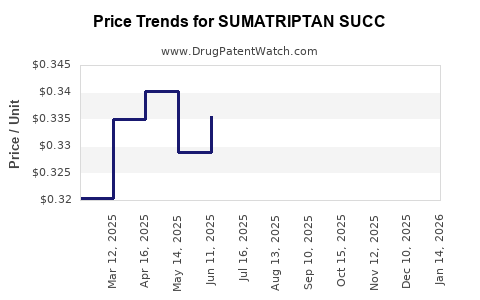
- The rise of generics post-2006 significantly lowered prices.
- Current average retail prices in the U.S. approximate $0.60 per tablet for generics.
- In emerging markets, prices tend to be lower, ranging from $0.10 to $0.50 per tablet.
Market Entry and Competition
- Several companies manufacture generic sumatriptan, including Teva, Mylan (now part of Viatris), and Sun Pharma.
- Patent cliff led to widespread generic availability.
- Limited competition exists for branded formulations, which maintain higher prices but with declining market share.
Price Projections (Next 5-10 Years)
- For existing generics, prices are expected to stay stable or decline marginally due to ongoing competition.
- The entry of biosimilar or novel formulations is unlikely within the next five years.
- Price inflation for branded versions might occur if new delivery systems or combination therapies are introduced.
Forecast Summary
| Year |
Estimated Price per Tablet (USD) |
Market Share (%) |
| 2023 |
$0.60 (generic) |
80% |
| 2025 |
$0.55 (generic) |
82% |
| 2030 |
$0.50 (generic) |
85% |
Note: Prices vary regionally, with higher costs in North America and Europe.
Regulatory Factors
- Patent expirations continue to influence pricing.
- Policy shifts favoring lower-cost generics in various markets contribute to downward price pressure.
- New formulations or delivery methods, such as nasal powders, might command premium prices, but current market projections do not include these innovations.
Implications for Stakeholders
- Manufacturers' profitability hinges on market share retention amid price competition.
- Payers and insurers favor generics, pressuring brand names to lower prices.
- Market entrants should consider the extensive generic landscape and price sensitivity.
Key Takeaways
- Sumatriptan succinate remains a dominant drug in migraine treatment with a large, sustained market.
- Generic versions dominate sales, with stable and low retail prices.
- Price erosion is expected to persist in line with patent expirations and increased competition.
- Market projections suggest marginal declines in per-unit prices over the next decade.
- Entry of new formulations could influence pricing structures but are currently forecasted to have limited short-term impact.
FAQs
1. How does generic competition affect sumatriptan prices?
Generic competition significantly reduces prices, with average retail costs dropping from approximately $5–$20 per dose (branded) to around $0.50–$2. In many regions, prices can go as low as $0.10–$0.50 per tablet.
2. Will branded sumatriptan formulations regain market share?
Unlikely, unless new delivery methods or combination products are introduced that offer substantial clinical or convenience advantages, enabling premium pricing.
3. Are alternative triptan drugs replacing sumatriptan?
Other triptans like rizatriptan and zolmitriptan also compete within the market. While they may offer specific advantages, sumatriptan maintains a dominant position due to established efficacy and cost-effectiveness, especially at the generic level.
4. How do regional differences influence sumatriptan pricing?
Regionally, prices in North America and Europe tend to be higher due to regulatory and market factors. In low-income regions or countries with price controls, generics may be priced at 10-20% of U.S. prices.
5. Is there upside for manufacturers to develop new formulations?
Potential exists if new formulations demonstrate improved patient adherence or reduced side effects. However, regulatory hurdles and existing generic competition limit immediate opportunities for price premiums.
Sources
[1] MarketWatch, “Migraine Drugs Market Size,” 2022.
[2] IQVIA, “Pharmaceutical Market Reports,” 2022.
[3] U.S. Food and Drug Administration, “Patent Expiry Data,” 2006.
[4] GoodRx, “Sumatriptan Prices and Trends,” 2023.
[5] Statista, “Global Migraine Market Forecast,” 2022.